| Unsubscribe |
In April 2024, I alerted my members to a potentially once-in-a-lifetime opportunity on gold.
Plenty of folks ignored me. I get it. Gold had gone nowhere for 13 years…
Then it more than doubled to a record high.
Most people who miss a move like that never get a second chance.
This time, you do.
Gold has fallen roughly 20% from its high.
And while the price came down, my long-term thesis is still very much intact.
Inflation is up. The Fed is hiking interest rates. The government is still borrowing like there’s no tomorrow. And the U.S. Treasury Secretary has said gold is his biggest position.
I’d look at the “backdoor” gold play that ran 846%, 1,668%, and 1,915% in the last major cycle.
This is the setup I waited 13 years to see…
Here’s the one trade I’d make right now.
Regards,
Ross Givens
Director of Research, Traders Agency
P.S. The first chance took 13 years to arrive. The second one showed up in months. I wouldn’t wait on a third – here’s the move I recommend making today.
Can NVIDIA Maintain Its Momentum Without Huang?
Written by Thomas Hughes. Date Posted: 11/12/2026.
Key Points
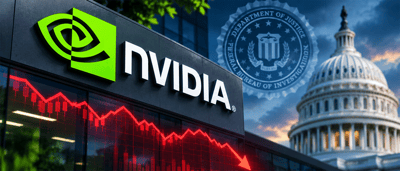
- Jensen Huang resigned as NVIDIA CEO amid a marital infidelity scandal, espionage allegations, and federal investigations, sending shares plunging again.
- NVIDIA's multiyear product roadmap, including Blackwell, Vera Rubin, and Feynman chips, may cushion the company's long-term strategy despite Huang's abrupt departure.
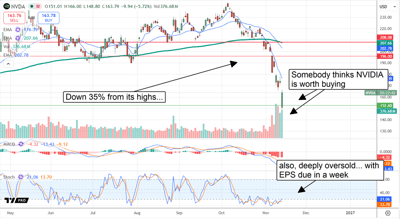
- NVIDIA shares fell more than 30% below October highs, prompting debate over whether the sell-off represents a buying opportunity ahead of Nov. 17 earnings.
- Special Report: Today's stock pick is on me (From Behind the Markets)
On Sunday, Nov. 8, NVIDIA (NASDAQ: NVDA) CEO Jensen Huang shocked markets when he publicly admitted to marital infidelity, following earlier reports linking him to a suspected Chinese intelligence operative. NVIDIA's board simultaneously announced an independent investigation, sparking a sell-off when markets opened Monday. On Wednesday, reports of a second alleged affair intensified the scandal.
Then, on Thursday morning, news of Huang's resignation went viral—and sent NVIDIA shares plunging again.
After the midterms: question your stock shortlist (Ad)
The vote is over. Is your watchlist too familiar? Explore seven hidden-gem stock ideas beyond your usual tickers. Read our free report, then examine each business and its risks before deciding what deserves a closer look.
Let me see the reportInvestors fear the worst, but the fallout for Huang, NVIDIA, the broader AI industry, and competitors such as Advanced Micro Devices (NASDAQ: AMD) may be far less damaging than expected. The post-news stock price collapse could even turn into a significant long-term buying opportunity.
In the near term, however, investors should expect continued volatility amid the headline-making news.
NVIDIA Faces Leadership Uncertainty and National-Security Scrutiny
The immediate challenge is the leadership transition: CFO Colette Kress has been named interim CEO, but NVIDIA has not yet selected a permanent successor.
Finding Huang's replacement is only one of the challenges facing the company. The investigations surrounding his departure could have broader consequences for NVIDIA's business and its relationships with U.S. officials.
NVIDIA's board has launched an independent investigation into reports that Huang was targeted by a foreign intelligence operation. The matter has also drawn federal scrutiny. President Donald Trump confirmed on Nov. 9 that the FBI was looking into the allegations, while congressional leaders have requested that Huang appear for a Nov. 18 briefing on the suspected espionage effort and NVIDIA's security protocols.
Although the company has said it has no reason to believe national security or its proprietary information was compromised, the investigations could raise questions about NVIDIA's internal security procedures, relationships with government officials, and compliance with U.S. export restrictions.
The company also faces legal exposure. A shareholder lawsuit filed on Nov. 9 alleges that NVIDIA and Huang misled investors about his relationship with the woman reportedly suspected of having ties to Chinese intelligence, as well as the potential national-security implications. The allegations have not been established in court, but the lawsuit adds another source of uncertainty.
For investors, the concern extends beyond the immediate leadership disruption. Prolonged investigations, potential regulatory consequences, and questions about corporate governance could weigh on NVIDIA's reputation and investor confidence, even if demand for its products remains strong.
NVIDIA's Multi-Year Roadmap Could Cushion the Leadership Shock
While NVIDIA faces immediate leadership uncertainty, Huang's departure does not erase the company's technological advantages or its established position in AI infrastructure.
Jensen Huang was central to NVIDIA’s success, but much of the company's future product strategy was already in motion before his departure. Given the multiyear cycle he set up, his ability to further shape the company's direction over the next several years was inherently limited.
Since 2022, NVIDIA has reinvested heavily in its technology, supply chain, and future, using profits to support future sales and strengthen customer dependence on its hardware and software ecosystem across multiple product generations.
Blackwell is the company's current workhorse, in full production and expected to remain the pillar through year’s end. Vera Rubin is the next cycle; it is in production and ramping up, and is expected to drive growth over the next one to two years. Feynman is the subsequent generation, currently planned for 2028. Together, these product generations provide NVIDIA with a multiyear development roadmap, giving its new leadership an established foundation on which to build.
So, while Huang's resignation is a blow, its full impact on NVIDIA's longer-term strategy may not be felt for years.
The AI Trade Remains Strong—Could AMD Gain Ground?
AI is a big business, requiring massive capital commitments, a multiyear construction outlook, and multigenerational product cycles.
Huang’s departure does not change the fundamental demand drivers behind the AI infrastructure buildout, which is already underway using existing technology. His absence could slow progress on future AI systems, but it will not automatically derail current deployments or the need for additional computing capacity.
Recent earnings reports from NVIDIA, AMD, Micron (NASDAQ: MU), Marvell (NASDAQ: MRVL), Credo Technologies (NASDAQ: CRDO), Astera Labs (NASDAQ: ALAB), and Oracle (NYSE: ORCL) point to common themes: AI demand is robust, orders outpace supply, and supply constraints are driving high capacity utilization. Capacity and production ramps are underway, initial investments are monetizing, and several quarters of acceleration lie ahead.
Huang's departure could present a significant opportunity for NVIDIA's leading competitor, Advanced Micro Devices, to challenge the company's dominance. AMD is already ramping up its rack-scale GPU business and has the added strength of CPU sales, with CPUs supporting AI inference workloads alongside GPUs and other specialized accelerators. Any disruption to NVIDIA's product development or customer relationships could give AMD a chance to capture market share.
There is also a potential downside risk. If the NVIDIA investigation leads to additional national-security scrutiny or tighter oversight of advanced semiconductor exports, the resulting restrictions could affect the broader industry rather than NVIDIA alone. That makes the competitive opportunity significant, but far from guaranteed.
NVIDIA Plunges: Is This a Dip-Buying Opportunity?
NVIDIA isn’t out of the woods—not by a long shot—and investors should expect volatility and downward pressure on the stock price to persist for the foreseeable future. But all hope is not lost.
The steep decline is also raising questions about whether the sell-off has gone too far. The scandal and Huang's resignation accelerated an existing sell-off, pushing NVIDIA shares more than 30% below their October highs and potentially creating a more attractive entry point.
NVIDIA’s investment opportunity lies in its revenue growth and earnings trajectory. The sell-off has driven its valuation sharply lower, suggesting investors are pricing in a far more pessimistic outlook than the company's recent financial performance would otherwise suggest.
The question is who is selling and who is buying.
Short-sellers may be contributing to the volatility, while others—including some retail and institutional investors focused on valuation, cash flow, and future earnings power—could view the decline as an opportunity. On Nov. 9, Cathie Wood's ARK Invest purchased 90,443 NVIDIA shares across five exchange-traded funds, worth approximately $16.2 million at that day's closing price. Retail investors have also stepped in: Vanda Research reported $111 million in individual-investor purchases during the first 30 minutes of Thursday's session.
The next major test will arrive on Nov. 17, when NVIDIA is scheduled to report fiscal Q3 earnings.
For long-term investors, NVIDIA's sell-off presents a difficult but potentially rewarding question: Is the market overreacting to a leadership crisis at a fundamentally strong company, or is it beginning to price in risks that could take years to resolve? The answer may depend less on the scandal itself than on how effectively NVIDIA's new leadership preserves the growth trajectory Huang helped build.
Jensen Huang's Next Move: New Opportunities, New Uncertainty
Leaving NVIDIA could ultimately work to Huang's advantage career-wise, potentially opening the door to new opportunities in pure AI, physical AI, and robotics.
One possibility attracting attention is SpaceX (NASDAQ: SPCX), whose CEO, Elon Musk, has already publicly expressed interest in hiring Huang. Another possibility is that Huang starts a company focused on next-generation AI architecture and applications.
But there are significant obstacles Huang will need to overcome before moving forward with the next chapter of his career.
While he has not been accused of criminal wrongdoing, the ongoing investigations and questions surrounding Huang's departure could complicate his professional prospects. Their findings could influence his opportunities and the direction of his next career move.
For now, Huang's next move remains uncertain. NVIDIA, meanwhile, faces a much more immediate test: proving that the AI powerhouse he built can continue delivering growth without him.
Oklo Changes the Narrative: Does a Nuclear Stock Price Explosion Come Next?
Written by Thomas Hughes. Date Posted: 11/9/2026.
Key Points
- Oklo shares surged roughly 23% after Q3 earnings, but the company's $3.13 billion cash position still falls short of the estimated $6.3 billion needed for its plans.
- The Idaho Aurora project's target for initial operations has slipped to 2028-2029, about a year later than previously expected, while modest new revenue from engineering and isotope services has begun to emerge.
- Analysts have lowered their average price target from $85 to $68, and heavy institutional ownership combined with dilution risk and short-selling could limit or reverse the stock's rebound.
- Special Report: 6 Men Secretly Changed America’s Money. Now It’s Happening Again (From Banyan Hill Publishing)
Investors wondering whether OKLO (NASDAQ: OKLO) has changed its narrative enough to support an explosive stock price increase can rest easy knowing that it has.
The questions, however, are whether the stock will keep rebounding, how high it can get and whether it will stay at loftier levels—because it may not. While the narrative has changed, many headwinds remain, keeping OKLO’s speculative risks high.
Five tickers can still share one risk (Ad)
The vote ended. Your portfolio risks remain. Several tickers can share the same exposure. Explore our five-stock portfolio-resilience report, then compare the ideas with what you already own. Start the review before reacting to the next headline.
Let me see the reportOklo’s narrative has improved with greater clarity on its Idaho Aurora build, supply chain and losses. Losses, as critical as technological success, have narrowed but remain a headwind. While the $3.13 billion in cash, marketable securities and equivalents reported in Q3 is substantial, it falls short of the approximately $6.3 billion analysts estimate the company needs to spend. The shortfall is substantial.
So, a near-term catalyst has emerged, but its long-term sustainability is uncertain and depends on execution in the coming quarters. If the company demonstrates traction, the ensuing upswing and rally may be quite large; if not, the decline could be equally sharp.
Oklo Advances Idaho Aurora Project, Improves Supply Chain Visibility
The good news is that Oklo is making progress at its Idaho Aurora facility and securing agreements for critical components. The deal with U.S. Forged Rings reserves manufacturing capacity for up to 27 Aurora modules through 2035, setting the stage for rapid deployment and revenue and earnings growth once regulatory approvals are achieved.
The bad news is that the Idaho Aurora project faces a longer road to commercialization than previously expected. Management extended the target window for initial operations to 2028–2029, about a year later than previously anticipated, reflecting potential testing and commissioning challenges. Given the project's complexity and regulatory requirements, further delays remain possible.
Oklo has also begun generating revenue, reporting $1.86 million in Q3 from engineering, consulting, manufacturing and fabrication services. While still modest compared with its long-term ambitions, that revenue marks an important step as the company develops additional businesses to help bridge the gap to full-scale nuclear power commercialization.
The company is building out fuel recycling and fabrication businesses, as well as an isotope business that is preparing for its first contracted delivery. Isotopes represent a small part of the business plan but are expected to ramp up in the coming year, while analysts project approximately $10 million in total company revenue for 2027.
While $10 million is far short of the capital required to complete core projects, revenue from these emerging businesses could help validate Oklo's strategy. Fuel fabrication and recycling are on a slightly longer timeline but are expected to generate revenue sooner than core energy operations, extending the bridge provided by isotopes. Equipment installation is underway, with the first fuel assemblies expected late next year.
Analysts See 150% Upside, But Oklo's Price Targets Are Falling
Initial analyst responses reflect cautious optimism, with bullish commentary focused on structural improvement rather than uncertain timelines.
The net result, however, is a mix of reaffirmed and reduced targets that reinforces the low end of the coverage range. These targets help establish a price floor and support near-term price action, but they limit longer-term upside potential.
Although the average analyst price target has fallen from $85 three months ago to $68 today, it still implies more than 150% upside. Several individual analysts have lowered their targets into the low $30s, underscoring growing caution despite the substantial upside implied by the broader consensus.
Oklo's Rebound Faces Dilution and Short-Selling Risks
Institutional ownership is another factor for bullish traders to consider. Institutions already own approximately 85% of Oklo's shares, reflecting substantial investor interest in its long-term potential.
Historically, members of this group may buy on dips but are unlikely to resume an aggressively bullish posture until there is more clarity on cash burn, revenue and profits—and less time left to wait and see. They have little reason to chase the market higher and ample reason to sell into rallies if the price rises high enough.
Dilution is a threat investors should not discount. Oklo’s balance sheet is in good shape today following 25% share dilution and a capital raise, but it may not be strong enough to see the business through to commercialization.
Follow-on sales could further dilute shareholder value and trigger short-selling. Short sellers tend to sell into a diluting market, adding to downward momentum, and are already a strong force in the stock. They may increase volatility during upswings through short-covering when it occurs, as well as during downswings—which are likely given the cash burn and time to profitability.
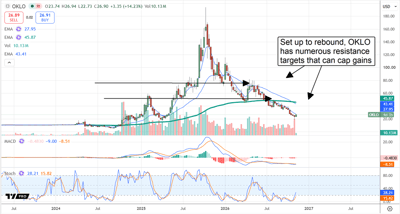
Stock price action is favorable for bullish traders following the release. Shares surged approximately 23% on Nov. 6 following earnings, providing momentum for a potential continued rebound. MACD and stochastic indicators reinforce the outlook, pointing to an oversold market set up for a bullish momentum swing. Resistance at the short- and long-term EMAs may trigger strong reactions when reached, as Oklo remains a speculative trading stock, not a cash-flow-producing investment.
This email message is a sponsored message sent on behalf of Traders Agency, a third-party advertiser of MarketBeat. Why did I receive this message?.
If you have questions about your subscription, feel free to contact our support team, based in South Dakota, at contact@marketbeat.com.
If you would no longer like to receive promotional emails from MarketBeat advertisers, you can unsubscribe or manage your mailing preferences here.
© 2006-2026 MarketBeat Media, LLC.
345 North Reid Place, Sixth Floor, Sioux Falls, S.D. 57103. United States..




No comments:
Post a Comment