Dear Reader,
The stock market just entered a highly dangerous new phase – which is going to have dramatic consequences for your money this summer.
The signs are everywhere:
SpaceX just went public. OpenAI and Anthropic will likely follow it.
If you're thinking of buying into any of these IPOs... PLEASE DON'T. They're likely to be disasters – the most overhyped, overvalued large-cap stocks of all time, foisted on gullible investors by Wall Street insiders.
At the same time, the President and his family are openly picking winners in the stock market... while a 24-year-old just founded his own hedge fund and made $5 billion in less than a year.
But it's what's coming NEXT that I'm most worried about.
I've spent 30 years on Wall Street. I have my MBA from Harvard and spend my time in correspondence with billionaires like Warren Buffett and Bill Ackman. I've forecast the collapse of dozens of stocks.
But what I see happening today scares me – as a former money manager, as a father, and as an American.
Because our country is headed toward an economic event unlike anything we've seen in over 100 years.
Perhaps you see the signs too. Or maybe you just feel it – that creeping, nagging doubt that tells you something is dangerously wrong in our country.
If that's you, I'd urge you... listen to your gut.
If you care about your wealth, your family, and your future, you need to understand what's really coming.
I've put together a free analysis explaining exactly what I see, and the specific steps I recommend you take with your money today.
I strongly encourage you to check it out here.
Regards,
Whitney Tilson
Editor, Stansberry Investment Advisory
Former Hedge Fund Manager
Co-Founder, Teach for America
Harvard MBA
P.S. What's happening today will reset the financial system in a way most of us can't imagine. If I'm even half-right, it's going to have a huge impact on your money and your future. Get the details here...
Oracle’s Sell-Off Looks More Like a Mispricing Than a Warning
Written by Thomas Hughes. Published: 6/23/2026.
Key Points
- Oracle's stock is trading at 22X current-year earnings, roughly 50% below typical blue-chip tech valuations, as the market underprices its long-term backlog conversion.
- Analysts tracked by MarketBeat rate ORCL a Moderate Buy with 79% buy-side bias and a consensus price target implying a 60% gain over the next 12 months.
- Oracle's AI-driven data center backlog is on track to reach trillion-dollar levels, with backlog conversion expected to fuel debt reduction and cash flow improvement over time.
- Special Report: Everyone wanted SpaceX. Smart money wants this.
Oracle’s (NYSE: ORCL) stock sell-off began as an understandable, if overdone, response to fears of software-as-a-service (SaaS) disruption and rising debt. Since then, however, it has spiraled into an outright disconnect from reality. Yes, debt is increasing, but this is not an emerging tech startup with an uncertain growth path. It is a blue-chip company at the center of AI, backed by a backlog that helps offset its liabilities.
Oracle is a proven builder and operator of AI-grade data centers, making this an execution story. Debt is rising in 2026, but so is its backlog, which is on track to reach trillion-dollar levels.
ALERT: Drop these 5 stocks before the market opens tomorrow! (Ad)
The Wall Street Journal is already raising the alarm about a potential market crash, and Weiss Ratings research points to the first half of 2026 as a particularly rough stretch for certain holdings.
Some of America's most popular stocks could take serious damage as a radical market shift plays out. Analysts at Weiss Ratings have identified five names you may want to remove from your portfolio before this unfolds.
If any of these are in your portfolio, now is the time to review your positions.
See the 5 stocks to avoidThe biggest risk is construction delays, though these are more about shifting resources than actual physical setbacks. The disruption caused by OpenAI's decision to abandon plans to expand its Stargate facilities is already fading, as the expected capacity will be picked up by other major hyperscalers, including Meta Platforms (NASDAQ: META). Funding and timeline concerns are also largely derisked, with Blackstone helping secure institutional investment. Critical infrastructure, including power systems, has also been secured. The worst-case scenario is that the initial revenue surge expected from backlogged capacity may not begin until early 2028.
Oracle Trades for Pennies on the Dollar in 2026
Oracle’s earnings quality and outlook offer ample incentive for buy-and-hold investors. At just 22 times the current-year earnings estimate, the company is fairly valued relative to the S&P 500, but still trades at roughly a 50% discount to where blue-chip tech growth stocks tend to command valuations. More importantly, that multiple does not reflect the coming backlog conversion, leaving the stock priced cheaply relative to longer-term forecasts.
Oracle’s price-to-earnings multiple (P/E) falls to as low as 8X within four years and to 4X by 2035, although the number of available estimates declines the farther out you look. The takeaway is that the market is pricing in debt and near-term headwinds, but not the growth ahead. That sets the stage for substantial gains in the years ahead. In this scenario, Oracle’s stock could rebound by as much as 50% in the near term, then continue advancing over subsequent quarters, potentially climbing 500% or more over the next decade as contracted backlog converts into revenue, cash flow, and earnings.
Cash flow and earnings will be central to Oracle’s stock performance over time. Cash flow is pressured in 2026, which limits buybacks and puts dividends at risk, but it is expected to improve over time. As backlog converts, debt reduction, stronger cash flow, and free cash flow should follow, eventually supporting more aggressive buybacks.
Bullish Analysts Support Oracle’s Market, Summer 2026
Analysts’ trends are equally bullish, underscoring the value opportunity. MarketBeat tracks 38 analysts, with coverage and sentiment steady in early 2026. By consensus, the group rates the stock a Moderate Buy with a 79% buy-side bias. Price targets are also moving higher, lifting the upper end of the range and leaving consensus forecast for a 60% gain in the stock price over the next 12 months. In this scenario, Oracle shares could rebound sharply, potentially helped by the upcoming earnings report.
Oracle is a mid-cycle reporter, expected to release fiscal Q1 2027 results in early to mid-September, several weeks after other leading AI infrastructure names. The likely result is that its cloud business will continue to outpace legacy segments, with infrastructure and AI leading the way. At present, Oracle’s cloud business is growing at a hyper pace and is only overshadowed by its backlog. Backlog and guidance will likely be the market-moving items, and both are expected to reflect continued strength and improving visibility into backlog conversion.
Oracle: A Market in the Midst of a Reversal
Oracle’s stock action has not been encouraging for bulls as of late June 2026. However, despite the recent weakness, the market remains above a critical support level and appears positioned for a reversal. The pattern in play is a Head & Shoulders formation that could be confirmed by month-end.
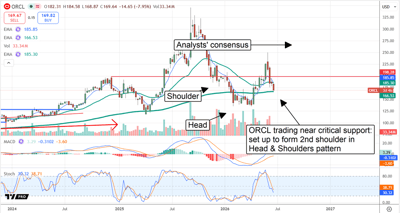
The risk is that institutions, which sold on balance late in the quarter, continue repositioning and push shares below the long-term 150-week exponential moving average. In that event, Oracle’s price could fall as low as $145, though a fresh low is not expected. Trading data suggest the group provided ample support when ORCL shares were near their lows in Q1 and early Q2.
The more likely scenario is that ORCL remains range-bound near current levels until catalysts begin to emerge. On the catalyst front, earnings are expected to reaffirm the outlook, news from other hyperscalers is also likely to be positive, and Oracle’s AI World conference is scheduled for late October. The event will feature keynote addresses and new product launches aimed at improving investor sentiment.
Manchester United’s Stock Rally Faces a Test Beyond Old Trafford
Written by Dan Schmidt. Published: 6/30/2026.

Key Points
- Manchester United shares have rallied on Old Trafford stadium progress, renewed ownership speculation and stronger fiscal third-quarter results.
- The club has secured land for a planned 100,000-seat stadium, but financing, construction timelines and ownership questions remain unresolved.
- The fiscal fourth-quarter report could test whether investors keep backing the rally as the club enters its seasonally weaker offseason period.
- Special Report: Everyone wanted SpaceX. Smart money wants this.
World Cup fever is spreading throughout North America as the knockout round begins, and the best players from around the globe are putting their club teams on hold to compete for their countries. But soccer—or football, for readers outside the United States—in Europe is big business, and the English Premier League (EPL) doesn’t stop just because the matches are on hold for six weeks.
One of the EPL’s most storied franchises is also publicly traded on the New York Stock Exchange, and it recently made headlines by striking a new stadium deal. Manchester United plc (NYSE: MANU) is up more than 40% over the last three months, driven by prospects of replacing its historic Old Trafford arena, a potential ownership change, and strong earnings in the most recent quarter. But as the traditionally weakest quarter approaches, is it time to sell this rally, or are there more gains ahead?
The 3 Catalysts Driving MANU Shares to Multi-Year Highs
ALERT: Drop these 5 stocks before the market opens tomorrow! (Ad)
The Wall Street Journal is already raising the alarm about a potential market crash, and Weiss Ratings research points to the first half of 2026 as a particularly rough stretch for certain holdings.
Some of America's most popular stocks could take serious damage as a radical market shift plays out. Analysts at Weiss Ratings have identified five names you may want to remove from your portfolio before this unfolds.
If any of these are in your portfolio, now is the time to review your positions.
See the 5 stocks to avoidManchester United has been home to some of the sport's greatest players: Bobby Charlton, George Best, Duncan Edwards, and, more recently, Wayne Rooney and Cristiano Ronaldo. But that home will change: the franchise reached a land agreement earlier this month for a new 100,000-seat stadium, purchasing a 25-acre site near its current home, Old Trafford. Old Trafford has been Manchester United’s home stadium since 1910, but the new arena aims to be the largest in the U.K. and part of a larger entertainment center that the team claims could create more than 90,000 jobs.
Two other factors have contributed to the stock’s outperformance this year:
The Glazer family, which owns a 70% stake in the team, has considered selling at least part of its share. Malcolm Glazer, who also owned the NFL’s Tampa Bay Buccaneers, passed away in 2014 and left his stake to his six children. But their tenure with Man Utd has been tumultuous, and many supporters (and apparently investors) would welcome a new ownership group.
A strong fiscal Q3 2026 earnings report on May 27 saw the company beat both revenue and earnings-per-share estimates, including a surprise profit of 4 cents per share despite analysts’ expectations for a loss. Operating profit totaled £37.7 million, or about $49.9 million, for the nine months ended March 31, a sharp swing from a £3.2 million ($4.2 million) operating loss in the same period a year earlier. The club also increased its full-year fiscal 2026 revenue guidance to £665 million ($877 million).
Each catalyst has played a part in driving the stock higher, especially the Glazer sale rumors, which caused an 11% pop in a single day. But each of these catalysts is fleeting. The stadium agreement is still just a land deal, and no funding has been secured to finance construction. The payoff from a new stadium could still be a decade away, and the ownership sale story looks like a typical “buy the rumor, sell the news” event.
Additionally, the earnings momentum could be on the verge of turning. The fourth quarter has typically been the weakest for Manchester United, as the EPL enters its offseason and no ticket revenue is generated. The EPL has a short offseason compared with American sports, and the season resumes on August 21, a week later than usual due to the World Cup. Manchester United’s Q4 2025 results will likely be released in mid-September or early October, and these offseason headwinds could dampen an already weak quarter.
Event-Driven Rally Getting Stretched, and Technicals Tell the Tale
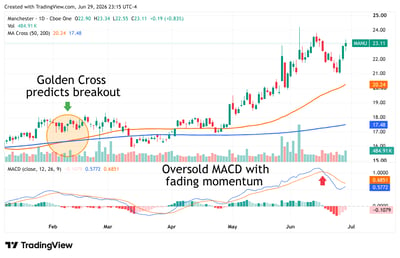
Technical signals often identify the end of a rally before the fundamentals turn down, and there’s evidence of that happening on the MANU chart. The 45% year-to-date (YTD) gain has driven the stock within arm’s length of its 2023 all-time high of $26.84, and a golden cross in early February hinted that a breakout was on the horizon. But technicals giveth and technicals taketh away, and now the rally is looking overextended.
The share price remains above the 50-day and 200-day moving averages, but it has surged well above these support levels over the last two months amid volatile trading. Excessive volatility is a concern for a stock with a beta of 0.61, and the team has still posted a net loss over the trailing 12 months and trades at 4.65 times sales. Now the moving average convergence divergence (MACD) has formed a bearish crossover, which could be the prelude to the end of this rally.
MANU shares have enjoyed a long-awaited breakout in 2026, but it's becoming stretched and remains dependent on narratives rather than profits. The new stadium deal is still in its formative stages, and the ownership situation remains unchanged despite the rumors. Narratives can sustain rallies for long periods, but absent a confirmed transaction, the Q4 2026 earnings print is likely to test it rather than extend it.
This message is a sponsored message for Stansberry Research, a third-party advertiser of DividendStocks.com and MarketBeat.
This ad is sent on behalf of Stansberry Research, 1125 N Charles St, Baltimore, MD 21201. If you would like to optout from receiving offers from Stansberry Research please click here.
If you have questions about your account, please feel free to email our U.S. based support team at contact@marketbeat.com.
If you no longer wish to receive email from DividendStocks.com, you can unsubscribe.
© 2006-2026 MarketBeat Media, LLC. All rights protected.
345 N Reid Pl. #620, Sioux Falls, S.D. 57103. United States of America..