| Unsubscribe |
Dear Reader,
The GOP was wiped out in the election …and many are worried about what will now happen to the stock market.
But here’s the deal:
There’s a $3 trillion crisis coming which is an even bigger threat to the stock market.
And it’s highly unlikely the Democrats can stop it, because this crisis has already begun.
It’s a ticking "time bomb" sitting under your retirement account, your annuity, your pension, your stock and bond portfolio and your bank … even in places where you think your money is safe.
It could soon unleash a disaster bigger than what we all lived through in 2007–08 …
Reuters reports, “alarm bells echo 2007 subprime warnings.”
But nobody in power is listening.
Bestselling author Dr. Martin Weiss just recorded a free briefing on this coming crisis …
It reveals five specific steps you can take to protect your wealth and potentially come out ahead.
Go here now to see why there’s worse news for the markets than Democrat control of Congress …
Eliza Lasky
Weiss Advocate
11780 US Highway 1,
Palm Beach Gardens, FL 33408-3080
Would you like to edit your e-mail notification preferences or unsubscribe from our mailing list?
Copyright © 2026 Weiss Ratings. All rights reserved.
If Japan's Stock Market Rally Returns, These 3 ETFs Could Benefit
By Nathan Reiff. Article Posted: 11/12/2026.

Key Points
- After gaining ground through early 2026, the Nikkei 225 lost momentum in the second half of the year, with AI-sector volatility and Bank of Japan rate hikes adding pressure.
- Investors seeking renewed upside in Japanese equities can choose among three ETFs that differ by currency hedging, company size focus, and dividend income potential.
- DXJ's yen-hedged strategy has delivered the strongest returns at nearly 23% YTD, while EWJ offers large- and mid-cap diversification and DFJ provides small-cap exposure with a 2.51% yield.
- Special Report: What if you already knew what to do? (From The Cycle Code)
The Nikkei 225's momentum throughout 2023 and 2024 accelerated in 2025 and early 2026. But in the second half of the year, the rally stalled and began to reverse course. While the index is still up about 21% year to date (YTD)—easily beating the S&P 500 over the same period—Japanese equities' reliance on the global AI investment cycle means a continued AI sell-off could hit the Nikkei particularly hard. The Bank of Japan's recent rate hikes, following a long period of historically low rates, may also be putting pressure on equities.
At the same time, Japanese equities could be in a position to quickly bounce back if corporate earnings improve, governance reforms boost efficiency, domestic consumption increases, or the energy and AI industries stabilize—especially if several of these developments take place. Exchange-traded funds (ETFs) like the WisdomTree Japan Hedged Equity Fund (NYSEARCA: DXJ), the iShares MSCI Japan ETF (NYSEARCA: EWJ), and the WisdomTree Japan SmallCap Dividend Fund (NYSEARCA: DFJ) all offer distinct ways to gain exposure.
DXJ: Winning Because of the Yen's Weakness
Today's stock pick is on me (Ad)
Elon can't build his satellite network without one key supplier, and he's paid this company since 2012.
His plan for 1,000,000 satellites could multiply that bill significantly, putting this overlooked stock back in focus.
Dylan has circled December 8th as a key date for this pick.
Claim today's free stock pick before December 8thA mid-sized ETF and the least expensive fund on this list by a small margin, DXJ combines broad exposure to Japanese equities with a hedge against yen exposure. This approach may be particularly attractive to international investors at this point because the yen's weakness has increased the cost of imported energy and materials, adding to the effects of rising global prices. A weaker yen also puts pressure on businesses, particularly those unable to pass higher costs on to consumers.
DXJ offers focused exposure to Japanese stocks, making it compelling for investors who expect the yen to remain depressed or weaken further against the dollar. The fund holds a broad basket of close to 500 equities across market capitalizations and sectors, and its top positions are relatively well distributed, helping it avoid overconcentration in any one company.
In terms of performance, DXJ has fallen less than the broader Nikkei over the past month and has also outperformed the index overall YTD, returning almost 23% in 2026. Investors who expect the yen to strengthen may want to avoid the fund, however, as it will likely underperform unhedged alternatives in that scenario.
EWJ: Despite Underperformance, a Solid Access Point for Large Japanese Companies
Likely the best-known Japan-focused ETF and one of the largest and most heavily traded, EWJ has about $23 billion in assets and a 30-year trading history. With an expense ratio just one basis point higher than DXJ's, EWJ is also competitive on cost.
EWJ's portfolio is narrower than DXJ's because it focuses on large- and mid-cap companies, but its roughly 175 holdings are still fairly evenly weighted. Despite its emphasis on larger companies, EWJ also offers strong sector diversification. This may appeal to investors looking to avoid significant overexposure to tech and AI stocks at a time when the industry is experiencing unusually high volatility.
Despite its narrow spreads and moderate cost compared with some other funds in the country-specific ETF space, EWJ has not performed as well as some of its peers this year. It has fallen 6% over the past month, more than DXJ but less than the broader Nikkei. It remains up about 14% YTD, but that lags the Japanese equities market overall. Still, it remains a popular buy-and-hold choice for investors looking to build exposure to major Japanese firms.
DFJ: Local Small-Cap Focus With a Strong Dividend
The smallest and most expensive fund on this list, DFJ has an annual fee of 0.58%, about 10 basis points higher than EWJ's. Still, its unique approach—targeting small-cap Japanese dividend-paying stocks—may justify the trade-offs investors face in terms of cost and liquidity.
Some investors view small-cap stocks as a more direct expression of a country's local economy because these companies tend to have fewer ties to global markets than large- and mega-cap firms with major international presences. DFJ's portfolio is large, comprising close to 1,000 companies, and it avoids extreme overconcentration: no single position accounts for more than about half a percent of the portfolio.
As a result, the fund is not dependent on the performance of any single company, making it a broader play on an important but often overlooked segment of the Japanese market. That small-cap segment has performed fairly well this year, rising by more than 14% YTD. The fund's appeal extends beyond that performance, however, thanks to its 2.51% dividend yield.
On Holding’s Sell-Off Overlooks a Key Part of Its Earnings Story
By Thomas Hughes. Article Posted: 11/11/2026.

Key Points
- On Holding shares fell 7% in premarket trading after Q3 earnings despite revenue growth of 17.2% and improving gross margins, prompting a buy-the-dip case.
- Analysts remain largely bullish, with 25 of 31 tracking firms rating the stock Buy or Strong Buy and Cantor Fitzgerald initiating coverage with a $46 price target.
- Rising inventory levels raise concerns about future markdowns, but management attributes the build-up to strong anticipated demand, including a successful Cloudsurfer 3 pre-launch.
- Special Report: 6 Men Secretly Changed America’s Money. Now It’s Happening Again (From Banyan Hill Publishing)
Investors were right to look past On Holding's (NYSE: ONON) massive Q3 earnings beat and focus on the core metrics, but they were wrong to drive the stock price down 7% in early premarket trading. While the headline results were robust, they were driven by tariff refunds, and the underlying results failed to provide a wow factor. That prompted some investors to sell the news despite the company's clear strengths, including an improving gross margin and its ability to sustain a premium position in a highly discounted merchandising environment. Those strengths give investors reasons to buy the dip.
Competitors such as Nike (NYSE: NKE) are leaning heavily into markdowns and promotions, while On Holding is managing inventory, maintaining a positive supply-and-demand balance, and translating that into bottom-line results. Critics point to lackluster Q3 wholesale results, but they miss the point. On Holding helps sustain its position by limiting wholesale access, which drives traffic to its higher-margin direct-to-consumer (DTC) business and supports bottom-line growth.
On Holding Had a Good Quarter, Just Not Strong Enough to Trigger Buyers
Today's stock pick is on me (Ad)
Elon can't build his satellite network without one key supplier, and he's paid this company since 2012.
His plan for 1,000,000 satellites could multiply that bill significantly, putting this overlooked stock back in focus.
Dylan has circled December 8th as a key date for this pick.
Claim today's free stock pick before December 8thOn Holding had a good quarter, growing revenue by 17.2% as reported and 17.8% on a currency-neutral basis. The company reported strength across all channels and regions, led by a 31.1% advance in Asia-Pacific (APAC). Emerging Markets, Europe & Africa (EMEA) was also strong, up 17.9%, while the Americas trailed with 12.4% growth. By channel, DTC was the bright spot, up 24.8%, followed by 13.2% growth in Wholesale, both on a currency-neutral basis. By category, Accessories led with a 39.2% reported gain, while Apparel rose 38.7% and remains central to the growth and margin outlook.
Margin news was mixed, but gross profitability remained strong even excluding tariff refunds. Gross margin improved by roughly 1 percentage point to 66.9% excluding refunds, though higher operating costs partly offset that gain. The adjusted EBITDA margin excluding refunds contracted slightly, to 21.9% from 22.6%, tempering the top-line strength but not enough to alter the fundamental outlook: On Holding is financially stable, growing, and widening its gross margins. While guidance includes the impact of tariffs, management left its revenue targets unchanged, expecting growth in the low 20% range, and raised its 2026 gross margin outlook to about 66% excluding refunds.
Balance sheet highlights reflect On Holding’s strength and growth. Cash is up about 30% year to date, alongside higher receivables and inventories, which have increased current and total assets. Financial debt remains modest, although the company carries significant lease liabilities. Cash exceeds financial debt, leaving On Holding in a nimble financial position from which it can sustain growth in future quarters.
Optimistic Analysts Express Near-Term Caution: Stock Drops
Initial analyst responses are optimistic, highlighting growth, cash flow, and brand positioning, as the brand continues to gain share in key markets. Analysts also point to slowing growth and inventory, which rose more than 18% in the first three quarters, raising questions about new product launches. If new launches don’t go as planned, the company may have to mark down products, risking its premium position, or take a write-off and dispose of inventory.
What naysayers may be getting wrong is On Holding’s strategy of building inventory to meet expected demand. That demand appears sufficient: While no unit sales figures were provided, executives said first-week Cloudsurfer 3 sell-through exceeded four times that of the Cloudsurfer 2 launch. If the market follows through on that signal, On Holding may be able to manage its inventory to lower levels as the initial demand surge subsides.
John Kernan at Cantor Fitzgerald initiated coverage of ONON with an Overweight rating and a $46 price target, about $2 above the current consensus target of $44, reinforcing bullish analyst sentiment. Overall, analyst data reflects a largely positive outlook: Of the 31 analysts tracked by MarketBeat, 25 have Buy or Strong Buy ratings, supporting the Moderate Buy consensus rating. Coverage has increased sharply in 2026, and consensus price targets have recently edged higher.
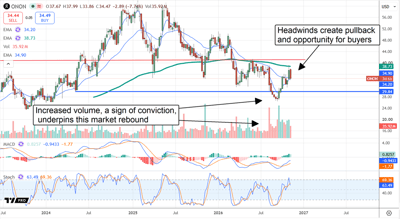
Price action on Nov. 10, following the earnings report, was as bearish as the early indication suggested. Under pressure, shares opened about 7.5% below the prior day's close and finished down 7.54%. The move signals caution, but the stock had rebounded from its late-October lows ahead of the report. Further declines are possible, and the post-earnings drop leaves that reversal unconfirmed. A volume increase supported the earlier rebound, suggesting actual buyers—not a short-term market fluctuation—drove it. The low valuation, at about 18 times projected 2027 earnings, is one potential catalyst.
On Holding’s biggest risk lies in consumer and fashion cycles. Consumer habits underpin the ebb and flow of growth cycles, and consumer spending is under pressure in 2026. More broadly, consumer preferences, including those related to fashion, can be fickle, leaving the company vulnerable to disruption. Investors concerned about disruption need only look at Nike, whose self-inflicted wounds helped enable On Holding’s success.
This email content is a sponsored message provided by Weiss Ratings, a third-party advertiser of MarketBeat. Why did I get this email?.
If you need help with your newsletter, please feel free to contact our support team, based in the United States, at contact@marketbeat.com.
If you would no longer like to receive promotional emails from MarketBeat advertisers, you can unsubscribe or manage your mailing preferences here.
© 2006-2026 MarketBeat Media, LLC.
345 North Reid Place, Suite 620, Sioux Falls, S.D. 57103. United States of America..




No comments:
Post a Comment