| Unsubscribe |
Ron Paul: "Sorry Socialists, more handouts won't fix this"
The Democratic Socialists more than tripled their votes in Congress and even took the D.C. mayor's office. But 12-term former Congressman Ron Paul says the most dangerous economic force in America took over Washington long before the election -- and could reach a breaking point in the coming weeks.
In this free new video, he reveals the #1 step Americans should take to protect themselves now.
This ad is sent on behalf of Stansberry Research, 1125 N Charles St, Baltimore, MD 21201. If you would like to optout from receiving offers from Stansberry Research please click here.
The Post-Midterm Rally Clock Is Ticking—and These 3 AI Stocks Stand Out
By Bridget Bennett. Published: 11/12/2026.

Key Points
- A machine-driven post-midterm selloff knocked the S&P 500 down about 4.4% in a single session, and similar drops since 1950 have preceded above-average three-month gains.
- Shopify and Zscaler have kept uptrends of higher lows intact while Chaikin Money Flow shows smart money buying the dip.
- Veeva Systems has pulled back only about 7% as analysts raise earnings estimates, setting up a potential catch-up in price targets.
- Special Report: Today's stock pick is on me (From Behind the Markets)
The 2026 midterms were supposed to light the fuse on the year-end rally. Instead, investors got one day of relief before a sharp sell-off.
Stocks rallied on Nov. 4, following the midterm elections, but the gains disappeared the next session. On Nov. 5, the S&P 500 fell about 4.4% and the Nasdaq-100 roughly 6.3%, while the Cboe Volatility Index (VIX) jumped above 25. The selling reflected concerns that Democratic wins in key states, including Texas, could stall AI data center projects already underway or still on the drawing board.
6 Men Secretly Changed America’s Money. Now It’s Happening Again (Ad)
In 1910, six powerful men secretly met to lay the groundwork for the Federal Reserve, reshaping America's financial system for generations.
Now six financial giants controlling $24 trillion have aligned behind a new initiative that Grey Swan Investment Fraternity's Andrew Packer says could echo that moment in history.
Addison Wiggin outlines three steps investors might consider before November 30th, including one stock ticker being shared at no cost.
Watch the full presentation to see the three recommended steps now.That fear hit hardest where the AI trade is most crowded. Yet sell-offs of that magnitude have historically set up stronger-than-normal gains, and the stocks that kept their trends intact through the damage may deserve the first look.
Machine Selling Sparked the Rout, and History Favors Buyers
Marc Chaikin, founder of Chaikin Analytics, sees the damage as mechanical rather than considered. No investment committee met and voted to unload Advanced Micro Devices (NASDAQ: AMD) over data center risk. Machines did the selling, according to Chaikin, and once it started, it fed on itself.
Indiscriminate selling tends to leave bargains behind. The historical record on days like this leans bullish, too.
Since 1950, the S&P 500 has fallen more than 4% in a single session 56 times, by Chaikin's count. Three months later, the index averaged a 6.5% gain, versus a typical three-month gain of about 2.5%. The Nasdaq-100 also closed three standard deviations below its 50-day moving average, an event that has occurred only 19 times since 1999. In those cases, average returns over the next one to three months ran more than 2.5 times normal.
Layer in the four-year presidential cycle, which has typically delivered post-midterm strength that carries into the pre-presidential year. Chaikin's view is that the rebound window opens before Thanksgiving, so any additional selling before then mostly sharpens the entry point.
Higher Lows Keep the E-Commerce Uptrend Intact
None of the three stocks on Chaikin's list builds data centers. They sell the software and data that run on top of them, making a Texas policy scare an odd reason to dump them.
Shopify (NASDAQ: SHOP) has emerged as a major force in online commerce. Amazon (NASDAQ: AMZN) still dominates, but many merchants distrust a marketplace that competes with them through private-label products. Shopify has used AI to build a fuller-service platform for small businesses priced out of Amazon and for larger brands tired of seeing their winning products copied.
Shares peaked near $180 in mid-October and dipped below $140 in the sell-off, a slide of almost 20%. The pattern underneath is what Chaikin likes. Lows have stepped up from roughly $110 after an earlier earnings report to $124 in September and about $136 in the latest drop. Higher highs and higher lows define an uptrend. Many AI hardware names, by contrast, broke below prior lows and have ground to make up.
Shopify holds a Bullish rating on the Chaikin Power Gauge, a 20-factor fundamental and technical model, and Chaikin Money Flow shows smart money accumulating the dip. A positive earnings surprise on Nov. 3 pushed back on earlier fears that AI would make the platform obsolete. Watch whether the $136 area holds.
Rising Estimates Point to Healthcare Data Catching Up
Veeva Systems (NYSE: VEEV) holds what Chaikin calls the largest pharmaceutical data set drug companies use to develop new treatments and track them after approval. It now supplies that data to customers' AI models to speed drug development. Proprietary, sensitive data like that is hard to replace with a general-purpose model.
The stock pulled back only about 7% from its high and has outperformed the market since late July. Analyst price targets sit close to the current price, but Chaikin weighs estimate trends more heavily than targets. Earnings estimates are rising, and healthcare technology shows strong relative strength as a group, so targets may follow as analysts catch up.
Elevated short interest adds fuel. After the last report, shares jumped from about $240 to $285 in a day. The next report lands in December, and a repeat is possible, but not promised.
Cloud Security Leads Cybersecurity on Technicals
Exposed data is the fastest way to turn an AI investment into a liability. A model built on OpenAI's ChatGPT or Anthropic's Claude with a backdoor presents exactly the kind of risk that Zscaler (NASDAQ: ZS) addresses with cloud-based security.
The stock rallied after a well-received September report, then fell from about $260 to $195 in a week, a decline of roughly 25%. It broke out above $180 in September after basing from March through July, and the pullback is now testing that zone. Chaikin Money Flow has spent only about 10 of the last 120 trading days in negative territory.
Fundamentals are strong across cybersecurity, but the charts have split. CrowdStrike (NASDAQ: CRWD) posted a lower high in late October, followed by a lower low, and sits below its long-term trend line as smart money sells. Fortinet (NASDAQ: FTNT) looks similar. Palo Alto Networks (NASDAQ: PANW) combines hardware and software, while Zscaler's cloud-native platform plugs more easily into existing information technology systems. That makes Zscaler Chaikin's favorite in the industry, with the $180 level as the line to watch.
Intact Uptrends and Smart Money Separate Rebound Candidates From Falling Knives
Shopify, Veeva Systems, and Zscaler sit in different corners of the market, but they share a profile. Each sells software or data that AI makes more valuable, each kept its uptrend through the sell-off, and each shows smart money buying rather than selling.
The upside is that a machine-driven rout may have marked down quality names alongside speculative ones, and history has favored buyers after sessions like this. The risk is that data center policy fears deepen or that the presidential-cycle pattern simply fails this time. Historical averages hide plenty of bad outcomes.
None of this depends on the data center debate resolving quickly. It does depend on these stocks holding their recent lows. Stay focused on support levels and money flow, because that's what separates a dip worth buying from the start of a real downtrend.
Chaikin is laying out his broader post-midterm outlook, including the $10 trillion opportunity he sees and the AI-driven themes he uses to hunt for overlooked names. Get Marc Chaikin's post-midterm market outlook and hidden-gem stock ideas.
3 Insider Selling Stories; 3 Different Signals for Investors
By Thomas Hughes. Published: 11/11/2026.

Key Points
- Liquidia insiders have sold shares amid a patent settlement and analyst price-target cuts, though institutional buying and rising YUTREPIA sales offer some offsetting support.
- Brinker International insiders sold heavily during a successful Chili's turnaround, but strong sales growth, margin gains, and analyst optimism suggest the sales are less concerning.
- Procter & Gamble's insider sales appear tied to routine prearranged trading plans, with analysts bullish on the stock and the company maintaining strong cash flow and dividend growth.
- Special Report: 6 Men Secretly Changed America’s Money. Now It’s Happening Again (From Banyan Hill Publishing)
Insider trading can send many signals, but not all of them are what they seem.
Insider selling can be a green light for investors or a warning to stay away; it depends on the market. Sector trends, the business cycle, and a company's profit outlook all influence how investors should interpret these transactions. All else being equal, profitable companies are more valuable than those that aren’t, helping distinguish true investments from speculation and risk.
Liquidia Insiders Liquidate After Bad News
The Hidden Danger Behind the AI Stock Rebound (Ad)
AI stocks are rebounding, but investing legend Alexander Green warns that some popular names may never recover their former highs. He points to Lucent Technologies, which plunged more than 90% after the dot-com bubble burst, and Nortel Networks, whose shares became virtually worthless.
New research involving Harvard and the Federal Reserve points to a historic turning point in AI adoption. Alex calls it "The Great AI Sorting" and has identified three household-name AI stocks he says investors should dump before the next wave of selling hits.
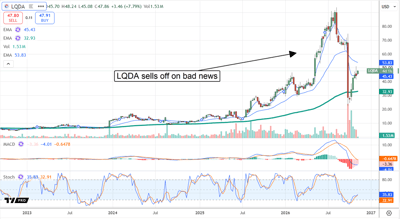
Watch Alexander Green's free presentation to see which three AI stocks he says to sell.Liquidia (NASDAQ: LQDA) is a commercial-stage biopharma company that reported bad news this year. Its primary treatment, YUTREPIA, faced a setback after a September patent ruling, but an October settlement with United Therapeutics resolved the litigation. Liquidia can continue selling YUTREPIA for pulmonary arterial hypertension, although it must stop promoting the drug for a separate indication and make substantial settlement payments. The agreement creates financial challenges, but the company's growing sales provide some relief. In Q3, YUTREPIA sales climbed 31% sequentially to $222.7 million, even as Liquidia recorded a $389.7 million charge related to the settlement.
To make matters worse, insider selling has added to pressure on shares during the correction.
Insiders own 25% of LQDA shares, making them a significant shareholder group. At least nine executives with “Chief” in their titles have sold shares since the patent court ruling. Prearranged trading plans account for some of these sales, allowing executives to capitalize on high share prices and manage share-based compensation. However, not all transactions fall under these plans. Many are open-market sales, suggesting that a top-heavy management team may be trimming excess risk.
Wall Street's outlook for Liquidia has weakened, adding to the stock's challenges.
Many analysts have slashed their price targets in recent months, reflecting growing concerns about Liquidia's outlook. Shares traded well below the $72.85 consensus target in early November, although that gap also suggests potential upside if the company's operating performance continues to improve.
Institutions own about 65% of Liquidia shares, and institutional buying has exceeded selling over the past 12 months. Despite recent insider selling, institutional support and improving sales could help offset some of the downward pressure on the stock.
Chili’s Insiders Reap Rewards of Successful Turnaround
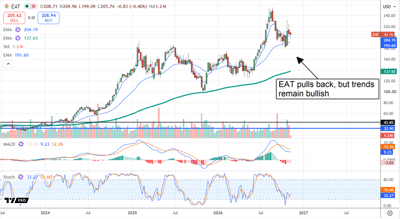
Chili’s parent company, Brinker International (NASDAQ: EAT), saw heavy insider selling in Q3 and early Q4, but its strong operating performance suggests those sales may be less concerning than they initially appear.
The sales came after two years of improving results, strong comparable sales, and margin gains tied to a strategic shift. Chili's has embraced a “better-than-fast-food” approach, offering value meals and beverages that resonate with consumers. The strategy has helped drive sustained sales growth, wider margins, and accelerating earnings, with Chili’s sales up more than 50% on a three-year-stack basis.
Analysts like what they are seeing from EAT. Coverage has increased, sentiment has strengthened, and price targets have climbed, supporting the stock's Moderate Buy consensus rating. The average price target is up more than 50% over the past 12 months and implies more than 20% upside from October’s lows. Reaching that target would put shares at a fresh all-time high.
Fiscal Q2 results, due in early 2027, could provide another catalyst for analysts to raise their targets if the company's momentum continues.
Institutions own approximately 99% of EAT shares and have been net buyers this year, signaling confidence in the company's turnaround. The risk is that they were net sellers in early Q4 and may continue to sell, limiting upside until the FQ2 release. Improving performance at non-core brands, expanding margins, strong cash flow, and sustained comparable sales growth could encourage institutions to increase their holdings.
Procter & Gamble Insider Sales Raise Few Red Flags
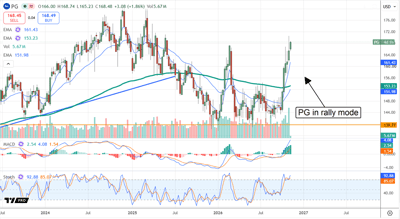
Insider selling of Procter & Gamble (NYSE: PG) shares is not a red flag. The sporadic, sometimes large, sales are linked to prearranged trading plans intended to maintain diversification and manage options exercises tied to share-based compensation.
Executives still own a significant stake, while the company's established business and strong cash flow help offset ongoing cost pressures.
The main hurdle for Procter & Gamble is the shift by consumers to cheaper alternatives, which could pressure sales and profitability. However, the company's broad product portfolio gives it an advantage, allowing it to serve budget-conscious consumers without relying solely on premium-priced products.
Analysts are bullish on PG stock. Of the 26 analysts covering Procter & Gamble, 15 rate it a Buy and 11 a Hold, giving the stock a Moderate Buy consensus rating. Price targets have also climbed, with the average around $170. Continued upward revisions could signal greater confidence in the company's outlook and support further share-price gains.
Investors should consider Procter & Gamble’s cash flow and profitability, which support healthy capital returns, including share buybacks and dividends with growing distributions.
The company is a Dividend King, yielding around 2.6%, and is positioned to continue increasing its annual distributions for the foreseeable future.
Procter & Gamble's acquisition of Thorne HealthTech could drive growth by expanding its presence in premium, practitioner-focused, subscription-based healthcare. However, rising input costs have already pressured margins, and further increases could weigh on profitability.
This email is a sponsored message provided by Stansberry Research, a third-party advertiser of InsiderTrades.com and MarketBeat.
If you have questions or concerns about your newsletter, please contact MarketBeat's support team, based in South Dakota, at contact@marketbeat.com.
If you no longer wish to receive email from InsiderTrades.com, you can unsubscribe.
© 2006-2026 MarketBeat Media, LLC.
345 N Reid Place, Sixth Floor, Sioux Falls, S.D. 57103-7078. United States..




No comments:
Post a Comment