| Unsubscribe |
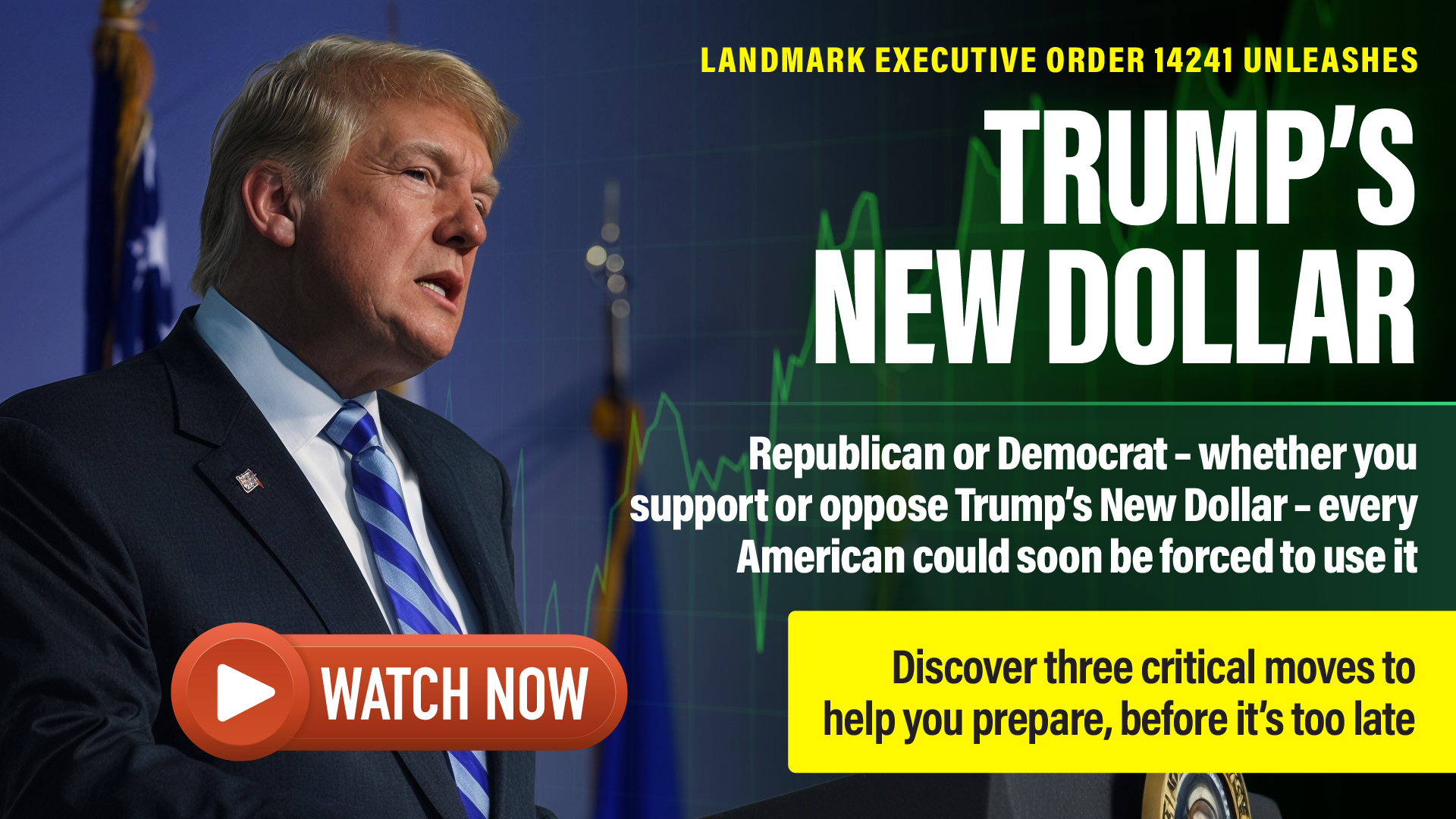
Editor’s Note: Porter Stansberry has just gone on record with the boldest claim of his career: that President Trump is replacing the U.S. dollar, bypassing Congress entirely.
If you have savings in the bank or money in the market, get informed now. Porter reveals how this money reset is being assembled in the shadows – and the name and ticker of his No. 1 move to make today, to help you prepare.
Watch the full exposé here.
I don’t know about you…
But it feels to me like our country is dying.
The virtues that built this nation – hard work, thrift, personal responsibility, and sacrifice – have been turned upside down.
The truth is, I barely recognize our country anymore.
Our inner cities have murder rates that would shame a failed state in the Third World.
A generation of adult men are still living in their childhood bedrooms, unable to even imagine starting a family.
More than a million young women are selling themselves to strangers on the internet – and calling it empowerment.
Addiction is everywhere: Gambling. Opioids. Pornography. Debt. All spreading through every zip code in America.
And the price of a decent life – healthy food, a nice car, a good home – has simply become too steep for most hard-working Americans to afford.
It’s a tragedy, playing out in real time.
If you're like me, you've watched all of this unfold and asked yourself one simple question:
What the hell is going on?
Well, more than 15 years ago, I warned that America was heading toward this exact kind of social breakdown.
My viral documentary – The End of America – was seen by around 50 million people…
And in it, I explained that a fundamental flaw at the heart of our financial system had one inevitable conclusion:
The destruction of American life as we know it.
Today, I want to show you why that warning came true…
And, more importantly, what I believe comes next.
But first, we have to understand what brought us here.
The Breakdown
The right blames the collapse of the family and the church.
The left blames capitalism, racism, and inequality.
The TV news blames social media and our failing schools.
What they’re all describing is the smoke, not the fire.
Because I believe there’s a single cause underneath all of it – one unseen, unspoken force that ties together all the madness, the crime, the despair, and the decay.
Sociologists have a name for it.
But almost no economist on Earth really understands it.
The word is anomie – the breakdown of a society's moral order.
It’s the moment when everything stops making sense, when virtue stops being rewarded, and an entire nation quietly stops believing in the future.
Sound familiar?
But anomie is not a cultural disease. It’s a monetary one.
When a nation’s money becomes worthless… when it intentionally debases its currency… it doesn't just rob its savers, it breaks the invisible contract that holds civilization together.
It breaks the sacred moral promise that hard work, thrift, and sacrifice today will be worth something tomorrow.
Destroy that promise and you destroy the reason to behave and to believe in the future.
It happened in Rome, as emperors clipped the silver from the denarius – and birth rates collapsed, crime soared, and the spectacles grew more depraved by the decade.
It happened in Weimar Germany, as the mark was printed into confetti – and Berlin became the vice capital of Europe almost overnight.
While respectable families sold their furniture, speculators made fortunes by leveraging the cheap money.
Debased money and a debased society are not two stories – they are one story. And, sadly, it is now America’s story.
Because when money stops holding its value, time itself stops feeling valuable. Life feels worthless.
Why work? Why save? Why invest for the future? Why sacrifice for your family or your country – when everything around you says sacrifice is for suckers, and the game is rigged for the people standing next to the money printer?
The young men trapped in their bedrooms understand this, even if they can't articulate it.
So do the workers who quit their jobs to collect a welfare check… the couples who never marry or have kids… the women degrading themselves on OnlyFans… and the millions numbing themselves one scroll and one online bet at a time.
They’re not lazy. They’re not stupid. They are responding – quite rationally – to a currency and a government that has failed them.
Ever since America's money was untethered from anything real, the dollar has lost 88% of its purchasing power.
And in that time the moral fabric of this country has unraveled in lockstep.
That’s not a coincidence, that’s cause and effect.
If you want to rebuild America's culture, you must first rebuild America's money.
Trump’s New Dollar
I know how most people feel about all of this. They’re lost. And they've given up.
They look at the direction we're heading and see an inevitable, unstoppable slide – into moral decay, into financial ruin, into a country that makes them afraid for their children and grandchildren.
They've stopped expecting anyone to fix it. Maybe you have too.
I understand that feeling, but I'm here to tell you it’s wrong.
Because right now, something remarkable is in motion that could reverse this destructive slide – the first serious effort in half a century to repair the broken heart of the American monetary system.
I believe President Trump is attempting to replace the U.S. Dollar.
I don't know if it will work. I don't know if it will come in time.
But I believe the Trump administration is moving heaven and earth to make it happen – mobilizing trillions of dollars, and redrawing the entire architecture of American money in the process.
There was no debate in Congress. No vote. And no public announcement.
Yet this reset is already underway.
And potentially as soon as this coming December, Trump’s monetary reset could be announced – in all but name – to a gathering of world leaders in Miami.
This has nothing to do with CBDCs, Bitcoin, crypto, or digital money.
But soon, every American could be using Trump’s New Dollar to pay for groceries, gas, medical bills and practically everything else – whether they support it or not.
And as I’d like to show you, this new monetary system is, in my view, already sending enormous waves of capital into a narrow group of companies and assets – which could create extraordinary returns for those already in position.
The White House calls the initiative behind it a “transformative force for our long-term prosperity.”
And Fortune says what’s unfolding is “the biggest change to the world’s relationship with the dollar” in a generation.
Yet most Americans have no idea it is happening – and are not prepared for it.
And that could be very dangerous – because the last time America reset its money, 52 years ago, it divided the country in two.
In the decades that followed, it’s estimated that America created more than a thousand new millionaires every day.
The greatest fortunes went to those who understood the new rules – and owned the assets the new monetary system rewarded.
But, sadly, countless families were left behind.
They worked hard. They lived within their means. They carefully put money aside for the future.
Yet still, they watched their wages stagnate, their savings steadily hollowed out, and the American Dream move further beyond their reach.
Not because they made foolish decisions. But because nobody told them the rules of money had changed.
And now, I believe that same dividing line is being drawn again.
Which side your family ends up on may depend on what you do with the information I’m putting into your hands today.
In my special broadcast on Trump’s initiative I explain exactly what it could mean for your savings, your portfolio, and your family’s financial future…
I reveal the companies I believe could create the most wealth as this new monetary order takes hold…
And give you one specific action you can take immediately.
Everything you need to know is right here.
Good investing,
Porter Stansberry
Off-Price, High-Yield: Why Ross Stores Is Defying the Retail Slump
Reported by Jeffrey Neal Johnson. Date Posted: 10/27/2026.

Key Points
- UBS upgraded Ross Stores with a Street-high $315 price target, citing potential to close a productivity gap with rival TJX Companies.
- Ross Stores reported strong quarterly results, with earnings per share of $2.66 and revenue up 13.3% year over year to about $6.26 billion.
- Despite a healthy balance sheet, Ross shares trade near a 28 price-to-earnings ratio, and notable insider selling raises questions about valuation risk.
- Special Report: One Company Spared After Renewable Credits Get Cut.
Persistent macroeconomic headwinds are reshaping the retail sector, forcing consumers to adjust their spending habits and move down the pricing ladder. Shoppers are increasingly abandoning full-price department stores for off-price environments, and discount retailers are capturing the resulting demand.
Wall Street is taking notice of this shift. Analysts at UBS recently upgraded Ross Stores (NASDAQ: ROST), setting a new Street-high price target of $315 and arguing that the broader market underestimates the retailer's ability to sustain top-line momentum.
The chip inside every Tesla (Ad)
Every Tesla built since 2012 pays this small, overlooked supplier a fee for its technology. So does every Starlink dish and AI satellite Elon launches.
When Nvidia tried to buy the company, Elon reportedly fought the deal. Now his filing for 1,000,000 satellites could expand its revenue stream sharply.
Dylan believes the stock could see significant movement starting December 8th.
See which overlooked supplier Elon has quietly paid since 2012The bullish call suggests Ross is positioned to close its long-standing productivity gap with key rivals, turning defensive consumer positioning into offensive market-share gains. For investors navigating a murky economic outlook, the off-price retail sector could offer a unique blend of defensive durability and operational growth.
Checking Out Growth: The Off-Price Advantage
The recent UBS upgrade hinges on a specific thesis. Analysts project that Ross Stores will generate an approximate 8.5% revenue compound annual growth rate over the next two years, pacing roughly 260 basis points above Wall Street consensus. This growth model depends on the executive leadership team executing a strategic mandate to close an estimated 20% store-productivity gap with competitor TJX Companies (NYSE: TJX).
Closing a productivity gap in brick-and-mortar retail requires more than simply opening new locations. Management can drive higher sales per square foot by optimizing inventory turnover and improving the in-store merchandising experience.
During the latest earnings call, executives attributed recent top-line growth to sustained gains in foot traffic and an enhanced assortment of branded goods. Ross is giving cost-conscious shoppers a reason to visit frequently, demonstrating that it can capture down-tier consumer migration rather than passively benefit from an economic squeeze.
Ross recently completed a 51-store expansion, effectively meeting its fiscal 2026 physical-growth targets. Scaling its physical footprint enhances inventory-buying power and increases the total addressable market. The off-price business model thrives on opportunistic buying. A larger footprint allows the retailer to source excess inventory from overstocked suppliers, store it when necessary, and eventually pass the savings on to consumers. This flexibility strengthens the core business model and keeps the merchandise assortment fresh, which is critical for driving repeat foot traffic.
Dressing for Success: The Balance Sheet Buffer
The underlying financials support the view that consumer spending has not evaporated but simply shifted. The most recent quarterly results delivered earnings per share of $2.66, easily exceeding consensus estimates of $1.95. Top-line revenue rose 13.3% year over year to approximately $6.26 billion.
What makes these figures stand out is the company's profitability. Operating in a discount environment often forces retailers into margin-crushing price wars to attract wary shoppers. Ross Stores maintains a healthy net margin of approximately 10.85%, along with a return on equity of about 39%.
To put these numbers in perspective, traditional full-line department stores often struggle to generate returns on equity even half that size. These metrics indicate that Ross successfully extracts strong profitability from value-seeking consumers through disciplined operations.
Stitching Together Capital Returns
From a balance sheet perspective, the foundation remains highly defensive. Ross Stores carries a low debt-to-equity ratio of 0.12 and a comfortable current ratio of 1.61. This relatively unlevered structure gives management flexibility to navigate potential economic downturns without the burden of heavy interest expenses. Retail is inherently cyclical, and companies carrying heavy debt loads often face severe margin pressure when consumer demand slows. Ross's financial strategy allows it to avoid this trap.
The retailer also returns capital to shareholders through a steady dividend, currently yielding roughly 0.8%. While the yield might seem modest to income-focused investors, it is backed by a conservative 21.55% payout ratio and a six-year track record of consecutive dividend increases. This low payout ratio leaves ample free cash flow for continued store expansion, infrastructure improvements and share repurchases.
Checking the Price Tag: Weighing Valuation Risks
While the operating picture appears robust, cautious investors should weigh the current valuation against emerging bearish signals. Following a year-to-date return approaching 30%, shares of Ross Stores trade at a trailing price-to-earnings ratio near 28.
For a traditional brick-and-mortar retailer, a multiple of nearly 30 times earnings leaves little margin for error. Retailers tend to trade closer to 15 to 20 times earnings. The stock is priced for near-flawless execution. If consumer spending stalls entirely rather than shifting toward discount channels, the premium valuation could compress rapidly.
A segment of the investing public appears to be betting on this scenario. Short interest in ROST has accumulated to roughly 9.7 million shares, suggesting that some investors anticipate the off-price retail tailwind is already fully priced into the stock.
Recent regulatory filings reveal notable insider selling. CEO James Conroy recently sold 49,205 shares, while other executives have similarly reduced their holdings. Insider selling does not inherently signal trouble, as executives often diversify their personal portfolios or execute planned selling programs. However, significant selling by the architect of the current turnaround strategy adds friction to the bullish narrative. It raises valid questions about whether leadership views the current valuation as a near-term ceiling following the stock's 43% one-year price increase.
The Checkout Counter: Bagging the Retail Trade
The off-price retail sector continues to demonstrate remarkable resilience in a challenging macroeconomic environment. Ross Stores has proven its ability to capitalize on changing consumer habits, delivering double-digit revenue growth and expanding its physical footprint while maintaining a healthy balance sheet. Its ambitious strategy to match industry-leading productivity metrics provides a clear runway for future earnings growth.
At the same time, the elevated valuation multiple and recent insider selling suggest that the easy money may already have been made. The market expects continued operational excellence, and any missteps in merchandising or inventory management could trigger a pullback.
Investors evaluating the retail space might view Ross as a high-quality, defensive asset that requires a measured approach to entry points. Monitoring upcoming foot traffic data and inventory turnover rates will provide critical clues about the sustainability of this off-price momentum.
Taiwan Semiconductor Flexes Pricing Power on AI's Frontline
Reported by Jeffrey Neal Johnson. Date Posted: 10/28/2026.

Key Points
- TSMC is raising prices 10% to 20% on advanced packaging and 3% to 6% on 2-nanometer and 3-nanometer wafers starting in early 2027.
- The foundry's dominant Chip-on-Wafer-on-Substrate technology gives it pricing leverage over clients like NVIDIA and AMD, who have little room to negotiate.
- TSMC refused to cede operational control over Elon Musk's proposed Terafab project, prompting Tesla and SpaceX to build the facility independently.
- Special Report: One Company Spared After Renewable Credits Get Cut.
The artificial intelligence (AI) boom often focuses on software developers and fabless chip designers, leaving the physical constraints of manufacturing in the background. When the entire technology sector tries to pivot to generative AI at once, the supply chain can quickly reach a physical ceiling.
Taiwan Semiconductor Manufacturing Company (NYSE: TSM) sits just below that ceiling. Investors evaluating infrastructure plays may begin to notice a shift in how value is captured across the silicon ecosystem. Industry reports suggest TSMC is preparing a coordinated series of price increases for its most advanced packaging and fabrication services, testing the limits of its pricing power. If implemented, those increases would help the foundry pass its expansion costs downstream.
Packaging Power: Why Fabless Designers Pay the Toll
A free stock pick, from me to you (Ad)
Elon's paid this chip supplier since 2012. When NVIDIA tried to buy the company, he fought the deal.
Without its chip, his AI satellites don't fly. Now he wants 1,000,000 of them in orbit, 100 times what's up there today, and every one pays this company a royalty.
Dylan believes shares could react by December 8th.
Claim this free stock pick before the December 8 deadline todayTo build modern AI accelerators, designers integrate high-bandwidth memory directly alongside compute dies. This integration requires highly specialized advanced packaging. TSMC's proprietary Chip-on-Wafer-on-Substrate technology is the industry standard for this process, giving the company a commanding position in high-end AI packaging.
Traditional organic substrates struggle to provide the fine-pitch interconnects required for the terabyte-per-second memory interfaces demanded by next-generation graphics processing units. When processing large language models, data-transfer speed is just as critical as raw computing power, making silicon stacking a core requirement.
Recognizing this reliance, TSMC could raise prices for its advanced packaging services by 10% to 20%. Downstream clients such as NVIDIA (NASDAQ: NVDA) and Advanced Micro Devices (NASDAQ: AMD) have little room to negotiate.
This limited negotiating power stems from the fact that new architectures, such as NVIDIA's Blackwell and Rubin, require extensive testing cycles. According to industry estimates, final testing for Blackwell takes about four times as long as testing for Hopper, while Rubin could require up to seven times as long.
These extended cycles tie up testing capacity and equipment bandwidth across the foundry. Fabless designers find themselves prioritizing guaranteed production slots over unit costs. In addition to the packaging premium, wafer prices for TSMC's advanced 2-nanometer and 3-nanometer nodes could increase by an estimated 3% to 6% beginning in early 2027. Successfully implementing these rate hikes across service lines without causing client attrition would demonstrate TSMC's outsized leverage in the semiconductor space.
Margin Mechanics: Expanding Profitability Through Scale
Pricing power directly influences profitability, but those premiums are also intended to offset substantial capital requirements. In the third quarter of 2026, Taiwan Semiconductor Manufacturing Company reported a slight sequential decline in gross margin, which landed at about 66.4%.
At first glance, the contraction might suggest pricing weakness, but it reflects the capital-intensive ramp-up of the new 2-nanometer node. Advanced packaging margins, which have traditionally hovered below the corporate average, are steadily moving toward parity as the new pricing structure takes effect.
The foundry maintained its 2026 capital expenditure guidance at an estimated $60 billion to $64 billion. Lead times for specialized upstream packaging equipment have stretched to roughly six to eight months. To bypass these delays, management reportedly placed equipment orders at existing prices rather than negotiating its usual vendor discounts. The company is prioritizing scale over immediate cost efficiency because it has the leverage to pass these higher capital expenditures directly to customers.
The strategy centers on increasing monthly advanced packaging capacity to roughly 130,000 wafers by the end of 2026, with a goal of reaching 200,000 wafers by 2027. Passing expansion costs downstream allows TSMC to maintain an exceptional net margin, currently hovering near 51.5%, even while financing one of the largest industrial expansions in modern history.
Strategic Restraint: Walking Away From Terafab
Beyond pricing leverage, Taiwan Semiconductor Manufacturing demonstrates stringent corporate discipline when navigating high-profile partnerships. Recent negotiations regarding Elon Musk's proposed Texas-based Terafab project highlight this dynamic. Despite the potential for a large influx of capital and guaranteed capacity demand, the foundry refused to relinquish operational control of the facility.
As a result, Musk indicated that Tesla (NASDAQ: TSLA) and SpaceX (NASDAQ: SPCX) will build and run the facility themselves. By walking away from a joint venture that could compromise its internal standards, TSMC insulates itself from high-risk external capital expenditure projects.
This decision protects the proprietary foundry moat and helps keep management focused on high-margin, fully controlled operations rather than diluting its expertise across experimental partnerships. Controlling the intellectual property and operational efficiency of every fab remains a core tenet of the underlying business model.
The Trickle-Down Effect: Inflation in the Silicon Stack
Investors assessing the current landscape should consider how these fundamental shifts affect valuation. Taiwan Semiconductor Manufacturing is trading at a forward price-to-earnings ratio of about 28. Given the raised revenue outlook, with recent quarterly revenue increasing more than 41% year over year to approximately $46.72 billion and earnings per share beating estimates at $4.60, the market appears to be recognizing the company's ability to command premium pricing.
Analyst consensus points to a 12-month average price target near $528, representing notable forecasted upside from current trading levels of around $437. Wall Street recognizes that while software companies compete over subscription pricing, the physical layer of the AI ecosystem operates under different rules.
Interestingly, institutional investors currently own about 16.5% of TSMC stock, leaving substantial room for broader institutional buying as the advanced packaging narrative becomes more widely understood.
Investors may also want to weigh the broader macroeconomic impact of these supply chain premiums. As fabless designers absorb higher fabrication and packaging costs, inflationary pressure on silicon will eventually trickle down to consumer hardware.
Subsequent price increases in end-market products could dampen aggregate consumer demand over a multiyear horizon. Cautious investors may want to monitor downstream hardware sales data to gauge whether end consumers can absorb rising AI infrastructure costs. Those seeking exposure to the technology sector's physical backbone might consider adding TSMC to their watchlist as its advanced-node expansion continues.
This message is a paid advertisement for Porter & Company, a third-party advertiser of The Early Bird and MarketBeat.
If you have questions about your account, please feel free to contact MarketBeat's support team, based in the United States, at contact@marketbeat.com.
If you no longer wish to receive email from The Early Bird, you can unsubscribe.
© 2006-2026 MarketBeat Media, LLC. All rights protected.
345 N Reid Pl., Sixth Floor, Sioux Falls, S.D. 57103-7078. United States of America..




No comments:
Post a Comment