| Unsubscribe |
Below is an important message from one of our highly valued sponsors. Please read it carefully as they have some special information to share with you.
Dear Reader,
Two of the most powerful men in technology, Elon Musk and Sam Altman, cannot stand each other. They have sued each other. They have been at war for years.
But within days of each other, both of them said the exact same peculiar thing: we are living at a tipping point in human history.
They call it "the Singularity."
I expect it will set off an unstoppable technological explosion. And that it will create unimaginable wealth for a small group of people.
For fifty years the idea was science fiction. Now the two men racing to build it say it is already here.
I have connected it all to something Elon could be switching on as soon as January 27. He calls it his "infinite money glitch."
I lay out what these two men see coming in a short presentation. Watch it immediately.
▶️ Watch my presentation here.
Regards,
James Altucher
P.S. I’m giving away a free report to anyone who watches this presentation today. It details Elon’s Musk’s unprecedented trillion-dollar compensation package and identifies the companies he NEEDS to hit his incentives. Just click here to watch the free video, and I’ll show you how to claim it. No credit card needed.
Palantir's Q3 Bar Is Higher Than It Looks: 3 Numbers to Watch
Submitted by Chris Markoch. Article Published: 10/28/2026.

Key Points
- Heading into its Nov. 2 earnings report, Palantir faces heightened expectations.
- Investors should scrutinize whether new customer additions, not just deeper spending from existing clients, are driving Palantir's commercial revenue growth.
- With shares trading at about 122 times 2026 earnings, Palantir's free cash flow results and forward guidance must clear high bars already priced in by Wall Street.
- Special Report: Grand Canyon Discovery Reshapes America's Energy Tax Credits.
Palantir Technologies (NASDAQ: PLTR) heads into its Q3 earnings report at the center of the AI trade. It's also persona non grata among investors who believe the stock's valuation remains too high.
In the first half of 2026, the naysayers had the upper hand. PLTR first cracked $207 in early November 2025. After that, it dropped to around $107, and for a moment, Palantir bears like Michael Burry were laughing at the company's loyal retail army of investors.
Trump and Musk are circling the same $5 stock (Ad)
A newly surfaced executive order targets an $8 to $16 trillion stockpile of critical metals essential for smartphones, electric vehicles, fighter jets, and AI data centers.
One small company, trading under $5 per share, reportedly has the tools and technology to help tap this resource at scale - drawing attention from Washington and from Elon Musk's metal-dependent ventures.
See the executive order and the stock details nowThat all changed after Palantir's Q2 report. The stock is up approximately 55% since then and closed at a new all-time high of around $209 on Oct. 12.
The rally raises the stakes for Palantir heading into its Q3 report on Nov. 2. While expectations were laughably low last quarter, Palantir now has a target on its back, and the risk of a bad report is higher. It could even be that a good report is not good enough.
The headline numbers are likely to be strong, but they could distract investors from what's really important.
Here are three specific data points investors should watch when Palantir reports.
Customer Count Shows Whether Growth Is Broadening
Palantir's U.S. commercial business is the engine of the bull case. In Q2, U.S. commercial revenue jumped 149% year over year to $764 million.
But revenue growth can come from two places: Palantir can win new customers, or it can sell more to existing ones. Right now, it's leaning heavily on the second.
The company ended Q2 with 653 U.S. commercial customers. That's up 35% from a year ago but only 6% from the prior quarter. Meanwhile, trailing 12-month revenue from its top 20 customers rose 67% to $124 million per customer.
On the one hand, deeper relationships prove that the platform delivers value. The downside is that they also concentrate risk.
If customer count stalls while revenue soars, bears will argue that growth is narrower than the headline suggests. Investors should look for sequential customer growth of at least 6%. That would show AIP is still landing new logos, not just expanding relationships with existing ones.
Free Cash Flow Tests Whether the Valuation Holds Up
Palantir's cash generation is its best answer to valuation critics. In Q2, adjusted free cash flow (FCF) hit a record $1.22 billion. That was up 115% year over year and represented a 63% margin.
Here's the wrinkle: Palantir raised its full-year adjusted FCF guidance to between $4.5 billion and $4.7 billion. The company generated about $2.15 billion in the first half, leaving roughly $1.18 billion to $1.28 billion per quarter for the second half.
In other words, the guidance implies free cash flow that's roughly flat with Q2. That's likely conservatism from a team that has beaten estimates for eight straight quarters. But with PLTR trading at about 122 times 2026 earnings, investors want proof. A Q3 number well above $1.22 billion would make the valuation easier to defend. A number in line with guidance could be read as a plateau.
That matters even more because of the bar Alex Karp set for himself in a July interview with CNBC. At that time, he said Palantir's financials pointed to $15 billion to $18 billion in FCF two years out. Even this year's raised guidance would need to more than triple to get there. A flat second half would make that path harder for investors to believe.
Guidance Reveals Whether the Rally Has More Room
Guidance is where the gap between perception and fundamentals is widest. Palantir guided for Q3 revenue between $2.160 billion and $2.164 billion. The analyst consensus is about $2.18 billion.
That means Wall Street has already priced in a beat. Hitting the top of Palantir's own range would be a miss relative to expectations. The full year looks similar. Company guidance calls for $8.150 billion to $8.158 billion, while consensus is closer to $8.22 billion.
After Q2, management delivered what it called its largest full-year guidance raise ever. Investors now expect that pattern to continue. For a stock trading at around 58 times 2026 sales, the raise matters more than the quarter. Anything short of a raise that clears consensus could create the "good but not good enough" scenario.
The Chart Says Investors Are Waiting
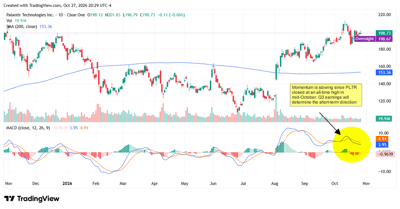
The technical picture adds a note of caution. PLTR's MACD line has crossed below its signal line, and the histogram has turned negative. Momentum has cooled since the October high, even as the stock holds near $199.
That's not a sell signal on its own. Shares remain well above the 200-day simple moving average near $153. But it suggests buyers want to see the report before committing. On Nov. 2, the three data points above will help determine which way the chart breaks.
Could a Trucking Squeeze Become J.B. Hunt’s Biggest Edge?
Submitted by Thomas Hughes. Article Published: 10/18/2026.

Key Points
- J.B. Hunt posted third-quarter revenue up 20% to $3.68 billion, beating MarketBeat's consensus estimate by 250 basis points across most segments.
- Operating margin lagged revenue growth due to rising driver costs, but executives plan a more aggressive repricing cadence to recover margin in 2027.
- MarketBeat tracks 26 analysts rating the stock a Moderate Buy, with institutional buying and technical support suggesting a potential bullish rebound toward prior highs.
- Special Report: Grand Canyon Discovery Reshapes America's Energy Tax Credits.
J.B. Hunt (NASDAQ: JBHT) continues to face headwinds, but investors shouldn’t get this turnaround story wrong. The company has not experienced a structural decline in its business; rather, it is navigating a dynamic market shift from which it should not only recover but also benefit. The shift centers on regulatory oversight and enforcement, as well as the resulting driver shortage and capacity constraints that underpin the business today.
While driver costs are rising, the company can recover those costs because they are part of the operating environment. There is little alternative; the entire industry faces the same headwinds.
Collecting up to $1,152 a month from rising gold prices (Ad)
Gold is hitting record highs, but most investors are leaving income on the table. A $15 fund is quietly paying out up to $1,152 a month to regular investors - no mining stocks, no options, no physical metal required.
Chief Income Strategist Tim Plaehn calls it a breakthrough strategy that transforms gold's rally into reliable monthly payouts. The next distribution is just days away.
Discover the gold income fund before the next payout dateWithin the industry, J.B. Hunt is uniquely positioned to benefit. It has the size, scale and intermodal expertise to deliver the quality services that businesses and enterprises demand.
For J.B. Hunt today, this means higher volume, with pricing and industry undercapacity driving the business. Next year, it could mean a dual lever for earnings growth, with top-line strength amplified by margin recovery.
Margin recovery will take time, but executives are actively working toward it and planning a more aggressive repricing cadence in the coming year.
J.B. Hunt’s Strong Q3 Sets the Stage for Margin Recovery
J.B. Hunt posted a solid Q3, with revenue up 20% to $3.68 billion and outperforming MarketBeat’s consensus by 250 basis points. Volume and pricing drove the strength, with most segments contributing. Intermodal grew 20% on an 8% volume gain, while Dedicated Contract Services grew 11% on truck additions and efficiency improvements, led by Integrated Capacity Solutions (ICS). ICS grew 57% on a 22% volume gain, amplified by a 29% improvement in revenue per load. Looking ahead, the volume and pricing metrics are expected to remain favorable, if not improve.
Margin remains the sore spot, but it was no worse than the company forecast and the market had priced in. Operating income increased 2%, much slower than the 20% top-line gain, but still better than expected. Key details for investors include the massive increase in purchased capacity, a metric that can be controlled over time, and a nearly 30% increase in salaries, which points to a steadily improving driver base.
The company did not provide guidance but did offer an optimistic outlook for Q4 and 2027. While repricing has affected only about 10% of contracts, another 30% is expected in each of the first three quarters of next year, setting the stage for accelerated revenue growth and margin recovery. Analysts’ consensus forecasts low-double-digit quarterly revenue growth on a compound basis over the next two years, with earnings growth accelerating to nearly 50% by Q3 2027 and then sustaining a high-double-digit pace in subsequent quarters.
J.B. Hunt’s Dividends and Buybacks Support Long-Term Growth
J.B. Hunt’s appeal lies as much in its cash flow and capital-return capacity as in anything else, including dividends and share buybacks. The dividend is the lesser of the two, yielding less than 0.8% annualized as of mid-October, but it is a reliable payment with annual growth that helps maintain buy-and-hold interest. Buybacks are more substantial, reducing the share count by more than 2.25% over the trailing 12 months. The likely outcome is that J.B. Hunt will continue paying dividends and buying back shares, helping boost earnings-per-share growth over time.
Analysts See Upside as Institutional Buying Supports J.B. Hunt Stock
Analysts responded to the report with cautious optimism. While some lowered their price targets, others reaffirmed theirs, and the overall outlook remains bullish. MarketBeat tracks 26 analysts with current ratings; the stock is pegged at Moderate Buy. Sentiment has been firm and steady, and the consensus price target trend is favorable. While recent price target reductions capped upside potential, consensus is up about 70% over the last year, forecasting more than 20% upside from early Q3 lows.
An immediate rebound is not guaranteed, but lower prices are unlikely. Institutions own about 75% of the stock, and buying spiked in late Q3 alongside the stock price collapse. The group’s activity indicates a price floor, which is also reflected in the technical action.
J.B. Hunt Stock Eyes New Highs, But Cost Risks Remain
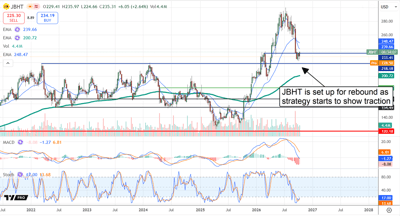
Chart price action reveals a market trading above critical support amid an inflection point and poised for a bullish upswing. In this setup, the stock price could return to its existing highs near $300; the question is whether it can move on to set new highs.
J.B. Hunt’s biggest risk is persistently high costs and the impact of price pass-throughs. On one hand, the company is on track to recoup margin. On the other, higher costs for end users are inflationary and may lead to slower activity than expected.
This email communication is a sponsored message sent on behalf of Paradigm Press, a third-party advertiser of MarketBeat. Why did I get this message?.
If you have questions or concerns about your account, feel free to contact MarketBeat's support team, based in South Dakota, at contact@marketbeat.com.
If you would no longer like to receive promotional emails from MarketBeat advertisers, you can unsubscribe or manage your mailing preferences here.
Copyright 2006-2026 MarketBeat Media, LLC. All rights protected.
345 N Reid Place #620, Sioux Falls, South Dakota 57103. U.S.A..




No comments:
Post a Comment