| Unsubscribe |
A new kind of civil war is coming after election day?

Across America, there's been violence, protests, lawsuits, cancelled projects, and campaigns to impose statewide moratoria to stop AI's impact on cities and small towns across the nation. And Whitney Tilson believes these frustrations are only going to get worse. In fact, now that these midterms are over, he believes it's all going to come to a head. And it will have huge implications on your portfolio. He's sharing his full analysis free, here.
This ad is sent on behalf of Stansberry Research, 1125 N Charles St, Baltimore, MD 21201. If you would like to optout from receiving offers from Stansberry Research please click here.
WD-40 Could Reward Patient Investors—Here's Why
Submitted by Thomas Hughes. First Published: 10/23/2026.

Key Points
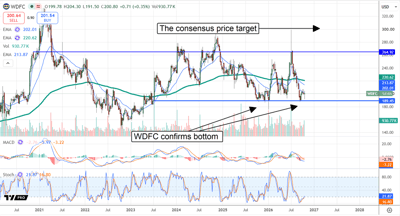
- WD-40's stock remains range-bound, with shares near support of about $190, with resistance near $265 to $300.
- Despite 8.1% revenue growth across all regions, WD-40 reported a 32% decline in operating income, net income, and GAAP EPS last quarter.
- WD-40 is accelerating stock buybacks with a new $100 million authorization, backed by over 90% institutional ownership and a consensus Moderate Buy rating.
- Special Report: The Last Energy Revolution Starts Now
WD-40 Company (NASDAQ: WDFC) isn't a headline-making company or a hypergrowth story, and its stock is likely to remain range-bound. But it also presents an attractive opportunity for investors seeking compounding returns.
Trading near the low end of its range, this dividend-paying, share-buying machine offers savvy investors clear entry and exit points.
Jon Najarian: Elon's next takeover target (Ad)
Jon Najarian, the Hall of Fame trader who called Apple, Tesla, and Nvidia, says Elon Musk may be eyeing a new target trading below $25 a share.
Musk has already secured rights to acquire up to 15% of the company, a pattern Najarian says mirrors his past moves with Maxwell Technologies, SolarCity, and Swarm.
See Jon Najarian's full breakdown before December 8.Whether through options or straightforward buy-and-sell strategies, WDFC is a good play with the potential to drive a high-double-digit total return over the next two to three years.
WD-40 Stock Offers Significant Upside as Buybacks Accelerate
The trading range dates back to the COVID-19 spike and has been confirmed several times since. The high end reflects a premium valuation, with the market pricing in quality, cash flow, and a growth trajectory. The low end, meanwhile, presents a value opportunity given the dividend's health and the buyback outlook. Support is near $190, while resistance runs from $265 to $300, representing approximately 40% to 58% upside from support.
Buybacks are a critical factor in late 2026. The company’s recent divestiture not only provided a cash injection but also aided margins, enabling it to accelerate repurchases. Highlights from the latest quarter included the exhaustion of an existing $50 million authorization and the start of a new $100 million authorization with no time limit. Repurchase activity reduced the share count by about 0.5% in fiscal 2026, with fiscal Q4 results reflecting an acceleration to about 0.7% by year-end.
WD-40 Company Reaches Inflection, Guides for Improving Profitability
WD-40 Company posted a solid quarter, with revenue up 8.1% and slightly above consensus. Growth came from all regions, led by a 13% gain in Asia-Pacific. EIMEA, which includes Europe, India, the Middle East, and Africa, grew by 10%, while the core Americas segment, which accounts for about 46% of revenue, grew by 5%.
Growth was also broad across product categories. Core WD-40 sales grew by 8%, Specialty by 18%, and other products by 10%. Home Care and Cleaning Products (HCCP), the company's harvest segment, contracted due to the divestiture of European operations but was otherwise stable.
Margin news was mixed, but it also points to a possible catalyst for share price gains. Gross margin contracted due to surging input costs, while higher SG&A compounded the pressure. SG&A increased because of spending on incentives and advertising, both of which support sales.
The takeaway is that the company is investing in growth and views fiscal Q4 as the inflection point. Guidance calls for sequential margin improvement beginning in the current fiscal quarter and continuing through the year. The full-year target is 54% to 55.5%, down year over year (YOY) but up significantly from Q4’s 52.8%.
The bad news is that operating income, net income, and GAAP earnings per share (EPS) contracted by 32%, with EPS falling short of consensus. The good news is that earnings cover the dividend, and the balance sheet is healthy enough to absorb the impact of spending and share buybacks. Looking ahead, cash flow is expected to improve sequentially, supporting balance sheet health and capital returns. Key year-end details include higher cash and assets, slightly lower borrowings, and increased equity, despite a rise in total liabilities and treasury stock. Equity increased by about 1.8%, adding to the impact of the share count reduction.
Analysts and Institutions Reflect High Confidence in WD-40’s Capital Return Flywheel
Few analysts cover WDFC; only six are tracked by MarketBeat. This is not surprising given the company’s low profile, low market cap, and already high institutional ownership. Institutions own more than 90% of the stock, a significant figure that suggests confidence in capital returns. They’ve also been accumulating shares in 2026, underpinning the stock price bottom. Analysts, meanwhile, rate WDFC a consensus Moderate Buy, maintain a 50% Buy-side bias with no Sell ratings logged, and see the stock advancing about 50% from critical support. There is only one current price target, set this summer, which aligns with the high end of the trading range.
Investors should not misread WDFC’s high payout ratio; it is not likely to be a problem. This company is an advertising machine, driving sales for a distributed network of localized producers. Those producers carry the balance sheet risk, owning the facilities and distribution networks, while WDFC benefits from an asset-light model, low overhead, and unimpaired cash flow. Despite hiccups in growth and margins, the well-entrenched brand drives sales and cash flow and can sustain long-term capital returns. The company can address earnings growth issues by pursuing more aggressive buybacks, which would help accelerate EPS growth.
One catalyst is a shift to direct distribution. This doesn't change the contract-light model; it removes the local middleman in overseas markets. The result is greater control, higher front-end margins, and faster scale.
LyondellBasell's Dividend Looks Safer, But a New Risk Could Change That
Submitted by Jeffrey Neal Johnson. First Published: 11/1/2026.

Key Points
- LyondellBasell's reduced dividend was covered by third-quarter free cash flow by a wide margin.
- Stronger oxyfuels profitability and improved polyethylene pricing helped offset weakness in parts of the chemicals business.
- LyondellBasell has been named as a potential bidder for Shell chemical assets, but no transaction has been announced.
- Special Report: The Last Energy Revolution Starts Now
LyondellBasell Industries (NYSE: LYB) cut its quarterly dividend roughly in half in February 2026, lowering the payout from $1.37 to 69 cents per share. For income-focused investors, a reduction of this magnitude can signal underlying distress or a shift in capital priorities.
The third-quarter earnings report gives investors a look at how the reduced payout fits within the company’s current cash flow profile. The underlying chemical business shows signs of stabilization in certain segments, and the new dividend was comfortably covered by third-quarter free cash flow.
My public warning after 55 years of watching the markets (Ad)
Dr. Martin D. Weiss has publicly predicted six major American market crashes over his 55-year career, each warning issued before the crisis hit.
Now the founder of Weiss Ratings, the only conflict-free rating agency in America, says he is watching a $3 trillion problem that could trigger a chain reaction across markets and banks.
See Martin Weiss's full warning before this risk spreads furtherAn unconfirmed report that LyondellBasell Industries is exploring a large acquisition adds another source of uncertainty. Weighing solid free cash flow against the potential debt implications of a buyout offers insight into where the balance sheet could be headed over the longer term.
Assessing the Balance Sheet
Dividend sustainability depends heavily on a company’s ability to generate free cash flow. During the third quarter, operations generated $1.7 billion in operating cash flow, aided by a release of working capital.
After accounting for approximately $303 million in capital expenditures, the business generated about $1.4 billion in free cash flow. Comparing this cash generation with the current dividend obligation helps clarify the payout’s safety. At 69 cents per share, the quarterly shareholder distribution required just $224 million. The recalibrated payout now consumes a relatively small share of operating cash flow, leaving a substantial buffer for debt reduction, share repurchases and operational reinvestment.
Adding to its cash position, management announced a definitive agreement to sell the former Houston Refinery site to Valero Energy (NYSE: VLO) for approximately $320.5 million. The deal is expected to close in the fourth quarter of 2026, subject to regulatory approvals and customary conditions. If completed, it would provide additional cash while transferring ongoing site operations, environmental liabilities and pension obligations to the buyer.
Removing a non-core asset and its associated carrying costs would give the balance sheet additional flexibility. The current capital structure comfortably supports the $2.76 annualized payout, which yields around 4.18%. By reducing its dividend obligation, LyondellBasell Industries effectively created a wider margin of safety, helping insulate the payout from typical sector volatility.
Core Segments Show Signs of Stabilization
Beyond the cash flow metrics, the underlying business shows signs of cautious stabilization amid a cyclical industry environment. The Intermediates and Derivatives segment provided a notable lift during the quarter, driven largely by strength in the oxyfuels business.
Global supply disruptions and favorable gasoline blend economics have kept oxyfuel margins robust. Meanwhile, the Bayport asset is operating at full capacity following a successful restart earlier in the year, supporting bottom-line margins.
In the polymers space, integrated polyethylene margins improved late in the quarter, settling roughly 50% above 2025 levels. These operational tailwinds helped drive quarterly revenue of $8.50 billion, an approximate 10% year-over-year increase, even as adjusted earnings per share of $2.54 narrowly missed the consensus estimate. These figures require context: The chemical sector is highly sensitive to macroeconomic shifts, making the margin improvements a welcome reprieve from the prolonged industry downturn.
Management maintains a measured near-term production outlook, acknowledging that global supply uncertainty and shifting customer buying patterns remain key variables. Fourth-quarter guidance calls for operating rates of 85% for North American Olefins and Polyolefins assets, 60% for European counterparts and 75% for Intermediates and Derivatives. These projections reflect management’s approach of aligning production with market demand and planned maintenance rather than operating at full capacity.
Debt, Equity and Unconfirmed Rumors
While third-quarter cash flow comfortably covered the current dividend, external reports introduce a potential structural risk to the investment thesis. Recent press coverage identified LyondellBasell Industries as a potential suitor for U.S. chemical assets currently held by Shell (NYSE: SHEL), including the Monaca complex in Pennsylvania, which cost Shell approximately $14 billion to develop. The broader portfolio could reportedly sell for up to $8 billion. This remains an unconfirmed press report, not an official corporate announcement. Still, assessing the potential impact of a transaction of this magnitude is standard practice when evaluating long-term dividend safety.
The long-term debt-to-equity ratio was around 1.05 as of June 30. Financing an acquisition valued at up to $8 billion would likely require significant new debt, equity dilution or a combination of both. Taking on new liabilities increases debt-servicing costs, which compete directly with the cash available for shareholder returns.
When a business borrows heavily to fund an acquisition, the resulting interest expense becomes a fixed draw on cash flow, narrowing the dividend’s margin of safety during economic downturns. In a high-interest-rate environment, the cost of capital makes large deals inherently riskier for income-oriented investors.
In its third-quarter earnings release, management explicitly reiterated its capital allocation priorities. These include operating assets safely, strengthening the balance sheet through disciplined deleveraging, maintaining an attractive dividend and selectively investing in opportunities that enhance long-term shareholder value.
A heavily debt-financed acquisition could complicate that deleveraging strategy. The potential tension between LyondellBasell Industries’ stated conservative financial strategy and reports of a major acquisition creates a complex dynamic for the market to assess.
Weighing Cash Flow Against External Risks
Absent a major acquisition, third-quarter operational data suggests the reduced dividend rests on a solid foundation. Strong cash generation provides liquidity to support the payout, while the pending refinery sale could add financial flexibility once completed. The current cash flow profile creates a comfortable buffer for the dividend under normal operating conditions.
A reduction in LYB’s short interest, from more than 21 million shares earlier in the year to roughly 11.5 million by mid-October, suggests bearish sentiment is easing.
Institutional sentiment appears mixed, with some major funds reducing their stakes while others have added to their positions. This division is reflected in the current consensus rating, which is firmly at Hold, with a price target pointing to modest upside.
Investors monitoring the materials sector may want to watch future capital allocation announcements. If LyondellBasell Industries adheres to its stated deleveraging goal, the current dividend yield appears well supported by third-quarter cash generation, provided operating cash flow remains sufficient. If a large-scale acquisition is officially confirmed, cautious investors may want to reevaluate the payout’s long-term sustainability in light of any additional debt burden.
This email content is a sponsored email sent on behalf of Stansberry Research, a third-party advertiser of MarketBeat. Why was I sent this email content?.
If you need help with your newsletter, feel free to email MarketBeat's support team, based in South Dakota, at contact@marketbeat.com.
If you would no longer like to receive promotional emails from MarketBeat advertisers, you can unsubscribe or manage your mailing preferences here.
© 2006-2026 MarketBeat Media, LLC. All rights protected.
345 N Reid Place #620, Sioux Falls, S.D. 57103-7078. U.S.A..




No comments:
Post a Comment