| Unsubscribe |
Most stocks under $10 are cheap for a reason. The trick is finding the ones that are simply early.
Our new free report, 5 Stocks Under $10 With Breakout Potential, names five that passed three tests: a real business, improving fundamentals, and a catalyst you can put on a calendar.
Among them:
- An air-taxi maker with a conditional order from United Airlines worth up to $1 billion, now building a defense business.
- Southeast Asia's super-app, now profitable and authorizing a $750 million buyback of its own stock.
- An old telecom carrier sitting on one of America's largest fiber networks, just as the AI buildout needs it.
See all five names and tickers here.
Another is a health insurer that just earned Medicare's top 5-Star rating and reports third-quarter results in early November. The report tells you exactly what to watch for each.
The full PDF report is free.
Edward Strauss
Editor, Financial Edge Daily
P.S. One of the five just posted a quarter with adjusted EBITDA up roughly sixfold from a year earlier. Find out which under-$10 stock it is.
By clicking any link in this email you agree to receive emails from Financial Edge Daily and our affiliates. You can opt out at any time. Privacy Policy.
Alphabet’s $400 Billion Sell-Off Could Be the Best AI Buying Window Left in 2026
By Bridget Bennett. Article Posted: 11/2/2026.

Key Points
- Alphabet’s $400 billion-plus single-session sell-off was driven by advertising misses and non-cash accounting charges, not by any slowdown in its AI business.
- Altimetry Research’s Joel Litman and Rob Spivey see the buildout’s real profit pools sitting with hyperscalers and power suppliers, naming Microsoft, Generac Holdings, and Advanced Micro Devices as the names positioned to capture them.
- CoreWeave and Cipher Digital occupy the squeezed middle of the AI value chain, renting commodity compute without the pricing power or scale to earn their cost of capital.
- Special Report: The Last Energy Revolution Starts Now
Investors just sold off a company for investing in the one business that doubled.
Alphabet Inc. (NASDAQ: GOOGL) fell 12% after its third-quarter report, erasing more than $400 billion in market value. Google Cloud revenue grew 103% in the same quarter.
Jon Najarian: Elon's next takeover target (Ad)
Jon Najarian, the Hall of Fame trader who called Apple, Tesla, and Nvidia, says Elon Musk may be eyeing a new target trading below $25 a share.
Musk has already secured rights to acquire up to 15% of the company, a pattern Najarian says mirrors his past moves with Maxwell Technologies, SolarCity, and Swarm.
See Jon Najarian's full breakdown before December 8.That’s the tension worth sitting with: the gap between what the market reacted to and what the numbers said is where the opportunity lies.
What Alphabet’s 12% Sell-Off Actually Priced In
The two misses that triggered the sell-off came from Google Search advertising and YouTube ad revenue. Search ad revenue still grew 12% to $63.3 billion.
That is not a franchise being erased by chatbots. It is a franchise growing slightly more slowly than the sell side had modeled.
Joel Litman and Rob Spivey of Altimetry Research argue that the cloud business invalidates the bubble narrative behind the sell-off.
Demand for AI compute is not softening. Customers are spending more with Google, not less.
The Accounting Rules That Punish Companies for Investing
Alphabet booked an $8.2 billion loss in other income and expenses, driven largely by an unrealized mark-to-market loss on its stake in SpaceX (NASDAQ: SPCX). No cash left the building. Litman points out that these are precisely the rules Warren Buffett has criticized for creating volatility without conveying information.
Research and development compounds the distortion. In the United States, R&D is recorded on the income statement as a period expense rather than a capitalized asset, making companies that invest the most appear less profitable.
Then there is free cash flow, the number that spooked the market most. Alphabet’s turned negative because capital expenditures (CapEx) climbed toward the company’s guidance of $195 billion to $205 billion for the year—not because operating cash flow deteriorated. Litman and Spivey view that as a company with high incremental returns pressing its advantage.
Microsoft’s Azure Capacity Still Sets the Revenue Ceiling
Microsoft Corporation (NASDAQ: MSFT) is following the same playbook.
Chief Executive Officer Satya Nadella has repeatedly said that more Azure capacity would mean more Azure revenue, and each capacity expansion that has spooked investors has been followed by a cloud revenue beat.
The recent voluntary exit offer extended to roughly 60,000 employees looks like a sign of distress to much of the financial press.
Spivey sees it as leverage. Headcount makes up an unusually large share of Microsoft’s cost base, and generating more revenue per employee translates directly into a higher return on investment—something the market has not priced in.
Generac’s Commercial Power Business Lands in the Right Lane
Generac Holdings Inc. (NYSE: GNRC) is not a name most investors associate with AI. Spivey argues it belongs in the conversation. The residential standby business remains dominant, while the commercial segment, historically the lower-margin half, is finally gaining pricing power as Caterpillar Inc. (NYSE: CAT) builds a backlog that stretches years into the future.
Generac added capacity ahead of that squeeze and has built a data center backlog measured in billions.
Spivey’s view is that reported metrics badly understate the economics, showing low-single-digit returns where Altimetry’s adjusted figures show returns in the mid-teens and rising. The stock’s slide since its summer peak, he says, reflects the narrative, not the fundamentals.
AMD Gets 2 Shots at the Buildout
Advanced Micro Devices, Inc. (NASDAQ: AMD) stands to benefit from a simple realization spreading through data centers: not every workload needs NVIDIA Corporation’s (NASDAQ: NVDA) top-end silicon.
Inference is pushing some work back toward CPUs, and AMD is the only major designer with products on both sides of that divide and integration between them.
The market has priced in the share-gain story.
It has not priced in the CPU density story.
Why CoreWeave and Cipher Digital Sit in the Wrong Spot
CoreWeave, Inc. (NASDAQ: CRWV) pays top dollar for chips, owns no frontier model and cannot tell customers they have nowhere else to go. Litman’s calculation is blunt: economic profit is negative today and is forecast to remain negative. Cipher Digital Inc. (NASDAQ: CIFR), formerly Cipher Mining, inherits the same problem with a rebrand attached. Renting bare compute is a business that Equinix, Inc. (NASDAQ: EQIX) and Digital Realty Trust, Inc. (NYSE: DLR) have run for decades, earning returns on assets of 3% to 4%.
The exception is scale paired with power already in the ground. That is why Spivey points to SpaceX and its xAI operation as the only neocloud he considers genuinely differentiated.
Owning something the buildout can’t route around is the whole game. Cloud revenue and power capacity show who qualifies, and five of those names are already cutting checks to shareholders while spending continues. See Joel Litman and Robert Spivey’s 5 AI build-out income stocks in Elon’s Shadow Trust.
onsemi’s AI Sales Surge 175%: Is a Stock Recovery Next?
By Thomas Hughes. Article Posted: 11/4/2026.
Key Points
- onsemi is acquiring Ferric, a power-delivery technology firm for AI processors, to strengthen its computer vision and AI data-center offerings for OEMs.
- The company reported a beat-and-raise third quarter, with $1.72 billion in net revenue, 11% year-over-year growth, and 43% growth in adjusted earnings per share.
- Analysts raised revenue and earnings targets despite automotive segment concerns, maintaining a Moderate Buy consensus with a price target implying about 35% upside.
- Special Report: The Last Energy Revolution Starts Now
onsemi (NASDAQ: ON) is taking another step toward cementing its position as a computer vision system original equipment manufacturer (OEM) for robotics, autonomous vehicles and the Internet of Things (IoT) with its deal to acquire Ferric.
Ferric specializes in power delivery for AI processors and holds dozens of patents related to its highly efficient technology. It moves power control off the motherboard and directly onto the semiconductor using thin-film technology. The result is a 50% to 70% reduction in size and lower power usage, allowing for more critical computing components and power at the edge, where computer vision systems handle a firehose of real-time data.
My public warning after 55 years of watching the markets (Ad)
Dr. Martin D. Weiss has publicly predicted six major American market crashes over his 55-year career, each warning issued before the crisis hit.
Now the founder of Weiss Ratings, the only conflict-free rating agency in America, says he is watching a $3 trillion problem that could trigger a chain reaction across markets and banks.
See Martin Weiss's full warning before this risk spreads furtherFerric fits cleanly into onsemi’s strategy. Its technology integrates seamlessly with onsemi’s primary power lines, enabling power handling on the substrate and delivery directly to the computer vision processor. For OEMs, this makes onsemi a one-stop shop capable of efficiently powering sensors and core system computing while providing an end-to-end computer vision system.
With its acquisition of Synaptics (NASDAQ: SYNA), onsemi would add processing and connectivity to its existing sensor and power technologies, broadening the range of components it supplies for automated machines. Ferric would strengthen power delivery across that portfolio while also expanding onsemi’s offering for AI data centers. Its technology can reduce the space needed for power components, cut power losses and reduce heat.
onsemi Posts Beat-and-Raise Quarter: Signals Bottom in Stock Price
onsemi had a solid Q3, reporting $1.72 billion in net revenue, an 11% year-over-year (YOY) increase. Revenue slightly exceeded consensus, an important result given that expectations had steadily risen throughout the year.
Growth was driven by gains in all segments, led by a 21% increase in the PSG (power control) segment. Among end markets, AI data centers were strongest, growing 39% sequentially and 175% YOY. This underscores onsemi’s importance to the industry and the durability of the broader AI market. The results suggest demand for AI data-center infrastructure remains strong, despite concerns that the buildout is slowing or falling off track.
Other key details include margin expansion alongside revenue growth. Gross and operating margins each improved by more than 100 basis points, accelerating earnings growth. Cash from operations grew 23% to $516 million, while free cash flow increased 31% to $489 million, or about 28% of revenue. Adjusted earnings per share (EPS) grew 43% to 90 cents. Cash flow is also important because it reduces the risk associated with the Ferric acquisition: onsemi plans to use cash on hand and appears to have plenty available.
Guidance could trigger further accumulation, given the stock’s significant correction and signs of support. The outlook for revenue and earnings was strong, though likely cautious given the company’s trends and business momentum.
Analysts Focus on Near-Term Headwinds, Lift Revenue and EPS Targets
Analysts’ initial responses to the release were mixed, reflecting strong results alongside concerns about onsemi’s automotive segment. The segment faces near-term pressure from consumer habits and product wind-downs as OEMs end existing programs and prepare for new ones. However, the company’s current strengths support a robust outlook, and the automotive market is unlikely to remain sluggish indefinitely. Next-generation product lines are expected to enter production next year and ramp up in the second half, pointing to sustainable, accelerating strength over the next four to six quarters.
Collectively, analysts are raising revenue and earnings targets while lowering their stock price forecasts, sending mixed signals to the market. The group has high conviction in its Moderate Buy rating, with a strong bullish bias and a consensus price target that implies about 35% upside. However, downward pressure on price targets may weigh on the stock in Q4, while also setting the stage for catalysts next year.
Catalysts for ON could include persistent strength in the AI market, improvement in the automotive market, outperformance and accelerating growth, cash flow, and capital returns.
onsemi’s capital returns consist entirely of share buybacks, and the company is aggressively reducing its share count. Q3 activity reduced the trailing 12-month share count by 2.62%, leaving room for further reductions in the coming quarters. Year-to-date balance sheet highlights include increases in cash, current assets and total assets, as well as steady equity, despite the lower share count and liability increases tied to expansion plans and acquisitions.
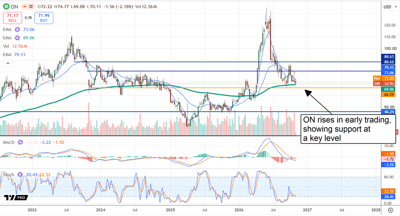
Stock price action following the release was more favorable than analysts’ responses, with shares up approximately 2.5% in premarket trading. The move suggests a market floor, a view also reflected in the stochastic and MACD indicators, which suggest investors are accumulating shares at these low levels and the stock could rebound soon. Institutional investors are key: they sold shares in Q3, contributing to the stock’s downtrend, but shifted back to accumulation in early Q4. If that trend continues, the stock could move higher over time, as institutions own nearly 98% of the shares.
This email message is a sponsored message for Financial Edge Daily, a third-party advertiser of MarketBeat. Why did I receive this email?.
If you need help with your newsletter, feel free to email our support team, based in South Dakota, at contact@marketbeat.com.
If you would no longer like to receive promotional emails from MarketBeat advertisers, you can unsubscribe or manage your mailing preferences here.
© 2006-2026 MarketBeat Media, LLC. All rights reserved.
345 N Reid Pl., Sixth Floor, Sioux Falls, South Dakota 57103-7078. U.S.A..




No comments:
Post a Comment