| Unsubscribe |
Most trading education asks for a lot before it gives you anything. An hour of video. A webinar you have to show up for. A course you will start and not finish.
This is the opposite of that.
Five questions. Under sixty seconds. You run them before you click buy, and if the trade fails any one of the five, you do not place the trade.
That is the whole thing.
Here is what the five cover, without giving away the answers.
The five-second question that separates the traders who stick around from the traders who blow up their accounts, and why almost no beginner thinks to ask it before clicking buy.
Why the safety net you were told to rely on, the stop-loss order, can quietly fail you on the exact day you need it most.
The silent cost that bleeds out of your trade every day even when you are 100% right about the stock, plus the ten-second check that catches it.
The simple sizing check that decides whether a loss is a scratch you shrug off, or the one you do not come back from.
Why the very first trade most beginners are taught to make is the most dangerous one on the board, and the one-line test that flags it before you risk a dollar.
I built the list over fifteen years of teaching derivatives inside the brokerage business, and it is the same filter I run on my own account today.
It is one page. There is nothing to sit through and nothing to schedule.
Normally $29.97. Today it's free, and you keep it either way.
Don Kaufman
Chief Derivatives Instructor, TheoTrade
P.S. The whole thing fits on a single page. If it takes you longer than a minute to run, I wrote it badly.
Priced for a Pullback or More Gains? These 3 Stocks Are Testing the Limits
By Chris Markoch. Originally Published: 9/19/2026.
Key Points
- September has lived up to its historically weak reputation in 2026, but several stocks are still pushing toward or setting new highs.
- Strong earnings, AI demand, and favorable industry conditions are keeping momentum alive even as valuations and technical indicators become more stretched.
- Dell Technologies, HP, and Phillips 66 each illustrate the same question from a different angle: how much upside is left after a powerful run?
- Special Report: SpaceX is offering you shares. Don't take them.
September is historically a weak month for stocks, and 2026 is doing little to shake that reputation. However, as is always the case, several stocks are positive for the month. In fact, some have recently reached all-time highs.
That raises a question all investors must consider: Are these stocks fully valued, fairly priced, or is there potential for further gains? Several sectors have outperformed the market in 2026, and catalysts suggest they may not be finished yet.
Dell Technologies: The AI Server Story Keeps Widening
Tomorrow it's $29.97 (Ad)
Bill Poulos is giving away his Simple Options Trading For Beginners book through a temporary link. Once that link expires, it returns to its usual price of $29.97.
The content stays the same - plain-English lessons and a handful of proven techniques - only the price changes. Waiting means paying for something you could have gotten for free.
Download your free copy before the link expires today.Dell Technologies Inc. (NYSE: DELL) has been one of the primary beneficiaries in the hardware sector as the artificial intelligence (AI) infrastructure trade moves beyond chips. Dell has become one of the leading names in AI servers.
In the company’s Q2 earnings report for fiscal year 2027 (FY2027), Dell reported record revenue and demand, including a $95 billion backlog that spans more than 6,500 customers. That demand extended beyond the company’s AI offerings.
Like many hardware companies, Dell acknowledged potential supply constraints in the current and future quarters. However, that didn’t prevent the company from raising its full-year guidance for both revenue and earnings per share (EPS).
DELL is up nearly 370% so far in 2026. Notably, the stock gained about 3.5% even as the Federal Reserve raised interest rates by 25 basis points.
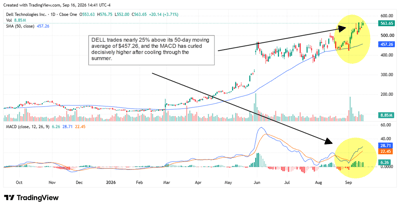
That said, the DELL chart looks stretched, and the stock trades approximately 5% above its consensus price target of $560.24. The stock also sits roughly 29% above its 50-day moving average of about $456, while the MACD has turned decisively higher after cooling through the summer.
That’s not a warning sign yet, but it does mean the stock has little cushion if AI server demand shows any sign of slowing. Until that appears in the numbers, however, the investment case is straightforward: Dell isn’t priced for a slowdown; it’s priced for further growth.
HP Inc.: A Rally That’s Outrunning Its Own Analyst Coverage
HP Inc. (NYSE: HPQ) is another technology company receiving a boost from AI. The specific catalyst is AI’s move to the edge, which is driving demand for the company’s AI personal computers (PCs).
The company’s Q3 2026 earnings report confirmed the demand story. HP posted record revenue of $15.7 billion, up 13% year over year. The bullish report was anchored by Personal Systems revenue of $11.8 billion, an 18% increase. Premium pricing is offsetting weaker volume.
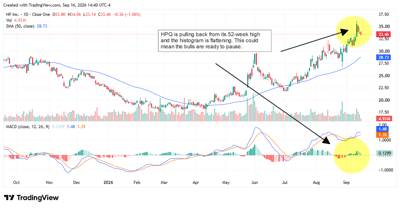
HPQ recently closed at $34.66, just below its 52-week high of $36.22. The stock is trading about 35% above its consensus price target of $25.77 and sits roughly 21% above its 50-day SMA of $28.73. Meanwhile, a recent drop of around 3.5%, paired with a flattening MACD histogram, suggests the market is pausing to ask whether the AI-PC refresh cycle represents real revenue or merely real hope.
Phillips 66: Geopolitics Did the Heavy Lifting
Phillips 66 (NYSE: PSX) is a midstream energy company focused on transporting, processing, storing and, more importantly in 2026, refining crude oil. Investors in the energy sector have been hearing about the widening crack spread, which represents the profit margin refiners earn on each barrel.
Middle East supply disruptions pushed crack spreads to record levels. The company’s marketing VP, Brian Mandell, noted that global markets are short 7 million barrels per day of refined products from the Middle East and Asia, along with another 1.4 million bpd from Russia. He said that setup supports stronger margins through year-end.
That was reflected in the company’s Q2 2026 earnings report, in which it posted adjusted earnings per share of $9.41. That came in well above the consensus estimate of $7.50. However, the top-line number drew the most attention: $52 billion in revenue, roughly 55% higher than the year-ago period.
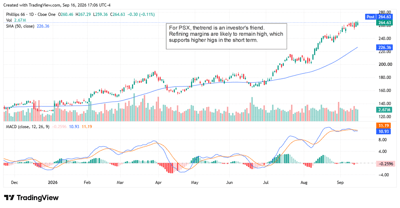
On Sept. 16, PSX closed at $264.62, essentially flat. Technically, PSX trades roughly 18% above its 50-day SMA of $226.40, with the MACD still elevated and confirming trend strength.
The risk to PSX is that the crack spread will normalize once the conflict with Iran is resolved. But it’s anyone’s guess when that will happen. PSX is trading more than 13% above its consensus price target of $237.35. Recent analyst forecasts, however, are bullish. Raymond James raised its price target on PSX to $300 from $240 on Sept. 14. That matches UBS Group, which raised its target to $300 from $235 on Sept. 8. That’s not a sign that analysts are pricing in a peace deal.
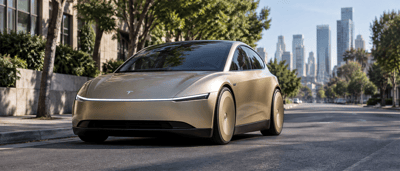
How Serious Is the Regulatory Threat Now Facing Tesla's Cybercab?
By Sam Quirke. Originally Published: 9/17/2026.
Key Points
- Federal regulators formally ordered Tesla to justify the Cybercab's lack of a steering wheel, pedals, and mirrors, with answers due by month's end.
- Tesla appears to have a workaround since regulators noted removable controls could be fitted, and Tesla already uses retrofitted Cybercabs to gather driving data.
- The bigger risk is a prolonged delay that stalls Cybercab expansion and lets rivals gain ground, rather than an outright recall or program collapse.
- Special Report: SpaceX is offering you shares. Don't take them.
After a solid, multi-week run that saw Tesla Inc. (NASDAQ: TSLA) shares climb almost 30% from their late-July low, the rally has stalled. The stock has drifted back to around $360 as a regulatory cloud over its Cybercab robotaxi gives the bulls a reason to bank some profits.
The concern first surfaced in early September, when reports emerged that safety regulators were scrutinizing the vehicle's design, taking some of the wind out of the stock's sails.
Shocking AI prediction from the “Billionaire Whisperer" (Ad)
Marc Chaikin's Power Gauge system flagged Micron before it soared 970 percent, Celestica before a 6,600 percent run, and Nvidia before it climbed more than 50,000 percent.
Now Chaikin says a new AI data center technology using 99 percent less electricity, water, and space could accelerate scientific breakthroughs 360-fold, and one company behind it just flashed bullish in his system.
See the full research and the ticker Chaikin is watching before this presentation goes offline.
Watch Chaikin's free presentation and see the ticker nowThis week, that scrutiny became official, with federal regulators formally ordering Tesla to justify the Cybercab's design and demanding answers by the end of the month. At the heart of the dispute is the car's most radical feature: the complete absence of a steering wheel, pedals or mirrors—the very things that make it a true driverless vehicle.
The order raises the stakes because a negative outcome could force regulators to recall Cybercabs already on the road. So how serious is this threat? Is it a true roadblock for Tesla's self-driving ambitions, or a hurdle it can clear without much trouble?
What the Regulators Actually Want
The headline might sound dramatic, but the good news for Tesla bulls is that the situation sounds more alarming than it really is. This isn't a recall or a finding that anything is wrong. It is simply a formal request for Tesla to explain the basis on which it certified the Cybercab as roadworthy.
At the heart of the matter is a difference in interpretation. Existing safety rules assume that a car has manual controls, while Tesla decided those rules should not apply to a vehicle designed never to be driven by a human. Rather than seek a formal exemption first, Tesla certified the car itself, and regulators now want to ensure that decision was valid.
For now, though, there's little cause for alarm. This is simply regulators doing their job and asking a company to show its work. Only if Tesla fails to satisfy them could the process escalate into something more serious.
Why It Should Prove Manageable
The reassuring part for investors is that this looks like a hardware and paperwork problem, not a fundamental flaw in the car's ability to drive itself—which would be a far graver concern. Tesla also appears to have a ready workaround, if needed. Regulators themselves noted that the company could fit removable steering and braking controls, and the vehicle's wiring already supports them. Tesla has even said it uses Cybercabs retrofitted with a steering wheel and pedals to gather driving data, so the capability plainly exists.
Seen this way, the bulls argue that the review could actually prove helpful. Forcing Tesla to settle the compliance question now, rather than later, would give it a clearer path to rolling out its robotaxis at scale further down the line.
The Bears Still Smell Trouble
The skeptics, however, see a more worrying picture, and their central concern is delay. A drawn-out process could push any meaningful expansion of the Cybercab fleet well into next year, just as rivals press ahead.
Tesla's chosen approach also matters. While competitors sought formal exemptions and accepted the existing rules, Tesla took the more combative path of certifying the car itself. If regulators reject that interpretation, the company may be forced into a costly redesign.
Tesla's robotaxi service is still in the early stages of its rollout, while many rivals are racing ahead. Every week or month lost to regulatory limbo gives the competition more time to build a lead.
A Hurdle, Not a Roadblock
Weighing it all up, this looks far more like a hurdle than a roadblock. The design issue appears technically solvable, Tesla has an obvious workaround waiting if needed, and the order is an early-stage inquiry rather than a damning verdict. The likeliest outcome is some combination of fixes and negotiation, not the collapse of the entire program.
It also helps to remember that the robotaxi business contributes almost nothing to Tesla's revenue today and won't for years. Its real value lies in the story it tells, underpinning the belief that Tesla is becoming a leader in autonomy and AI. That's what this dispute quietly puts at risk.
The real danger, then, is not a permanent block but a costly delay—one that saps momentum and gives rivals room to run. For now, the sensible course may be to watch how Tesla responds by the deadline and how regulators react in turn. The Cybercab dream isn't dead—far from it—but this episode is a timely reminder that the road to a driverless future runs straight through regulators, and that's rarely a fast lane.
This email is a paid sponsorship sent on behalf of Theo Trade, a third-party advertiser of MarketBeat. Why did I get this email?.
If you have questions or concerns about your newsletter, please contact MarketBeat's South Dakota based support team at contact@marketbeat.com.
If you would no longer like to receive promotional emails from MarketBeat advertisers, you can unsubscribe or manage your mailing preferences here.
© 2006-2026 MarketBeat Media, LLC.
345 N Reid Pl. #620, Sioux Falls, SD 57103. USA..




No comments:
Post a Comment