| Unsubscribe |
Unless something totally out of the ordinary happens, the first hour remains the most important hour of the day.
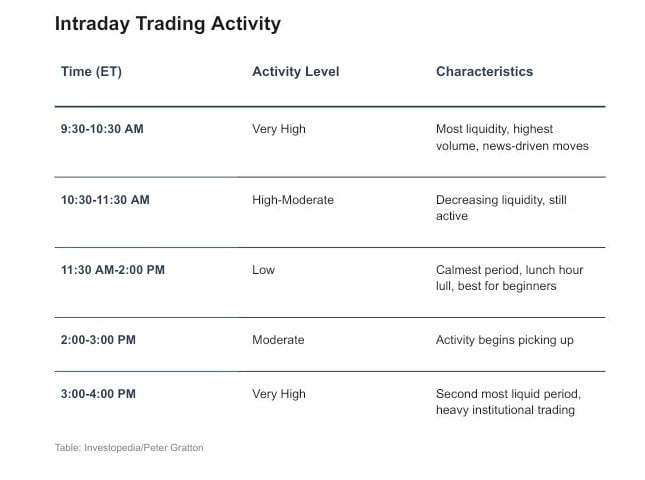
And if you know what to look out for, you can leverage that first hour, turning it into a shot at a 50% - 100% payout at the end of the day.
It's exactly what we do every morning when I deploy my #1 daily approach to trading the SPY.
Throughout the year, we've recorded a ton of daily winners, soaking up 50% here and 100% there just by following the exact same blueprint.
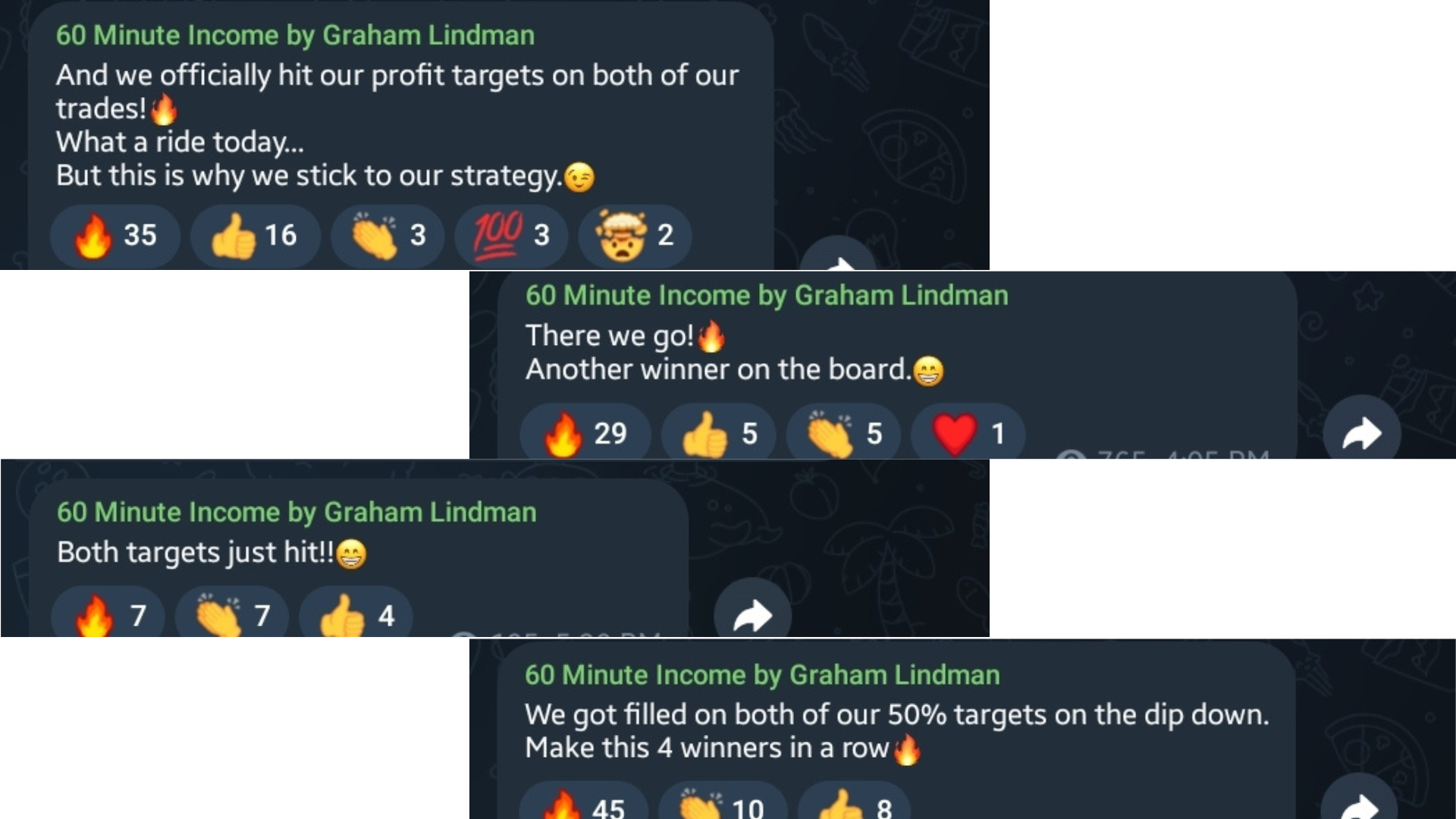
Sure, we've had trades that totally went against us, plus I can't make reckless trading guarantees here...
But I can walk you through the entire setup so you're ready to hit the ground running with us tomorrow.
If you'd like that, the starting point is right here.
By clicking the link above you agree to periodic updates from ProsperityPub and its partners (privacy policy)
Talk soon,
Graham Lindman
The End of Big Tech Buybacks? Only One Hyperscaler Is Still Repurchasing Shares
Author: Leo Miller. First Published: 9/14/2026.
Key Points
- Rising AI spending has pushed Alphabet's free cash flow to negative $5.9 billion and slashed Meta's and Microsoft's cash flow, forcing all three to scale back stock buybacks.
- Alphabet and Meta have completely stopped repurchasing shares in 2026, while rising share issuance and stock-based compensation are now pushing both companies' share counts higher.
- Unlike its hyperscaler customers, NVIDIA posted rising free cash flow and record buybacks of $19.7 billion last quarter, continuing to shrink its own share count.
- Special Report: SpaceX is offering you shares. Don't take them.
Big Tech giants seem to be spending everything they can on AI infrastructure. Alphabet’s (NASDAQ: GOOGL) spending caused its free cash flow (FCF) to come in at negative $5.9 billion last quarter, while Meta Platforms' (NASDAQ: META) FCF fell more than 90% to $784 million. Microsoft (NASDAQ: MSFT) was the only AI hyperscaler to post FCF above $1 billion. However, its FCF still fell 23% year over year (YOY) to $19.6 billion.
Against this backdrop, something investors have become accustomed to seeing from these companies has started to fall by the wayside: share buybacks. As investors consider the outlooks for these names, this dynamic is worth recognizing as the AI buildout pressures their ability to return capital.
Silver's record run faded but this project never slowed (Ad)
Silver is up more than 50 percent over the past year, yet interest has faded since its January record.
The metal gave back roughly half that move and most traders moved on to other trades.
One explorer kept its drill rig running through the pullback, working the site while attention was elsewhere.
See what this silver explorer has been drilling forOn the other side of the equation, the company to which these three hyperscalers hand billions of dollars each quarter is buying back shares like never before.
Alphabet Halts Repurchases, Opts for Issuance
Among this group, Alphabet has shown by far the largest drop-off in repurchase activity. Notably, the company spent $61.5 billion on buybacks in 2023, $62.2 billion in 2024 and $45.7 billion in 2025.
Over this period, it reduced its outstanding share count by more than 6%, providing a solid tailwind for metrics such as earnings per share (EPS). However, by the fourth quarter of 2025, buybacks had fallen to just $5.5 billion, down more than 64% YOY.
This was the last time Alphabet bought back shares, as the firm has engaged in no repurchases during 2026. In fact, the company’s outstanding share count is now increasing. In the second quarter, Alphabet issued $30.5 billion in shares, bringing its outstanding share count up approximately 1.4% since the start of the year. Its share count could rise even further.
This $30.5 billion represented just a portion of its larger $80 billion equity offering, as Alphabet seeks more funding for its AI investments.
Meta’s Share Count Increases as Buybacks Tank
A very similar story is playing out at Meta. In 2023, 2024 and 2025, the company spent $19.8 billion, $30.1 billion and $26.2 billion on buybacks, respectively. This helped Meta lower its outstanding share count by around 3% during that period.
However, as with Alphabet, Meta’s repurchases have dwindled to zero in 2026. Furthermore, the company’s outstanding share count has risen by around 1.4% since the third quarter of 2025. This increase is the result of Meta’s share-based compensation rising steeply as repurchases have fallen.
Notably, Meta’s stock-based compensation rose more than 58% YOY to $7.66 billion in its latest quarter and increased 30% from the first quarter. While Meta’s FCF remained slightly positive last quarter, analysts do not expect this to continue. In turn, Meta’s buyback spending is unlikely to recover in the near future, placing further upward pressure on its share count.
Microsoft’s Buybacks Hold Steady, But for How Long?
Amid Microsoft’s higher FCF, the company’s buyback spending is also showing greater resilience than Alphabet’s and Meta’s. In its fiscal years 2024, 2025 and 2026, Microsoft spent $17.2 billion, $18.4 billion and $22.3 billion on repurchases. (Note that because Microsoft’s fiscal year ends in June, the timeline is two quarters ahead of Alphabet’s and Meta’s.)
While this spending was large in absolute terms, Microsoft’s share count changed little during this period, with buybacks primarily offsetting stock-based compensation. Still, in the first half of calendar 2026, Microsoft spent $6.8 billion on buybacks, a slight increase from the $6.7 billion it spent during the same period last year. As a result, its share count has not risen, unlike Alphabet’s and Meta’s.
While Microsoft expects to remain FCF positive over the next 12 months, analysts still see its FCF declining significantly. This could put pressure on its future buyback capacity and cause its share count to rise.
Investors may notice the omission of Amazon.com (NASDAQ: AMZN) from this discussion. This is because Amazon has not historically engaged in significant buybacks, with its last repurchases coming in 2022.
NVIDIA’s Buybacks Hit Record Levels as Big Tech Spending Soars
Considering this data, investors may have to accept that buybacks are not a top concern for hyperscalers at the moment and likely will not be for some time. However, as these firms spend billions on NVIDIA’s (NASDAQ: NVDA) AI compute and networking products, NVIDIA’s buybacks are soaring.
Last quarter, NVIDIA spent a record $19.7 billion on buybacks, up from $19.3 billion in the prior quarter. In mid-2022, the company ended a more than five-year run of increasing its share count.
Since then, NVIDIA’s share count has dropped approximately 3.5%.
With $99 billion remaining under its share repurchase authorization and FCF rising 59% YOY to $21.4 billion last quarter, the company is in a strong position to continue lowering its share count, in contrast to other hyperscalers.
Not Just Banks: 3 Trading Stocks to Watch After the Fed Rate Hike
Author: Dan Schmidt. First Published: 9/19/2026.

Key Points
- The Federal Reserve raised its benchmark rate by 25 basis points on Sept. 16, reversing earlier expectations for 2026 rate cuts amid persistent inflation.
- Brokers and exchanges such as Interactive Brokers, Robinhood, and CME Group can benefit more than banks from rate hikes through faster-repricing net interest income and hedging demand.
- Interactive Brokers appears most directly tied to rate gains, while Robinhood's outlook depends on trading volume and CME Group benefits from ongoing rate path uncertainty.
- Special Report: SpaceX is offering you shares. Don't take them.
What a difference a year makes. In fall 2025, markets expected 2026 to bring rate cuts. The Trump administration’s tariffs had been muted, the job market was shaky, and disinflation was the presumed economic outcome. But much like the calls for a recession in 2023, the real world has a funny way of making prognosticators look foolish. The Federal Reserve raised rates for the first time in three years on Sept. 16, lifting the benchmark overnight rate by 25 basis points (bps). The vote was unanimous, and many Fed officials see room for additional hikes before year-end.
The immediate market reaction was a sell-off, but stocks surged the following day despite the prospect of further hikes in 2026 and 2027. A new hiking cycle is usually good news for the financial sector, and many investors will screen for banks that benefit most in that environment. However, banks aren’t the only businesses in finance, and many brokers and exchanges stand to benefit from rising short-term rates.
Why Brokers and Exchanges Deserve a Look
Tomorrow it's $29.97 (Ad)
Bill Poulos is giving away his Simple Options Trading For Beginners book through a temporary link. Once that link expires, it returns to its usual price of $29.97.
The content stays the same - plain-English lessons and a handful of proven techniques - only the price changes. Waiting means paying for something you could have gotten for free.
Download your free copy before the link expires today.The rate path shifted dramatically in less than 12 months due to persistent energy-driven inflation. Stoked by the war in Iran and the subsequent closure of the Strait of Hormuz, WTI crude futures soared from under $60 per barrel in January to more than $105 by September. With no exit ramp in sight, the interest-rate path remains murky and influenced by factors far beyond the Fed’s control.
The market typically views rate hikes as foul-tasting medicine: a needed remedy that goes down bitterly. Higher rates mean lenders can charge more for loans, but they also need to compete to retain deposits. Brokers and exchanges often benefit more than banks during rate-hike cycles for three reasons:
Net interest income (NII) on cash sweeps and margin loans
Customers holding more cash for higher yields and engaging in less speculative trading
Increased demand for hedging products
Unlike banks, brokers and exchanges have no long-duration loan books and don’t need to worry about deposit beta. Customer cash spreads and margin loans reprice far more quickly during these cycles than typical banking activities. The three companies listed below each offer a different way to profit in this environment.
Interactive Brokers: The Cleanest Beneficiary of a 25-Basis-Point Hike
Interactive Brokers Group Inc. (NASDAQ: IBKR) might be the most immediate beneficiary of a 25-bps hike, but you don’t need to take my word for it.
During the conference call for the company’s fiscal Q2 2026 earnings report on July 21, CFO Paul Brody estimated that a 25-bps hike would add $81 million in annual NII.
In Q2, NII rose 23% to $1.06 billion. Adding $81 million to an annualized NII figure of $4.2 billion would represent about a 2% lift for every 25 bps. NII also represented more than 56% of total Q2 revenue, so the rate story very much dominates this stock.
Interactive Brokers grew NII through the first part of the year as account balances expanded, so this rate hike adds a tailwind to an already growing segment. Margin loan interest grew 39%, and margin loan balances increased 67% year-over-year (YOY) to $108.5 billion.
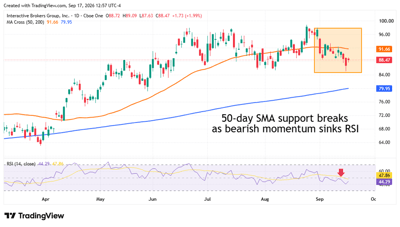
But investors should be cautious: This rate hike was widely priced in, and IBKR shares likely need another catalyst to resume their rally. Support at the 50-day moving average has broken ahead of the fiscal Q3 2026 report on Oct. 20, and the Relative Strength Index (RSI) has dipped into bearish territory.
Robinhood: Interest Exposure at Odds With Growth Appetite
The story at Robinhood Markets Inc. (NASDAQ: HOOD) is a little muddier.
On one hand, Robinhood earns payment for order flow, so the company generates more profit when trading volumes are high, especially for speculative assets such as options and cryptocurrencies.
On the other hand, net interest revenue (NIR) grew 9% YOY in fiscal Q2 2026, and the margin book more than doubled to a record $21.6 billion.
The conflict between growth and interest income is at the heart of the Robinhood thesis. If speculative risk appetite slows, the loss of trading revenue could more than offset the gains in interest revenue.
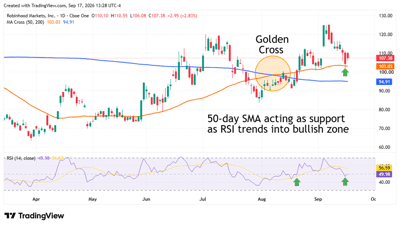
Traders bid up HOOD shares by more than 12% in the month ahead of the expected rate hike, and some technical signals have now turned higher. The RSI is once again trending above the bullish threshold of 50, and a Golden Cross in August affirmed support at the 50-day moving average.
CME Group: The Best Bet on an Uncertain Rate Path
Fed officials have made it clear that the rate path is littered with potential obstacles, and an uncertain future might be the best environment for CME Group Inc. (NASDAQ: CME).
CME operates global derivatives marketplaces where investors can trade SOFR, federal funds and Treasury futures. The more uncertainty reigns, the greater the demand for these hedging products is likely to be.
Average daily volume (ADV) was up 8% YOY in fiscal Q2 2026, and August figures showed that nearly 30 million contracts were traded ahead of the Fed decision.
The September hike was widely telegraphed, yet trading volumes still grew strongly. An uncertain path in 2027 could unlock even more value in CME shares.
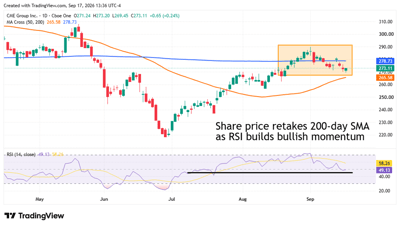
CME shares regained the 200-day moving average in the weeks leading up to the Fed meeting, and this level will need to hold as support for further short-term gains. The RSI has moved down from its overbought reading but still maintains bullish momentum, so investors will need to monitor these technical trends ahead of the fiscal Q3 2026 earnings catalyst on Oct. 21.
This message is a paid sponsorship from ProsperityPub, a third-party advertiser of MarketBeat. Why did I get this email content?.
We develop tools and strategies to the best of our ability, but no one can guarantee the future. There is always a risk of loss when trading; past performance is not indicative of future results. The results on live trades published in real time during 6/20/2025 - 7/15/2026 produced a 74.4% win rate with an average return of 12.55% at a one-day hold time.
If you need help with your account, please contact MarketBeat's South Dakota based support team at contact@marketbeat.com.
If you would no longer like to receive promotional emails from MarketBeat advertisers, you can unsubscribe or manage your mailing preferences here.
Copyright 2006-2026 MarketBeat Media, LLC. All rights reserved.
345 N Reid Place, Sixth Floor, Sioux Falls, S.D. 57103-7078. United States..




No comments:
Post a Comment