| Unsubscribe |
Hi there,
Your account is eligible for a full month of MarketBeat All Access for $1.
Why a dollar? Because talk is cheap and seeing is believing. A month of using our tools on your own portfolio will tell you more than anything I could put in an email.
Here is what you get to try:
- Real-time alerts when an analyst upgrades, an insider buys or a company beats earnings on a stock you follow.
- Analyst ratings with track records, so you can tell which calls are worth acting on.
- Screeners, the weekly Idea Engine and every premium report, in one place instead of a dozen browser tabs.
Start your month of All Access →
Even people who manage money for a living rely on it. "It is one of my 'must have' resources that I depend on as we navigate the markets," writes Tom S. Take a look for yourself.
If you stay, your first year is $199, or $19.99 a month if you would rather pay monthly. If it is not for you, cancel online before your month is up and you will not be charged again.
Matthew Paulson
Founder and CEO, MarketBeat
P.S. The timer above runs out at midnight Central. Claim 1 Month of MarketBeat All Access for $1.
Firefly Aerospace Lights Up a High-Risk Space Opportunity
Authored by Thomas Hughes. Date Posted: 11/13/2026.
Key Points
- Firefly Aerospace's backlog, contract wins, and a landmark $1.3 billion AST SpaceMobile deal position it to quickly close the gap with larger rival Rocket Lab.
- Improved guidance, a Lockheed Martin launch agreement extension, and five concurrent lunar missions underscore accelerating momentum despite swelling adjusted losses.
- Shareholder dilution, government contract concentration, and recurring Alpha launch delays remain significant risks clouding Firefly's path to profitability.
- Special Report: Today's stock pick is on me (From Behind the Markets)
Firefly Aerospace (NASDAQ: FLY) is still a small company, but it represents an aggressive opportunity in space development. While Q3 revenue came in at less than half of what Rocket Lab (NASDAQ: RKLB) reported for the same period, Firefly’s backlog, contract wins and expansion plans position it to catch up quickly. For investors, the opportunity is to enter the market while shares remain well below their earlier highs. Firefly is growing at a rapid pace, although the timeline for profitability remains uncertain.
Q3 results reflect a company executing its strategy and attracting strong demand. Highlights include a landmark deal with AST SpaceMobile (NASDAQ: ASTS) to provide hardware, intellectual property (IP) and support services. Valued at about $1.3 billion, the deal includes about $800 million for a license to manufacture Miranda and Vira engines, with the remainder covering engine deliveries and engineering services. The agreement validates Firefly’s technology and adds to its growth prospects. Its existing backlog represents nearly four years of activity at the Q3 pace, even before accounting for the AST agreement. The deal could also reduce launch risks for AST SpaceMobile.
Firefly Aerospace Builds Momentum With Q3 Results
What if your familiar watchlist leaves too much out? (Ad)
The vote is over. Is your watchlist too familiar? Explore seven hidden-gem stock ideas beyond your usual tickers. Read our free report, then examine each business and its risks before deciding what deserves a closer look.
Let me see the reportFirefly Aerospace’s Q3 results showed accelerating momentum, with revenue up about 260% year over year, 7.3% above expectations, and guidance improving. Revenue was driven by numerous projects, while work on five lunar missions also improved visibility. Contract wins include an extension of a multiyear launch agreement with Lockheed Martin (NYSE: LMT), providing visibility into the early next decade.
Margin news was mixed, with adjusted losses swelling as the company invested in strategic execution. This work included expanding a cleanroom facility, which now enables the simultaneous manufacture of up to 12 lunar landers and orbital vehicles. Despite the heavy spending, the adjusted loss per share came in five cents better than consensus.
Guidance is a catalyst. The improved outlook compounded quarterly strength and backlog growth, coming in ahead of consensus and forecasting approximately 24% sequential growth, though it remains cautious. While launch delays are weighing on the outlook, strength in other segments, including defense software, provides an offset. The five parallel lunar missions also provide a solid baseline and lay the groundwork for upside surprises.
Analysts Lift Targets, Reinforcing Upside Potential for Firefly Investors
Analysts’ responses highlight the strength of Firefly’s quarter, with several firms raising their price targets after the report. Commentary focused on the earnings beat, backlog and guidance, as well as the validating AST SpaceMobile deal. The target range is wide, but Firefly has a Moderate Buy consensus rating and an average price target of $35.75, suggesting about 50% upside from recent trading levels. The expectation now is that Firefly will continue executing its strategy and sustain its bullish revision cycle.
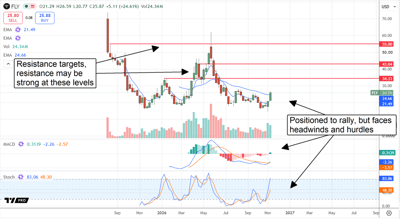
Price action was bullish following the release, with shares rising by more than 10% and suggesting a potential market bottom. Whether this is the absolute bottom remains to be seen. Near-term signals point to upside potential, but technical hurdles remain. Prior highs near $35, along with a congestion band in the $35 to $45 region, may provide enough resistance to cap gains.
There Are Plenty of Risks and Headwinds for Firefly Shareholders
Risks include, but are not limited to, shareholder dilution. Q3 highlights show a well-capitalized company with limited debt and steady equity, but cash is down year to date despite a dilutive capital raise, and the cash burn continues. Cash could keep dwindling, increasing dilution risk until the company reaches profitability. Based on Q3 figures, additional financing remains a risk before that transition. News of capital-raising activity could create selling pressure.
Other risks center on concentration and execution. Firefly Aerospace’s outlook is rapidly improving, but its existing revenue and backlog are tied to a few government entities, while the new AST SpaceMobile agreement introduces additional execution risks. Government contracts are exposed to budget shifts and changes in administration, while ASTS is an equally speculative bet on space-based 5G services with no guarantee of success. The Alpha launch system has experienced several setbacks and delays, with the next launch not slated until early 2027. Governance is also a risk, with a large shareholder retaining significant influence over the company.
In short, bulls may be underestimating the time it will take Firefly to scale. Project delays, costs and widening adjusted losses weigh on the outlook and make the existing timeline uncertain at best. Bears may be wrong to treat Firefly as a pure launch company, since its primary revenue source and growth drivers are spacecraft solutions, including vehicles and defense software. While launch matters, the five concurrent lunar missions and the vehicles they require are the bigger story. In addition, acquiring SciTec gives Firefly a foothold in the defense software industry.
Alphabet Escalates AI Chip Rivalry With NVIDIA
Authored by Ryan Hasson. Date Posted: 11/11/2026.

Key Points
- Alphabet unveiled two new specialized TPU systems, the TPU 8tx and TPU 8i Max, challenging NVIDIA while shares remain well below their 52-week high.
- The launch bolsters Alphabet's case that heavy capital spending is building a vertically integrated AI hardware business rather than simply adding costs.
- Despite the TPU news, the announcement does little to resolve concerns about slowing Search query monetization, which remains the central worry for investors.
- Special Report: Ron Paul: "Sorry Socialists, more handouts won't fix this" (From Stansberry Research)
Alphabet (NASDAQ: GOOGL) has had a difficult few weeks. As MarketBeat reported, shares slid 12.6% in the Oct. 29 session after the company’s third-quarter report, as slowing Search growth and rising capital spending overshadowed an otherwise strong quarter.
The Nov. 5 sell-off in AI and chip stocks added to the pressure.
This is likely to EXPLODE (Ad)
Dr. Martin D. Weiss, founder of Weiss Ratings and a two-time Congressional witness on financial institution risk, is warning of a looming $3 trillion threat in today's financial system.
He says the same ratings agency practices that preceded the 2008 crisis are repeating themselves, while regulators stay quiet about the risks.
Watch Dr Weiss's free video to learn how to protect your moneyThen, on Monday, Nov. 9, Alphabet gave investors something different to consider when it unveiled two specialized Tensor Processing Unit (TPU) systems, the TPU 8tx and TPU 8i Max, further challenging NVIDIA (NASDAQ: NVDA). Shares closed slightly higher after the announcement, though the stock remains about 30% below its 52-week high of $408.61.
The launch strengthens Alphabet’s position as one of the few AI spenders that can also sell its own hardware. Whether that’s enough to offset lingering concerns about Search and spending is a more complicated question.
Two Chips Built for Very Specific Jobs
The two systems join the TPU 8t and TPU 8i that Alphabet’s Google introduced in April, making 2026 the first year the company has rolled out four TPU systems. Both are specialized configurations built around existing eighth-generation chips and are expected to become available next year.
The TPU 8tx is aimed at confidential computing. Paired with an Advanced Micro Devices (NASDAQ: AMD) EPYC processor, it is designed for government agencies and companies in regulated industries such as finance and healthcare.
The TPU 8i Max combines two TPU 8i chips in a single package, doubling compute capacity and memory bandwidth. It is built for long-context AI applications that need to process far more information per request.
Google cited drug discovery, math and coding as key use cases, adding, “Our aim is to make TPUs more easily accessible to every developer and Cloud customer.”
A Stronger Answer to the Spending Question Than the Search One
The launch arguably does more to ease spending concerns than worries about Search. Alphabet’s capital expenditures reached $51.4 billion in the third quarter, exceeding the $42.3 billion in operating cash flow it generated over the same period.
TPUs change the conversation because Google can deploy its proprietary hardware in its own cloud infrastructure or sell complete systems to customers, rather than relying solely on outside suppliers.
Google Cloud brought in $30.7 billion in revenue in the third quarter, roughly double the $15.2 billion it generated a year earlier, with demand for TPU systems a key contributor. Google has also said it builds TPU-system inventory only after securing customer contracts.
The announcement does little to address Search, however. The central question hanging over Alphabet’s legacy business is the gap between query growth, which is at a five-year high, and the slower ad monetization of AI Mode.
Sizing the Opportunity Against NVIDIA
NVIDIA still operates on a far larger scale, generating $89 billion in data center revenue in its fiscal 2027 second quarter alone.
Alphabet does not disclose separate TPU revenue or profit figures, making a direct comparison difficult. Still, Google’s ability to design and sell complete AI systems gives it another way to generate revenue from its infrastructure investments.
From AI Labs to Trading Firms
Alphabet said on its third-quarter call that it now has more than 100 significant TPU customers. Anthropic stands out, with arrangements to obtain additional TPU compute from Google or third-party providers. According to a regulatory filing, these arrangements could involve $125 billion to $150 billion in future payments for capacity delivered from 2028 through 2031.
Apple (NASDAQ: AAPL) and Jump Trading are also customers, while Meta Platforms (NASDAQ: META) has collaborated with Google on software that supports TPUs. Oracle (NYSE: ORCL) plans to offer TPUs through Oracle Cloud Infrastructure in 2027, marking the first time the chips will be available on another major cloud platform. Potential new buyers include the government agencies, banks and healthcare providers the 8tx is designed for.
Enough to Quiet the Doubters?
The new systems alone are unlikely to settle those fears entirely.
However, they give bulls a stronger case that Alphabet’s heavy spending is building a vertically integrated AI business rather than simply adding costs.
Skeptics might point out that NVIDIA is still far larger, that OpenAI and Anthropic are both developing their own chips, and that the Search monetization gap remains unresolved.
The coming months should offer clearer answers. Management has said it expects TPU system sales to scale in the fourth quarter, ahead of a meaningful revenue ramp in 2027, when Oracle’s TPU offering is also expected to become available.
If TPU system sales continue to grow while Search monetization improves, the case that shares have been unfairly punished will become considerably stronger.
If you have questions about your subscription, please email MarketBeat's support team, based in the United States, at contact@marketbeat.com.
If you no longer wish to receive email from The Early Bird, you can unsubscribe.
© 2006-2026 MarketBeat Media, LLC. All rights protected.
345 N Reid Place #620, Sioux Falls, SD 57103-7078. United States..





No comments:
Post a Comment