| Unsubscribe |
Something strange is happening to your money.
It wasn't voted on. It wasn't debated in the Senate. And most Americans have no idea it's even taking place but…
President Trump is replacing the U.S. dollar.
Not with crypto. Not with a digital currency. Something far bigger than that – and it's already been signed and sealed in the back rooms of D.C., ready to be issued by the U.S. Treasury.
Bypassing every legal and political channel under the guise of "national security," Trump has enacted this total money reset using a landmark executive order (1421).
Whether you’re a Democrat or Republican, whether you support this new money or not, it doesn't matter.
Soon, every U.S. citizen will be forced to use Trump's New Dollar to fill their gas tank, buy groceries, and pay medical bills.
Which is why I've produced a critical new documentary laying out exactly what Trump's New Dollar means for your savings, your investments, and your family's financial future.
Detailing three important steps you can take today to prepare – including the name of a core band of assets connected to Trump’s initiative that could surge as a result.
As you’ll see in my briefing, the last time America reset its money like this – under Richard Nixon’s presidency in the 1970s – it created one of the greatest wealth divides in the history of our nation.
On one side, it minted an average of 1,300 new millionaires a day for over half a century. And on the other… the folks left behind, drowning in debt, with no idea how to use America’s new money to create wealth.
As Trump rolls out his new dollar, the question is:

Good investing,
Porter Stansberry
PS. If you’re wondering what Trump’s new money will look like, when it will be issued, what it means for your investments and why it could be front page news on December 14 – all of those questions are answered in my briefing.
Are RTX Corporation and Northrop Grumman Ready to Break Out?
By Thomas Hughes. First Published: 10/22/2026.

Key Points
- RTX and Northrop Grumman reported record Q3 backlogs and raised earnings guidance, signaling strong long-term revenue visibility despite margin pressures.
- Both companies generated robust free cash flow exceeding $3 billion combined, supporting safe dividend yields and improving balance sheet strength.
- Analysts see high-teens upside for both stocks, with Northrop poised for a stronger recovery after a sharper pullback than RTX.
- Special Report: Why This Clean Energy Well Escaped the Solar and Wind Cuts.
Defense stocks RTX (NYSE: RTX) and Northrop Grumman (NYSE: NOC) are facing headwinds, including margin pressures and government scrutiny of their operations. While share buybacks are largely paused amid this scrutiny and the risk of lost contracts, these concerns may already be priced in, shifting attention to the companies' fundamental growth drivers. These include the need to replenish depleted stockpiles, ongoing conflicts and modernization, and increased government spending—all of which point to multiyear cycles for leading defense original equipment manufacturers (OEMs).
Q3 reports across the defense sector revealed record backlogs. RTX, the larger and more diversified of the two companies, reported a $340 billion backlog, underpinned by a recently awarded Tomahawk missile contract. Northrop’s 1.5x book-to-bill ratio also reflects strong order volume. The takeaway for investors is that these companies have clear visibility into long-term revenue growth and earnings quality, along with the potential to resume or accelerate buybacks next year.
Defense Stocks Outperform in Q3, Raise Guidance, Strengthen Balance Sheets
Every satellite pays this company... (Ad)
Elon filed to put 1,000,000 AI satellites into orbit, a project SpaceX values at $28.5 trillion. Not even Bezos has attempted anything on this scale.
But Elon does not own the chip inside those satellites. He licenses it from one little-known company that could collect a royalty on every satellite launched.
The ticker is detailed in a single government filing, and the window to see it closes December 8th.
See the ticker behind Elon's satellite plan before December 8thDefense stocks had a decent Q3, with revenue growth in the high-single-digit to low-double-digit range. RTX grew by 11.1%, outpacing its smaller rival by more than 400 basis points, but both companies showed strengths. Broad-based demand drove growth across commercial and defense applications, with the only weakness being tepid growth in Northrop’s space and missile businesses.
Margins were another strength. Both companies reported strong bottom-line results, outperforming estimates through core improvements and revenue leverage.
More importantly, free cash flow looks robust, totaling more than $3 billion between the two companies. That’s enough to sustain dividend payments while improving balance-sheet health. Dividends are the primary form of shareholder return, yielding 1.5% for RTX and 1.8% for Northrop Grumman, and are arguably safe at less than 50% of the earnings outlook.
The earnings outlook is a catalyst for this pair. Both companies raised guidance, lifting their earnings outlooks above consensus estimates. Business momentum is strong and expected to continue for the foreseeable future, underpinning a healthy cash-flow outlook despite market misgivings.
These companies can sustain their outperformance in this environment, setting the stage for a persistently bullish revision cycle among analysts.
Analysts Praise Defense Stocks, Reaffirm Upside Potential
Analyst sentiment contributed to price corrections for RTX and Northrop in early fall, as price targets softened over the summer. However, those corrections were a market overreaction, leaving the stocks at discounted levels in late October.
The market’s response to the companies’ Q3 results reveals renewed confidence in their long-term growth and profit trajectories, as well as their capital returns. Both RTX and NOC currently have high-teens upside to consensus, but offer different opportunities for investors.
While RTX’s correction was more of a pause within an uptrend, leaving it positioned to hit fresh highs, NOC’s correction is more of a recovery story, with potential for far more upside. The stock significantly underperformed its peers during the defense-stock pullback due to company-specific factors. However, Northrop's earnings report made concerns such as lost contracts less relevant by revealing strength in orders and backlog. Its stock looks poised to stage a full recovery.
Balance-sheet highlights reflect the strength of these companies' positions: cash holdings are strong, assets are growing, debt is falling, and equity is rising. One difference is that Northrop grew equity by 10%, nearly double RTX's pace, while its share count is declining. Down significantly from the prior year, Northrop Grumman’s buybacks were still enough to reduce its share count while improving equity, providing a dual lever for a share-price rebound.
NOC’s share price advanced 5% following the release, confirming support near $515. The move marks the second of two bottoms, possibly forming a double-bottom reversal pattern, with the potential to reach $595 before year’s end. Other factors supporting a rebound include MACD and stochastic divergences, along with emerging buy signals that point to a strong bottom. The risk is that the market enters a range and remains trapped until more news becomes available, but this seems unlikely given current trends.
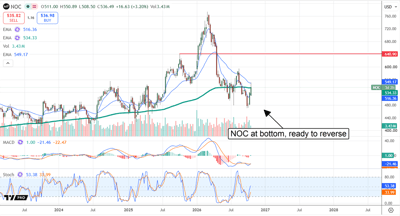
Northrop Grumman’s biggest risk is its exposure to fixed-price contracts, such as the B-21 Stealth Bomber. Cost overruns could squeeze margins and weigh on future share-price performance. RTX’s more diversified business is less exposed to this problem, with its biggest risks tied to its commercial business. Cyclicality and lawsuits cloud the outlook.
Amex Stock Slides on Job Cuts, But the Real Story Is Macro
By Chris Markoch. First Published: 10/24/2026.

Key Points
- American Express shares fell despite record third-quarter revenue of $20.1 billion and diluted earnings per share rising 31% to $5.42.
- Management raised full-year 2026 EPS guidance, and credit quality improved, with the net write-off rate falling to 1.8% from 1.9% a year ago.
- The sell-off appears driven by macroeconomic concerns and soft commercial billings growth rather than weakness in premium consumer spending or company fundamentals.
- Special Report: Why This Clean Energy Well Escaped the Solar and Wind Cuts.
American Express Co. (NYSE: AXP) reported third-quarter 2026 earnings before the opening bell on Oct. 23. The results were solid, yet when the market opened, AXP was the worst-performing stock in the Dow Jones Industrial Average (DJIA).
Investors who follow American Express have seen this movie before. The company delivers strong quarterly results, and the stock sells off anyway. The only questions are how long the selling will last and whether it should scare away long-term investors.
A free stock pick, from me to you (Ad)
Elon's paid this chip supplier since 2012. When NVIDIA tried to buy the company, he fought the deal.
Without its chip, his AI satellites don't fly. Now he wants 1,000,000 of them in orbit, 100 times what's up there today, and every one pays this company a royalty.
Dylan believes shares could react by December 8th.
Claim this free stock pick before the December 8 deadline todayThe company’s announcement of a 5% workforce reduction may help explain the selling this time. Job cuts rarely make for a feel-good headline.
However, the restructuring charge was offset by a one-time gain from selling the company’s stake in Global Business Travel Group (NYSE: GBTG).
In other words, management used a windfall to make the business leaner. The company said it intends to use the savings to return value to shareholders.
A more likely driver of the pullback is the macroeconomic picture. That matters because of what American Express represents: its customer base skews toward upper-income consumers and business customers, who account for the majority of spending in today’s economy. That’s particularly true in travel and entertainment (T&E).
Record Revenue Shows the Premium Consumer Is Still Spending
To oversimplify it, as these consumers go, so goes the economy. Investors treat Amex as a real-time read on that consumer, so any hint of fatigue gets priced in quickly. For now, however, the AXP earnings report suggests spending is stable.
American Express posted record third-quarter revenue of $20.1 billion, up 9% year-over-year. Diluted earnings per share (EPS) rose 31% to $5.42. Excluding the GBTG gain and restructuring charge, adjusted EPS was $4.68—still up 13% from $4.14 a year ago.
Total billed business grew 8% to $454 billion. Travel and entertainment spending led the way, rising 10% on a foreign exchange-adjusted basis. Airline billings jumped 13%. Within U.S. Consumer Services, T&E spending climbed 11%. That’s the premium consumer in action: These customers aren’t pulling back on discretionary spending yet.
Card fees tell a similar story. Net card fees rose 16% to nearly $3 billion, reflecting the refreshed U.S. Platinum Card and growth in premium card portfolios. Customers are paying higher annual fees and sticking around. About 76% of new accounts came on fee-paying products.
The pipeline looks healthy, too. Spending by Gen Z customers in U.S. Consumer Services jumped 35%. Millennial and Gen Z customers accounted for 65% of new global consumer accounts.
Raised Guidance Signals Confidence
Management raised its full-year 2026 EPS guidance to a range of $18.30 to $18.60 on a GAAP basis. On an adjusted basis, the range is $17.60 to $17.90, up from the prior range of $17.30 to $17.90. The company also reaffirmed its outlook for 10% revenue growth.
CEO Stephen Squeri pointed to strength in billings, new acquisitions, Card Member retention and credit quality. Management teams rarely raise guidance with one quarter left if they see storm clouds forming.
Credit Quality Is the Key Detail
Perhaps the most important number in the report is the net write-off rate. It fell to 1.8% from 1.9% a year ago and 2.0% last quarter. Card balances 30 or more days past due held steady at 1.2%.
Consolidated provisions for credit losses also fell to $985 million from $1.29 billion a year ago. Part of that decline came from a $215 million reserve release tied to a model update. Still, the underlying write-off trend is moving in the right direction.
This matters for the macro debate. If upper-income consumers were feeling stress, it would show up in delinquencies first. So far, it hasn’t.
Why Investors Are Selling on Good News
So why the selling? The commercial segment offers one clue. Commercial Services billings grew just 3%, held back by exits from the Lowe’s (NYSE: LOW) and Amazon (NASDAQ: AMZN) small business co-branded portfolios. Excluding those exits, growth was 5%. Small business spending on goods and services was soft, rising only 2%.
Investors may also be looking past the quarter. When the market worries about growth, it sells the bellwether first and asks questions later. That behavioral reaction is something long-term investors can use to their advantage.
Valuation Leaves Room for Upside
AXP stock isn’t expensive at around 19x earnings. That’s a reasonable multiple for a company with a 38% return on equity through the first nine months of 2026. Shares are also trading about 15% below their consensus price target.
The chart shows the stock bouncing off support near $300 in recent weeks. However, shares remain below their 50-week moving average near $334. A move back above that level would suggest the market is coming around.
The company is also returning capital. Amex repurchased $1.6 billion in stock and paid $600 million in dividends during the quarter. Its share count has fallen to 671 million from 689 million a year ago.
The early sell-off says more about macro anxiety than about American Express. Record revenue, raised guidance and improving credit point to a premium consumer still in good shape. As long as that holds, pullbacks like this one may look like opportunities in hindsight.
This message is a paid advertisement for Porter & Company, a third-party advertiser of MarketBeat. Why did I get this email content?.
If you need help with your newsletter, feel free to email our support team, based in the United States, at contact@marketbeat.com.
If you would no longer like to receive promotional emails from MarketBeat advertisers, you can unsubscribe or manage your mailing preferences here.
© 2006-2026 MarketBeat Media, LLC.
345 N Reid Pl., Sixth Floor, Sioux Falls, South Dakota 57103. United States..




No comments:
Post a Comment