| Unsubscribe |
Here's the math on my Black Friday deal.
$7. One payment. A full year of the Instant Scanner.
There are roughly 250 trading nights in a year.
That's 2.8 cents a night to have nearly a thousand of America's biggest stocks checked for you — with exact buy prices on whatever qualifies.
At the regular $247, it works out to about a dollar a night.
At $7, the money isn't the question anymore. It's just whether you get around to it.
Good Trading,
Bill Poulos
P.S. One payment, no re-bills, nothing to install. Here's the link.
A 10-Stock Strategy That Balances AI Growth With Cash Flow
Submitted by Thomas Hughes. Article Published: 11/13/2026.

Key Points
- The AI trade is shifting from speculation to execution, favoring companies like NVIDIA, AMD, Micron, and Oracle that generate real demand, backlogs, and cash flow.
- A proposed portfolio pairs core AI infrastructure and connectivity names, including Credo, Astera Labs, and Cerebras, with stable cash-generating staples like Kroger, PepsiCo, and Casey's.
- The strategy targets a high double-digit compound annual growth rate by combining AI-driven capital gains with steady dividends, buybacks, and compounding cash flow.
- Special Report: Pentagon magnet restrictions take effect January 1, 2027 (From OilPrice)
The AI trade is still alive and well, but it’s shifting from speculation to execution—a phase in which investors may find the biggest gains. This portfolio aims to capture those gains by focusing on companies critical to AI’s success while balancing them with a trio of powerhouse cash-flow machines. The goal is a high double-digit compound annual growth rate, underpinned by capital gains, cash flow and the power of compounding.
AI speculation drove sharp price increases as the market poured money into any stock with AI in its name or business plan. The execution phase marks a shift in focus from speculative what-ifs to companies producing results. It may not deliver the same sharp increases, but it could generate larger gains over time through growth and valuation. Some of these stocks may offer substantial upside based on long-term earnings forecasts, although those projections remain uncertain.
The investigation Porter spent tens of thousands to document (Ad)
Porter Stansberry flew the Porter and Co. team 3,300 miles to Dublin to investigate a 17-year investing experiment called Project Prophet - and documented everything on film.
Rooted in the laws of physics, this quantitative approach challenges conventional wealth-building wisdom. With 17 years of verified data behind it, Porter calls it unlike anything he has seen in nearly 30 years in the business.
Watch the full investigation and decide for yourselfSigns of AI success include demand for products, rising capacity, swelling backlogs and—critically—cash flow. While many AI stocks were punished in Q3 and early Q4, those generating cash flow may be better positioned to recover and sustain upward momentum. When the next major market peak arrives is anybody’s guess, as the AI build-out could continue for years.
NVIDIA: The Source of AI as We Know It
Jensen Huang’s indiscretion and the potential spy controversy aren’t good news for NVIDIA (NASDAQ: NVDA) shareholders, but they don’t change the company’s leading position in AI or Huang’s role in shaping it. He is the architect of critical hardware and software, including the CUDA developer platform for parallel computing. CUDA helps GPUs perform complex computing tasks beyond graphics, including the workloads that power modern AI. NVIDIA can continue without him, with its established GPU roadmap providing continuity as the company searches for a permanent CEO.
NVIDIA is central to the portfolio today because of its GPUs and the adjacent technologies that harness their power. It is also central to the long-term outlook because of the circular investment cycle Huang developed: GPU demand drives NVIDIA cash flow; NVIDIA’s cash flow helps advance AI technology; and advances in AI technology drive demand for NVIDIA GPUs. Long-term earnings growth could support further gains, although forecasts that far into the future carry substantial uncertainty.
Advanced Micro Devices: Inference and the Edge
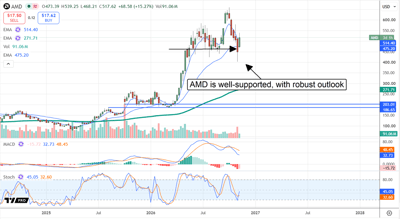
Advanced Micro Devices (NASDAQ: AMD) is central to the portfolio because of its MI450 line and Helios rack architecture. These offerings position AMD as a major competitor to NVIDIA in large-scale AI GPU clusters.
More importantly, AMD’s clusters could compete on efficiency and cost in inference, both key factors in hyperscale success. AMD is also a key player in the CPU market, which is important to inference as well. Demand for CPUs alongside GPUs could grow as inference gains traction, and inference could become a much larger market than model training.
AMD’s long-term growth outlook depends heavily on Helios adoption, and analysts’ earnings estimates could continue to change as deployments scale.
Micron Technology: AI and Inference Are All About Memory
Micron (NASDAQ: MU) is central to the portfolio because of its high-bandwidth memory (HBM). Strong demand and constrained supply have supported elevated HBM prices, and those conditions aren’t expected to ease soon. Supply constraints could persist through 2028 or beyond.
Recent reports suggest demand will remain strong through 2030, setting the stage for the memory upcycle to last for many years. Even when prices fall, demand could remain high, enabling Micron to generate ample cash flow and fund capital returns.
Dividends are a token amount, while buybacks are a catalyst that could accelerate in 2026 and continue over time. MU’s forward earnings estimates may understate the duration of the memory upcycle, setting the stage for a persistently bullish analyst revision cycle.
Oracle: AI Infrastructure Player, Not Just a Database Company
Oracle (NYSE: ORCL) is among the biggest AI winners, driving a systemic shift from a software services company to a hyperscale AI enabler. Leading AI labs and hyperscale enterprises book Oracle’s cloud instances for advanced computing workloads and incorporate its legacy products into their operations.
Oracle competes with megatech companies while also selling them services and capacity, creating a symbiotic relationship that drives revenue for both sides. The opportunity today is the low price: the market has punished Oracle’s shares for its debt and heavy AI infrastructure spending, even as its earnings outlook anticipates a return to positive free cash flow later in the investment cycle.
Credo Technologies and Astera Labs: 2 Sides of the Connectivity Coin
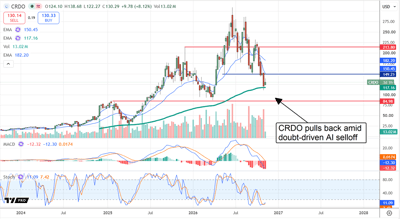
Credo Technologies (NASDAQ: CRDO) and Astera Labs (NASDAQ: ALAB) operate in the connectivity layer, providing services at different points in the AI chain. For investors, the key is that their next-generation technologies are gaining adoption and could benefit from multiyear, potentially multigenerational product cycles.
This doesn’t mean a single win, but rather the potential for repeat business as new systems are deployed. In this scenario, both companies are positioned to serve the AI industry at large and sustain high levels of business, if not growth, for years to come.
Long-term earnings forecasts suggest substantial upside potential, although those gains depend on continued growth and execution.
Cerebras: Inference Engine Pureplay
Cerebras (NASDAQ: CBRS) is critical to AI and this portfolio because of its inference technology. Its large, dinner-plate-sized semiconductors reduce dependence on HBM by using substantial on-chip memory.
Their size allows them to keep more model data on-chip. They also add utility by reducing connectivity bottlenecks, speeding time to token and lowering overall costs.
Cerebras is approaching breakeven on a core operating basis, although its longer-term transition to sustained profitability remains uncertain. Future earnings growth could offer upside over time.
Kroger: Dividends and Buybacks, Aisle 9!
Kroger (NYSE: KR) is central to this portfolio because of its blue-chip position in consumer staples.
As the leading independent grocery chain, Kroger’s business is supported by daily essentials that drive consistent cash flow.
Growth isn’t substantial, but it is present, underpinning a dividend distribution increase cycle that drives shareholder value.
Kroger has increased its payout for 20 consecutive years and continues to move closer to Dividend Champion status.
PepsiCo: Cyclical Recovery Drives Value
PepsiCo (NASDAQ: PEP) is key to this portfolio because of its healthy balance sheet, consistent cash flow and capital returns.
It’s also well positioned for a cyclical recovery as it addresses company-specific issues and adapts to consumer demands, including a preference for higher-protein snacks.
Valuation is also a factor: PepsiCo trades at a relatively low valuation compared with recent years, offering value relative to peers like The Coca-Cola Company (NYSE: KO) and a higher-than-average yield of about 4.1% as of mid-Q4.
Casey’s General Stores: Self-Funding the Future
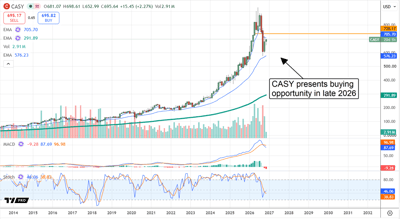
Casey’s General Stores (NASDAQ: CASY) merits a spot in this portfolio because of its healthy balance sheet, capacity to self-fund growth, cash flow and capital returns.
Capital returns include dividends and share buybacks, with buybacks helping reduce the share count when cash flow isn’t focused on acquisitions.
Acquisitions such as Fikes in 2024 expand the company’s footprint while creating cost-saving opportunities and a platform for further expansion.
Looking ahead, continued consolidation in the convenience store and gas station industry could create additional opportunities for acquisitions and capital returns.
Beaming Up the Backlog: AeroVironment Lands $405M Laser Deal
Submitted by Jeffrey Neal Johnson. Article Published: 11/16/2026.

Key Points
- AeroVironment secured a $405 million Middle East export order for its LOCUST X3 laser system, pushing its total backlog past $4 billion.
- Despite strong contract momentum, AeroVironment shares have fallen about 50% year-to-date following Space Force contract pauses and domestic budget delays.
- The company expects negative free cash flow this fiscal year due to heavy capital spending, even as institutional investors like ARK Invest add to positions.
- Special Report: Do You Own Any of These 10 Stocks? See This Warning Before Dec. 10 (From Altimetry)
Defense technology is shifting away from reliance on legacy heavy armor and toward software-integrated, asymmetric solutions. Investors evaluating the defense sector often look for clear signs that research and development investments are translating into commercial scale. For AeroVironment, Inc. (NASDAQ: AVAV), that signal recently arrived in the form of a $405 million Middle East order for its LOCUST X3 high-energy laser system.
This nine-figure commercial export agreement highlights a shift in global defense procurement toward directed-energy weapons. Securing a direct commercial sale of this magnitude moves AeroVironment beyond its traditional uncrewed aerial vehicle roots and into scaled production of laser defense networks. With shares down about 50% year to date following earlier space-contract setbacks and domestic budget delays, newly secured domestic and export contracts give investors a fresh reason to evaluate the stock.
Scaling the Laser Defense Market
AI needs electricity. Look what Microsoft did. (Ad)
Microsoft just made a 20-year bet on a power source many AI investors barely discuss. In June, Chevron announced an agreement to supply electricity to a Microsoft data center in West Texas.
The proposed natural gas project is expected to reach approximately 2.67 gigawatts of capacity, with a final investment decision expected by the end of 2026.
Karim Rahemtulla sees one American energy producer worth a closer look, one that has also extended a multi-year, multimillion-dollar agreement with Palantir.
Watch Karim Rahemtulla's briefing on his Ultimate Stock Unicorn and the AI power trend.AeroVironment recently secured a $405 million international order from an undisclosed Middle Eastern ally for its LOCUST X3 high-energy laser weapon systems. Just two days earlier, AeroVironment booked an initial $315 million funding award under a multiyear indefinite-delivery contract with a U.S. government customer for autonomous systems. Securing more than $700 million in firm awards within a single week adds to AeroVironment's substantial backlog.
Despite this strong revenue visibility, AeroVironment's stock price has hovered around $120, reflecting multiple compression over the past year. The company currently trades at roughly 35 times forward earnings, representing a valuation reset after a protracted pullback.
Much of the recent selling pressure stemmed from the U.S. Space Force's termination of AeroVironment's Satellite Communications Augmentation Resource contract. New export demand for directed energy diversifies the business model and provides a fresh catalyst. It also demonstrates the commercial viability of the intellectual property acquired in the 2025 BlueHalo merger, shifting the narrative from space-contract setbacks to active laser production.
Asymmetric Economics: Cheap Lasers Beat Costly Interceptors
Modern conflicts increasingly demand cost-effective solutions to counter high-volume, low-cost drone swarms. Firing conventional surface-to-air missiles, which can cost hundreds of thousands or even millions of dollars per unit, at one-way attack drones creates an unsustainable financial burden for allied militaries.
The 30-kilowatt LOCUST X3 addresses this cost asymmetry. Designed to target Group One through Group Three uncrewed aircraft systems, the laser costs less than $10 per shot, according to AeroVironment. It is designed to integrate with existing radar and command-and-control software, preserving expensive kinetic missile inventories for higher-tier ballistic or cruise missile threats.
This export agreement complements an approximately $465 million U.S. Army production contract awarded in September 2026 for the Enduring-High Energy Laser program. To support the domestic rollout, AeroVironment selected Leonardo DRS, Inc. (NASDAQ: DRS) to provide power-management and thermal-cooling systems. Together, these contracts indicate that directed energy is moving from the experimental phase to active battlefield deployment.
Sidestepping Gridlock to Protect Profit Margins
The structure of the Middle East contract offers a specific advantage in the current macroeconomic environment. As a direct commercial sale negotiated with the foreign buyer, the agreement bypasses the multistep timelines of the standard U.S. Foreign Military Sales process.
This insulation matters right now. A federal continuing resolution running through mid-December freezes Pentagon spending at previous fiscal levels, stalling new domestic program starts. Post-election budget negotiations risk pushing U.S. military cash disbursements into early next year. Export contracts negotiated directly with allied nations can support production despite congressional appropriation delays.
Scaling production should also support segment margin recovery. AeroVironment's space, cyber, and directed energy segment recently recorded an adjusted EBITDA loss, following lower revenue tied in part to the terminated space contract.
As manufacturing ramps up for these new domestic and international laser orders, fixed-cost absorption across production lines appears poised to improve in the second half of the fiscal year. First-quarter product gross margins already expanded to about 35%, and increased scale could help insulate those gains from broader supply chain pressures.
Software Over Steel: Rebalancing Traditional Defense Holdings
Investors often weigh defense contractors by comparing steady legacy dividend payers with growth-oriented technology providers. Traditional primes like General Dynamics Corp. (NYSE: GD), Lockheed Martin Corp. (NYSE: LMT), and RTX Corp. (NYSE: RTX) offer established dividend yields and steadier GAAP margins. They have less organic growth exposure to small autonomous systems and directed-energy platforms, relying instead on major platform sustainment and heavy manufacturing.
AeroVironment pays no dividend, choosing to allocate capital to internal research and production capacity. With a forward price-to-earnings ratio of about 28, its valuation is below that of its direct unmanned peer, Kratos Defense & Security Solutions, Inc. (NASDAQ: KTOS), which commands a multiple of around 37.
Investors looking to rebalance a portfolio away from reliance on heavy armor could consider software-integrated counter-drone and laser networks for direct exposure to some of the fastest-growing segments in modern defense spending. The valuation reset gives investors a chance to evaluate the stock after a steep pullback, although it still carries a premium over traditional defense primes.
Balancing Backlog Visibility With Cash Flow
While nine-figure contracts provide strong multiyear revenue visibility, investors should balance top-line growth against near-term cash flow realities. Before the November awards, AeroVironment already held an approximately $1.5 billion funded backlog. Converting that backlog into free cash flow requires upfront investment.
AeroVironment management expects free cash flow to remain negative this fiscal year. This reflects a temporary capital expenditure cycle that requires roughly 12% to 14% of revenue to fund manufacturing expansions across Utah, New Mexico, and Alabama, as well as a new Southern California campus. Establishing an in-country maintenance and sustainment depot for the Middle East contract will also require working capital. To support these operational needs, AeroVironment recently expanded its revolving credit facility to $450 million.
Despite the near-term cash constraints, institutional conviction remains steady. Recent trading records indicate accumulation by high-conviction growth managers, including ARK Invest, which added to its position during the recent pullback. Options market data also leans bullish, with calls outnumbering puts in open interest.
Investors evaluating the defense technology sector might consider adding AeroVironment to their watchlist as laser production scales. The transition from experimental research to commercial manufacturing takes time, but the recent influx of commercial orders suggests AeroVironment is securing a foothold in the next generation of air defense.
This email is a sponsored email sent on behalf of Profits Run, a third-party advertiser of MarketBeat. Why did I receive this email?.
If you have questions or concerns about your newsletter, feel free to contact our support team, based in the United States, at contact@marketbeat.com.
If you would no longer like to receive promotional emails from MarketBeat advertisers, you can unsubscribe or manage your mailing preferences here.
© 2006-2026 MarketBeat Media, LLC. All rights protected.
345 North Reid Place #620, Sioux Falls, South Dakota 57103. United States of America..




No comments:
Post a Comment