| Unsubscribe |
Investigating Project Prophet is now live.

Over the last several days I've shared why I felt compelled to fly the Porter & Co. team halfway around the world to get to the bottom of a 17-year-long investing experiment.
We documented everything. And I mean everything.
From leaving my apartment in New York to landing in Dublin and sitting down in the Irish Stock Exchange – where some of the world’s first stocks were traded – to grilling the team behind Project Prophet.
Now I want you to see the full story.
And listen, I’ve been in this business for nearly 30 years. I’ve seen every so-called algorithm and "black box" on offer… and I’ve laughed at 99% of them. So, let’s just say, I went to Ireland as a skeptic, looking for the catch.
But what we uncovered in Dublin is unlike anything I’ve ever seen.
It’s a quantitative approach rooted in the laws of physics that appears to shatter every preconceived notion about building wealth that you’ve likely ever had or heard parroted on CNBC.
I won’t tell you what to think about it. That’s not my job. My job was to investigate, to ask the hard questions, and to film the receipts so you could make up your own mind.
If this is real – and the 17 years of verified data we saw suggest it is – it could potentially be the kind of unfair advantage that has always been reserved for the world’s most sophisticated institutional players.
Something that could potentially help you build the type of wealth that doesn’t just transform your retirement; it has the potential to alter your family’s financial trajectory for generations.
As I’ve said, there’s a reason I spent tens of thousands of dollars and flew my team 3,300 miles to document this, because I knew that if this system was actually what it claimed to be… I had to be the one to show it to you first.
I’ll let the footage speak for itself.
Good investing,
Porter Stansberry

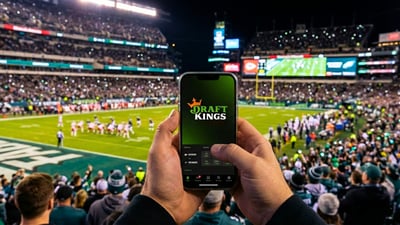
DraftKings Just Lost 20%—And Its Biggest Gamble Is Still Ahead
Author: Dan Schmidt. Published: 11/10/2026.
Key Points
- DraftKings shares fell 20% after weak 2027 EBITDA guidance showed increased Predictions spending would delay profitability payoff until 2028.
- A looming Supreme Court ruling on prediction market regulation, expected around mid-2028, poses a major risk to DraftKings' costly Predictions investment.
- Several analysts cut price targets and JPMorgan Chase downgraded DraftKings to Neutral, while technical charts show persistent resistance at the 200-day moving average.
- Special Report: Today's stock pick is on me (From Behind the Markets)
The sports betting industry has had a rough year.
Prediction markets like Kalshi and Polymarket have been slowly attracting customers, and differences in their regulatory and tax treatment may give them an advantage. In addition, consumers are putting off travel and leisure spending because of high gas prices, leaving casinos feeling the sting of lost revenue.
Today's stock pick is on me (Ad)
Elon can't build his satellite network without one key supplier, and he's paid this company since 2012.
His plan for 1,000,000 satellites could multiply that bill significantly, putting this overlooked stock back in focus.
Dylan has circled December 8th as a key date for this pick.
Claim today's free stock pick before December 8thThe bad news kept coming last week when DraftKings Inc. (NASDAQ: DKNG) reported Q3 earnings and immediately lost 20% of its value.
While the headline numbers weren’t alarming, the market is increasingly skeptical that the company’s massive Predictions bet will pay off, and a Supreme Court decision is looming over the entire sector.
Sell-off Triggered by 2027 Guidance, Not Q3 2026 Results
DraftKings reported its Q3 2026 results after the closing bell on Nov. 5. At first glance, the numbers didn’t seem to warrant such a sharp sell-off.
Revenue came in just below expectations at $1.33 billion, but still grew 16.2% year over year (YOY). Monthly Unique Payers (MUPs) grew 13% YOY to 4.1 million, ahead of consensus, while net Sportsbook revenue grew 36% on 12% handle growth.
The earnings per share (EPS) miss was more significant. The company lost 53 cents per share, more than the anticipated 41-cent-per-share loss. Much of the loss reflects DraftKings ramping up its own prediction market to counter the threat from Kalshi and Polymarket. The Predictions buildout requires investment, and management expects the platform to reduce 2026 adjusted EBITDA by $650 million to $700 million.
Additionally, average revenue per MUP grew just 3% to $109, primarily reflecting an improvement in sportsbook net revenue margin. Meanwhile, increased promotional spending in iGaming is putting pressure on near-term profitability.
Full-year 2026 revenue guidance was reduced to $6.35 billion to $6.55 billion, and adjusted EBITDA guidance was lowered to $175 million to $275 million, following increased investment in Predictions.
But the 2027 guidance truly surprised analysts. Fiscal 2027 revenue guidance came in slightly below consensus, while the adjusted EBITDA range of $800 million to $1 billion was 20% below expectations due to increased Predictions spending.
Analysts had been lowering their 2026 expectations in anticipation of increased Predictions spending, but 2027 estimates had largely been untouched. Now that the company plans to make another $250 million to $350 million in Predictions investments in 2027, the payoff narrative has changed, and the stock was punished as a result.
DraftKings' Predictions Bet Faces a Regulatory Test
The market now views the Predictions bet as much riskier than it did in previous quarters.
Predictions investments could reduce EBITDA by more than $1 billion through the end of 2027, with promotions and bonuses weighing on results in 2026. Growth in the core sports betting business is also slowing, and management expects only single-digit growth in the segments in 2027.
Now that the profitability payoff has likely been pushed out to 2028, the company’s additional spending is under the microscope. The company must not only meet its efficiency targets but also avoid an unfavorable Supreme Court ruling just as the Predictions segment is expected to start paying off.
Prediction markets are far from settled law in the U.S. Current legislation places prediction market event contracts under the Commodity Futures Trading Commission (CFTC), but stakeholders such as state gambling commissions, Native American tribes and the NFL are challenging that framework. An appeals court ruled in September that Ohio and Tennessee gambling laws could apply to prediction markets, and the Supreme Court will likely make the final call on who regulates these platforms.
DraftKings CEO Jason Robins expects a Supreme Court ruling sometime in mid-2028, giving the company time to recoup its investment if sports contracts are completely banned. A favorable ruling is the ideal outcome, but timing is DraftKings’ biggest risk. If the ruling comes earlier than anticipated (such as in 2027) and proves unfavorable, DraftKings could lose access to a major part of its Predictions market before fully recovering its investment, adding pressure to an already slowing core revenue growth outlook.
DraftKings Stock Faces Stubborn Technical Resistance
DraftKings stock analysts were out in force the Monday after the report, issuing seven price target reductions and a downgrade from Overweight to Neutral from JPMorgan Chase.
While the stock carries an analyst consensus Moderate Buy rating and the average price target of $28.71 still represents upside of more than 50%, the average target among the seven analysts who cut their estimates is just $24.29.
Analysts cutting price targets after a steep earnings-related decline is never a good sign, and the technicals show a stock firmly controlled by sellers.
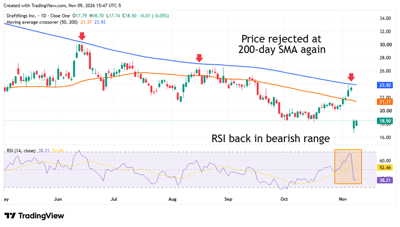
DKNG shares staged a brief rally ahead of the earnings release, but the price was rejected at the 200-day moving average for the third time since June. This stubborn resistance level hasn’t been broken since late 2025, and the Relative Strength Index (RSI) has now fallen out of bullish territory without triggering an overbought signal.
Both the fundamental and technical signals point to the same predicament: DraftKings went all-in on prediction markets and will need the courts to deliver a winning hand.
Game On: The Hidden Value in Take-Two's Stock
Author: Jeffrey Neal Johnson. Published: 11/13/2026.

Key Points
- Take-Two shares rose about 11% despite a GAAP loss, as investors focused on the confirmed Nov. 19 launch of Grand Theft Auto VI.
- Heavy capitalized development costs have depressed recent cash flow and GAAP earnings, but management projects over $1.17 billion in second-half operating cash inflow.
- Analysts hold a Moderate Buy rating with a roughly $287 price target, citing scarcity value, institutional backing, and strong pre-order demand ahead of launch.
- Special Report: The Untold Story Behind Nvidia's CEO Bombshell (From The Oxford Club)
Take-Two Interactive Software, Inc. (NASDAQ: TTWO) recently reported a fiscal 2027 second-quarter GAAP loss of 29 cents per share, missing profitability expectations. Non-GAAP earnings per share (EPS) came in at 99 cents, narrowly exceeding the analyst consensus estimate of 96 cents. Yet instead of selling off, shares climbed about 11% over the next two trading sessions, bucking broader inflation-driven market weakness.
This price action highlights a classic divergence between backward-looking accounting and forward-looking cash generation. Management confirmed the highly anticipated Nov. 19 launch of Grand Theft Auto VI (GTA VI), with pre-orders running well ahead of internal targets.
The Hidden Danger Behind the AI Stock Rebound (Ad)
AI stocks are rebounding, but investing legend Alexander Green warns that some popular names may never recover their former highs. He points to Lucent Technologies, which plunged more than 90% after the dot-com bubble burst, and Nortel Networks, whose shares became virtually worthless.
New research involving Harvard and the Federal Reserve points to a historic turning point in AI adoption. Alex calls it "The Great AI Sorting" and has identified three household-name AI stocks he says investors should dump before the next wave of selling hits.
Watch Alexander Green's free presentation to see which three AI stocks he says to sell.Years of heavy engineering and marketing outlays have built approximately $2.58 billion in capitalized software assets on the balance sheet. While this capitalization temporarily depresses pre-launch cash flow and compresses near-term GAAP margins, it masks an imminent second-half operating cash swing of more than $1.17 billion.
For investors, this setup offers a clear view of how institutional capital prices digital entertainment assets during the final stages of a major development cycle. Moving from development to commercialization changes a publisher's financial profile entirely.
Reaffirmed Launch Timeline Clears Pre-Release Overhang
Investors often discount video game publishers heavily when release dates are uncertain. Management recently removed that overhang by confirming that development on GTA VI is complete, global console preloads are live, and the Nov. 19 launch is set. Removing the risk of a delay served as the primary catalyst for the stock's revaluation.
Demand indicators point to a significant release. Third-party tracking from Sensor Tower estimates digital pre-orders at more than 10 million units, heavily favoring the PlayStation 5. Early demand also leans toward the $99.99 Ultimate Edition over the $79.99 Standard Edition. The premium version includes add-on content, and management expects its sales to help drive growth in recurrent consumer spending.
Broader cultural traction is also evident. A promotional preview for the game recently debuted on Netflix, Inc. (NASDAQ: NFLX), drawing about 31 million viewers in four days and becoming the streaming platform's top weekly program. This level of cross-platform engagement suggests the franchise's transition is well underway, setting the stage for a dramatic shift in the publisher's financial metrics.
How Capitalized Development Masks Multi-Year Cash Generation
Building a flagship entertainment property requires years of upfront cash outlays. Under software accounting standards, these engineering costs are deferred on the balance sheet as assets rather than expensed immediately. Take-Two Interactive currently holds approximately $2.58 billion in capitalized software development costs and licenses, representing about 27.5% of total assets.
Upfront development spending has weighed on operating cash flow, which was negative $173.5 million in the first half of the fiscal year. Once the game ships, cash development spending tapers off while digital sales generate cash. Management projects full-year operating cash flow to exceed $1.0 billion, implying a second-half cash inflow of more than $1.17 billion.
This expected cash generation provides a healthy financial cushion. It could give Take-Two Interactive the flexibility to retire roughly $630 million in near-term debt organically, including $600 million in 3.70% senior notes maturing in April 2027, potentially avoiding refinancing at higher prevailing interest rates.
Meanwhile, Take-Two's FY2027 guidance implies management-adjusted earnings per share of approximately $5.75 to $6. Once GTA VI launches, amortization of its capitalized development costs will add to cost of revenue, weighing on GAAP earnings even as actual cash flow expands. Understanding the interplay between past cash costs and upcoming GAAP amortization helps explain why institutional investors are looking past current earnings compression.
Multiplayer Mode: Institutional Backing and Scarcity Value
The public market for AAA video game publishers has shrunk considerably. Following Microsoft Corp.'s (NASDAQ: MSFT) acquisition of Activision Blizzard and a recent $55 billion go-private buyout of Electronic Arts, Take-Two Interactive stands as the only U.S. pure-play publisher of its size. Sector scarcity intensified recently amid reports that private equity groups approached Unity Software Inc. (NYSE: U) about a potential $25 billion acquisition.
Unlike diversified peers such as Sony Group Corp. (NYSE: SONY) and NetEase, Inc. (NASDAQ: NTES), which pay modest dividends, Take-Two Interactive retains all capital for internal development, acquisitions, debt obligations, and other corporate priorities. This zero-dividend reinvestment model aligns closely with growth-oriented peers like Roblox Corp. (NYSE: RBLX).
Institutional positioning reflects confidence in this approach. Vanguard Portfolio Management recently disclosed a 5.13% passive stake in Take-Two Interactive.
Wall Street analysts maintain a Moderate Buy consensus, with an average price target of around $287, representing roughly 25% upside from current levels.
Options market activity also suggests institutional support. Notable cash-secured put selling at the December $180 strike indicates that larger players see a firm valuation floor after launch. An approximate 5.03% short float could provide a short-covering tailwind as delay fears fade, helping support the recent upward price momentum.
Boss Level: Valuation and Market Headwinds
While the cash flow inflection appears promising, investors may want to monitor a few structural and operational risks. Second-quarter operational net bookings came in slightly below internal guidance at $1.60 billion, driven by softer initial monetization in NBA 2K27. Management also expects mobile net bookings to decline in FY2027, partly due to anticipated moderation in several mature Zynga titles.
Console hardware inflation also presents a sector-wide headwind. With U.S. PlayStation 5 models priced from approximately $600 for the Digital Edition to $900 for the PS5 Pro, late-cycle hardware adoption could face friction. Day-one support for Xbox Cloud Gaming offers a mitigating factor, allowing owners of older consoles to stream the new title without buying expensive new hardware. Take-Two Interactive is also expanding its direct-to-consumer mobile payments, bypassing third-party app store fees and helping support gross margins.
Trading at around 27.5 times forward non-GAAP earnings, the stock leaves little room for execution missteps. The upcoming fiscal third-quarter earnings report, anticipated in early February 2027, will provide the first official look at post-launch sales data. Investors may want to monitor how effectively Take-Two Interactive converts its substantial deferred asset pool into free cash flow over the next two quarters before initiating new positions.
This email content is a sponsored message for Porter & Company, a third-party advertiser of MarketBeat. Why did I receive this email?.
If you have questions about your account, please feel free to contact MarketBeat's support team, based in the United States, at contact@marketbeat.com.
If you would no longer like to receive promotional emails from MarketBeat advertisers, you can unsubscribe or manage your mailing preferences here.
© 2006-2026 MarketBeat Media, LLC.
345 N Reid Pl. #620, Sioux Falls, South Dakota 57103. USA..




No comments:
Post a Comment