| Unsubscribe |
Sometimes the world changes, and no one notices.
On the morning after Henry Kissinger's petrodollar deal with the Saudis in 1974, the bills in your wallet looked exactly as they had the night before.
The U.S. Treasury didn't issue any new money -- and nothing was announced, voted on or passed through Congress. America's new monetary order was created in secret.
Yet over the five decades that followed, that one deal helped take America from roughly 180,000 millionaires to nearly 24 million – creating extraordinary wealth for those who owned the right assets.
At the same time, the dollar lost more than 84% of its purchasing power, quietly draining the savings of millions of families.
I believe the same thing is happening again, and once more the dollar in your pocket won't look any different.
It’s got nothing to do with crypto, CBDCs or gold.
And you'll only see the change later – in what could be a radical repricing of assets, goods and services across America.
To help explain what's happening, and before it’s too late for you to prepare for this shift…
I sat down for an interview with financial reporter Kimi Weintraub:
You'll discover how President Trump has assembled his new monetary order in the shadows – through executive orders, closed-door deals with tech billionaires and a reported 13-nation agreement almost nobody has heard of…
I also share the five critical assets I believe sit at the heart of this historic shift…
Including the name and ticker of my No. 1 move to make today.
Time is a factor. When world leaders gather at Trump's resort in Miami on December 14, I believe the President could unveil this new monetary order to the world as a done deal.
Go here for the full interview.

Good investing,
Porter Stansberry
Firefly Aerospace Lights Up a High-Risk Space Opportunity
By Thomas Hughes. Originally Published: 11/13/2026.

Key Points
- Firefly Aerospace's backlog, contract wins, and a landmark $1.3 billion AST SpaceMobile deal position it to quickly close the gap with larger rival Rocket Lab.
- Improved guidance, a Lockheed Martin launch agreement extension, and five concurrent lunar missions underscore accelerating momentum despite swelling adjusted losses.
- Shareholder dilution, government contract concentration, and recurring Alpha launch delays remain significant risks clouding Firefly's path to profitability.
- Special Report: Today's stock pick is on me (From Behind the Markets)
Firefly Aerospace (NASDAQ: FLY) is still a small company, but it represents an aggressive opportunity in space development. While Q3 revenue was less than half of what Rocket Lab (NASDAQ: RKLB) reported for the same period, Firefly’s backlog, contract wins and expansion plans position it to catch up quickly. For investors, the opportunity is to enter the market while shares remain well below their earlier highs. Firefly is growing at a rapid pace, although its timeline for profitability remains uncertain.
Q3 results reflect a company executing its strategy and seeing strong demand. Highlights include a landmark deal with AST SpaceMobile (NASDAQ: ASTS) to provide hardware, intellectual property (IP) and support services. Valued at about $1.3 billion, the deal includes about $800 million in consideration for a license to manufacture Miranda and Vira engines, with the remainder covering engine deliveries and engineering services. The deal validates Firefly’s technology and adds to its growth prospects. Its existing backlog represents nearly four years of activity at the Q3 pace, even before accounting for the AST agreement. The deal could also reduce launch risks for AST SpaceMobile.
Firefly Aerospace Triggers Momentum Boost With Q3 Results
Today's stock pick is on me (Ad)
Elon can't build his satellite network without one key supplier, and he's paid this company since 2012.
His plan for 1,000,000 satellites could multiply that bill significantly, putting this overlooked stock back in focus.
Dylan has circled December 8th as a key date for this pick.
Claim today's free stock pick before December 8thFirefly Aerospace’s Q3 results showed accelerating momentum, with revenue up about 260% year over year, 7.3% above expectations, and guidance improving. Revenue was driven by numerous projects, while work on five lunar missions also improved visibility. Contract wins include an extension of a multiyear launch agreement with Lockheed Martin (NYSE: LMT), providing clarity into the early next decade.
Margin news was mixed, with adjusted losses widening as the company pursued its strategy. Work included expanding a cleanroom facility, which now enables the simultaneous manufacture of up to 12 lunar landers and orbital vehicles. Despite the heavy spending, adjusted losses came in a nickel below consensus.
Improved guidance is another catalyst, compounding the quarterly strength and backlog growth. It came in ahead of consensus and forecasts approximately 24% sequential growth, though it remains cautious. While launch delays are affecting the outlook, strength in other segments, including defense software, provides an offset. The five parallel lunar missions also offer a solid baseline and lay the groundwork for upside surprises.
Analysts Lift Targets, Reinforcing Upside Potential for Firefly Investors
Analysts’ responses highlight the strength of Firefly’s quarter, with several firms raising their price targets after the report. Commentary focused on the earnings beat, backlog and guidance, as well as the validating AST SpaceMobile deal. The target range is wide, but Firefly has a Moderate Buy consensus rating and an average price target of $35.75, suggesting about 50% upside from recent trading levels. Investors will now be watching to see whether Firefly can continue executing its strategy and sustain its bullish revision cycle.
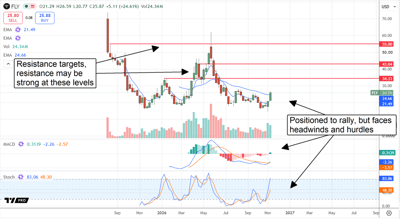
Price action was bullish following the release, with shares rising by more than 10% and suggesting a potential market bottom. Whether this is the absolute bottom remains to be seen. Near-term signals point to upside potential, but technical hurdles remain. Prior highs near $35, along with a congestion band in the $35 to $45 region, may provide enough resistance to cap gains.
There Are Plenty of Risks and Headwinds for Firefly Shareholders
Risks include, but are not limited to, shareholder dilution. Q3 highlights show a well-capitalized company with limited debt and steady equity, but cash is down year to date despite a dilutive capital raise, and the cash bonfire is still burning. Cash could continue to dwindle, increasing dilution risk until the company reaches profitability. Based on Q3 figures, additional financing remains a risk before that transition. News of capital-raising activity could create selling pressure.
Other risks center on concentration and execution. Firefly Aerospace’s outlook is rapidly improving, but its existing revenue and backlog are tied to a few government entities, while the new AST SpaceMobile agreement introduces additional execution risks. Government contracts are exposed to budget shifts and changes in administration, while ASTS is an equally speculative play on space-based 5G services with no guarantee of success. The Alpha launch system has experienced several setbacks and delays, and its next launch is not slated until early 2027. Governance is also a risk, with a large shareholder retaining significant influence over the company.
Boiled down, bulls may be underestimating the timeline to scale. Project delays, costs and widening adjusted losses weigh on the outlook and make the existing timeline uncertain at best. Bears may be wrong to treat Firefly like a pure launch company, because its primary revenue source and growth drivers are spacecraft solutions, including vehicles and defense software. While launch matters, the five concurrent lunar missions and the vehicle requirements they bring are the bigger story. In addition, acquiring SciTec embeds Firefly in the defense software industry.
Want to Escape the AI Sell-Off? This ETF Offers a Surprising Alternative
By Jessica Mitacek. Originally Published: 11/9/2026.

Key Points
- The ProShares S&P 500 ex-Technology ETF excludes the tech sector entirely and has outperformed the S&P 500 recently amid an AI-driven sell-off.
- Despite omitting tech stocks, SPXT still holds significant mega-cap exposure through Amazon, Alphabet, Meta Platforms, and Tesla among its top holdings.
- SPXT offers lower volatility and a 1.27% dividend yield but has historically trailed the S&P 500 and faces thin trading liquidity.
- Special Report: 6 Men Secretly Changed America’s Money. Now It’s Happening Again (From Banyan Hill Publishing)
If you’re looking for proof that nobody on Wall Street has a crystal ball, look no further than Crocs (NASDAQ: CROX)—the maker of plastic-based foam clogs—which is outperforming every member of the Magnificent Seven this year.
Of course, that may say more about Crocs’ more than 85% year-to-date (YTD) gain than it does about the hyperscalers’ respective performances. But between runaway CapEx, Q3 free cash flow turning negative for Alphabet (NASDAQ: GOOGL), and AI stocks undergoing yet another sell-off, it’s no wonder that a footwear company with a $7.31 billion market cap in the consumer discretionary sector is outperforming every one of those mega-cap stocks in 2026.
Today's stock pick is on me (Ad)
Elon can't build his satellite network without one key supplier, and he's paid this company since 2012.
His plan for 1,000,000 satellites could multiply that bill significantly, putting this overlooked stock back in focus.
Dylan has circled December 8th as a key date for this pick.
Claim today's free stock pick before December 8thFor those growing wary of the AI trade, there’s a silver lining. The S&P ex-AI Index has caught up with the S&P 500’s performance this year, as multiple rotations out of tech throughout 2026 have leveled the playing field.
The ProShares S&P 500 ex-Technology ETF (NYSEARCA: SPXT) offers another way to reduce AI-related exposure by excluding the technology sector entirely. But given the historically high concentration in the tech sector, investors considering shielding their portfolios from further AI-driven volatility need to carefully evaluate SPXT’s safety-for-upside trade-off.
Why the AI Sell-Off Is Benefiting Other Sectors
The most recent AI sell-off has highlighted the relative strength of several nontechnology sectors as AI-related stocks have come under pressure. That’s largely because the tech sector has posted the worst performance of the S&P 500’s 11 sectors over the past month.
Its approximately 15% loss has benefited other sectors, as the market has rotated into defensive areas such as healthcare, consumer staples, and utilities. As of Nov. 6, those sectors had one-month gains of 10.29%, 11.86%, and 7.87%, respectively.
The S&P 500’s Magnificent Seven Index is down 7.46% over the same period and has posted an uninspiring 6.7% YTD gain. From a technical standpoint, there could be more pain in store in Q4. The index recently broke a critical support level, which could lead to continued selling pressure as those names deal with the fallout from mixed earnings results.
How SPXT Reduces Tech Exposure Without Eliminating AI Risk
On the surface, the ProShares S&P 500 ex-Technology ETF presents a reasonable solution, especially for conservative investors comfortable with reducing their exposure to tech names. Over the past month, the fund has outperformed the S&P 500, gaining more than 2.34% while the index has declined approximately 5.5%.
But investors don’t turn to SPXT for outperformance. In fact, the ETF has trailed the S&P 500 over longer investment horizons, although its recent performance shows how excluding technology can provide an advantage during sector sell-offs. Instead, investors own the fund specifically because it excludes tech names.
However, that can be misleading when looking at the ETF’s portfolio. While it omits tech, SPXT still maintains plenty of mega-cap growth exposure through leading communication services and consumer discretionary names.
The fund’s top five holdings include four Magnificent Seven companies: Amazon (NASDAQ: AMZN), both Class A and Class C shares of Alphabet, Meta Platforms (NASDAQ: META), and Tesla (NASDAQ: TSLA).
But potential volatility from those positions could be partially offset by SPXT’s two largest sectors by exposure: financials and healthcare. Eli Lilly (NYSE: LLY), Berkshire Hathaway (NYSE: BRK.B), and JPMorgan Chase (NYSE: JPM) are also among the fund’s largest holdings.
Industry exposure is similarly diversified. Specialty retail and media each account for 11.4% of the fund, while biotechnology, banks, and insurance account for another 9.3%, 5.2%, and 4.9%, respectively.
The Trade-Off: Less Tech Exposure, But Not Without Risk
Although SPXT excludes the tech sector, growth remains a primary objective. That growth is tempered, as reflected in the fund’s lower-volatility beta of 0.85.
Still, when AI bubble fears and chipmaker sell-offs drag down mega-caps, more than 19% of the ETF’s portfolio—spread across the five aforementioned Magnificent Seven holdings—remains susceptible.
Shareholders would need to accept that some AI exposure remains and be comfortable with communication services and consumer discretionary mega-caps over their tech counterparts.
Liquidity presents another concern. Average daily trading volume is light, at around 19,000 shares, and that is unlikely to change given the fund’s less than $329 million in assets under management.
But with a low-cost expense ratio of just 0.09% and a dividend yield of 1.27%, or $1.43 per share annually at current prices, investors looking to reduce their tech exposure while being paid to hold SPXT may find that enough to accept the trade-off of less upside potential.
This email message is a sponsored email from Porter & Company, a third-party advertiser of The Early Bird and MarketBeat.
If you need help with your account, please feel free to email MarketBeat's support team, based in the United States, at contact@marketbeat.com.
If you no longer wish to receive email from The Early Bird, you can unsubscribe.
Copyright 2006-2026 MarketBeat Media, LLC. All rights reserved.
345 N Reid Pl., Suite 620, Sioux Falls, S.D. 57103-7078. United States..




No comments:
Post a Comment