| Unsubscribe |
Hi there,
I am writing to let you know that your $100 MarketBeat account credit is set to expire Friday, October 30 at 11:59 PM.
Until then, you can upgrade to MarketBeat All Access for $149 a year instead of $249. Unlike our past sales, the discount does not end after year one. Your rate stays at $149 at every renewal for as long as you remain a member.
Here is what the upgrade adds to your account:
- Real-time analyst ratings and price targets the moment they are published
- Earnings, dividend and insider-trade alerts on every stock you follow, by email and text
- Unlimited watchlist stocks instead of a cap of 10
- Fresh stock ideas from the Idea Engine every Monday morning
- Every screener, report and research tool fully unlocked
It is earnings season, which is when those alerts earn their keep.
Lock in $149 a year before October 30 →
If it is not for you, our support team (Wendy, Amanda and Liz) will refund 100% within 30 days. No questions asked.
Matthew Paulson
Founder & CEO, MarketBeat
P.S. Prefer monthly billing? It is $14.99 a month instead of $29, with the same rate lock and the same October 30 deadline. See both options here.
Does Lemonade’s Growth Signal Profits Ahead?
By Peter Frank. Published: 10/8/2026.

Key Points
- Lemonade's second-quarter revenue jumped 79.4% to $294.4 million, with in-force premium growth accelerating for an 11th consecutive quarter.
- Underwriting and cost metrics improved sharply, with the gross loss ratio falling to 60% and claims handling costs dropping to a record 5% of premiums.
- Despite operational progress and an upcoming Nov. 17 Investor Day, Lemonade remains unprofitable, and shares have fallen more than 34% this year.
- Special Report: The Last Energy Revolution Starts Now
Lemonade (NYSE: LMND) has always had an audacious idea.
The insurer would rebuild insurance using artificial intelligence and behavioral economics to streamline policy purchases and claims filing, replace brokers with bots, and pay claims in seconds. For years, nonbelievers dismissed it as a cash-burning app dressed up as an insurer.
Trump goes "all-in" on Grand Canyon energy breakthrough (Ad)
A drilling crew near the Grand Canyon uncovered a clean energy well producing nearly eight times the output of Saudi Arabia's largest oil field, with potential to last two million years.
While the One Big Beautiful Bill Act eliminated federal credits for solar, wind, and EVs, this energy source was reclassified alongside oil and nuclear power and given eight years of tax credits. Google signed a 15-year contract, and Bill Gates committed $100 million.
One company controls the entire supply chain behind this discovery.
See the ticker behind this Grand Canyon energy breakthrough nowThis year, though, the company has started posting numbers that answer its critics. The stock, however, remains unconvinced.
A fresh quarterly report in early November and an Investor Day are both on the calendar. Management has also circled the fourth quarter of 2026 as the target for delivering its first quarter of positive adjusted EBITDA.
For investors, the next few months could provide a proof-of-concept moment.
Growth Accelerates Across Key Metrics
Second-quarter results, announced July 29, helped set the stage. Revenue soared 79.4% to $294.4 million, edging past the Wall Street consensus of $291 million. The company’s loss of $43 million, or 56 cents per share, matched forecasts exactly.
The more important number was in-force premium, the total annualized value of policies on the books. It reached $1.43 billion, up 32.4% from a year earlier and marking the 11th consecutive quarter of accelerating growth. Customer count rose 23% to 3.3 million, and the company added about 166,000 new customers during the quarter, roughly 12% more than in the same period a year earlier.
That momentum built on a solid 2025. Full-year revenue climbed 40% to $737.9 million, while the net loss narrowed to $165.5 million from $202.2 million.
Underwriting Performance Continues to Improve
Growth on its own does not help insurers if they write bad policies. Lemonade made progress here, too. The gross loss ratio, or the share of premiums paid out in claims, came in at 60% in the second quarter. Just over a year ago, that figure was running at 78%.
Its AI-heavy claims operation is also paying off. The cost of handling claims fell to a record 5% of premiums, compared with an industry average of roughly 9%. Gross profit rose 76% to a record $113 million, representing a gross margin of 38%.
Losses are also shrinking. The adjusted EBITDA loss improved to $19 million from $41 million, and adjusted free cash flow was positive for a fifth consecutive quarter at $19 million.
Management raised its full-year outlook to roughly 65% revenue growth and 33% in-force premium growth.
Car Insurance Drives Expansion
The positive thesis rests on Lemonade becoming a multiproduct insurer rather than remaining a renters-and-pets niche player, and car insurance is the key.
Lemonade Car grew nearly 60% year over year in the second quarter, and an Aug. 26 launch in Florida brought it to states representing nearly 50% of the U.S. car insurance market. In January, the company launched insurance that cut rates for miles driven on Tesla (NASDAQ: TSLA) Full Self-Driving by 50%, and it has since taken that product to Indiana, Colorado and Tennessee.
More recently, the company announced a slew of expansions, including pet insurance in Kentucky and renters’ coverage in Kansas and Alaska. These moves are part of a pace of 14 new state-product launches in about 100 days.
Profitability Remains the Biggest Risk
The challenge is that Lemonade still loses money. Its trailing 12-month loss is $1.83 per share.
Wall Street expects the loss to narrow to $1.06 per share next year, which means profits probably remain a distant target. The stock also trades at about 4.8 times sales and nearly 6.5 times book value, which is rather rich for an insurer.
Expectations have also been high. The stock fell 20% after the July 29 report because the outlook, while raised, did not provide the larger catalyst investors had already priced in.
Competition is also intensifying. Although aggressive, Lemonade remains a small player next to car insurance giants such as Progressive (NYSE: PGR), Allstate (NYSE: ALL) and Berkshire Hathaway's (NYSE: BRK.B) GEICO. It also faces digital challenger Root (NASDAQ: ROOT) and pet specialist Trupanion (NASDAQ: TRUP).
Traders are clearly betting against the stock, with roughly 16% of the float sold short.
Analysts Remain Divided on Lemonade
Analysts are split on the stock, giving it a consensus Hold rating. Of the nine analysts tracking the stock, four have given the company a Buy rating, four have assigned a Hold rating and one suggests a Sell.
The 12-month average price target is $63.50, implying about 36% upside. Targets range from $44 per share at the low end to $92 at the high end.
Shares have also taken a hit this year. The stock is down more than 34% since the start of the year and has fallen even further from its 52-week high of $99.90 in late January.
The Sell-Off Could Create an Opportunity
The curious reality is that Lemonade is a better business today than it was when the stock sat near $100. Growth is accelerating, underwriting has improved and positive adjusted EBITDA is within reach.
The 2026 sell-off has reset expectations, and that reset could appeal to investors looking for beaten-down growth stocks.
But profitability remains a central issue. The next earnings report and the company’s Nov. 17 Investor Day could be determinative if management can confirm its path to positive results.
Microsoft Is Almost Back to $555—Now the Hard Part Begins
Reported by Chris Markoch. First Published: 10/9/2026.
Key Points
- Microsoft shares have surged about 37% this quarter to around $530, nearing their 52-week high of $553.72 after a strong earnings beat.
- Investors who bought near the October 2025 peak are approaching breakeven, which could trigger selling pressure as the disposition effect and "get-evenitis" take hold.
- Microsoft's upcoming fiscal Q1 2027 earnings, expected around Oct. 28, must clear higher expectations, including roughly 45% Azure growth, to justify the stock's recent rally.
- Special Report: The Last Energy Revolution Starts Now
Microsoft Corporation (NASDAQ: MSFT) stock is closing in on familiar territory. Shares traded around $530 this week, putting MSFT within 5% of its 52-week high of $553.72.
That's a remarkable turnaround. Microsoft gained about 37% in the third quarter of 2026, its best quarterly performance since 1998. In late June, shares were trading around $372.
Trump goes "all-in" on Grand Canyon energy breakthrough (Ad)
A drilling crew near the Grand Canyon uncovered a clean energy well producing nearly eight times the output of Saudi Arabia's largest oil field, with potential to last two million years.
While the One Big Beautiful Bill Act eliminated federal credits for solar, wind, and EVs, this energy source was reclassified alongside oil and nuclear power and given eight years of tax credits. Google signed a 15-year contract, and Bill Gates committed $100 million.
One company controls the entire supply chain behind this discovery.
See the ticker behind this Grand Canyon energy breakthrough nowBut the easy part of this rally may be over. The next leg will depend less on Microsoft's business and more on investor psychology.
MSFT peaked near $555 in October 2025 before spending roughly eight months falling. At the bottom, a $10,000 investment made at the peak was worth about $6,510. Many of those investors are finally close to breaking even.
That creates a different kind of test for MSFT stock. Investors tend to sell winners too early and hold losers too long. When a losing position finally gets back to breakeven, the urge to sell can be overwhelming.
Microsoft's fundamentals have earned this rally. Now the stock has to work through a wall of breakeven sellers while heading into an earnings report with much higher expectations than it had three months ago.
Q4 Turned a Pariah Into Wall Street's Darling
It's hard to overstate how quickly the narrative changed. Heading into July, the story around Microsoft was capital expenditures (CapEx) fatigue. Investors questioned whether its massive AI spending would ever generate an adequate return.
Then Microsoft reported fiscal fourth-quarter 2026 results on July 29. Revenue came in at $90 billion, up nearly 18% year over year. Azure crossed $100 billion in annual revenue for the first time, while earnings per share (EPS) of $4.74 topped the $4.24 consensus estimate.
The stock jumped about 15% the next day, marking Microsoft's biggest single-day gain since 2008.
Analysts have followed the price higher. Stifel upgraded MSFT to Buy in late September. On Oct. 5, Melius Research upgraded the stock to Buy with a $665 price target. Scotiabank raised its target to $615 from $510.
This is the same company, with largely the same AI strategy, that investors were avoiding in the spring. What changed was perception. In other words, the numbers gave investors permission to believe again.
Why $555 Is a Psychological Level, Not Just a Technical One
Most investors will see $553.72 as resistance on a chart. That's true, but it misses the behavioral story behind the number.
Think about who owns MSFT at that level. Many bought during the AI enthusiasm of late 2025. Some added on the way down, convinced the sell-off was overdone. Others simply held through a drawdown of roughly 35%.
Behavioral economists call the tendency to sell winners and hold losers the disposition effect. A related bias, sometimes called "get-evenitis," keeps investors anchored to their purchase price. Once a stock returns to that price, the relief of avoiding a loss often outweighs the hope of further gains.
That doesn't mean Microsoft can't break through. It means the stock needs a reason to absorb that supply. Momentum alone may not be enough; a fresh catalyst usually does the job. For Microsoft, that catalyst is its Q1 earnings report for fiscal 2027 (FY2027).
Earnings Will Have to Clear a Higher Bar
Microsoft hasn't confirmed its next earnings date, but the report is estimated for Oct. 28. The headline number will be Azure growth. Management guided for growth of about 45% in the quarter.
Three months ago, a number like that would have looked like upside. Now it's closer to the baseline. With the stock up nearly 40% in a quarter, investors may want more than a match.
There's also some fine print in last quarter's beat. The $4.74 EPS figure included a $3.2 billion gain on Microsoft's Anthropic stake. That's a real gain, but it isn't a repeatable operating result.
Spending remains part of the debate, too. Quarterly capital expenditures roughly doubled year over year, while free cash flow fell about 23%. Management also expects CapEx to grow again in fiscal 2027.
None of this breaks the bull case. CFO Amy Hood said in July that demand still exceeds available capacity. But it does mean the stock has less room for a merely good quarter.
Chasing MSFT at $530 Is a Different Trade
For long-term investors, Microsoft's story looks stronger than it did six months ago. Its AI investments are showing up in revenue, and Wall Street sentiment has turned firmly bullish.
But buying MSFT at $530 isn't the same trade as buying it at $372. At roughly 30x trailing earnings, the stock is priced for steady execution, leaving less room for error.
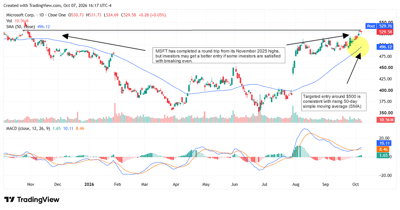
Investors who want exposure may be better served by scaling in. A pullback toward $500, where the stock consolidated in late September, would offer a more comfortable entry. A decisive close above $553.72 on strong volume would confirm a breakout.
If MSFT stalls near its old high, don't read it as a verdict on the business. It may simply be breakeven investors heading for the exits. Once they're gone, the path higher could get a lot easier.
If you need help with your newsletter, please don't hesitate to email MarketBeat's South Dakota based support team at contact@marketbeat.com.
If you no longer wish to receive email from The Early Bird, you can unsubscribe.
© 2006-2026 MarketBeat Media, LLC. All rights reserved.
345 North Reid Place #620, Sioux Falls, S.D. 57103. USA..




No comments:
Post a Comment