|
Dear Reader, The stock market has suffered losses for four consecutive sessions, with the S&P falling half a percent, thanks to surging oil prices, increasing bond yields and rising inflation. When you add the fact that September is historically the worst month of the year for stocks... Your portfolio could be teetering over the edge of a cliff. But in one of the worst five-year stretch for stocks in a generation... one that included the 2020 Covid crash, the 2022 bear market, shifts in interest rates, the 2025 Tariff Tantrum, and major spikes in volatility... One AI tool outperformed Berkshire Hathaway by 347% in backtests. And it is the very tool you need to prepare for this next dangerous phase of the market. I'm Keith Kaplan, CEO of TradeSmith. We're a financial technology company that has spent $17 million on AI tools and research... with our firm seen in Forbes, The Economist, and the Wall Street Journal...and a platform that 120,000 people worldwide use to track $29 billion in the stock market. We built this tool using used TimeGPT, a model pioneered inside Google and set it loose on the stock market. The result: That means roughly 7 out of every 10 trades this system flagged were winners. This forecasting engine gives you a powerful monthly stock rotation of the five top-ranking stocks to own. And you don't have to watch the market every day, time every entry, or follow weekly email updates. It's the smart play to use AI to get into and out of stocks... I've arranged for you to claim free access to a lite version of the tool (no purchase required). But I urge you to try it today - our AI has flagged its September picks, which could slow the bleeding in your portfolio from the stock market losses we've experienced. Claim your free access to our AI tool here, no credit card or purchase required. Best, Keith Kaplan P.S. One AI tool would've outperformed Berkshire Hathaway by 347% through two crashes, hiked tariffs and major volatility. Claim your free access to our AI tool today to protect your portfolio from any more stock market losses. Today’s editorial pick for you Morgan Stanley’s Powerful $105 Billion Franchise Has One Big WeaknessPosted On Oct 15, 2026 by Grayson Cavern 
Morgan Stanley (NYSE: MS) is generating billions in profits, pulling in new client assets and producing a 22.6% return on tangible common equity. Yet the stock closed October 14 at $181.51, down sharply from its summer peak near $230. The third-quarter report gives investors a reason to stay interested in the franchise, but the numbers also expose a split between its strongest businesses and the parts losing momentum. Table of ContentsRevenue climbed 12% year over year to $20.34 billion, while diluted EPS rose from $2.80 to $3.03. The bigger story sits inside those results: Wealth Management is expanding its recurring-fee base, while Institutional Securities is riding a powerful equities business. Investment Management, meanwhile, is dragging. That uneven performance helps explain why a strong earnings report has yet to turn the stock around. Equities Are Carrying the Institutional BusinessInstitutional Securities generated $10.03 billion in third-quarter revenue, up from $8.52 billion a year earlier. Equities supplied most of the lift, with revenue surging 41% to $5.80 billion on stronger client engagement across regions, particularly Asia. Investment banking revenue increased 2% to $2.16 billion, helped by higher advisory revenue from completed M&A activity in the Americas. The weak spot was fixed income. Revenue declined 7% to $2.01 billion, reflecting lower performance in credit, securitized products, and commodities. Equity underwriting also fell from $652 million to $525 million as lower IPO and block activity outweighed higher follow-on offerings. That mix makes the headline growth less straightforward than it first appears. Morgan Stanley has a powerful equities franchise, but a 41% jump in trading revenue can be difficult to repeat if client activity cools. Investment banking is improving, yet its growth remains modest beside equities. The next leg of institutional earnings growth needs broader participation across the segment. Wealth Management Is Building a Larger Earnings EngineWealth Management delivered record revenue of $9.07 billion, up 10% year over year, and record pretax income of $2.8 billion, producing a 30.4% pretax margin. The business attracted $232.4 billion in net new assets and $80.5 billion in fee-based flows during the quarter. Fee-based client assets reached $3.16 trillion, up from $2.65 trillion a year earlier. Those figures offer the strongest support for the long-term thesis. A growing pool of fee-generating assets can produce recurring revenue across market cycles, while the advisor-led channel keeps bringing new money onto the platform. Morgan Stanley also reported $201.1 billion in loans, compared with $173.9 billion a year earlier, as lending growth and higher average sweep deposits helped lift net interest income to $2.23 billion from $1.99 billion. Keep in mind, just over half of the quarter’s net new assets were associated with IPO-related flows. That makes the record inflow figure less useful as a standalone measure of recurring momentum. Still, the combination of larger fee-based assets, stronger net interest income and a 30.4% pretax margin gives Wealth Management real weight in the earnings mix. Investment Management Is the Weak LinkInvestment Management generated $1.46 billion in revenue, down 12% from $1.65 billion a year earlier. Pretax income fell to $259 million from $364 million. Asset management and related fees increased to $1.57 billion, but performance-based income and other revenue swung to a $106 million loss from $117 million in positive revenue a year earlier. The company attributed the decline primarily to a reversal of accrued carried interest tied to certain private-fund investments. That reversal helps explain why the segment’s results weakened even as assets under management rose to $2.05 trillion from $1.81 trillion. Long-term net flows were $15.8 billion, below the $17.9 billion recorded a year earlier. The broader business is growing, but that growth is not reaching every earnings line evenly. Morgan Stanley’s consolidated revenue fell from $21.35 billion in Q2 to $20.34 billion in Q3, while EPS declined from $3.46 to $3.03. ROTCE also eased from 26.6% to 22.6%. The year-over-year trend remains positive, but the sequential pullback shows the firm has stepped down from a stronger quarter. MS Needs to Reclaim $194The stock is still under pressure. MS closed at $181.51, below its 20-day moving average at $193.14, its 50-day at $205.72, and its 200-day at $194.29. The rising trendline from the spring has broken, and the stock has retreated from its summer high near $230. The first challenge is $190–$194, where the 200-day average sits near recent price action. A reclaim would be an initial sign that buyers are returning. Above that, $205–$212 is a tougher resistance zone. On the downside, the recent low around $176 is the level to watch; a break could expose the stock to another leg lower. Morgan Stanley repurchased $1.54 billion in shares during the quarter and declared a $1.15 quarterly dividend. Its standardized Common Equity Tier 1 capital ratio stood at 14.9%. The franchise has scale, capital, and a growing wealth business. I’m sold on those fundamentals, but I would want to see MS reclaim $194 before treating the selloff as exhausted. The next bullish leg needs the chart to catch up with the business. 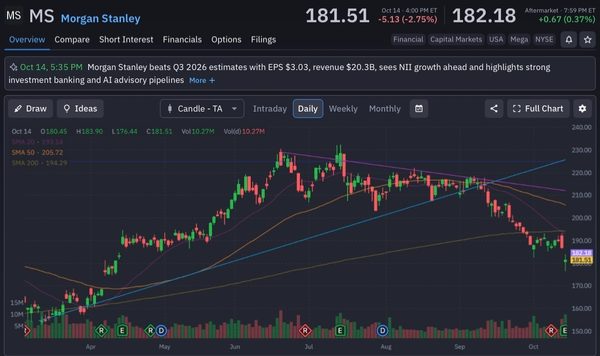
This is a PAID ADVERTISEMENT provided to the subscribers of StockEarnings Free Newsletter. Although we have sent you this email, StockEarnings does not specifically endorse this product nor is it responsible for the content of this advertisement. Furthermore, we make no guarantee or warranty about what is advertised above. Your privacy is very important to us, if you wish to be excluded from future notices, do not reply to this message. Instead, please click Unsubscribe. Stock Earnings, LLC |





No comments:
Post a Comment