| Unsubscribe |
The REAL Reason 2,000 Missiles Rained on Iran
For a moment…
Forget about terrorism.
Forget about oil prices.
Forget about everything the evening news has been telling you.
Because after two private meetings with United States Congressmen on March 2nd — and weeks of digging into what those conversations pointed me toward — I'm now convinced we launched those strikes for a completely different reason.
Click here to find out what it is.
If you have even a single dollar invested in the U.S. stock market, what I've uncovered is going to directly impact you.
And the clock is about to run out for you to protect yourself.
Discover the real reason here.
Time to Nibble on MCD Stock After it Enters Oversold Territory?
By Ryan Hasson. First Published: 10/2/2026.
Key Points
- McDonald's shares have fallen to their lowest levels since 2022, pushing the stock's RSI to around 25, a deeply oversold reading.
- The decline accelerated after McDonald's unveiled AI-powered pricing plans, sparking investor fears of a Wendy's-style backlash over dynamic pricing.
- Despite the sell-off, analysts hold a Moderate Buy consensus with nearly 30% upside, and key support levels near $229 and $217 are in focus ahead of Nov. 4 earnings.
- Special Report: The Untouched Energy Source Behind a New Eight Year Tax Break
Blue-chip, established, household-name stocks rarely go on sale, which is precisely why McDonald's (NYSE: MCD) is worth a closer look right now.
After a punishing slide that has dragged the stock to its lowest levels since 2022, shares have fallen into deeply oversold territory, with a relative strength index (RSI) reading of around 25. That is well below the 30 threshold technicians use to flag a stock as stretched to the downside.
Elon will prove them wrong again (Ad)
Elon Musk's critics said self-driving cars were a pipe dream. Today, Tesla robotaxis carry passengers with no driver in major U.S. cities.
Veteran tech investor James Altucher says Musk is applying the same playbook to a new project he calls his infinite money glitch, expected to launch October 21.
Altucher, who has tracked tech breakthroughs for nearly four decades, calls this the biggest one he has ever covered.
Watch the free presentation before October 21 to learn more.For a company as defensive and historically steady as McDonald's, such an extreme signal is unusual enough to warrant attention.
It also raises the question every contrarian eventually asks: Has the selling gone too far, or is this a falling knife best left alone?
What's Behind the Slide
The weakness has been building all year amid softening U.S. traffic, pressure on lower-income consumers, and execution inefficiencies related to the rollout of the company's value menus and service slowdowns. However, the most recent leg down followed McDonald's investor day, where it introduced an AI-powered system for pricing and customer rewards. Investors quickly drew an unflattering parallel to Wendy's (NASDAQ: WEN), whose mere mention of dynamic pricing in 2024 triggered a fierce public backlash. The concern is that diners already feeling pressured on value could sour on prices that vary by location or individual customer.
McDonald's enormous loyalty base, which numbers in the hundreds of millions, is exactly why the pricing opportunity is tempting—and exactly why a misstep would sting. For now, the market has focused squarely on the downside.
That reaction has pushed an already weak chart into genuinely oversold territory. The key for potential investors is to distinguish between a company facing real questions and a stock that may have fallen too far, too fast.
The Fundamentals Haven't Collapsed
Despite all the pessimism and downward momentum, it’s important to remember that McDonald's is not a broken business. The company still generates net margins north of 31%, pays a dividend yielding 3.2% that has been supported by decades of consecutive increases, and trades at a forward price-to-earnings (P/E) ratio of around 19—a notable discount to its historical average. Its beta of just 0.44 reflects the defensive, low-volatility profile that has made it a portfolio staple for generations.
Analysts remain constructive, too, with a Moderate Buy consensus among 37 analysts and an average price target of $300.64, implying nearly 30% upside from current levels. In other words, Wall Street views the sell-off as a significant overreaction relative to the underlying business.
The Technical Picture
From a broader technical perspective, the setup is precarious but interesting. McDonald's now trades well below its key moving averages, including its 50-day, 100-day, and 200-day simple moving averages, underscoring the severity of the recent downside momentum.
A move this stretched can typically resolve in one of two ways: either a sharp mean-reversion bounce or further capitulation. The most important level to watch is the 2022 bear-market low near $217, which ultimately needs to hold as a last line of defense in this major downtrend.
But the stock gave an encouraging signal on Thursday, snapping back sharply from an intraday low near $229.61 to close around $232. That move may mark a short-term bottom. For that signal to hold, the $229 area needs to act as support and provide an initial sign of stabilization. If it gives way, the 2022 low near $217 becomes the next potential support zone.
Time to Nibble?
So where does that leave investors? At face value, McDonald's offers a rare combination of a genuinely oversold technical reading, a defensive, cash-generative business, a 3.2% dividend, and almost 30% implied upside to the analyst consensus. That profile tends to reward patience, provided the key levels hold. The caution is that oversold can always become more oversold, and the AI-pricing overhang will not be fully resolved—or provide the clarity the market clearly wants—until the company reports its upcoming third-quarter earnings on Nov. 4.
For investors who prefer to buy quality names when sentiment is at its worst, this setup fits the bill: a fallen blue chip, deeply oversold, with the $229 level and the 2022 low serving as clear markers to watch. Whether it proves to be a bottom or merely a pause on the way lower will likely come down to whether those levels hold and what the company delivers when it reports on Nov. 4.
Viking's Obesity Edge May Be Staying Power, Not Weight Loss
By Chris Markoch. First Published: 9/23/2026.

Key Points
- Viking Therapeutics shares jumped 36% after new data showed patients on VK2735 kept most weight loss when switched to less frequent dosing.
- The maintenance edge could differentiate Viking from Eli Lilly and Novo Nordisk, though rivals Amgen and Pfizer are also pursuing monthly dosing options.
- Phase 3 VANQUISH trial readouts are expected in 2027, and Viking's roughly $502 million in cash may not cover a full commercial launch.
- Special Report: The Untouched Energy Source Behind a New Eight Year Tax Break
Viking Therapeutics (NASDAQ: VKTX) stock jumped 36% on Sept. 22. The catalyst was new maintenance data for VK2735, its GLP-1/GIP obesity candidate. The data showed that patients maintained most of their weight loss after switching from weekly injections to dosing every other week or once a month.
Investors shouldn't oversimplify this as just another win in the obesity drug market. The study wasn't about how much weight patients lost. It was about how long they kept the weight off and how often they needed an injection to do so.
The retirement stock I'd buy before Nvidia today (Ad)
In 2014, Marc Chaikin pointed readers toward Nvidia. Now the 60-year Wall Street veteran and creator of the Chaikin Money Flow indicator has a new top retirement pick.
The company holds three fast-growing businesses -- including an autonomous vehicle unit and a streaming service with 10x Netflix's reach -- any of which could be spun off in the next 12 to 24 months. It also pays a dividend, a rarity among high-growth AI names.
Chaikin lays out the full case in a new free presentation, no email or credit card required.
Get Marc Chaikin's free presentation on this overlooked AI stock nowThat distinction matters because the GLP-1 market is maturing. The category is crowded, and pricing is under pressure. Eli Lilly (NYSE: LLY) and Novo Nordisk (NYSE: NVO) are competing most aggressively on peak weight loss. Competing on that data point alone is a difficult game for a clinical-stage company.
Viking may be able to take a different path. An edge in weight-loss maintenance would give Viking's candidate an additional benefit beyond simply being "a cheaper Zepbound." That presents a question for investors: Is less frequent dosing a real commercial edge, or is it merely a nice feature in a market where Lilly already dominates?
What the VK2735 Data Actually Show
Roughly 180 adults with obesity took a weekly dose of VK2735 or a placebo for 21 weeks. Weight loss ranged from about 16% to 19%, compared with roughly 0% for the placebo group. Patients were then moved to less frequent dosing for 12 weeks.
Viking's headline numbers showed that patients maintained 97% and 90% of their weight loss, respectively. However, investors need to examine the details. Each figure came from a single dose group of about a dozen patients.
The combined averages tell a clearer story. Patients switched to every-other-week dosing retained 90% of their weight loss, while monthly patients retained 85%. Those switched to placebo retained 61%. Gastrointestinal side effects during maintenance were similar to those seen with placebo.
Is Less Frequent Dosing a Real Edge?
The current best-selling GLP-1 drugs are weekly injections. Lilly's Zepbound and Novo's Wegovy both require a shot every week. Both companies now also sell daily pills. Novo's Wegovy pill was approved in December, and Lilly's Foundayo followed in April.
Lilly has already staked a claim in maintenance treatment. In its ATTAIN-MAINTAIN trial, patients switched from Wegovy to daily orforglipron. Over 52 weeks, they retained all but 0.9 kilograms of their prior weight loss. Zepbound switchers regained about five kilograms.
With VK2735, Viking offers a third option: a monthly shot. For patients who dislike daily pills or weekly injections, that's a real convenience. Better adherence can make weight loss more durable. Payers may also favor a lower-dose maintenance regimen if it reduces the cost per patient.
However, Viking is likely to face competition sooner rather than later. Amgen (NYSE: AMGN) has MariTide, while Pfizer (NYSE: PFE) is pursuing berobenatide, acquired through Metsera. Both companies are targeting monthly dosing. While monthly dosing is a differentiator today, it may be table stakes by the time VK2735 reaches the market.
What Phase 3 Still Has to Prove
The maintenance study was short and small. A 12-week trial says little about what happens after a year or more. It also enrolled otherwise healthy adults rather than the higher-risk patients who drive much of the market.
The VANQUISH Phase 3 program addresses some of those limitations. VANQUISH-1 enrolled about 4,500 adults with obesity, while VANQUISH-2 enrolled about 1,000 adults with obesity and type 2 diabetes. Both are 78-week trials, with readouts expected in 2027.
However, VANQUISH tests weekly dosing. Maintenance regimens will be studied in extension trials expected to begin in late 2026 or early 2027. Viking also plans to begin an oral Phase 3 program this quarter.
How Does Viking Pay for the Road to Approval?
Viking ended June with about $502 million in cash. Management says that amount will fund operations into 2028. That should cover the VANQUISH readouts, but it likely won't cover a full commercial launch.
Building manufacturing capacity and a sales force to compete with Lilly and Novo is expensive. Viking has three realistic paths: It can raise equity, thereby diluting shareholders; partner with a larger drugmaker; or be acquired.
Takeover speculation has followed Viking for years. Pfizer's roughly $10 billion Metsera deal, which the company won in a bidding war with Novo, shows big pharma's appetite for obesity assets. But that's a scenario, not a prediction. Viking has so far advanced VK2735 on its own.
VKTX Stock Technical Analysis: Can the Rally Break $43?
Analyst sentiment for VKTX remains strong. The consensus price target of $99.22 offers upside of 150%. However, context is important: That price target was established before the latest VK2735 results.
Analysts understand that it will still be some time before the Phase 3 study is completed and even longer before the drug gains commercial approval.
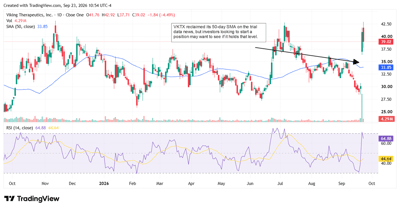
The chart confirms that cautious outlook. VKTX gapped up from around $30 to over $40 on the news. Volume was the highest in the past year, confirming strong buying interest. The stock also reclaimed its 50-day simple moving average (SMA), which is now near $34.
However, the rally is running into a familiar ceiling. The $42.50 to $43 zone capped the stock in November 2025 and again in July. On Sept. 23, shares touched $42.92 before reversing lower.
Momentum is cooling as well. The relative strength index (RSI) neared overbought territory at 70 before easing to around 65. The 50-day SMA is also still sloping downward. A pullback toward the $34 to $37 range would not be surprising. A close above $43 would signal a true breakout.
Viking Stock: A GLP-1 Durability Play, Not a Zepbound Rival
The GLP-1 trade has matured. Being "another obesity drug" is no longer enough to attract investor dollars. Viking's maintenance data point to a different identity: the durability and convenience option.
Whether that identity holds depends on the Phase 3 results and how quickly monthly rivals advance. For now, the rally reflects a narrative shift more than a proven commercial edge. Investors should value it accordingly.
This email communication is a sponsored message sent on behalf of Behind the Markets, a third-party advertiser of MarketBeat. Why was I sent this email message?.
If you need help with your newsletter, please contact MarketBeat's South Dakota based support team at contact@marketbeat.com.
If you would no longer like to receive promotional emails from MarketBeat advertisers, you can unsubscribe or manage your mailing preferences here.
© 2006-2026 MarketBeat Media, LLC. All rights protected.
345 N Reid Place, Sixth Floor, Sioux Falls, SD 57103-7078. United States..




No comments:
Post a Comment