Thursday, November 26, 2026

Your free book is about to disappear

If you still haven't downloaded my "Safe Trade Options Formula" book...

...please take a few seconds and download it right now before your new temporary download link expires.

I eventually plan to charge for this book, so do yourself a favor and download it now...

That way, no matter how much it is in the future, you'll have a copy on your computer already.

Make sense?

FREE: Safe Trade Options Formula << Download Now

Good Trading,
Bill Poulos

p.s. Go here to save a copy of my "Safe Trade Options Formula" book to your computer before I start charging for it.


Today's Exclusive News

These 3 Dividend Stocks Have Outpaced the S&P 500, But Which Has the Most Upside?

Reported by Leo Miller. Originally Published: 11/23/2026.

Falling US dollar bills scattered across a dark surface, symbolizing rising dividends and strong shareholder returns in financial markets.

Key Points

  • Merck raised its 2026 revenue and earnings guidance while increasing its quarterly dividend.
  • Motorola Solutions reported double-digit segment growth, a record backlog, and a dividend increase of more than 10%.
  • Aramark raised its dividend and announced a $1 billion buyback as its Nexus business creates another growth opportunity.
  • Special Report: Every Starlink dish pays this stock tc pixel

While AI stocks have dominated the conversation among investors in 2026, companies in other parts of the economy have shown real strength as well. Three notable names in healthcare, public safety and food are strongly outperforming the S&P 500 Index.

In addition, these companies offer meaningful dividend yields of between 1% and 2.7% and have recently increased their dividends. All three have payout ratios that appear manageable based on reported or projected earnings, leaving room for potential increases in the coming years.

Merck Boosts Guidance and Dividend With Shares Up Significantly in 2026

Do You Own Any of These 10 Stocks? See This Warning Before Dec. 10 (Ad)

Joel Litman, a professor who has lectured at Harvard and Wharton, is warning of a $33 trillion grid crisis that could ignite as soon as Dec. 10. He says that if nothing changes, it could bring "the end of the global economy as we know it."

Litman predicted the 2020 crash just weeks before it happened. Around the 2008 crisis, he named 57 companies he said would collapse, and 50 did.

He and Altimetry's Rob Spivey have a list of 10 widely held stocks they recommend selling before Dec. 10.

See the 10 stocks Altimetry recommends selling before the Dec. 10 warning date.tc pixel

Pharmaceutical giant Merck & Co., Inc. (NYSE: MRK) has performed well in 2026, with shares up around 28% year-to-date (YTD). Including the stock’s dividend yield brings its total return to 30%, far exceeding the S&P 500’s total return of nearly 6%. In its latest earnings report, Merck raised the midpoint of its 2026 revenue and non-GAAP earnings per share (EPS) guidance. The company now expects sales of between $66.8 billion and $67.3 billion, representing growth of 3% to 4%. While that may sound uninspiring, it would be a notable acceleration from the company’s 2025 growth of just 1.3%.

Merck also recently announced a moderate 3.5% dividend increase, lifting its forward dividend yield to 2.65%. The company intends to pay its next quarterly dividend of 88 cents on Jan. 8, 2027, to shareholders of record as of Dec. 15.

At first glance, Merck’s payout ratio looks alarmingly high, at nearly 350%. However, this is largely an accounting artifact. The company has recorded around $6 per share in one-time EPS charges related to acquisitions during the year, including a $3.62 charge in Q1 and a $2.31 charge in Q2. Based on next year’s estimates, which exclude those charges, Merck’s payout ratio falls to around 37%.

Motorola Raises Dividend More Than 10% Alongside Record Backlog

Shares of Motorola Solutions (NYSE: MSI) have appreciated around 37% in 2026 and have delivered a total return of nearly 39%. Motorola is a notable player in the public safety industry, providing radios, body cameras and other security solutions to law enforcement agencies and prisons.

The company posted double-digit growth in both segments last quarter. Products and Systems Integration grew 12% year over year (YOY), while Software and Services grew 13% YOY. Motorola raised its full-year revenue, EPS and operating cash flow guidance and reported a record backlog of $16.6 billion.

Motorola also announced a sizable 10.7% dividend increase, bringing the stock’s forward dividend yield to nearly 1%. The company intends to pay its next quarterly dividend of $1.34 on Jan. 15, 2027, to shareholders of record as of Dec. 15. During Q3, Motorola also added $2 billion in buyback capacity, equal to around 2.3% of the company’s market capitalization. Based on trailing 12-month earnings, the company’s payout ratio is approximately 39%, leaving its dividend well-supported by earnings.

Aramark Tops Off Solid Growth With Dividend Increase and New Buyback Program

Last is Aramark (NYSE: ARMK), which has gained around 51% in 2026 and delivered a total return of nearly 52%. Aramark provides food and facilities management services, including dining and meal preparation programs at schools and hospitals.

In its latest fiscal year, Aramark grew organic sales by 10% YOY, a strong acceleration from 7% growth in the prior year. Total sales reached $20.1 billion, and annualized gross new client wins hit a record $1.9 billion. Aramark expects another year of solid growth, forecasting an organic sales increase of 9% to 10% and adjusted EPS growth of 20% to 25%.

Aramark recently announced a large 16.7% dividend increase, raising its quarterly payout to 14 cents per share. The company’s forward dividend yield is now approximately 1%. Aramark’s next dividend is payable on Dec. 16, with a record date of Dec. 4.

Based on the last 12 months’ earnings, Aramark’s payout ratio at the new annualized dividend rate is approximately 35%, well within sustainable territory. The company also approved a new $1 billion repurchase program, replacing its previous $500 million authorization. The new program is equal to nearly 7% of the firm’s market capitalization.

Based on price target data for this group, Wall Street analysts are most bullish on Aramark. The MarketBeat consensus price target of $68.32 implies upside of more than 20%. Another potential growth driver is the company’s Nexus platform, which provides housing, dining and hospitality services at remote worksites, including data center construction sites. Aramark is already working with one hyperscaler client and projects roughly $500 million in Nexus revenue for fiscal 2027.

3 Dividend Stocks With Room for Further Growth

Merck, Motorola Solutions and Aramark have all significantly outperformed the S&P 500 in 2026 while increasing their dividends. Each company has different growth drivers, from Merck’s improving earnings outlook to Motorola’s record backlog and Aramark’s expanding business opportunities.

Although their dividend yields are relatively modest, all three companies have payout ratios that suggest room for further increases. Continued earnings growth will be key to sustaining those payouts, especially after such strong share-price gains.


Today's Exclusive News

CrowdStrike's $44B Zscaler Bet: Why Wall Street Sold the News

Reported by Chris Markoch. Originally Published: 11/23/2026.

CrowdStrike and Zscaler logos displayed on server racks connected by a glowing red and blue digital arch.

Key Points

  • CrowdStrike announced a $43.9 billion all-stock acquisition of Zscaler, combining two major cybersecurity platforms in the industry's largest acquisition to date.
  • CrowdStrike reported record annual recurring revenue growth and cash flow in its fiscal third quarter, but its shares fell following the acquisition announcement.
  • The acquisition offers significant cross-selling opportunities, although shareholder dilution, integration challenges, and regulatory approval remain risks.
  • Special Report: Do You Own Any of These 10 Stocks? See This Warning Before Dec. 10 tc pixel

CrowdStrike Holdings (NASDAQ: CRWD) announced Monday, Nov. 23, 2026, that it will acquire Zscaler (NASDAQ: ZS) in an all-stock deal with an enterprise value of about $43.9 billion. The transaction would be the largest cybersecurity acquisition on record.

Zscaler shareholders will receive 1.135 CrowdStrike shares for each share they own. Based on the closing price on Friday, Nov. 20, that exchange ratio implied a value of about $260.41 per share—a 34% premium. CrowdStrike shareholders will own roughly 84% of the combined company.

Black Friday will be darker for America after this crisis (Ad)

Dr. Martin D. Weiss, founder of Weiss Ratings, warns of a new Great Financial Crisis that could make 2008 look mild. It starts with a $3 trillion problem he calls just the tip of the iceberg.

Weiss has publicly predicted six major market crashes in 55 years, and his firm has never accepted payment from any company it rates.

In the Black Friday Weekend Event, you get full access to his five-step reports for $29 (77% off), plus a year of The Safe Money Report. The offer expires Monday night.

Get the five-step crisis reports for $29 before the offer ends Monday night.tc pixel

The market's initial reaction was split. ZS jumped about 20% in premarket trading on Nov. 23, while CRWD fell more than 7%. That reaction suggests investors are more concerned about the deal's immediate financial implications than its long-term strategic potential.

The announcement also came alongside CrowdStrike's fiscal third-quarter 2027 results, released ahead of their originally scheduled Dec. 1 announcement. CrowdStrike described the quarter as its best ever. For now, investors may be placing more weight on the price tag of the Zscaler acquisition.

The Deal Would Bring Network Security to Falcon

Zscaler is a leader in Zero Trust and secure access service edge (SASE) tools. Those products protect traffic moving between users, applications and the internet. CrowdStrike built its Falcon platform around endpoint, cloud workload, identity and data protection. Network security was the obvious missing piece.

The two companies are not strangers. They already share more than 2,000 customers and 16 product integrations. The acquisition would give CrowdStrike access to roughly 8,000 Zscaler customers who don't use Falcon. After the deal closes, both product lines will be available through a single Falcon Flex contract.

CEO George Kurtz framed the deal around artificial intelligence. He described a unified control plane for deploying, controlling and securing AI agents. Zscaler founder Jay Chaudhry said Zero Trust is now essential as AI agents become a major vulnerability. If the transaction closes, Chaudhry will continue to run the Zscaler business and join CrowdStrike's board.

The Numbers Behind the Price Tag

Zscaler had $3.9 billion in annual recurring revenue (ARR) at the end of October 2026. CrowdStrike expects combined ARR to exceed $10 billion at closing. Management is targeting about $1 billion in annualized revenue synergies within 30 months of closing. It also projects $500 million in annual cost synergies within 18 to 24 months.

CrowdStrike says the deal will be immediately and significantly accretive to free cash flow per share, even before synergies. Including synergies, management expects gains in revenue growth, non-GAAP operating margin and free cash flow margin within the first fiscal year after closing.

The company also estimates that the deal will expand its addressable market by more than $185 billion in 2029. That potential expansion helps explain why management was willing to pay a 34% premium.

Why CrowdStrike Stock Fell Anyway

Acquirers frequently see their shares decline when major deals are announced. Two factors help explain CrowdStrike's initial sell-off:

  • CrowdStrike is issuing a large block of new shares. Existing holders would own about 84% of the combined company, reflecting roughly 16% ownership dilution.

  • Combining two large, independent platforms also carries real integration risk.

Timing adds another layer of uncertainty. The deal isn't expected to close until the second half of CrowdStrike's fiscal year 2028, pointing to a closing between August 2027 and January 2028. Rivals such as Palo Alto Networks (NASDAQ: PANW) could use that window to court uncertain customers.

The Quarter Investors May Be Overlooking

The fundamentals tell a different story than the stock chart. CrowdStrike posted record net new ARR of $419 million in the third quarter.

That figure was up 58% year over year (YOY). Ending ARR reached $6.26 billion, up 27% YOY, marking a fifth straight quarter of accelerating growth.

The company's cash generation also set records. Operating cash flow hit $665 million, and free cash flow reached $474 million.

Management raised its full-year fiscal 2027 net new ARR growth guidance by 1,060 basis points, to 45% at the midpoint. Those are not the numbers of a company buying growth out of desperation.

What the Arbitrage Spread Says

Because the deal is all stock, Zscaler's potential acquisition value moves with CrowdStrike's share price. The $260.41 headline price reflects the Nov. 20 closing price, not a guaranteed cash payment. During premarket trading on Nov. 23, CrowdStrike traded near $212, implying a deal value of about $241 per Zscaler share. Zscaler traded near $234, a gap of roughly 3%.

That spread was only a premarket snapshot, not proof that the transaction is likely to close. The gap can widen or narrow as the companies' share prices move and investors reassess deal risk. Chaudhry and his affiliates hold about 34% of Zscaler shares and signed voting agreements supporting the deal. Both boards approved it unanimously. The remaining hurdles include Zscaler shareholder approval and regulatory clearance.

A Sell-Off Driven by Dilution, Not Doubt

For CrowdStrike investors, the Nov. 23 sell-off reflects concerns about dilution and the risks of completing and integrating a major acquisition—not a weakening business. The company just delivered its best quarter ever while committing to its most ambitious bet.

The real test comes later. Investors will watch whether cross-selling to Zscaler's customer base shows up in net new ARR and whether cost synergies arrive on schedule. Until then, CrowdStrike may trade as much on deal-related uncertainty as on its underlying financial performance. For long-term holders, that disconnect could become an opportunity.

Thank you for subscribing to The Early Bird, MarketBeat's 7:00 AM newsletter that covers stories that will impact the stock market each day.
 
This email is a sponsored email provided by Profits Run, a third-party advertiser of The Early Bird and MarketBeat.
 
If you have questions about your newsletter, please contact MarketBeat's support team, based in South Dakota, at contact@marketbeat.com.
 
If you no longer wish to receive email from The Early Bird, you can unsubscribe.
 
Copyright 2006-2026 MarketBeat Media, LLC. All rights reserved.
345 N Reid Place, Suite 620, Sioux Falls, SD 57103. United States..
 
From Our Partners: I have publicly predicted six major American crashes, before each one happened. tc pixel

Every Starlink dish pays this stock

Dear Friend,

I owe you one.

So here's a free stock pick.

It's a little-known company that collects every time Elon builds.

Not Tesla. Not SpaceX.

The chip inside every Tesla and Starlink dish? Elon doesn't own it. He pays this company to use it.

Now he's filed to launch 1,000,000 AI satellites.

One royalty. A million times over.

That could mean a 100X bigger bill.

Dylan believes it takes off December 8th.

Miss that, and you're watching from the sidelines.

Claim your free pick here >>

The Buck Stops Here,

Kelly Maguire
Behind the Markets

P.S. It's a public stock. A few clicks and you own it. Just do it before December 8th.

Get the pick before December 8th here >>


Just For You

Anthropic's Record IPO Could Ease a Major Concern for Broadcom Investors

Authored by Leo Miller. Publication Date: 11/21/2026.

Close-up of a computer processor chip on a circuit board with rows of illuminated server racks in a data center.

Key Points

  • Anthropic's IPO and private placement raised roughly $117.6 billion, strengthening its ability to fund $161.2 billion in chip leasing commitments owed to Broadcom.
  • Broadcom expects Anthropic to become its largest custom AI chip customer in 2027, making the developer's access to capital an important factor in its growth outlook.
  • Strong demand for Anthropic's shares suggests investors remain willing to finance large technology companies, although higher borrowing costs and long-term infrastructure obligations remain risks.
  • Special Report: A $247 tool for $7 tc pixel

After a long wait, Claude developer Anthropic PBC (NASDAQ: ANT) is finally a publicly traded company. The news is positive for many firms across the AI and semiconductor industries, including chip giant Broadcom (NASDAQ: AVGO). The move not only bolsters Anthropic’s ability to meet its large-scale commitments to Broadcom but also addresses one of the key concerns Broadcom’s CEO outlined earlier this year.

Anthropic Fortifies Balance Sheet With IPO and Private Placement Proceeds

Anthropic’s total chip-leasing commitments to Broadcom are $161.2 billion over the next five years, excluding interest. Based on these commitments, Broadcom expects Anthropic to become its largest XPU customer in 2027 and maintain that position in 2028. This makes Anthropic’s ability to pay Broadcom critical to the chip giant achieving its forecast of $350 billion in AI semiconductor sales from fiscal 2027 through fiscal 2028.

My $247 scanner for $7 (Ad)

Bill Poulos is cutting the price of his $247 Instant Scanner to $7 for Black Friday. It's a one-time payment that covers a full year, with no subscription and no re-bills.

Every night after the close, the scanner screens nearly a thousand of America's biggest stocks. It returns a short list of qualifying setups with the exact buy price next to each one.

There's nothing to install. If you decide it's not for you, you get the $7 back and keep the scanner for the year.

Get the Instant Scanner for $7 in the Black Friday sale today.tc pixel

Anthropic’s total commitments to AI hyperscalers and neoclouds are also several times larger than its commitment to Broadcom. To meet all these payment obligations, securing as much cash as possible is key. Fortunately for Anthropic and its suppliers, the company’s latest share offerings will significantly bolster its balance sheet.

Anthropic set its IPO price at $83 and initially offered 980 million shares. After excluding the 23.6 million shares sold by certain stockholders, Anthropic reported proceeds from the original offering, after underwriting discounts but before other expenses, of around $78.8 billion. Underwriters subsequently exercised their option to buy 147 million additional shares, bringing the total offering to 1.127 billion shares and Anthropic’s gross IPO proceeds to approximately $91.6 billion.

Separately, the company closed a private share placement worth around $26 billion, with Broadcom among the investors. Including that placement, Anthropic raised approximately $117.6 billion in gross proceeds from newly issued shares across both offerings, before fees and expenses.

The company’s amended S-1 filing shows that it was already in a very strong cash position, with around $131.8 billion in cash, cash equivalents and short-term investments. Its final prospectus estimates that these holdings would have totaled approximately $244.6 billion on a pro forma adjusted basis as of Sept. 30, assuming the completed offerings and full exercise of the underwriters’ option, after estimated expenses and related tax-withholding obligations.

This massive cash reserve should go a long way toward helping Anthropic fund its lease and compute commitments in the coming years as it works to increase profitability. Although the company’s sales are growing rapidly and margins are improving, its commitments still dwarf its profits. In the first nine months of 2026, Anthropic’s adjusted operating profit was $4.08 billion, and its operating cash flow was $6.57 billion.

Anthropic’s IPO Demand Signals Willingness to Commit Capital to AI Firms

When discussing constraints on the AI buildout, Broadcom CEO Hock Tan recently said, “What I think might be the biggest constraint is capital.” In this context, strong demand for Anthropic’s IPO is a positive sign, indicating that investors are still willing to commit capital to AI companies.

Around a week before going public, Anthropic said the expected IPO price would be between $70 and $78 per share. The company also said it expected to offer 825 million shares. Based on those figures, the high end of Anthropic’s gross proceeds from the offering was around $64.35 billion, including shares sold by existing stockholders.

However, reports soon emerged that the company’s IPO was six times oversubscribed, indicating very strong investor demand. The company subsequently increased both the price per share and the number of shares offered, pushing its IPO proceeds well above the earlier figure.

Something similar has played out with the recent equity and bond offerings at Meta Platforms (NASDAQ: META). According to reports, all of these offerings were several times oversubscribed, again signaling strong demand to provide capital to AI companies. This is another positive sign for Broadcom, as Meta is also one of its top chip customers, and the companies are partnering to design Meta’s custom AI accelerators.

Still, the fact that Anthropic and Meta can attract capital today doesn’t mean the entire AI ecosystem can do so—or that this will continue indefinitely. Pressure is already building on debt issuance in the form of higher interest rates and credit spreads, as Meta’s recent offerings show.

Wall Street Continues to Eye Strong Upside in Broadcom Shares

Anthropic’s IPO is another positive development for Broadcom’s outlook as the company targets immense AI chip sales growth in the coming years. Notably, Broadcom shares had recovered significantly after plummeting below $300 following the market’s reaction to the midterm election results. However, the stock took another big hit on Nov. 12, falling below $310.
Wall Street analysts have generally maintained a bullish outlook on Broadcom. The MarketBeat consensus price target of nearly $525 implies more than 70% upside. However, Rothschild & Co Redburn significantly lowered its target in November, from $595 to $398.


Just For You

Champion Homes: The Affordability Play Hiding in Plain Sight

Authored by Chris Markoch. Publication Date: 11/23/2026.

Champion Homes logo over a manufactured home with gray siding and a pitched roof on a factory assembly line, surrounded by construction workers and equipment.

Key Points

  • Champion Homes shares have gained roughly 22% over the past month as investors recognize the potential of manufactured housing.
  • New federal housing legislation could lower costs and expand opportunities for Champion Homes, although implementation will take time.
  • Champion Homes has a $500.2 million order backlog, but margin pressure and technical resistance remain concerns.
  • Special Report: Do You Own Any of These 10 Stocks? See This Warning Before Dec. 10 tc pixel

Champion Homes (NYSE: SKY) is flying under the radar of most investors amid this flight to safety. The company designs and builds factory-produced homes and buildings, including manufactured and modular homes. It’s also a leader in the space, with a 23% share of the U.S. wholesale market for HUD-code homes.

SKY jumped about 22% in the 30 days ended Nov. 19, and for good reason. Manufactured homes have been identified as one solution to the U.S. housing shortage. Investors also liked what they saw in the company’s latest earnings report.

It's costing you money (Ad)

The financial news isn't there to help you build wealth. It's there to keep you watching, and the easiest way is to keep you scared or excited. Every reaction costs you: buy the hype, sell the panic.

Joel Peterson's rule is simple: boring is the cure. He skips the news and looks at one color. Elections, rate hikes, crashes, the plan doesn't change.

He walks through it in a free workshop with sessions every day.

Save your free seat at Joel Peterson's workshop, then turn off the TV.tc pixel

Champion reported its second-quarter earnings for fiscal 2027 on Nov. 3. The company generated $727 million in revenue, a 6.2% year-over-year increase. Adjusted gross profit was $185.3 million, for an adjusted gross profit margin of 25.5%. Higher material costs were partially offset by sales growth and improved price realization.

The bottom line was softer. Net income fell to $52.7 million from $58.2 million a year earlier. Diluted earnings per share (EPS) slipped to 97 cents from $1.03. Management attributed the decline primarily to inflation-driven increases in the cost of sales. The backlog of unfilled orders jumped to $500.2 million from $313.2 million a year ago as orders outpaced production.

Why Manufactured Homes Fit the Affordability Moment

The U.S. housing shortage is well documented. The Pew Charitable Trusts cites estimates of a shortage of four million to seven million homes. But solutions that rely on traditional homebuilders face higher building costs, while buyers contend with higher mortgage rates. The bottom line is that current economics make it difficult to close the gap through traditional construction alone.

That’s where manufactured homes can fill a key gap. Democrats won control of both chambers of Congress in the midterm elections, campaigning on affordability. Manufactured homes offer an affordable option, and buyers can move in much sooner. Research funded by Pew found that new manufactured homes cost up to two-thirds less than similar site-built homes.

The policy tailwind is bipartisan. The 21st Century ROAD to Housing Act passed the Senate 85-5 and the House 358-42. It became law on July 11. A key provision ends a 1974 rule requiring manufactured homes to sit on a permanent steel chassis. Removing that requirement could lower construction costs by thousands of dollars per home.

Champion is already positioning itself for that shift. In September, it brought its New Horizon home to the National Mall for the “Homes on the Hill” event. The two-story HUD-code home eliminates the second-floor chassis and is designed for narrow urban lots. The company is also expanding its retail business. It has 95 sales centers and plans to acquire Timberline Homes.

Chart Shows Momentum, But Resistance Looms

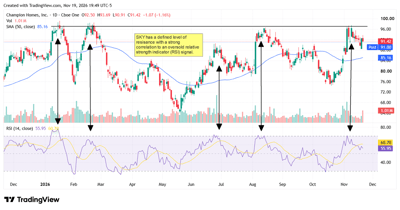
SKY gapped above its 50-day simple moving average after earnings. It’s now consolidating around $91, about 7% above that average, which is near $85. The relative strength index (RSI) has cooled to about 56 after topping 70 earlier this month.

That leaves room to run. However, the stock has stalled in the $96 to $99 range several times over the past year. A decisive break above that range would be a meaningful signal.

Champion Homes (SKY) stock chart shows repeated tests of resistance alongside weakening RSI momentum signals.

Why SKY Isn't for Every Investor

Champion Homes is a mid-cap company with a market cap just shy of $5 billion ($4.91 billion). It’s profitable and generates solid cash, with about $93 million in free cash flow in the first half of fiscal 2027.

But it doesn’t pay a dividend. Instead, it returns cash through buybacks, repurchasing $100 million in stock during those six months. That means returns depend on the stock price. As the chart shows, after a spike in 2021, the stock’s growth has been uneven over the past five years.

Plus, the policy tailwind will take time. The ROAD to Housing Act is law, but nearly every state must update its own statutes. As of Oct. 1, only six states had taken steps. HUD also needs to rewrite its building code for homes without a chassis. Regulatory change typically takes longer than expected. And with divided government expected beginning in January, new affordability bills could stall.

Adding to the complexity, manufactured homes aren't the right solution for every homebuyer. However, they can be a practical, affordable option for first-time buyers, young families trying to break the rent cycle and retirees.

Data from Rachel Siegel of Pew's Housing Policy Initiative suggest that these buyers may also be good candidates for safer loans. Of manufactured home borrowers surveyed, 89% reported being current on their loans, and only 4% reported being behind on payments by three or more months.

For patient investors, Champion Homes is a case of perception catching up with fundamentals. Analysts are bullish on SKY. Nine analysts give the stock a consensus Moderate Buy rating. The price target of $104.25 is more than 14% above the stock's recent trading levels.

The backlog shows that demand is real. The open question is how quickly policy will allow Champion to turn that backlog into sales.


This email is a paid advertisement from Behind the Markets, a third-party advertiser of MarketBeat. Why was I sent this message?.
 
If you have questions or concerns about your account, feel free to email our support team, based in the United States, at contact@marketbeat.com.
 
If you would no longer like to receive promotional emails from MarketBeat advertisers, you can unsubscribe or manage your mailing preferences here.
 
© 2006-2026 MarketBeat Media, LLC. All rights reserved.
345 N Reid Place #620, Sioux Falls, S.D. 57103-7078. U.S.A..
 
From Our Partners: I have publicly predicted six major American crashes, before each one happened. tc pixel

Whoops! I wasn’t supposed to share this with you yet

Hey Trader,

I made some enemies this week!

Apparently, giving away my proprietary Snapback Indicator for just $7 isn't sitting too well with some people in the trading industry.

Whoops!

For years, traders have paid as much as $500 for this type of technology.

But I've decided to make it available to everyone.

No subscription. No recurring charges. No funny business.

Just $7. And it's yours for life.

The indicator helps identify potential turning points in the market, showing you when it may be time to buy, sell, or even go short.

Get My Snapback Indicator For Just $7 Here

I guess you can't make everyone happy!

In your corner,

Thomas Wood

Base Camp Trading

P.S. I'm sure some people will continue complaining. But I think you'll agree that $7 is a pretty good deal. Here's why I'm doing it.


Additional Reading from MarketBeat

Airfares Are Up, Flights Are Tight: 3 Airline Stocks Facing a Winter Test

Written by Jeffrey Neal Johnson. Originally Published: 11/20/2026.

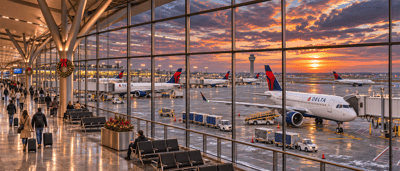
Airport terminal at sunset with travelers walking past windows overlooking Delta Air Lines planes parked at gates.

Key Points

  • Major carriers like United, Delta, and JetBlue are cutting off-peak winter seat capacity to prioritize yield management over market share amid rising costs.
  • Spirit Airlines' liquidation reduced ultra-low-cost fare competition, giving remaining carriers more pricing leverage while elevated jet fuel and infrastructure costs pressure margins.
  • Delta and United show stronger balance sheets and liquidity than JetBlue, which remains a higher-risk turnaround story despite improving unit revenue trends.
  • Special Report: They voted for it. They didn’t read it. tc pixel

The Thanksgiving travel window often sets the tone for the winter aviation market. Ahead of the late-November rush, domestic holiday flight bookings are running slightly behind previous levels, and middle-income households are spending less on winter airfare.

Yet AAA reports that domestic Thanksgiving round-trip flights booked through its services average roughly $800, up 17% year over year. This pricing resilience is no accident. Major network and hybrid carriers are actively adjusting off-peak winter seat capacity to counter macroeconomic headwinds and elevated operating costs. By reassessing marginal flights on their schedules, management teams are prioritizing yield management over market share.

Musk says this ramp will be faster than anything in history (Ad)

Musk says production of his new breakthrough will ramp faster than anything in human history, and he calls it 1,123x bigger than Tesla's cars.

Jeff Brown of Brownstone Research is tracking Musk's small-cap suppliers. Past Tesla-linked winners include Piedmont Lithium (395% in 24 hours), Blink Charging (4,951% in 10 months) and EcoPro (17,153% in just over three years).

Brown says he has found one tiny company at the center of the ramp and believes Musk could announce a deal with it soon.

Watch Jeff Brown's strategy session on Musk's small-cap suppliers before it comes down.tc pixel

This capacity discipline marks a structural shift for an industry historically known for chasing volume, creating a potentially compelling setup for the months ahead.

Fewer Seats, Higher Yields

In past economic cycles, operators often responded to softening passenger volume by slashing ticket prices to fill empty seats. That strategy routinely eroded margins and destroyed shareholder value. Today, network planners at United Airlines Holdings (NASDAQ: UAL), Delta Air Lines (NYSE: DAL), and JetBlue Airways (NASDAQ: JBLU) are demonstrating a commitment to preserving margins by adjusting seat supply to match profitable demand.

By selectively adjusting off-peak winter schedules, these operators seek to capture higher unit revenues rather than fill every available seat. In the third quarter, United Airlines Holdings held capacity growth to about 1.3% year over year. This restraint coincided with nearly 16% growth in total revenue per available seat mile.

United reported a modest decline in its overall passenger load factor alongside a roughly 17% increase in yield. Delta Air Lines followed a similar strategy, keeping third-quarter seat supply flat while driving roughly 15.4% adjusted unit revenue growth. For investors evaluating the travel and leisure sector, this willingness to ground uneconomic flights illustrates a disciplined focus on sustainable cash flow.

Capturing Market Share in a Post-Spirit Airspace

The broader domestic market structure supports this newfound pricing power. Spirit Airlines' liquidation earlier this year removed a layer of ultra-low-cost fare discounting from domestic travel corridors. The departure of the industry's largest budget carrier altered the supply landscape, allowing remaining operators to regain pricing leverage.

JetBlue Airways capitalized on this consolidation by acquiring 22 former Spirit slots at LaGuardia Airport. While the airline grew systemwide capacity by 2.3% in the third quarter, it strategically expanded local seat capacity in key markets such as Fort Lauderdale. This targeted approach lifted third-quarter unit revenue by about 18.4%.

Beyond physical seat constraints, carriers rely on capital-light revenue streams to bolster operating margins without adding excess inventory. Delta Air Lines continues to leverage its lucrative American Express co-brand partnership, which is projected to generate more than $9 billion in remuneration this year.

Similarly, the capital-light Blue Sky loyalty and booking partnership between United Airlines Holdings and JetBlue Airways reached key milestones. Travelers have redeemed more than one billion TrueBlue points on United flights, while JetBlue's loyalty revenue grew roughly 20%. These diversified income channels help offset the cyclical nature of physical ticket sales.

Up-Gauging Against Fuel and Infrastructure Headwinds

Capacity discipline largely reflects severe operating cost pressures. Geopolitical supply tensions pushed third-quarter jet fuel prices up about 60% year over year across the sector. This spike added roughly $1.6 billion to Delta Air Lines' adjusted fuel expenses and $1.8 billion to United Airlines Holdings' expenses. Non-fuel unit costs also trended higher following recent labor contract increases.

Infrastructure disruptions remain a persistent headwind. A nationwide FAA communications outage caused widespread cancellations, affecting nearly 18% of scheduled U.S. flights during the mid-November disruption. Analysts estimate this disruption could cost Delta Air Lines up to $244 million and JetBlue Airways up to $73 million in the fourth quarter. Extended regulatory flight caps at constrained hubs such as Chicago O'Hare further limit supply expansion.

To counter these margin pressures, carriers are emphasizing higher-yield products. Delta Air Lines and United Airlines Holdings continue to see resilient demand for their high-margin premium cabins, which absorb cost shocks better than basic economy fares. JetBlue Airways is following suit with its turnaround plan. The carrier recently raised first-checked-bag fees to the $50-$70 range and plans to debut its domestic first-class product in early December.

Fortunately for unhedged operators, recent macroeconomic shifts offer some immediate relief. With U.S. crude oil prices retreating below $90 per barrel, airlines could realize cost savings against their conservative fourth-quarter fuel estimates of $4.25 to $4.80 per gallon. At its recent quarterly fuel consumption rate, JetBlue's fuel expense would fall by roughly $22 million for every 10-cent decline in jet fuel prices.

Finding Value in Airline Cash Flows and Turnarounds

Focusing on capacity-disciplined operators helps distinguish self-funding industry leaders from distressed turnaround stories. Legacy carriers with durable margins can generally absorb energy and regulatory shocks while preserving equity value.

Delta Air Lines maintains a healthy balance sheet, with a debt-to-equity ratio near 0.42, and projects about $2.5 billion in free cash flow for the year. Delta successfully executed a $500 million debt refinancing, demonstrating strong access to credit despite elevated interest rates. Smart money appears to recognize this stability. Berkshire Hathaway increased its stake in Delta by 12% in the third quarter, building a position valued at nearly $5.4 billion.

United Airlines Holdings also presents an interesting profile. United Airlines stock trades at roughly nine times forward earnings and carries a low price-to-cash-flow multiple. United holds about $17.7 billion in liquidity, providing a buffer as it manages capital expenditures. The recent regulatory certification of Boeing's 737 MAX 10 clears a multiyear delivery bottleneck, positioning United for fleet-efficiency gains as the company moves into 2027.

JetBlue Airways is a higher-beta recovery play. Trading at a fraction of its book value, the company carries a heavier debt load but retains about $2.2 billion in liquidity. While JetBlue reported operating cash burn in the third quarter, aggressive capacity cuts and unit revenue growth signal a stabilizing foundation. An independent director recently bought 100,000 shares of JetBlue on the open market, signaling confidence in the turnaround strategy.

Adjusting Your Radar for Airline Investments

The aviation industry is navigating a complex environment of rising operating costs, infrastructure constraints, and shifting consumer budgets. However, management teams are adapting by prioritizing yield and profitability over raw market share.

Investors monitoring the travel sector should watch how effectively these companies manage their winter schedules. Favorable capacity adjustments, moderating fuel costs, and expanding premium product lines create a supportive backdrop for margin expansion. Investors with a long-term horizon might consider tracking companies that consistently demonstrate operational discipline and sustainable free cash flow generation as the market moves toward 2027.


Additional Reading from MarketBeat

Lowe's Earnings Beat Looked Strong Until a 34-Cent Tariff Refund Changed the Math

Written by Chris Markoch. Originally Published: 11/19/2026.

Lowe's logo displayed over a blurred store aisle with tool displays including DeWalt, Kobalt, and Craftsman brands.

Key Points

  • Lowe's beat third-quarter earnings and revenue estimates and raised its full-year sales outlook, but a tariff refund boosted EPS by 34 cents, masking a weaker underlying result.
  • Gross and operating margins declined year-over-year, and excluding the one-time tariff refund, adjusted EPS would have missed consensus expectations for the quarter.
  • Lowe's stock reaction was muted because growth remains tied to a housing market recovery that has not yet materialized, despite the company's Dividend King status and acquisitions expanding its Pro business.
  • Special Report: Your book is inside tc pixel

Lowe's Companies, Inc. (NYSE: LOW) reported third-quarter earnings that beat expectations on both earnings and revenue and raised its full-year sales outlook. The market got what it expected from Lowe's, but the stock had a muted reaction. Following its earnings report on Wednesday, Nov. 18, shares opened nearly 4% lower before recovering to trade slightly higher by mid-afternoon.

In this case, a tariff refund flattered earnings per share (EPS) by 34 cents. Without that nonrecurring credit, the company's profit would have missed expectations.

The investigation Porter spent tens of thousands to document (Ad)

Porter Stansberry flew the Porter and Co. team 3,300 miles to Dublin to investigate a 17-year investing experiment called Project Prophet - and documented everything on film.

Rooted in the laws of physics, this quantitative approach challenges conventional wealth-building wisdom. With 17 years of verified data behind it, Porter calls it unlike anything he has seen in nearly 30 years in the business.

Watch the full investigation and decide for yourselftc pixel

Over the last five years, LOW has delivered a roughly flat total return. That includes the company's dividend, which has a yield of about 2.25%. That has made the stock a difficult hold, but it accurately reflects the market in which Lowe's operates. Its results are tied to the housing market, tariffs, and inflation.

The company's Q3 report showed that Lowe's is still controlling what it can control. Investors have to decide whether that's enough reason for growth investors to own the stock while they wait for a housing recovery.

Check the Receipt: Lowe's Earnings Beat Has a Catch

Lowe’s reported adjusted EPS of $3.10, up 1.3% from $3.06 a year ago. That topped consensus estimates of roughly $2.85 to $2.90. Revenue climbed 9.3% to $22.8 billion, ahead of the roughly $22.4 billion analysts expected.

The context for that top-line growth is important. Most of it came from acquisitions, including Foundation Building Materials (FBM) and Artisan Design Group (ADG).

Comparable sales rose a more modest 1.8%. Still, that was an improvement after two consecutive quarters of slowing comps. Online sales jumped 17.4%, and management cited solid performance in Pro and home services.

Margins told a different story. Gross margin fell to 32.95% from 34.19% a year earlier. Operating margin slipped to 11.32% from 11.92%. Part of that reflects the lower-margin distribution businesses added to the mix. However, another part reflects cost pressures that haven’t gone away.

Then there’s the refund. Lowe’s recognized about $250 million in pre-tax IEEPA tariff refunds in the quarter. That added 34 cents to EPS. Strip it out, and adjusted EPS lands near $2.76, short of expectations.

The guidance update follows the same pattern. Lowe’s raised its full-year sales outlook to about $92.5 billion from $92 billion. It now expects comparable sales to rise about 0.5%, versus flat previously. But it trimmed its adjusted operating margin target to 11.5% from 11.6%.

Adjusted EPS guidance held at roughly $12.25. That figure now includes the third-quarter refund. In other words, the outlook for core earnings effectively moved lower.

A Housing Recovery Isn’t on the Calendar Yet

The housing market is the elephant in the room for Lowe’s and its competitors, such as Home Depot (NYSE: HD) and Builders FirstSource (NYSE: BLDR). Recent housing data offer a mixed but cautious picture of the U.S. market, suggesting that headwinds will continue to limit near-term growth.

Affordability remains stretched, and many homeowners are staying put. That slows the big-ticket remodeling projects that drive some of Lowe’s most valuable sales. Larger discretionary purchases remain under pressure.

Lowe’s could be one of the biggest winners when the housing market recovers. That day isn’t here yet, and it’s hard to see the market ramping up over the next several quarters.

But Lowe’s is building for that day. The FBM deal added roughly 370 locations focused on professional contractors. Many are in markets where Lowe's has less of a presence. That expands its reach among Pro customers, a segment where Home Depot has long held the edge. Stifel made that point when it recently downgraded LOW to Sell.

Lowe's Stock Tests Its 200-Day Moving Average

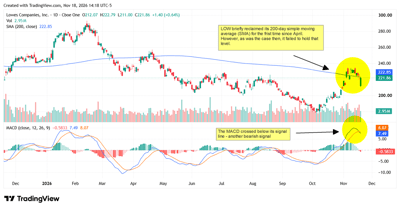
The chart reflects that tug-of-war. LOW rallied from around $192 in mid-October to above $230 in early November. That move pushed the stock above its 200-day simple moving average (SMA) for the first time since April.

This week, shares slipped back to that line, which sits near $222.85. The MACD indicator also crossed below its signal line, a bearish signal. On the positive side, buyers stepped in quickly after the stock touched $211 at the open. Whether LOW can reclaim the 200-day SMA may show which story the market believes.

Lowe's (LOW) stock chart shows a failed break above the 200-day moving average and a bearish MACD crossover.

Lowe's Is Built to Last, Not to Sprint

Lowe's is a stock that falls into the category of knowing what you own. It is one of the bluest of blue-chip stocks. Backing up that statement is the fact that over 74% of the stock's float is owned by institutions. It also has a stable, well-documented business model, which was on display again in this earnings report.

Plus, Lowe’s is a Dividend King that has now raised its dividend for 53 consecutive years. That’s the kind of consistency that makes it a staple for income-oriented investors.

That consistency comes with a trade-off. Lowe’s isn’t likely to deliver much growth until housing turns. And the tariff refund made this quarter look cleaner than it was. Investors who own LOW for its dividend and long-term recovery potential got little reason to sell. Investors looking for near-term upside got little reason to buy.

Thank you for subscribing to The Early Bird, MarketBeat's 7:00 AM newsletter that covers stories that will impact the stock market each day.
 
This email content is a sponsored message from Base Camp Trading, a third-party advertiser of The Early Bird and MarketBeat.
 
If you have questions about your account, don't hesitate to email MarketBeat's support team, based in the United States, at contact@marketbeat.com.
 
If you no longer wish to receive email from The Early Bird, you can unsubscribe.
 
© 2006-2026 MarketBeat Media, LLC. All rights reserved.
345 N Reid Place, Suite 620, Sioux Falls, SD 57103. United States..

 
Link of the Day: A $1 invitation for people who ask why tc pixel

Page List

Blog Archive

Search This Blog

5 Tips for Investing in Volatile Markets Without Panicking

Volatile markets can create opportunities for investors who stay disci...  ‌ ‌ ‌ ‌ ‌ ‌ ‌ ‌ ‌ ‌ ‌ ‌ ‌ ‌ ‌ ‌ ‌ ‌ ‌ ‌ ‌ ‌ ‌ ‌ ‌ ‌ ‌ ‌ ‌ ‌ ‌ ‌...