| Unsubscribe |
Hey Trader,
Everyone is mad at me!
I guess I shouldn't have expected to win any friends in the industry by giving away my proprietary "Snapback Indicator" for just $7.
No recurring billing or anything like that.
Just seven bucks and it's yours for life. The indicator shows you when it's time to sell (or go short) and when it makes sense to buy.
Don't make another trade until you check it for a potential "Snapback."
Black Friday Discount Activated! Get the "Snapback" Indicator For Just $7
In your corner,
Thomas Wood
Base Camp Trading
P.S. Others paid $500 for this. So why am I giving you such an outlandish discount on this incredible indicator? Full explanation here.
From Berlin to Brussels: Tesla's $3.3 Billion Robotaxi Gamble
Written by Jeffrey Neal Johnson. Published: 11/19/2026.
Key Points
- Tesla committed about $3.3 billion to expand its Berlin-area Gigafactory, targeting production of up to one million autonomous Cybercabs by 2029.
- European regulations still restrict large-scale approvals for driverless robotaxis, making the timing of future regulatory changes critical to Tesla's expansion.
- Tesla's substantial cash reserves support its manufacturing ambitions, but regulatory uncertainty, execution costs, and its premium valuation remain significant risks.
- Special Report: A $247 tool for $7 (From Profits Run)
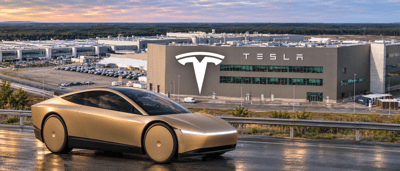
European Union small-series approval rules currently limit registrations of fully driverless cars to 1,500 units per model each year. Despite this tight restriction, Tesla, Inc. (NASDAQ: TSLA) recently committed approximately $3.3 billion to expand its manufacturing facility near Berlin. The objective is to begin production in 2029 and eventually produce up to one million autonomous Cybercabs annually.
This scenario creates an interesting dynamic for investors. Why would an automaker deploy billions of dollars into a market where its core product is effectively restricted from mass adoption?
The investigation Porter spent tens of thousands to document (Ad)
Porter Stansberry flew the Porter and Co. team 3,300 miles to Dublin to investigate a 17-year investing experiment called Project Prophet - and documented everything on film.
Rooted in the laws of physics, this quantitative approach challenges conventional wealth-building wisdom. With 17 years of verified data behind it, Porter calls it unlike anything he has seen in nearly 30 years in the business.
Watch the full investigation and decide for yourselfThe answer lies in looking beyond traditional market-share battles and focusing on upcoming regulatory shifts. Tesla is deploying excess capital to get ahead of new autonomous safety standards before Brussels officially lifts volume caps. Understanding this timeline provides a clearer picture of how Tesla intends to build a localized manufacturing moat over the next few years. Seeing how the regulatory roadmap aligns with the company’s financial runway helps put this aggressive capital deployment in context.
1 Million Cybercabs Vs. a 1,500-Vehicle Limit
The recent capital allocation for the Gigafactory Berlin-Brandenburg plant represents a calculated wager on the future of European transport. The expansion will fund a new production hall, while separate plans call for localized battery cell manufacturing slated for mid-2027. Once production begins in 2029, the facility aims to eventually assemble up to one million steering-wheel-free Cybercabs annually, alongside the existing Model Y production lines.
This capacity target contrasts sharply with current European Union small-series type-approval rules. Under existing regulations, fully automated vehicles using the small-series approval route face a hard ceiling of 1,500 registrations across the entire 27-nation bloc. Building infrastructure for one million vehicles in a market where approvals are capped at 1,500 units requires foresight and financial endurance.
For investors monitoring Tesla, which recently traded near $382 with a market capitalization hovering around $1.5 trillion, this discrepancy is central to the thesis. Shares have consolidated near their moving averages as Wall Street weighs the costs of autonomous scaling against an elevated trailing price-to-earnings ratio. Rather than viewing the Berlin expansion as a conventional effort to defend European electric-vehicle margins, investors might see it as a forward-looking strategy to build capacity years ahead of legal demand.
Reading the Regulatory Road Signs in Europe
The strategic foundation for this multibillion-dollar investment rests on an impending global policy update. The United Nations Economic Commission for Europe adopted a harmonized global safety framework for Automated Driving Systems earlier this year. The framework has not yet been incorporated into EU law, although the European Commission has proposed applying related requirements starting in January 2027.
While individual national permits and the 1,500-unit European small-series cap remain binding today, the United Nations framework provides a technical standard the European Commission could use to establish large-series type approvals.
Tesla is actively working to influence regulators by demonstrating real-world reliability and building the necessary safety case. Analysts note that Tesla has accumulated about 5.3 million unsupervised miles in the United States, with more than 1,300 robotaxis registered in Texas alone. This empirical data could form part of the safety case Tesla presents to European authorities, showcasing round-the-clock autonomous operations across eight active markets.
Meanwhile, Tesla is seeking wider approval for its supervised driving software on Hardware 4-equipped vehicles across Europe. This could expand access to the software as more countries grant approval. Finland recently became the 11th European nation to approve a supervised version of the software, illustrating slow but steady regulatory momentum. That momentum could pave the way for fully unsupervised approvals by the time the Berlin expansion goes live, although driverless robotaxis require separate authorization.
A Fortress Balance Sheet Built for Heavy Lifting
Funding a $3.3 billion expansion years before its revenue can be fully realized requires exceptional financial flexibility. Fortunately, Tesla operates with a fortress balance sheet that can absorb upfront infrastructure costs without straining liquidity or diluting shareholders.
The third-quarter earnings report highlights this capital capacity. Tesla holds about $45.45 billion in cash and short-term investments, along with $30 billion in unused credit commitments. Adjusted earnings before interest, taxes, depreciation, and amortization reached about $3.9 billion for the quarter, while free cash flow totaled $1.53 billion. Core automotive gross margins, excluding regulatory credits, also improved sequentially, reaching 18.1%.
Tesla is demonstrating capital discipline in support of its autonomous ambitions. Management's decision to end Cybertruck production by the end of summer 2027, after initially targeting mid-2027, effectively retires a lower-volume product line, freeing up factory floor space and engineering resources. By moderating overall 2026 capital expenditure guidance to just above $20 billion, leadership can comfortably direct funds toward the Berlin buildout.
This heavy spending does come with near-term financial trade-offs. Heavy research and development outlays have compressed operating margins to about 2.6%, and trailing return on invested capital has eased to 3.9%. Tesla is absorbing this margin compression now, accepting a dip in near-term profitability to secure a structural advantage later.
Lapping Cautious European Automakers on Their Home Turf
Committing capital today could create a manufacturing moat against regional competitors. If the Berlin facility reaches its combined target of 1.38 million vehicles annually, it would surpass the production capacity of Europe's largest legacy auto plants.
This expansion comes as domestic German automakers pull back. Volkswagen AG (OTC: VWAGY) is navigating domestic staff reductions and restructuring efforts to protect profitability. Mercedes-Benz Group AG (OTC: MBGAF) recently paused certain domestic plant investments to conserve cash amid a shifting automotive landscape.
The competitive landscape for autonomous technology in Europe is currently dominated by asset-light pilot programs rather than heavy manufacturing commitments. Alphabet Inc. (NASDAQ: GOOGL) operates its Waymo unit through municipal trials and is preparing for gradual rollouts in cities such as Munich and London. Baidu, Inc. (NASDAQ: BIDU) and other software-first developers are running similarly restricted test fleets in select European countries.
These competitors largely design software for existing vehicle platforms or rely on third-party manufacturing. If Brussels lifts the small-series volume caps by 2029, a localized facility producing proprietary battery cells and dedicated autonomous hardware could give Tesla a volume advantage that pilot-stage software developers cannot quickly match.
Checking the Mirrors Before Taking a Position
While the strategic rationale for the Berlin expansion is clear, investors still face execution and governance risks. Tesla's stock trades at a premium valuation, carrying a high forward price-to-earnings ratio. This elevated multiple suggests the market has already priced in future autonomous success, leaving little room for regulatory delays or manufacturing missteps.
The company also faces commercial hurdles. The $299 monthly Autonomy Subscription required for select personal Cybercab buyers has drawn internal and external scrutiny over consumer price elasticity. It remains to be seen how broadly consumers will adopt a recurring fee of that size. Additionally, recent tax-related and discretionary insider selling by executives and directors could signal a lack of internal conviction at current price levels, something investors should monitor.
Despite these near-term friction points, Wall Street remains generally constructive. The consensus price target hovers around $414, offering modest implied upside, and short interest remains low at about 2% of the float.
For those evaluating Tesla's stock, the $3.3 billion German investment acts as a well-funded call option on European deregulation. Investors may want to add Tesla to their watchlist and monitor upcoming European Commission rulings on automated driving frameworks, as any changes to the timeline for large-series approvals will directly affect the Berlin facility's return profile.
3 Large-Cap Stocks Are Outperforming the S&P 500 Without AI Hype
Written by Chris Markoch. Published: 11/16/2026.

Key Points
- Costco, Apple, and Visa have outperformed the S&P 500 in 2026 without relying on the AI infrastructure trade.
- Costco's special dividend, Apple's new product lineup, and Visa's payment growth provide catalysts.
- Premium valuations remain a consideration despite the companies' strong performance.
- Special Report: It's costing you money (From The Cycle Code)
Every market cycle has its lottery tickets that are hard to resist, and the AI trade has been no different. Investors who got into NVIDIA (NASDAQ: NVDA), Micron Technology (NASDAQ: MU), Palantir Technologies (NASDAQ: PLTR), or Sandisk (NASDAQ: SNDK) at the right time booked healthy profits.
However, many of these stocks have a tendency to rise and then fall. Chasing momentum is not for the faint of heart.
Do You Own Any of These 10 Stocks? See This Warning Before Dec. 10 (Ad)
Joel Litman, a professor who has lectured at Harvard and Wharton, is warning of a $33 trillion grid crisis that could ignite as soon as Dec. 10. He says that if nothing changes, it could bring "the end of the global economy as we know it."
Litman predicted the 2020 crash just weeks before it happened. Around the 2008 crisis, he named 57 companies he said would collapse, and 50 did.
He and Altimetry's Rob Spivey have a list of 10 widely held stocks they recommend selling before Dec. 10.
See the 10 stocks Altimetry recommends selling before the Dec. 10 warning date.That has caused many investors to look for safety. But avoiding volatility doesn't mean settling for small gains. For example, three familiar large-cap stocks are up more than 20% in 2026, outpacing the S&P 500 without the headline noise.
Familiarity Breeds Indifference
Over any significant period, fundamental factors such as profits, free cash flow, and market share drive stock price growth. But on a day-to-day basis, headlines can create asymmetric opportunities that last longer than the fundamentals suggest they should.
Against that backdrop, stocks that deliver steady growth may not seem psychologically attractive. But overlooking them can be a mistake. Qualities such as pricing power, loyal customers, and durable growth—which investors hope to find someday in a moonshot—are often right in front of them in household-name stocks.
Critics will argue that many of these stocks, attractive as they may seem, can carry premium valuations. It's a fair point. Investors should avoid overpaying for any stock, regardless of its size or perceived safety. The three stocks below offer proven performance, with catalysts that help justify their high multiples.
Costco's Special Dividend Is a Bonus, Not a Gimmick
On Nov. 10, Costco Wholesale Corp. (NASDAQ: COST) announced it would issue a special dividend of $30 per share. The move was widely expected, but investors shouldn't downplay its significance. Costco isn't rewarding shareholders just to keep them interested; the dividend is a bonus on top of a continuing trend of bullish growth.
Costco has delivered seven consecutive quarters of revenue growth that exceeded expectations. In five of those quarters, the company also beat expectations for adjusted earnings per share (EPS). The driving force is Costco's membership model, which keeps traffic coming through the door despite the impact of inflation.
COST is up more than 26% in 2026 and is trading near its 52-week high following the special dividend announcement. That puts the company's Dec. 10 earnings report in sharp focus as investors weigh a stock price above $1,000 per share and a valuation multiple that is high compared with the company's historical levels and the broader market.
The answer may be that you get what you pay for. In Costco's case, investors have received unmatched predictability that shows no signs of slowing.
Apple's Next Chapter Is off to a Strong Start
Apple (NASDAQ: AAPL) has been one of the best-performing technology stocks, holding up despite the sector's recent sell-off. One reason is that Apple doesn't rely on massive AI infrastructure capital expenditures (CapEx) to fund its growth.
But saying what a company is not isn't the same as saying what it is. That distinction has been a concern as investors grew restless about what seemed like a lack of innovation and wondered what life after former chief executive officer (CEO) Tim Cook would look like.
The first question has started to be answered with the long-awaited launch of the iPhone Duo. The second part is also off to a strong start. In the company's first earnings report with its new CEO, John Ternus, Apple reported its best-ever fiscal year for revenue and earnings per share (EPS).
AAPL is up more than 30% in 2026 and was trading near its 52-week high as of the market close on Nov. 12. The stock has moved above its consensus price target of $347.11. However, since Apple's earnings report, several analysts have raised their price targets above the consensus, including Guggenheim, which set a $400 price target for AAPL.
Visa's Revenue Grows With Every Transaction
If Costco is where consumers shop, Visa Inc. (NYSE: V) provides the payment network that allows their transactions to go through. In the company's latest earnings report, net revenue increased by 13%—a significant gain at a time when many retailers, including Costco, continue to warn that consumers are under pressure.
More importantly, the company expects low-double-digit net revenue growth to continue in the coming quarters. Cross-border payment volume is another catalyst, having grown by 14% in constant dollars.
Visa stock is up about 20% in 2026 and has dipped slightly from its 52-week high. A more significant pullback could create an attractive buying opportunity as analysts continue to raise their price targets above the current consensus target of $443.35.
This email message is a sponsored email sent on behalf of Base Camp Trading, a third-party advertiser of InsiderTrades.com and MarketBeat.
If you need help with your newsletter, don't hesitate to contact our support team, based in South Dakota, at contact@marketbeat.com.
If you no longer wish to receive email from InsiderTrades.com, you can unsubscribe.
© 2006-2026 MarketBeat Media, LLC. All rights reserved.
345 N Reid Place, Sixth Floor, Sioux Falls, S.D. 57103-7078. United States of America..