| Unsubscribe |
A lot of investors are wondering when the AI bubble will burst…
Wrong question.
The question you should be asking is:
What happens in the decade after it pops?
Here's why:
In March 2000, the Dot-Com Bubble finally popped.
The Nasdaq began its long march down – eventually falling 78%.
But during the decade after the bubble burst…
Something extraordinary happened.
Gold went on a historic bull run.
Better yet, a handful of gold miners produced gains of 50X... 53X... 252X… and even 362X. Just a $2,000 stake in each of those gold miners…
Would have handed you $1,437,320.
History may not repeat – but it sure rhymes.
That's why I've identified the four best miners for the next "Great Rotation" out of AI stocks and into gold miners.
I'm Garrett Goggin.
I'm a CFA and CMT who's spent more than 20 years studying gold and the cycles that move money from one asset class to another.
I also spent 15 years working alongside legendary gold analyst John Doody.
Here's the single most valuable lesson I've learned in my career:
The best time to make a fortune is AFTER a major market correction...
When trillions of dollars move out of growth stocks and into hard assets. I call this kind of move a "Great Rotation."
That process is already happening again.
Look…
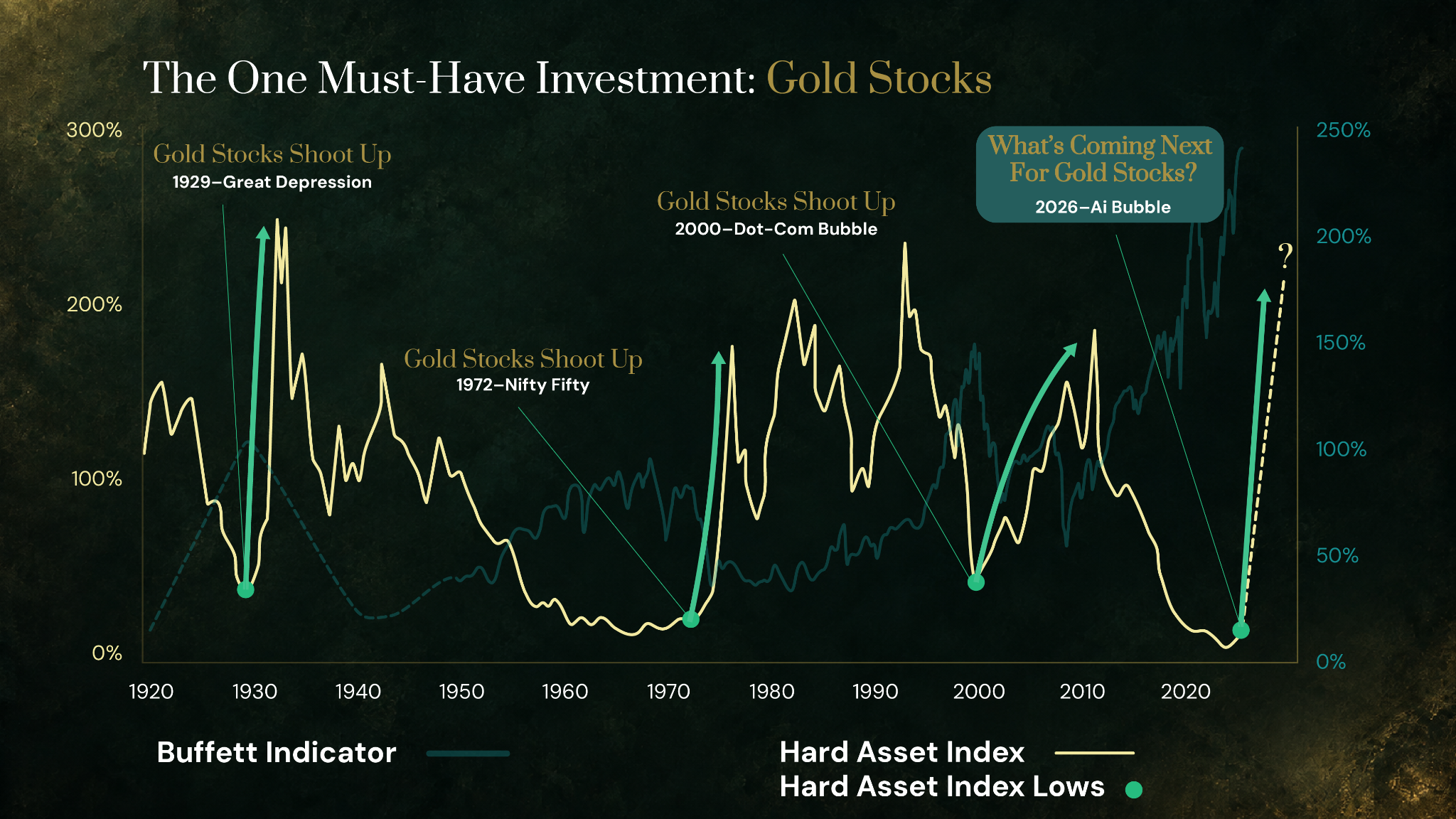
Hard assets like gold stocks soar when a "Great Rotation" hits.
You can forget about predicting the exact day AI stocks peak. Instead…
Ask yourself: where will money rotate next?
If you want to know what history says…
Regards,
Garrett Goggin, CFA, CMT
Lead Analyst and Founder, The Golden Portfolio
Qualcomm Beat Earnings, But Its Fastest-Growing Businesses Have a Catch
By Sam Quirke. Article Published: 11/5/2026.

Key Points
- Qualcomm beat fiscal fourth-quarter earnings expectations, but its stock fell sharply as investors focused on weaker handset revenue and margin pressures.
- Automotive revenue increased 89% year over year, while Qualcomm expects data-center revenue to reach $5 billion in fiscal 2027.
- Apple's shift to in-house modems and rising semiconductor costs remain concerns as Qualcomm expands beyond smartphones.
- Special Report: Last note from me on this (From The Cycle Code)
When a company beats expectations on both the top and bottom lines in its earnings report, yet its stock still drops in the immediate aftermath, the market is trying to tell you something. Qualcomm Inc. (NASDAQ: QCOM), the chip giant, handed investors exactly that puzzle after its fiscal fourth-quarter 2026 results landed on Nov. 4.
The headline looked clean enough. Revenue and earnings both edged past consensus, a solid double beat that would normally earn a company a pat on the back and give its shares a good reason to rise.
I'm handing you this stock today (Ad)
Elon doesn't own the chip inside his Teslas or Starlink dishes. He licenses it from one little known public company.
Now he's planning 1,000,000 AI satellites in orbit, and every one could pay this company a royalty.
Analyst Dylan says the window to get in closes around December 8th, before new money floods into the buildout.
Download this free stock pick before December 8th arrivesHowever, despite the earnings beat, Qualcomm shares were trading down close to 10% in premarket trading on Nov. 5, a move that threatens to send the stock back to 2020 levels. For a business that has spent the past year trying to convince investors it’s ushering in a new era, this isn’t a great look. So why are investors so spooked, and could they be overreacting?
Qualcomm’s Headline Beat Ran Into a Soft Outlook
The quarter itself was solid. Against a market thrown into turmoil by surging memory costs, Qualcomm beat expectations on both the top and bottom lines, even as its revenue continued to contract. At the same time, emerging segments like automotive saw strong revenue growth. From that perspective, Qualcomm executed well in a difficult environment.
The problem was the outlook. Management guided for next-quarter revenue with a midpoint of $10.8 billion, slightly above analyst expectations, but its non-GAAP earnings per share (EPS) midpoint of $2.25 landed slightly below consensus. In other words, Qualcomm expects to sell more but earn less than investors had forecast, and that’s rarely a combination the market wants to see.
For a stock that has long traded on the strength of its margins rather than sheer scale, soft guidance like this was always going to spook investors. The reason lies in Qualcomm’s ongoing shift away from its historical reliance on handset revenue. That revenue was down more than a quarter year over year, and Qualcomm expects another sequential decline as Apple Inc. (NASDAQ: AAPL), long a key customer, continues to shift its modem business in-house.
That shift is at the center of the soft outlook and the market’s reaction: Qualcomm is watching formerly dependable, high-margin handset revenue walk out the door faster than its newer, lower-margin businesses can backfill it.
The Diversification Efforts Are Starting to Pay Off
Here’s where the bull case gets its oxygen, however. Qualcomm’s automotive segment posted its first quarter near $2 billion, up nearly 90% from a year earlier—a seriously eye-catching figure for a business the market once treated as a side project.
Qualcomm’s data center ambition is the other leg. Management now expects its nascent server chip business to contribute north of $650 million next quarter and has reaffirmed a $5 billion revenue target for fiscal 2027.
Combined with the Internet of Things (IoT) segment, these businesses are projected to grow more than 60% in fiscal 2027. If Qualcomm hits those marks, the handset decline could become less central to its investment story, and today’s valuation could look much more attractive. The catch is that much of that projected growth still has to materialize in fiscal 2027, and the market has become increasingly reluctant to pay up for growth that hasn’t yet materialized.
The Apple Hole Is Still There
To be sure, the bears have the more immediate point. Qualcomm’s modem supply relationship with Apple has been the elephant in the room for years, and declining chip sales continue to haunt the company’s quarterly reports. While there are plenty of reasons to be excited about where Qualcomm could be in a year, the near-term outlook is rocky. Yes, automotive might be growing fast, but even its latest red-hot numbers can’t fully plug the hole left by shrinking handset sales. Qualcomm’s data center story, meanwhile, is only beginning its revenue ramp.
The bear case, in the end, is a bet on timing: Qualcomm knows its Apple modem revenue is declining but has yet to demonstrate that automotive and data center growth can consistently offset it. Until those newer engines are large enough to counter handset weakness, each soft outlook may reinforce concerns about Qualcomm's transition.
Qualcomm’s Hold Rating Reflects a Timing Bet
Weighing all that up, the market’s reaction to the earnings report looks less like panic and more like a repricing of that timing risk. A double beat on the headline numbers is nice, but investors will always price a stock based on its coming earnings, not its past ones.
That tension helps explain why Qualcomm shares currently carry a MarketBeat consensus Hold rating, and the latest report does little to settle the debate. The diversification story is real and, in automotive, already working, but analysts may want more evidence that the newer businesses can offset handset weakness before turning more bullish.
3 Stocks Wall Street Likes More Than the Market Does
By Nathan Reiff. Article Published: 11/11/2026.

Key Points
- Cigna, Toll Brothers, and General Motors trade at relatively low valuations despite strong fundamentals and favorable analyst ratings, suggesting the market may be undervaluing them.
- Cigna raised its full-year adjusted earnings outlook and has cut its share count by a fifth over five years while trading at about 9x forward earnings.
- General Motors beat Q3 2026 revenue and earnings expectations, approved a new $20 billion buyback, and trades around 6x forward earnings despite tariff and EV headwinds.
- Special Report: I'm handing you this stock today (From Behind the Markets)
Favorable analyst ratings don't necessarily mean a company's share price will rise. Sometimes the market lags behind a bullish Wall Street assessment, leaving quality companies at relatively low earnings multiples even as they accumulate Buy ratings. The key is for investors to identify those companies before the broader market catches on.
Cigna Group (NYSE: CI), Toll Brothers Inc. (NYSE: TOL), and General Motors Co. (NYSE: GM) could all fit that description. These companies have notable strengths, including substantial free cash flow, disciplined share-count management, and relatively low valuations. Each offers a unique but compelling case for why investors may be overlooking an opportunity to buy before prices rise.
Cigna Combines Low Valuation With Strong Buybacks and Improving Earnings
Last note from me on this (Ad)
Joel Peterson's free workshop breaks down a three step, three color system that works across stocks, ETFs, gold, and other assets.
The hour long session answers the question every investor faces: when to buy, when to sell, or when to simply hold steady.
Sessions run every day, including evenings and early mornings, so there's a slot that fits any schedule.
Reserve your free session now and see the full planHealth services giant Cigna announced nearly 6% year-over-year (YOY) revenue growth and beat expectations on both the top and bottom lines for Q3 2026. However, the biggest news from the company's latest earnings report may be its higher full-year adjusted earnings outlook: at least $30.60 per share, up from a previous floor of $30.45.
Evernorth, which includes the company's pharmacy benefit and specialty businesses, has continued to drive growth. However, it will likely face new pressures in the coming quarters due to industry-wide shifts in rebates and an overall reduction in the number of employers offering coverage for GLP-1 drugs for weight loss.
Nonetheless, across its pharmacy benefit, specialty, and care services businesses, Cigna expects at least 10% adjusted earnings per share (EPS) growth in 2027 from its ongoing businesses.
Cigna trades at a relatively modest 9x forward earnings, a sizable discount to the broader market. The company has taken advantage of this valuation by reducing its share count by a fifth over the last five years, including approximately $500 million in repurchases during the first nine months of 2026. The 2025 sale of its Medicare Advantage business helped make this possible.
An improving earnings outlook, strong buybacks, and a low valuation may point to an overlooked stock, but Wall Street rates CI shares a Moderate Buy overall. Risks remain, however. In addition to pressures on its pharmacy benefit business, Cigna is preparing to roll out its Signature pharmacy pricing model to fully insured customers in 2027, while costs continue to rise.
Toll Brothers' Customer Base Is Resilient, Even If the Market Hasn't Noticed
Homebuilder stocks have faced a difficult macro environment, as affordability pressures and waning consumer sentiment have weighed on performance. However, Toll Brothers is in a unique position because of its luxury brand and customer base. Its homes sold for an average of about $996,400 in Q3 2026, and its affluent buyers may have been better able to weather inflation in recent years.
The company's luxury move-up segment accounted for 61% of Toll Brothers' Q3 2026 home sales revenue. A 25% cash-purchase rate helped give management the confidence to reaffirm its full-year outlook for fiscal 2026. The company also had $3.3 billion in liquidity and a net debt-to-capital ratio of 15.6% at the end of Q3.
That said, TOL shares still trade at around 11.5x forward earnings and a modest premium to book value. By comparison, rivals like NVR Inc. (NYSE: NVR) and Lennar Corp. (NYSE: LEN) both trade above 17x forward earnings. This may suggest that the market isn't giving Toll enough credit for its resilient customer base and that the stock remains undervalued relative to its industry peers.
The firm has also aggressively reduced its share count, repurchasing hundreds of millions of dollars in stock annually in recent years. Investors could benefit if Toll's most natural upside catalyst comes to pass: a reduction in mortgage rates. Lower rates would expand the pool of potential buyers and help reduce the need for the company to offer incentives.
General Motors Faces Tariff, Inflation, and EV Headwinds, But Growth Is Strong
Despite its size and prominence, General Motors demonstrates a major disconnect between its fundamentals and valuation. The company trades at around 6x forward earnings, and its low valuation has helped prompt a share-count reduction of about a third over the last four years. With significant liquidity, General Motors can also continue to offer a modest quarterly dividend.
On the earnings front, GM has performed well: It beat analyst revenue expectations for Q3 2026 by $1.2 billion and also came in a cent ahead of EPS predictions. The company raised its full-year adjusted automotive free cash flow expectations while approving a new $20 billion share repurchase authorization.
The question for investors is whether GM's ability to grow earnings and cash while returning capital to investors makes the stock attractive despite the risks facing the industry. Inflation has hit automotive firms particularly hard, and electric vehicles are disrupting the company's longstanding business model. GM also continues to navigate challenges in China and from tariffs.
If GM can continue its buyback program and sustain its pricing in the truck and SUV segments, it may be able to realize analysts' prediction of more than 14% in upside.
This email message is a sponsored email provided by Golden Portfolio, a third-party advertiser of MarketBeat. Why did I receive this email content?.
If you have questions or concerns about your newsletter, please feel free to email our support team, based in the United States, at contact@marketbeat.com.
If you would no longer like to receive promotional emails from MarketBeat advertisers, you can unsubscribe or manage your mailing preferences here.
© 2006-2026 MarketBeat Media, LLC. All rights reserved.
345 N Reid Place #620, Sioux Falls, S.D. 57103. USA..