|
Thursday, November 5, 2026
WARNING: Do not touch the biggest IPO in history



ELON + YOU + DECEMBER 8TH
| Unsubscribe |
Below is an important message from one of our highly valued sponsors. Please read it carefully as they have some special information to share with you.
Dear Reader,
You have until December 8th.
That's when this all comes to a head.
And I believe the days before it may be the most important of your investing life.
I've compiled proof that Elon Musk is about to launch the biggest project of his career.
For the first time ever, Elon isn't trying to make headlines. He's trying to avoid them.
Forget PayPal. Forget Tesla. Forget SpaceX.
I believe this dwarfs everything he's ever done…
And a 100x move could create 1,806,000 new millionaires over the next decade, starting December 8th.
Will you be one of them?
That's the decision in front of you today.
Because my NEW MILLIONAIRE MAKER MASTERCLASS is live and completely FREE.
Inside, I will show you exactly what Elon filed with the government…
Why he's working so hard to keep it quiet…
And the one move I believe you need to make before December 8th
PLUS there's a $1,000 gift waiting to be claimed inside for a limited number of people who act fast.
But move now
.
December 8th is quickly approaching, and this masterclass is for action takers only.
If that's you, click here.
Sincerely,
James Altucher
Starbucks Says Its Turnaround Is Done—The Numbers Make a Strong Case (With 1 Catch)
By Ryan Hasson. Originally Published: 10/31/2026.

Key Points
- Starbucks topped fiscal fourth-quarter earnings and U.S. comparable sales expectations, but shares fell about 2% after revenue missed estimates.
- Revenue declined mainly because Starbucks converted nearly 8,000 Chinese stores into a licensed joint venture, while North America revenue actually grew 6%.
- For fiscal 2027, Starbucks guided to about 4% North America comparable sales growth and $3.15 to $3.25 in non-GAAP earnings per share.
- Special Report: The Untouched Energy Source Behind a New Eight Year Tax Break
Starbucks (NASDAQ: SBUX) reported fiscal fourth-quarter 2026 results after the market close on Thursday, Oct. 29. The report was its first since CEO Brian Niccol declared the core turnaround complete. Niccol summed it up in the release: “Back to Starbucks started as our turnaround plan. Now, it’s our growth plan.”
Overall, the quarter supported that confidence. U.S. comparable sales climbed 7.7%, well ahead of management’s guidance of 6.5% or better.
Today's stock pick is on me (Ad)
Elon can't build his satellite network without one key supplier, and he's paid this company since 2012.
His plan for 1,000,000 satellites could multiply that bill significantly, putting this overlooked stock back in focus.
Dylan has circled December 8th as a key date for this pick.
Claim today's free stock pick before December 8thNon-GAAP earnings rose 54% to 80 cents per share, topping the 72-cent consensus, while non-GAAP operating margin widened by roughly 450 basis points to 14%.
Even so, shares slipped about 2% in after-hours trading, as revenue came in below expectations. This isn’t the first time a beat failed to stick. After its fiscal second-quarter report, the stock rallied about 8% that day, then gave back those gains over the next month.
Why Revenue Looks Weaker Than the Business
On the surface, revenue fell about 4.5% to $9.1 billion, short of the roughly $9.2 billion analysts expected. That decline, however, mostly reflects a change in how the business is structured rather than softer demand. During the third quarter of fiscal 2026, Starbucks shifted its China retail operations into a licensed joint venture, converting nearly 8,000 company-operated coffeehouses into licensed stores. Instead of booking the full sales from those locations, Starbucks now earns royalties and product sales. North America revenue, meanwhile, grew 6% to $7.3 billion.
More Visits or Higher Prices?
Now, the source of that comparable sales growth deserves a closer look. Through much of fiscal 2026, more frequent customer visits drove the recovery. U.S. transactions rose 4.3% in fiscal Q2 and 4.2% in fiscal Q3, outpacing ticket growth in both quarters.
That balance shifted in fiscal Q4. The U.S. average ticket rose 5.2%, while transactions grew a more modest 2.4%. In North America, the company attributed the higher ticket to a stronger product mix, more customers adding food to their orders, pricing, and increased delivery sales. So the gain didn’t come simply from raising prices; the quarter clearly leaned more on how much each customer spent than on how many customers walked in.
Margins Held Without the Tariff Boost
Margins were also worth watching. Starbucks recorded tariff refunds in fiscal Q3 that largely offset the tariffs it paid earlier in the year, so the fourth quarter didn’t benefit from that tailwind. Margins expanded anyway. CFO Cathy Smith pointed to sales leverage, cost savings, and the comparison with last year’s labor investments in the company’s Green Apron service model. These factors were partly offset by higher product costs tied to mix. Coffee prices had a roughly neutral effect in the quarter, and management indicated coffee should become more of a tailwind in fiscal 2027.
A First Look at Fiscal 2027
Arguably, the outlook carried more weight than the quarter itself. Fiscal 2027 will be a 53-week year, and Starbucks expects North America comparable sales growth of about 4%, with a non-GAAP operating margin of 13.5% to 14%. It guided to non-GAAP earnings per share (EPS) of $3.15 to $3.25, a range that includes slightly more than 10 cents from the extra week.
Revenue is expected to decline about 1%, mainly because of the China transition, while the company plans to add roughly 1,200 net new coffeehouses globally, led by International. Starbucks also plans to upgrade more than 2,000 North American coffeehouses and resume share repurchases. In September, it closed about 250 underperforming North American locations.
Turnaround Complete?
Niccol has a solid case. Starbucks has now posted five straight quarters of positive comparable sales, more than 80% of its North American company-operated stores delivered positive comps in the quarter, and margins expanded without any help from tariff refunds. Management also said fiscal 2027 is tracking roughly a year ahead of the framework it had laid out for fiscal 2028.
Still, there are reasons to be cautious. Transaction growth cooled noticeably as ticket did more of the lifting, and the roughly 4% North America comp guide for fiscal 2027 is a clear step down from fiscal 2026’s 6.6%. International remains soft, with comparable transactions down 2.8%. Now that the turnaround has been declared complete, the yardstick shifts from recovery to sustained growth, which may prove the tougher test.
Apple's Earnings Beat Comes With a Catch for Investors Heading Into the Holidays
By Sam Quirke. Originally Published: 11/3/2026.

Key Points
- Apple reported record fiscal fourth-quarter revenue, with strong iPhone and Mac sales and continued Services growth.
- Apple's holiday-quarter gross margin forecast disappointed investors as rising memory costs and Siri AI expenses added pressure.
- The iPhone 18 Pro lineup and foldable iPhone Duo offer potential holiday sales growth, but Apple's valuation leaves less room for disappointment.
- Special Report: The Untouched Energy Source Behind a New Eight Year Tax Break
Apple Inc. (NASDAQ: AAPL) just beat Wall Street on almost every metric that mattered, and the stock fell anyway. The company reported a record September quarter after the close on Nov. 2, with revenue up nearly 12% and iPhone sales growing at a healthy clip. Yet at the Nov. 3 open, shares had fallen about 3.8%, though they later recovered some of those initial losses.
As has been a recurring theme for Big Tech this earnings season, the culprit wasn’t so much the quarter just ended as the one ahead. Apple may have guided for its highest-revenue holiday season ever, but it also warned of thinner margins, and that was enough to sour a market already paying a rich price for the stock.
Shocking AI prediction from the "Billionaire Whisperer" (Ad)
Marc Chaikin's Power Gauge system flagged Micron before it soared 970 percent, Celestica before a 6,600 percent run, and Nvidia before it climbed more than 50,000 percent.
Now Chaikin says a new AI data center technology using 99 percent less electricity, water, and space could accelerate scientific breakthroughs 360-fold, and one company behind it just flashed bullish in his system.
See the full research and the ticker Chaikin is watching before this presentation goes offline.
Watch Chaikin's free presentation and see the ticker nowThat leaves a big question hanging over the stock as the holiday quarter gets underway: Can Apple’s rally, intact since April, continue, or are there too many holes in the bull case for now?
Apple's Record Quarter Driven by Strong iPhone and Mac Sales
Start with what went right, because most of it did. Apple posted a record fourth quarter for fiscal 2026, with iPhone revenue jumping nearly 18% and Mac revenue rising nearly 24%. Revenue in China grew 21%, setting a September-quarter record.
Services hit a fresh high, too, and the company generated cash as it always does, returning roughly $28 billion to shareholders in the quarter alone. To be sure, not everything shone: revenue from the iPad and wearables units both slipped. But those businesses are small change compared with their iPhone and Services siblings, which have always carried the story.
That last point matters more than usual right now. While many AI hyperscalers pour cash into data centers, Apple is somewhat of an anomaly, still returning so much money to investors rather than spending it. With the market increasingly willing to punish heavy spenders, that’s not a bad reputation to have.
Apple's Holiday Margin Outlook Raises Concerns
So why the cold shoulder? The problem lies in the guidance. Apple now expects holiday gross margin of 45% to 46%, down from nearly 48% last quarter, which also benefited from tariff refunds. Rising memory prices and the cost of ramping up its new Siri AI are also putting pressure on profitability.
A revenue beat in the quarter just ended is one thing; a softer margin outlook can draw even more attention. There was a subtler concern, too: Services revenue grew about 10% in the September quarter, but Apple expects growth of 8% to 9% in the holiday quarter, partly due to currency and licensing headwinds. That’s another concern for investors, even as hardware sales surge.
The stock’s already elevated valuation only sharpened the reaction. Apple was trading around 38 times earnings heading into the report, well above its valuation in several recent years. In that context, there’s less room for disappointment when the margin outlook softens.
iPhone 18 and Duo Sales Face a Holiday Season Test
The real swing factor is the new lineup. The iPhone 18 Pro and Pro Max went on sale only days before the September quarter ended, while the foldable iPhone Duo didn't launch until Oct. 23. That means most of their sales impact will come in the holiday quarter. Holiday guidance, which topped Street expectations, is therefore as much a demand signal as the results themselves.
Early signs look encouraging, with reports of extended delivery times for the Duo, which CEO John Ternus called “the most transformational iPhone since the original.” The caveat is that long waits can signal constrained supply as easily as runaway demand, so the exact size of the Duo’s contribution is still guesswork.
Still, bulls have reason to feel positive that this quarter could prove demand is real. It will be the first to capture a full quarter of iPhone 18 Pro sales and a contribution from the Duo, following a September quarter that already beat expectations.
Can Apple's Stock Rally Hold Up Against Rising Costs?
Which brings us back to the chart. Apple’s broader uptrend has held in recent weeks, despite hyperscaler peers like Alphabet Inc. (NASDAQ: GOOGL) and Amazon.com Inc. (NASDAQ: AMZN) selling off amid fears that their AI spending won’t pay off soon enough.
Apple’s problem is the opposite kind: It’s not spending too much, but soaring component costs and limited supply could squeeze its margins. In a market that’s grown increasingly wary of cash-hungry AI bets, a company that still mints profits and returns them may be exactly where nervous money hides.
The next test is whether Apple’s shares can maintain their broader uptrend as investors weigh holiday-quarter demand against pressure on profit margins.
This email communication is a sponsored email for Paradigm Press, a third-party advertiser of The Early Bird and MarketBeat.
If you have questions or concerns about your account, please feel free to email our support team, based in the United States, at contact@marketbeat.com.
If you no longer wish to receive email from The Early Bird, you can unsubscribe.
© 2006-2026 MarketBeat Media, LLC. All rights reserved.
345 North Reid Place, Suite 620, Sioux Falls, S.D. 57103-7078. United States of America..
U.S. Attorneys News News Update
|

|
Cyber Crime News Update
|
|
The Hidden Economic War Behind Iran
| Unsubscribe |
Dear Reader,
The chaos you're seeing?
It's not chaos at all.
I realized that after two private meetings with United States Congressmen — three days after 2,000 missiles rained on Iran.
March 2nd. Back-to-back meetings. No cameras. No staff.
And what I dug into afterward led me to something much larger than anyone on the news is reporting.
A coordinated Two-Front Economic War.
Already in motion.
I didn't want to believe the scale of what I found.
But after weeks of research…
It became undeniable.
Click here to uncover the hidden strategy behind the Iran war.
You can ignore this…
Or you can understand what's really happening — and position yourself before the clock runs out.
Go here now and decide for yourself.
Sincerely,
Dylan Jovine
Founder, Behind the Markets
Tower Semiconductor's Earnings Are Soaring—So Why Is Its Stock Down More Than 50%?
By Thomas Hughes. First Published: 11/4/2026.

Key Points
- Tower Semiconductor reported record Q3 revenue of $526 million, up 33% year over year, alongside triple-digit earnings growth and strong Q4 guidance.
- Despite record earnings and expanding silicon photonics contracts, Tower's stock has fallen more than 50% from its 2026 peak amid valuation concerns.
- Institutional investors, who own more than 70% of shares, have resumed buying in early Q4, suggesting the stock's pullback may be bottoming.
- Special Report: Why This Clean Energy Well Escaped the Solar and Wind Cuts.
AI markets have firmly shifted from speculation to execution, and Tower Semiconductor (NASDAQ: TSEM) is well positioned to benefit. As demand for AI infrastructure accelerates, the company is delivering record earnings, yet its stock has fallen more than 50% from its 2026 peak.
Tower is a leading specialty foundry for silicon photonics (SiPho) and silicon-germanium (SiGe) technologies, both of which help overcome power and data-transmission bottlenecks in AI data centers.
One stock to sell now that Libs have taken over (Ad)
A veteran analyst dubbed The Prophet by CNBC believes a major shift in Washington could create a rare opportunity for investors who position themselves early.
Matt Weinschenk highlights the catalyst behind this move, why Wall Street may be overlooking it, and how changing political power could reshape portfolios.
Watch the full briefing now to learn his full analysisSimply put, Tower integrates small lasers into chips, enabling faster, more energy-efficient data transmission that helps AI data centers handle growing computing demands.
Despite the steep stock-price pullback, Tower has several catalysts working in its favor: leadership in a rapidly growing industry, substantial customer commitments that provide revenue visibility, government-backed expansion, and strategic partnerships that could fuel further growth.
Tower Semiconductor Forecasts Its Strongest Growth Period Ahead
Tower Semiconductor posted robust Q3 earnings, reporting record revenue and profits while issuing strong Q4 guidance.
Strong demand for high-speed connectivity drove revenue growth of 33% to $526 million, beating the analyst consensus estimate of $521.83 million by approximately $4.33 million. The RF Infrastructure segment surged, with revenue nearly tripling year over year (YOY) and accounting for 56% of total sales, up from 27% a year earlier.
Even more impressive than Tower's revenue growth was its margin expansion, which helped drive triple-digit earnings growth. Gross profit grew by 92%, driven by scale and operating leverage. Operating profit grew 2.5-fold, and net profit increased 2.2-fold, driving GAAP earnings of $1.05 per share—up more than 100% YOY. Cash from operations increased approximately 33% year over year to $185 million.
Looking ahead, investors can expect this strength to continue. The company issued strong guidance, projecting approximately $600 million in revenue versus the analyst consensus of $578 million, representing 36% year-over-year growth.
With capacity expansions progressing faster than anticipated and customer contracts supporting demand, Tower could exceed its revenue forecasts and deliver further earnings growth. In May, the company announced $1.3 billion in silicon photonics contracts tied to 2027 revenue, along with $290 million in customer prepayments for capacity reservations.
Other factors pointing to potential outperformance include management's forecast that demand will help the company avoid its typical Q1 seasonal slowdown, tailwinds from AI optics, and structural margin expansion tied to capacity utilization and product-mix shifts.
Valuation Remains a Headwind, But Tower's Growth Outlook Offers Hope
Tower's elevated valuation, at approximately 52x trailing earnings, continues to weigh on its stock price despite the company's strong growth outlook.
Analyst responses to the Q3 results highlight this headwind, with several price target reductions emerging.
However, those reductions don't necessarily undermine the company's long-term growth prospects.
Tower's projected earnings growth could make its current valuation considerably more attractive over time.
Management's financial model targets $3.6 billion in annual revenue and $1.2 billion in net profit by 2028, supported by expanding silicon photonics demand and manufacturing capacity. If Tower achieves those targets and sustains its growth trajectory through 2030, its earnings-based valuation could improve substantially, potentially supporting significant stock-price appreciation.
In this environment, analyst price-target reductions could also set the stage for a stock-price advance if strong future results prompt analysts to adopt a more bullish outlook.
Until then, MarketBeat data shows a Moderate Buy consensus rating, rising coverage, firming sentiment, and an average price target implying more than 80% upside.
Institutional Activity Could Signal a Bottom for TSEM
Institutional activity suggests TSEM may be nearing or have reached a bottom in its H2 price pullback. Institutions own more than 70% of shares, providing a solid support base. After selling in Q2 and Q3, which brought overall activity to multi-year lows, they returned to buying in early Q4 as the share price declined.
Institutions may continue buying at these levels, underpinning support and providing a launchpad for prices if the market's view shifts back toward the company's fundamentals.
TSEM’s chart price action aligns with the thesis that the market is shifting from speculation to execution. Shares fell approximately 53% from their June 2026 peak to their Nov. 2 intraday low, a dramatic correction following an extraordinary multiyear rally. That rally began in late 2023 and continued through June 2026, creating a pattern that technical analysts might interpret as an Elliott Wave cycle.
Market sentiment remains clouded by fear and uncertainty, with profitable AI infrastructure companies like Tower facing selling pressure alongside more speculative, cash-burning AI businesses. Elliott Wave theory identifies recurring market cycles influenced by shifts in investor sentiment, including optimism, greed, fear, and doubt. Under this interpretation, Tower's steep correction could reflect the later stages of a sentiment cycle, potentially setting the stage for another rally.
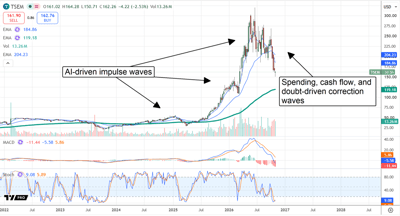
Yet Tower's expanding capacity, accelerating revenue growth, and robust margins could help drive a recovery as investors increasingly distinguish companies delivering results from those relying on future promises. The AI buildout trade remains strong and could be poised for a second wind.
The Invisible AI Backbone: Corning's AI Fiber Play
Submitted by Jeffrey Neal Johnson. Date Posted: 10/28/2026.

Key Points
- Corning's Optical Communications and Enterprise Networks segments posted sharp sales gains, with generative AI product sales growing faster than GPU unit shipments.
- Customer deposits from hyperscalers and telecom firms like AT&T and Verizon are helping fund Corning's capacity expansion while the company still generated positive adjusted free cash flow.
- Corning's stock decline of about 50% from its summer peak contrasts with management's upgraded target of $40 billion in annualized sales by 2030.
- Special Report: Why This Clean Energy Well Escaped the Solar and Wind Cuts.
The market's obsession with artificial intelligence (AI) largely centers on the processors powering data centers. Yet even the most advanced GPUs cannot scale without the physical networking layer that connects them. As capital flows into semiconductor designers and server manufacturers, the infrastructure required to move large datasets is undergoing its own quiet revolution.
Corning Incorporated (NYSE: GLW) recently pulled back roughly 50% from its summer highs. To investors focused on headline valuation metrics, this drawdown might look like the end of a cyclical run. However, a closer look at the company's financials reveals a potential disconnect between its valuation and growth outlook.
A free stock pick, from me to you (Ad)
Elon's paid this chip supplier since 2012. When NVIDIA tried to buy the company, he fought the deal.
Without its chip, his AI satellites don't fly. Now he wants 1,000,000 of them in orbit, 100 times what's up there today, and every one pays this company a royalty.
Dylan believes shares could react by December 8th.
Claim this free stock pick before the December 8 deadline todayCorning is rapidly becoming a key supplier of the physical networking layer behind the generative AI buildout. Long-term customer agreements are helping fund capacity expansions, while an anticipated architectural shift could dramatically increase fiber density. Together, these factors may make Corning's current market dislocation a compelling entry point into the AI infrastructure space.
Clear Growth: Corning's Earnings Beat
Recent earnings data highlights a stark divergence between Corning's underlying business performance and its recent stock performance. Core sales in the latest quarter reached about $5.08 billion, up about 19% year over year and above consensus estimates of $5.03 billion.
The primary engine behind this momentum is the Optical Communications segment, where sales surged roughly 44% year over year to nearly $2.38 billion. The Enterprise Networks division also turned in a notable performance, with sales up about 84%, driven by generative AI product sales that grew more than 100%. According to management, Corning's generative AI product sales are growing faster than GPU unit shipments.
While the broader market fixates on the semiconductor sector, Corning is steadily expanding its position in the physical networking layer. The company is executing long-term agreements to supply the optical fiber that enables data centers to function as cohesive supercomputers. This momentum is reflected in its fundamentals: core operating margins expanded 310 basis points to about 22.7%.
Scale-Up Density: Sowing the Seeds for 2030
To understand why fiber sales are outpacing GPU growth, investors should consider how AI data center architecture is evolving. Today, data centers use optical fiber for scale-out networking, which connects rows of servers across a facility. In these existing architectures, Corning estimates that typical scale-out connections require around 16 fibers per GPU.
A substantial architectural shift may be approaching. Inside server racks, GPUs currently use copper cables for scale-up connections. Copper works well over short distances, but faces increasing bandwidth, distance and power limitations as data processing needs multiply. Corning expects the transition from copper to optical scale-up connections to accelerate significantly in 2028.
If scale-up connections become fully optical, Corning estimates total fiber requirements could rise from 16 fibers to roughly 160 fibers per GPU. This tenfold increase in density could be a generational catalyst for optical suppliers. Management is already positioning Corning for this transition, using anticipated demand to support an upgraded target of a $40 billion annualized sales run rate by 2030.
Insulating the Balance Sheet From AI Sprawl
Cautious investors might note that scaling manufacturing to meet a potential tenfold increase in demand would require significant capital expenditure, which has traditionally pressured free cash flow and strained balance sheets. Planned capital expenditure for 2026 is around $2 billion, a figure that might ordinarily concern traditional value investors.
Corning is mitigating this risk through a funding mechanism centered on customer deposits. Hyperscalers and telecom giants like AT&T Inc. (NYSE: T) and Verizon (NYSE: VZ) are signing multiyear supply agreements. Some agreements also include upfront cash payments to help fund future capacity, although Corning has not disclosed deposit terms for every customer.
Corning's financial statements show that the company collected roughly $639 million in net customer deposits through the first nine months of the year. In effect, some of Corning's largest clients are helping fund its capacity expansion.
As Corning delivers fiber, customer deposits are applied or returned in accordance with the agreements, helping smooth working capital fluctuations and reduce the need for additional financing. After accounting for these capital investments, Corning still generated about $661 million in adjusted free cash flow for the quarter, suggesting the model can support heavy investment in expansion.
Corning's PEG Ratio Edge
Recent selling pressure appears to stem largely from surface-level valuation concerns. At a glance, a trailing price-to-earnings ratio hovering around 59 looks expensive, especially compared with traditional AI leaders like NVIDIA Corporation (NASDAQ: NVDA), which currently trades at a lower trailing multiple.
The gap between the trailing multiple and future earnings potential could create an opportunity, but the valuation deserves a closer look. With projected earnings growth near 31% for the coming year, the price-to-earnings-to-growth ratio falls to about 0.44. A PEG ratio below 1.0 can signal that a stock is undervalued relative to its earnings growth trajectory, making Corning an outlier in the expensive hardware sector.
Corning also appears to have room to expand its capital returns. While the trailing dividend payout ratio is just over 51%, the forward payout ratio, based on next year's earnings estimates, is roughly 25%.
This could give Corning ample room to maintain and increase its dividend payments without putting undue pressure on day-to-day operations.
Options activity also suggests investors are paying attention to the pullback, though the positioning is mixed.
Recent options flow data shows substantial trading in both calls and puts, rather than a one-sided bullish bet. The activity signals heightened interest but does not establish that large investors expect an imminent rebound.
Wiring Your Portfolio for the Next AI Phase
For investors managing portfolio exposure to the AI sector, the infrastructure layer offers a distinct risk-reward profile compared with hardware and software pure plays. The recent sharp pullback may present an entry point into a business with long-term customer agreements supporting capacity expansion and a potential catalyst on the horizon in 2028.
Investors seeking exposure to the generative AI boom might consider this valuation disconnect. While headline multiples may continue to cause short-term turbulence, the underlying financials point to a business investing heavily in the physical infrastructure of artificial intelligence. Adding Corning to a watchlist after its steep decline could be worth considering before the anticipated copper-to-optical transition is more widely priced into the market.
This email communication is a sponsored message for Behind the Markets, a third-party advertiser of The Early Bird and MarketBeat.
If you need assistance with your account, don't hesitate to contact MarketBeat's support team, based in South Dakota, at contact@marketbeat.com.
If you no longer wish to receive email from The Early Bird, you can unsubscribe.
Copyright 2006-2026 MarketBeat Media, LLC.
345 N Reid Pl., Suite 620, Sioux Falls, S.D. 57103-7078. USA..

-
We'll be sending you the latest buy and sell ratings from Wall Street's top analysts, but first,...
-
We'll be sending you the latest buy and sell ratings from Wall Street's top analysts, but first, this... ͏ ͏ ͏...
-
Offices of the United States Attorneys You are subscribed to USAO - New Jersey...


