|

|
||||
|
|
||||
| Unsubscribe |
Dear Reader,
Based on my 55 years of watching the market, I'm deeply concerned that we're in the early stages of a financial crisis that could be larger than the Great Financial Crisis of 2008.
This has very little to do with the national debt, as bad as that is.
Nor is it another debt crisis in the housing market like the one that tanked the markets in 2008.
In fact, it doesn't even involve the "AI bubble" or the high-flying stock market, although major, widely held stocks will almost certainly be among the first to crash.
No, this is something far worse, and even more dangerous.
I'm Dr. Martin D. Weiss, New York Times best-selling author, named "Mr. Independence" by Forbesand founder of Weiss Ratings, rated #1 in the Wall Street Journal.
Why #1? Because for 55 years, I have run Weiss Ratings as the nation's only 100% conflict-free, independent financial rating agency in America.
We have never accepted a dime from rated companies for the grades we issue, and we never will. We answer to no one but our members.
Since 1971, when I founded this company, I have publicly predicted six major American crashes before they happened, always naming the companies most likely to fail with ample warning.
And today I'm issuing a public warning about what could be the biggest crisis to ever hit America.

In previous financial crises, many have lost half, or even most of their retirement savings.
My job — and my family's job for nearly one hundred years — has been to give Americans the warning before the warning is too late.
And that's what I'm doing in a free video you can watch today.
>> Go here now to see the most important warning of my career. <<
Good luck and God bless!

Martin D. Weiss, PhD
Weiss Ratings Founder
11780 US Highway 1,
Palm Beach Gardens, FL 33408-3080
Would you like to edit your e-mail notification preferences or unsubscribe from our mailing list?
Copyright © 2026 Weiss Ratings. All rights reserved.
By Chris Markoch. Published: 10/23/2026.

Microsoft Corp. (NASDAQ: MSFT) heads into its fiscal 2027 (FY2027) first-quarter report with very little room for error. The stock closed above $530 per share on Oct. 21, putting it within striking distance of its 52-week high of $553.72.
MSFT is up about 33% since the company last reported earnings, raising the stakes for this release, which is scheduled after the market closes on Wednesday, Oct. 28. A stock trading near its high has already priced in plenty of good news. That's why a clean beat may not be enough to push it higher. Investors will want a beat that also raises the bar for the rest of the fiscal year.
Nvidia CEO Jensen Huang says Elon Musk's $119 billion plan will be extremely hard to pull off.
Larry Benedict, who ran a $900 million hedge fund and posted 20 consecutive years without a loss, including over $274 million in audited net income between 2004 and 2012, says one long forgotten American company already holds what Musk needs.
Get the ticker and his full analysis before the November 30 deadline.
Click here to get the free ticker before November 30The good news is that analysts don't appear worried. Microsoft analyst forecasts on MarketBeat give the stock a consensus price target of $592.15, up from $578.73 less than two weeks ago. That implies roughly 12% upside from current levels. Adding to the bullish sentiment, 43 of the 49 analysts tracked by MarketBeat rate the stock a Buy.
The latest moves are notable. Jefferies raised its target from $575 to $650 on Oct. 14. Citigroup followed a day later, lifting its target from $600 to $636. Wells Fargo sits near the high end of the range with a $725 target.
As usual, Azure is the headline number to watch. Last quarter, Azure grew 43%, ahead of the 40% analysts expected. The business also topped $100 billion in annual revenue for the first time.
Then management raised the stakes. Microsoft guided for 45% Azure growth in constant currency this quarter, well above the roughly 41% analysts had modeled at the time.
However, that makes 45% the baseline, not the upside case. The market has a history of punishing Microsoft for small misses. In January, Azure grew 38%, beating guidance. The stock still fell 10% because buy-side expectations were higher.
Microsoft guided for total revenue between $89.85 billion and $90.95 billion. Analysts expect earnings of roughly $4.70 per share. Last quarter, the company posted earnings of $4.74 per share, topping consensus by 50 cents.
The second number may matter even more. Microsoft guided for about $50 billion in capital expenditures (CapEx) this quarter, up from roughly $36 billion in the prior quarter. The company also projected $175 billion in CapEx for calendar 2026.
Investors will listen closely to management's tone around that spending. Microsoft has said demand still exceeds its available capacity. That's the bullish case for continued investment.
But any hint of a pause would ripple far beyond Redmond. Chipmakers, data center operators and power suppliers all depend on hyperscaler budgets. A slowdown signal from Microsoft would likely be viewed as bearish for the broader AI trade.
There's a counterweight to watch. Free cash flow fell 23% year over year last quarter. Investors want spending to remain aggressive, but they also want proof that it's paying off.
Gaming rarely moves Microsoft stock, but it could shape the narrative. In July, CEO Satya Nadella said he expects Xbox to return to growth in fiscal 2027. That's a bold promise after a rough year.
Xbox revenue fell 7% in fiscal 2026. Hardware revenue dropped 29% on lower console sales. Content and services, which include Game Pass, declined 10% in the fourth quarter alone. Management guided for another mid-single-digit decline this quarter.
That makes October's launch of Gears of War: E-Day an early test. The game set a franchise record with more than 31,000 concurrent players on Steam. Yet estimates from Alinea Analytics put early unit sales at only about 230,000 copies.
The bigger number is subscriptions. The same estimates show about 1.7 million players accessing the game through Game Pass. Microsoft is betting on recurring subscription revenue rather than one-time game sales.
Gears launched in the current quarter, so it won't appear in these results. But management's holiday-quarter outlook could reveal how much it's counting on the franchise. Any update on Game Pass growth will offer a tell on the turnaround.
The technical picture is constructive, but momentum is fading. MSFT gapped higher after its July report and has trended upward since. The stock remains well above its rising 50-day simple moving average (SMA), now near $507.
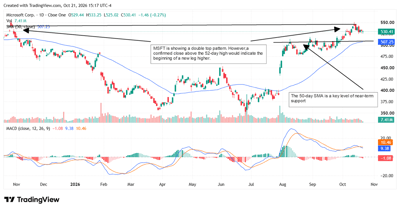
However, the stock stalled near $550 in mid-October. That's close to where it peaked last fall before a long decline. A failure to clear that level would raise the risk of a double top.
The MACD indicator adds to the caution. The MACD line has crossed below its signal line, and the histogram has turned negative. MACD also made a lower high in October, even as the stock made a higher high. That bearish divergence suggests buyers are losing conviction.
Initial support sits near $515, the top of the August-September trading range. Below that, the 50-day SMA near $507 is the next key level. On the upside, a decisive close above $554 would confirm the breakout.
Submitted by Ryan Hasson. First Published: 10/26/2026.

The past few weeks have been rough for much of the technology sector. Concerns about AI spending, lofty valuations and new competition in the chip space have weighed on many tech stocks, particularly semiconductor stocks, neocloud companies and memory stocks. The VanEck Semiconductor ETF (NASDAQ: SMH), for example, finished Friday, Oct. 23, more than 21% below its 52-week high and near major higher-timeframe support and its 200-day simple moving average (SMA).
The good news for bulls, however, is that the sell-off hasn’t been a one-way street across the entire tech sector. Look a little closer, and several pockets of the sector have held up surprisingly well, with a few still trading within striking distance of their 52-week and even all-time highs. Interestingly, much of that strength has come from software and cybersecurity stocks—two areas many investors had written off earlier this year as likely losers in the AI race. That narrative has since flipped on its head.
Nvidia CEO Jensen Huang says Elon Musk's $119 billion plan will be extremely hard to pull off.
Larry Benedict, who ran a $900 million hedge fund and posted 20 consecutive years without a loss, including over $274 million in audited net income between 2004 and 2012, says one long forgotten American company already holds what Musk needs.
Get the ticker and his full analysis before the November 30 deadline.
Click here to get the free ticker before November 30That recent outperformance and relative strength are worth watching. When one corner of a sector sells off while another holds firm, it can reveal where capital is flowing and which groups could lead if sentiment improves. Here are five names and funds within the technology sector that stand out.
The Amplify Cybersecurity ETF (NYSEARCA: HACK) has been one of technology’s steadiest corners through the recent sell-off and turbulence. The fund is up 60% year to date and closed Friday less than 3% below its 52-week high. The ETF is arguably one of the purest ways to gain exposure to the broader cybersecurity industry.
HACK holds 49 cybersecurity names. Its largest positions include Broadcom (NASDAQ: AVGO), CrowdStrike (NASDAQ: CRWD), Cisco (NASDAQ: CSCO), Palo Alto Networks (NASDAQ: PANW) and Fortinet (NASDAQ: FTNT), each representing roughly 5% to 6.5% of the fund.
The bull case for cybersecurity has strengthened as AI spreads and gains wider adoption. Every AI agent and automated workflow a company deploys creates new access points that need protection, and security budgets have historically been among the last to be cut when spending tightens. With a beta of 0.84, HACK has also traded with less volatility than the broader market.
From a technical perspective, the relative strength is clear. The ETF pulled back in early October to its rising short-term SMAs but quickly confirmed a higher low within its uptrend. Unlike the broader technology benchmark, it is holding close to its 52-week high and above all its key SMAs. That’s a clear sign that capital has flowed into this pocket of the technology sector, potentially setting it up as a future leader.
At first glance, the iShares Expanded Tech-Software Sector ETF (BATS: IGV) doesn’t look like a standout, up only about 5% on the year. That figure, however, obscures how far the fund has come. IGV has rallied nearly 50% from its 52-week low and now sits roughly 6% below its high, near the top of its higher-timeframe range.
Technically, it’s also shaping up for a potential breakout. The fund has spent several months consolidating near its 52-week high, with that high now acting as a potential springboard for further upward momentum and continued outperformance.
The shift in narrative has been the key driver. Earlier in the year, investors worried AI would undercut traditional software. More recently, they seem to be recognizing that companies controlling customer data and everyday business workflows are often best positioned to sell AI on top of those assets. IGV’s top holdings tell the story: Palo Alto Networks, CrowdStrike, Palantir (NASDAQ: PLTR) and Microsoft (NASDAQ: MSFT) each make up roughly 8% to 9.6% of the fund, and many of those names have shown notable short-term outperformance versus the broader sector.
Microsoft (NASDAQ: MSFT) closed Friday at $524.51, up about 9% this year and roughly 5% below its 52-week high. For a $3.9 trillion company in the middle of an AI-driven sell-off, that’s notable resilience.
The next big test for the mega-cap tech titan is just around the corner. Microsoft reports fiscal first-quarter 2027 results on Oct. 28, and investors will be watching closely to see whether Azure delivers on growth guidance of around 45%, along with updates on capital spending.
The fundamentals remain strong, with net margins above 40% and projected earnings growth of 18%. Analysts have a Moderate Buy consensus from 49 analysts, with an average price target of $592.15 implying 13% upside. Still, with the stock near its highs heading into the report, the bar for a positive reaction is high.
CrowdStrike (NASDAQ: CRWD) is the standout performer of the group, up about 120% year to date. Shares have pulled back about 10% from their 52-week high of $286.99.
Friday’s action stood out in particular. The stock held its rising 50-day SMA and sharply rallied intraday to close above its 20-day SMA. That move confirmed a higher low in its steady uptrend and, from a technical perspective, further established the stock as a leader in the technology sector.
CrowdStrike is the largest holding in HACK and the second-largest holding in IGV, so its strength helps explain both funds’ resilience. Demand for its Falcon platform has stayed sticky, and CEO George Kurtz recently warned that a fresh wave of cyberattacks is coming—a reminder that security spending tends to be driven by threats rather than the economic cycle.
One thing worth noting, however, is that the average analyst price target of $239.27 now sits below the current share price, suggesting the stock has moved faster than Wall Street’s models. The stock’s next major known test will be its next earnings report, estimated for early December.
Palantir Technologies (NASDAQ: PLTR) has also held up relatively well, closing Friday at $196.75. That put it up nearly 11% this year and roughly 8% below its 52-week high of $212.94. While many other retail-favorite technology names have fallen below their key SMAs, PLTR has done a great job maintaining its uptrend and staying above its key moving averages.
Beyond its much-discussed stretched valuation, including a forward price-to-earnings ratio of almost 150, the business has continued to impress fundamentally. Palantir generates net margins of about 49%, and analysts project earnings growth of nearly 46% over the next year.
Palantir recently announced a new partnership with Knox Systems that expands its reach in government technology. However, valuation remains the central debate. At more than 100 times sales, the stock leaves little room for disappointment, and the average price target of $203.48 implies only about 3% upside. With third-quarter earnings due around Nov. 2, the results will need to justify the premium.
Taken together, these five suggest the recent sell-off has been more of a rotation within technology than a wholesale exit from the sector. Chips and memory have taken the brunt of AI fears, while many mega-cap software and cybersecurity names have held near their highs.
That doesn’t make these names immune. CrowdStrike and Palantir already trade near or above their average analyst targets, while Microsoft’s Oct. 28 earnings report and Palantir’s Nov. 2 results will be key tests. But if fears around AI valuations and spending ease, the groups that held up best under pressure may be best positioned to lead the next move higher.
| Unsubscribe |
There are a lot of AI skeptics today, including several on my staff.
Given the obvious parallels to the dot-com boom, I don’t blame them.
And I agree in several ways too. So much so that I’m not recommending any of the major AI giants but rather a select group of companies that I believe could deliver far greater upside from the AI build-out.
But here’s what the AI skeptics are missing: over the last 50 years, the most important, broadly applicable corporate moat was compute.
And right now, that moat is getting wider, much wider, thanks to artificial intelligence.
By compute, I mean three specific things:
When you break down virtually any business to its most basic elements, you end up with a sequence of decisions, all of which must be made with partially incomplete information.
A firm that shrinks the possible outcome dispersion of its educated guesses earns more on every dollar of capital it deploys and can reinvest the difference into shrinking risks further.
I know this works because I’ve done it often in my career.
Steve Sjuggerud and I spent millions of dollars building proprietary databases between 2002 and 2019 to discover the patterns and correlations that drive the markets.
At every step of my career as an investor, I’ve been trying to gain an information advantage (legally). I’m constantly seeking new ways to minimize risk.
And the best way to do that is through investments in compute.
The same is true for every great business.
In 1987, Walmart finished building the largest private satellite communications network in the United States. It cost $24 million, took two and a half years to build, and connected more than 1,200 sites.
Walmart founder Sam Walton was famously cheap.
So what did he buy for $24 million? No more guessing. Every register in the chain reported what it had sold, overnight, to one building in Arkansas.
By 1992, Teradata had built Walmart the first commercial data warehouse to cross a single terabyte.
A competitor down the road reordered on a merchandiser’s instinct and a monthly report. Walmart reordered on Tuesday’s actual sales, store by store, item by item.
That database was probably more valuable than Walmart’s physical stores.
How do I know?
Kmart was the larger discount chain by revenue when those satellites went up. By the time Kmart understood what the network was for, it was hopelessly behind.
It never built a similar system and ended up in bankruptcy, mostly because of Walmart.
Or look at AMR, then the parent of American Airlines.
They spent roughly $40 million and 400 man-years building the Semi-Automated Business Research Environment with IBM. Known today as Sabre, it went live in 1960.
A booking that normally took 90 minutes now took only seconds. What was worth more: all the airplanes and all of the routes, or the database?
In March 2000, AMR spun Sabre off. AMR carried that stake on its books at about $600 million. The market valued it at $5.2 billion. The database was worth way more than the planes.
Capital One Financial was founded on the premise that a credit card is not a product but an experiment.
In 1999 alone, it ran 36,114 tests on pricing, terms, and solicitations. Its competitors mailed one offer to everyone at one price and wrote off the resulting defaults as a cost of doing business.
Capital One stopped guessing.
This is my message:
There’s no such thing as a company that isn’t a tech company.
If you’re not leading your field in applying compute, you risk going out of business over the next decade. There’s no such thing as a tech stock anymore.
There are simply companies that are good at applying compute and companies that fail.
But here is the most important part of this story… everything above happened while computation was scarce and expensive. It is now neither.
Right now, Big Tech is pouring hundreds of billions of dollars into AI data centers. This massive infrastructure build-out is driving the cost of compute down to near zero.
The companies building these data centers are financing these investments with mountains of debt.
And that’s why the real wealth won't be made by the builders.
It will be made by the companies that can absorb this hyper-abundant, near-free compute to completely rewrite their own economics.
So the question is: which industry can absorb almost unlimited, near-free computing power and still defend its prices?
We’ve found the answer.
It’s a completely abandoned sector of the market that represents the largest computational puzzle on earth.
More importantly, it’s the only industry where the government hands you a legal, federally enforced monopoly to protect your product for decades.
I believe this sector is about to absorb the capex of the AI boom, and it could be among the best-performing sectors of the stock market… the next Magnificent 7.
I lay out the entire roadmap, including what you need to consider selling immediately and exactly where this capital is rotating, in my new broadcast.
Click here to watch before it’s too late.
Good investing,
Porter Stansberry
Submitted by Thomas Hughes. First Published: 10/20/2026.

The weakest takeaway from Halliburton’s (NYSE: HAL) Q3 report was weaker free cash flow, alongside higher capital expenditures (CapEx) and their impact on free cash flow (FCF). While FCF is down sequentially and year over year (YOY), this self-inflicted wound comes as Halliburton invests in repositioning, equipment movement, and staging for future success. The best takeaway from Halliburton’s Q3 release is its numerous contract wins and project advancements, which position the company for a multiyear upcycle. Investment in the Mediterranean, Latin America, Asia, and the Middle East includes multiyear development agreements that will drive business across both of Halliburton’s core segments.
In the meantime, management expects margins to recover and capital returns to resume. Management is demonstrating its confidence through the dividend and share buybacks, which FCF did not cover. The takeaway is that Halliburton will likely maintain its dividend and buybacks as margins recover, then increase capital returns over the coming years. As it stands, the share count fell more than 2% YOY, adding to shareholder returns beyond the dividend. The dividend yields a little more than 2%, has a payout ratio below 30% of adjusted earnings, and should grow over time. The company does not make annual increases but tends to raise payments as cash flow allows.
Nvidia CEO Jensen Huang says Elon Musk's $119 billion plan will be extremely hard to pull off.
Larry Benedict, who ran a $900 million hedge fund and posted 20 consecutive years without a loss, including over $274 million in audited net income between 2004 and 2012, says one long forgotten American company already holds what Musk needs.
Get the ticker and his full analysis before the November 30 deadline.
Click here to get the free ticker before November 30Halliburton struggled in Q3, with weakness in North America offset by strength abroad, but it performed better than analysts had expected. Revenue rose 1.8% YOY to $5.7 billion, about 2% above expectations. International revenue increased 3% sequentially, offsetting a 5% sequential decline in North America. Within the International segment, Latin America and Europe/Africa were flat sequentially, while the Middle East/Asia grew 8%, supported by increased activity in Saudi Arabia and Kuwait. By segment, Completion and Production revenue fell 4% YOY, while Drilling and Evaluation revenue increased 4%.
Margin news was the sore spot in Q3, but it is easy to overlook given the cause and the implications for the outlook. Margins contracted year over year but improved sequentially, leaving the company in a better position than expected while it advances its strategy. The key detail is that adjusted earnings per share came in at 60 cents, two cents better than expected, leaving the capital return outlook fundamentally unchanged.
Executives did not provide Q4 guidance, instead focusing on macroeconomic conditions and the initial outlook for next year. They are targeting mid-single-digit revenue growth and operating margins of about 15% in 2027, up from roughly 13%, though they may be cautious in their estimates. The Middle East is only one source of oilfield demand; Russia, Ukraine, Venezuela, and offshore Latin America also need development.
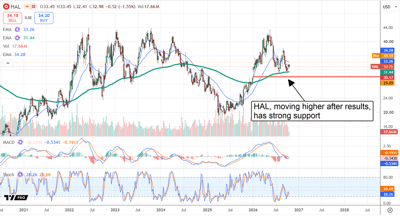
Halliburton stock struggled through the first three quarters of 2026, surging about 50% in the first half before giving up those gains by the end of Q3. The narrative, however, is that the market is establishing a support base and gaining traction in Q4. Analyst trends reflect steady coverage, a firm Moderate Buy consensus rating, a bullish bias, and an uptrend in price targets. Consensus puts HAL above $44, which would be a fresh long-term high, while the trend points to the high end of the range, roughly another $9, or 20%, higher.
Institutions, meanwhile, have accumulated for eight consecutive quarters, with reported institutional buying outpacing selling and providing a solid support base. Institutions now own about 85% of the shares. The likely outcome is that analyst trends continue to firm, driven by upcoming results and margin improvement, while institutions continue accumulating shares based on the dividend and buyback outlook.
As tepid as the early 2026 price action has been, it aligns with a market in reversal and shows support at a critical level. That level aligns with prior congestion zones, a breakout, and a price gap that reveals shifting market dynamics. The 150-week exponential moving average (EMA) strengthens the support zone, reflecting buy-and-hold activity from investors such as institutional groups, and likely serves as a launchpad for rallies. Resistance may appear at $34, $40, and $44, with $44 as the key target. A break above that level could open the door to a much larger move.
Halliburton’s biggest risk is the transition to cleaner, greener energy and its impact on oilfield demand. However, this risk is also a catalyst, driving energy companies to seek better, more efficient technologies, including natural gas. Halliburton is critical to unlocking natural gas from shale formations, helping energy companies drill wells and bring gas into production. Other risks include exposure to the North American market, though that risk is becoming smaller with each new international contract.
Author: Chris Markoch. Date Posted: 10/27/2026.

Deckers Outdoor Corp. (NYSE: DECK) delivered a mixed second-quarter earnings report for fiscal 2027 (FY2027) on Oct. 22. Earnings topped expectations, but revenue of $1.48 billion fell just short of the $1.51 billion estimate. Management also lowered its full-year sales outlook for its HOKA and UGG brands.
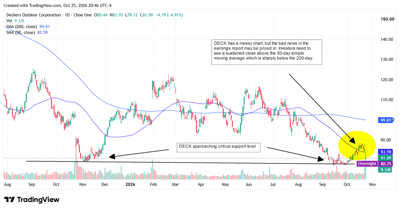
Investors reacted decisively. DECK stock fell 5% on Oct. 23 to close at $81.01, leaving shares just above their September low.
Nvidia CEO Jensen Huang says Elon Musk's $119 billion plan will be extremely hard to pull off.
Larry Benedict, who ran a $900 million hedge fund and posted 20 consecutive years without a loss, including over $274 million in audited net income between 2004 and 2012, says one long forgotten American company already holds what Musk needs.
Get the ticker and his full analysis before the November 30 deadline.
Click here to get the free ticker before November 30But the headline reaction missed a larger point: The sell-off did not start with this report. DECK lost roughly 30% between late July and mid-September. Investors were pricing in slower growth long before management confirmed it. That changes how to interpret the guidance cut. Bad news the market already expected is not really new information. There is also a reasonable case that Deckers deliberately set its new outlook low.
The perception is that Deckers is a growth story in decline. The fundamentals show a company that is still growing, expanding margins and buying back stock at a rapid pace.
Deckers has a long record of guiding cautiously and then beating expectations. If that pattern holds, DECK is set up to clear a low bar rather than chase a high one.
DECK traded near $110 after its first-quarter report in late July. By mid-September, shares had dropped below $80. That decline came without any new guidance from the company.
The stock then bounced toward $88 heading into earnings. Friday's drop erased that rally, but it did not break new ground. Shares dipped to $78.12 during the session and still held above the September low.
There is still technical work to do. DECK trades below its 50-day moving average of $83.59 and well below its 200-day average of $99.81, which continues to trend lower. Reclaiming the 50-day average would be the first sign of a recovery.
Still, the price action matters. A stock that holds its lows after a guidance cut can signal that sellers are running out of steam.
Revenue rose 3.5% to a record $1.48 billion. HOKA sales climbed 6.8% to $677.2 million, while UGG sales grew 3.5% to $786.4 million. Both flagship brands are still growing.
The revenue shortfall was modest. Analysts expected about $1.51 billion, and management attributed roughly $22 million of the gap to shipping delays related to a European logistics transition. That points to more of a timing issue than a demand collapse.
Margins were the real highlight. Gross margin jumped to 60.5% from 56.2%. Tariff refunds contributed about 310 basis points of that gain. The remaining 120 basis points came from selling more products at full price instead of relying on discounts.
Earnings per share (EPS) came in at $2.31. Excluding the refund benefit, adjusted EPS was about $2.03. That still beat the consensus estimate of $1.79 and represented 11.5% growth from a year ago.
Now consider the new outlook. Deckers expects fiscal 2027 sales of $5.700 billion to $5.725 billion, down from the prior range of $5.86 billion to $5.91 billion. HOKA growth is now expected to be in the high single digits, while UGG is expected to grow in the low single digits.
Full-year EPS guidance rose to $7.80 to $7.95, but that includes about 52 cents from tariff refunds. Without those refunds, the range is roughly $7.28 to $7.43, slightly below the prior outlook.
On paper, that looks like a downgrade. But consider the track record. Deckers has beaten EPS estimates in each of its last five quarters, usually by double-digit percentages. A company that keeps beating is likely guiding with room to spare.
Management also has every incentive to remain cautious. In a weak consumer market, missing a raised forecast costs far more than beating a lowered one.
There is a hidden upside, too. The outlook includes only the tariff refunds received through Oct. 8. Any additional refunds that would boost results are not yet reflected in the guidance.
Deckers is putting its cash to work. It repurchased $637.5 million of stock in the first half of fiscal 2027 at an average price of $98.77. The company carries no debt.
About $4.4 billion remains under the buyback authorization. At today's price, that equals roughly 40% of the company's market value. The current outlook assumes $1 billion in repurchases this year.
Valuation adds to the case. At $81, DECK trades near 11 times the midpoint of its full-year EPS guidance, excluding tariff refunds. That is a low multiple for a debt-free company with operating margins above 20% and two growing global brands.
The bear case is real. Direct-to-consumer comparable sales fell 6.4%, while domestic sales slipped 0.4%. HOKA's growth rate continues to slow, and that remains the stock's biggest long-term question.
There is also a caveat to the low-bar thesis. Second-quarter revenue came in below management's own internal expectations, not just Wall Street's. Conservative guidance only works if the company can meet it.
The Deckers analyst forecasts on MarketBeat continue to shift toward a bearish stance. The consensus rating from 26 analysts is Hold, with 11 Holds and four Sell ratings.
Even so, the balance of risk has shifted. The sell-off began months before this report.
The guidance cut confirms what the stock had already priced in, and the new bar looks low enough to clear.
For patient investors, that gap between perception and the company's fundamentals represents the opportunity.
The perception is of a fading growth story. The fundamentals show a profitable, debt-free company buying back its own shares at a discount.
Extra 31% OFF : Día de los Muertos marks the final day of our Halloween Sale! ͏ ͏ ͏ ͏ ͏ ͏ ͏ ͏ ͏ ͏ ͏ ͏ ͏ ͏ ͏ ͏ ͏ ͏ ͏ ͏ ...