Lamb Weston Holdings Inc (NYSE: LW) has spent the last year fighting a nasty combination of weak restaurant traffic, customer destocking, falling price/mix, and bloated potato inventories across the industry. The latest Q1 FY2027 earnings report finally gives shareholders something more useful than another promise of improvement: North American volume is accelerating while the potato market is moving toward tighter supply.
Table of Contents
That creates an unusual setup for a company whose earnings have been dragged lower by pricing and input costs. LW grew companywide sales volume 2% in Q1, North American volume 6.7%, and North America delivered 11% growth in adjusted EBITDA. Yet company-wide adjusted EBITDA still fell 5% to $286 million because Europe remained under pressure.
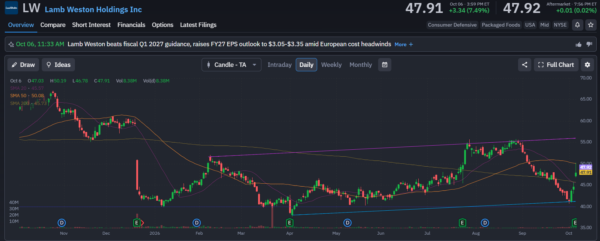
The stock responded accordingly, jumping 7.49% to $47.91 on October 6, with 8.38 million shares changing hands. After months of selling, the tape is starting to price something different.
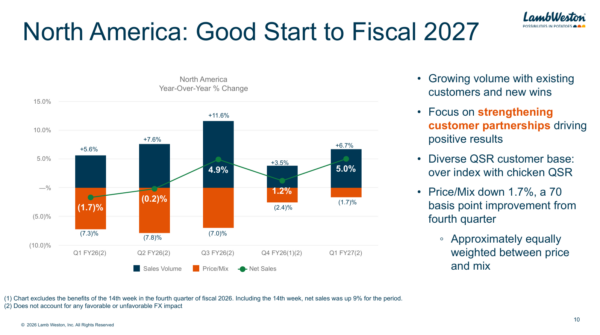
The most important number in Lamb Weston’s Q1 report isn’t the $1.67 billion of revenue or the $0.75 of adjusted EPS. It’s the seventh consecutive quarter of North American volume growth.
North American sales rose 5%, powered by 6.7% volume growth, while price/mix was still negative 1.7%. Management said volume growth came from existing customers, new wins, and a strong mix of QSR relationships, with the company particularly exposed to chicken-focused chains. U.S. restaurant traffic was essentially flat and QSR traffic declined 1%, yet Lamb Weston still outperformed those trends.
The pricing drag is shrinking too. Price/mix improved from negative 2.4% in Q4 to negative 1.7% in Q1, a 70-basis-point sequential improvement. About 70% of contracts up for renewal this year have already been completed, with high retention and pricing reflecting the inflationary environment.
That is a much healthier setup than the stock’s recent price action suggests. Lamb Weston doesn’t need restaurant traffic to explode. It needs its existing volume gains to keep showing up while the pricing hole gets smaller.
Europe Is The Problem That Could Become An Advantage
Europe is still ugly. International sales fell 8%, with volume down 6% and price/mix down 2%. International adjusted EBITDA dropped to $27 million, reflecting lower European volume and higher carry-in potato costs. Then the supply picture gets complicated.
Lamb Weston says prolonged heat and dry conditions in Europe produced a smaller potato crop, with tonnage tracking well below historical averages. The company expects tighter supply to raise raw-material costs and is already working with customers to modify product specifications. Normally, higher potato costs would be another reason to stay away from LW.
This time, there is another side to the equation. Management says industry capacity is rationalizing, expansion projects are being delayed or shut down, and supply and demand are beginning to move back toward balance. Lamb Weston has also stopped production at its Broekhuizenvorst facility and shifted customers to other locations to improve network utilization.
The company is therefore entering a tighter supply environment with a cost structure it has already been attacking for more than a year. That can matter enormously once volume gains stop being swallowed by excess capacity and weaker pricing.
The Guidance Requires Less Than You Think
Lamb Weston raised fiscal 2027 guidance despite the international weakness. Management now expects low-single-digit net-sales growth, $1.125 billion to $1.215 billion of adjusted EBITDA, $3.05 to $3.35 of adjusted EPS, $730 million to $810 million of adjusted operating income and $750 million to $800 million of operating cash flow. The previous EPS range was $2.95 to $3.25, while the comparable FY2026 adjusted EPS was $2.90.
The EBITDA math is particularly interesting as Q1 produced $286 million. The midpoint of the new full-year EBITDA range is $1.17 billion, leaving roughly $884 million for the final three quarters, or about $295 million per quarter.
That isn’t an outrageous hurdle at all. Management already expects Q2 adjusted EBITDA to rise in the high single digits to low double digits, with net sales up in the low single digits. Meanwhile, the company is running an enterprise-wide zero-based budgeting program, with adjusted SG&A essentially flat year over year after removing one-time items. Management says the cost program has permanently lowered its operating cost base.
Put another way, the ingredients for better earnings are starting to line up: volume is rising, price/mix is recovering, costs are being attacked, and industry capacity is coming out.
Elon Musk has gone "all in" on Texas, home of SpaceX. But Texas just froze ALL new AI data center buildouts.
The reason? Data center demand in Texas has soared from 48 gigawatts to 474 gigawatts... since 2023, according to Reuters. But according to 60-year Wall Street legend Marc Chaikin, one company has the solution. Its "micro cluster" technology will consume an estimated 99% less electricity and water. And it'll come online as soon as Oct. 20th. When it does, it'll make current data centers obsolete when it comes to major AI breakthroughs – including Elon's Grok.
The technical picture gives the fundamental story some teeth here. LW spent September sliding from the mid-$50s toward $40, where buyers repeatedly defended the stock. October 6 brought a sharp reversal: the shares closed at $47.91 after trading as high as $50.19, with volume surging to 8.38 million.
The stock has reclaimed its 20-day SMA at $45.57 and is now just above its 200-day SMA at $45.73. The 50-day SMA at $50.08 is the next obstacle. A clean move through 50–50.10 would take LW back above its intermediate trend and put the 54–55 September breakdown area back in play.
I like the setup. The North American business is already producing volume and EBITDA growth, while a tightening potato market and shrinking industry capacity could give those gains more earnings leverage than the current numbers show. If LW clears $50 with volume behind it, the market may finally start trading the earnings power that sits beyond this quarter’s headline results.
In today’s newsletter: Why some of Ken Paxton’s allies think he’s being sabotaged in the Texas Senate race. Errors by Flock license plate readers are leading police to pull over the wrong people. And Steelers quarterback Aaron Rodgers redeems himself in a win over the Colts.
It’s been a brutal stretch for Republican Texas Senate candidate Ken Paxton.
Damaging leaks of his private conversations. Details of his past romantic affairs. Jabs at his physical appearance. And at least some of his allies are convinced the sabotage is coming from within his own party.
Wounds haven’t healed from the contentious primary in which Paxton defeated Sen. John Cornyn. Many in Paxton’s corner are convinced those aligned with Cornyn are trying to tank his chances. Others in the GOP say Paxton’s negatives are so high that few want to associate with him.
Interviews with more than a dozen Texas Republicans involved in the crossfire make it clear there’s no hope for a truce before Election Day — or perhaps ever. Some say the fissures threaten to sideline GOP efforts ahead of a critical election.
Analysis: Trump’s rallies are designed to pump enthusiasm into a base showing signs of fatigue and dissatisfaction. While the president can still bring a crowd like no one else in the Republican Party, he’s speaking in smaller venues — and often staring out at empty seats. Some say he may not be getting as much bang for his buck as he once did.
Republican Sen. Darline Graham of South Carolina and Democratic challenger Annie Andrews clashed over Iran, AI and Trump in their first debate.
Limited-time offer of 25% off the first year of an NBC News annual subscription of $59.99(+tax)/yr. Applies to web-only subscription. No redemption code necessary. Offer ends 11/05/26 at 11:59:59 PM ET. Must be 18+. After first year, you will be automatically charged $59.99 (+tax)/yr for an annual subscription until you cancel. Cancel anytime. See full terms.
Danny Brooks, an electrician in Indiana, was sitting in his company truck when police officers surrounded the vehicle, guns drawn. They handcuffed him and said the truck was reported stolen — but they had the wrong man.
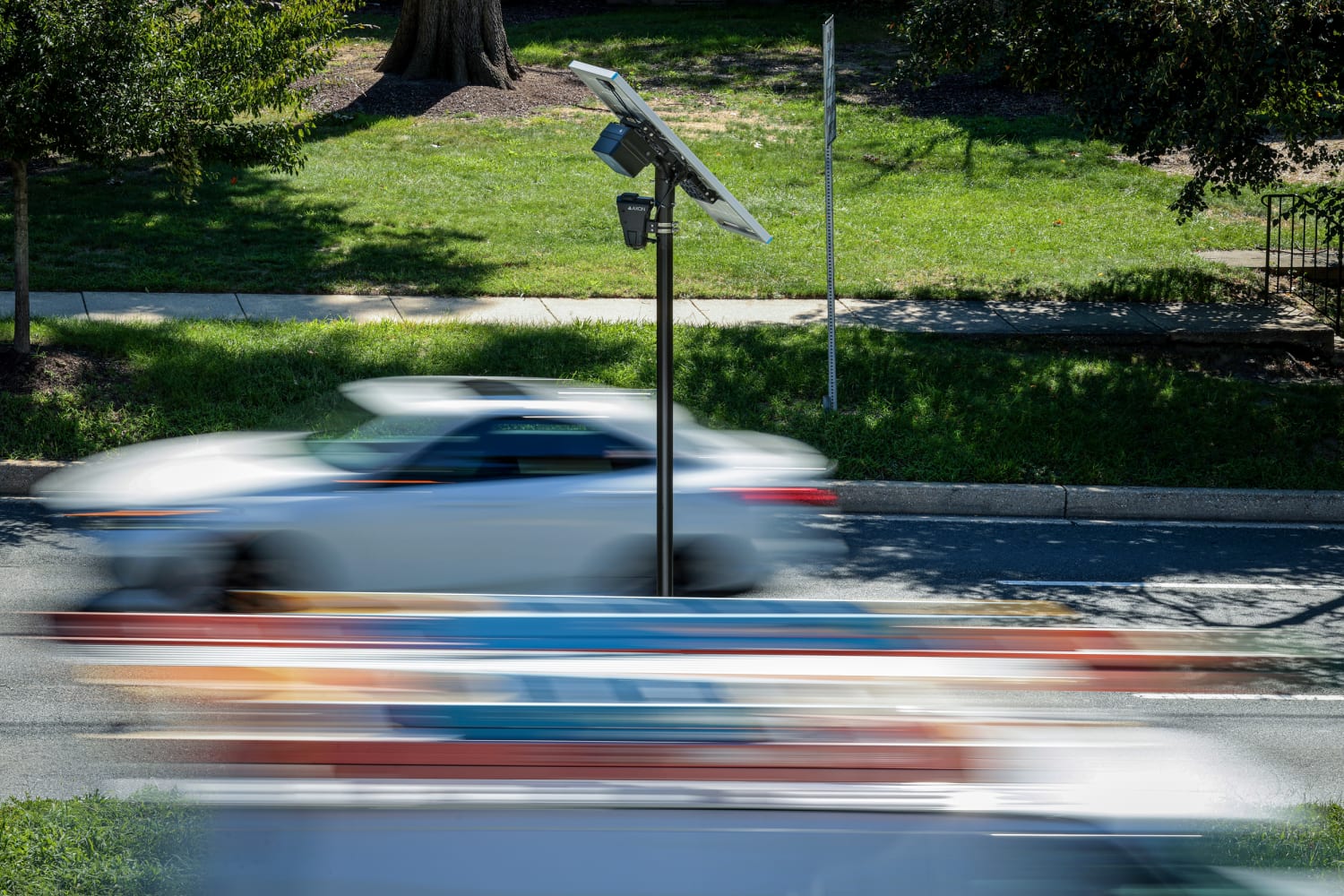
An error by a Flock license plate reader caused the mix up.
These readers indiscriminately capture a photo of each car that passes its cameras. If one of the plates Flock photographs is on a “hotlist,” a law enforcement registry containing plate numbers suspected of connections to a crime, police are notified. But the system isn’t perfect.
NBC News spoke with five people who have been pulled over or detained after Flock’s system raised false flags, including one who was jailed for nearly two weeks.
We also analyzed logs showing officers searching and adding license plates to a system containing hotlists. Some officers intentionally added the wrong plate numbers to compensate for Flock mistakes.
Week 5 of the NFL season featured the latest chapter of a storied rivalry and a resurgent performance from a 42-year-old quarterback. Here’s what you missed yesterday:
After having looked like one of the worst quarterbacks in the NFL to begin the season, Steelers starter Aaron Rodgers threw three touchdown passes for the third straight game, this time in a 34-22 win over the Colts.
The Packers restored some balance in their rivalry with the Bears, defeating the Caleb Williams-less squad 31-7.
The Commanders had seconds left to secure a win — and blew it. They tied with the Giants 27-27 after Jayden Daniels’ poor decision to run the ball left the entire NFL in disbelief.
In one of the craziest endings, the Eagles lost 19-17 to the Jaguars.
Fifty years after his death, China’s former leader Mao Zedong is finding renewed appeal among young Chinese people, who are flocking to his old residences and monuments to learn about his past and turning to his books for inspiration. They are drawing from his ideas to manage everyday challenges, from work and study to even video games.
Some believe that the tightly controlled history textbooks and heavily censored internet in China might lead to an incomplete understanding of him, but this is not the only nor the primary reason behind the appeal.
We travelled to Mao’s hometown of Shaoshan in southern China to speak with young visitors to find out how they felt seeing the site in person. We also spoke with two Chinese history experts to explore why Mao strikes a chord with a younger generation facing a slowing economy and growing social pressures.
— Erin Tan and Dawn Liu, researchers based in Beijing
▼ Read All About It
Kelly Clarkson says a Brooklyn store snubbed her. The shop says the item she wanted wasn’t for sale.
A man whose toddler was among eight people killed in a mass shooting in Erie, Pennsylvania, said that the gunman was a grandfather who never seemed distressed or out of the ordinary.