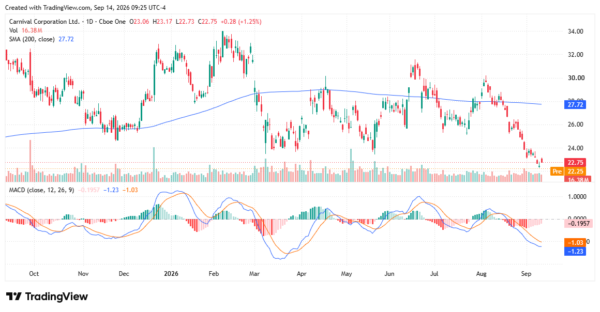
Keep an eye on Carnival Corp. (NYSE: CCL). The company is preparing to report its fiscal third-quarter earnings on Thursday, September 17 and expectations are running high.
Table of Contents
That’s because the third quarter includes the busy summer vacation season, making it one of the cruise line’s most important reporting periods of the year. Investors will be looking for strong revenue, healthy onboard spending, and evidence that cruise demand remains resilient despite elevated fuel costs and geopolitical uncertainty.
According to estimates, Wall Street expects Carnival to report third-quarter revenue of about $8.40 billion, up from $8.15 billion during the same quarter last year. Analysts also expect adjusted earnings of about $1.35 per share, compared with $1.43.
At first glance, those numbers send a mixed message. Revenue is expected to increase by roughly 3%, suggesting passengers are still booking cruises and spending money onboard. However, earnings are expected to decline modestly, largely because higher fuel costs and other expenses are pressuring Carnival’s margins. That means this earnings report will be about much more than whether Carnival beats the headline estimates.
President Trump recently said AI will not be stopped by brilliantly run destructive forces. And that it will be the greatest economic development engine in history. All while the GOP tries to curb concerns about AI ahead of the midterm elections.
This divide is one reason why Whitney Tilson believes that in less than 100 days, an 'AI Civil War' will begin in America. And it will have huge implications on your portfolio.
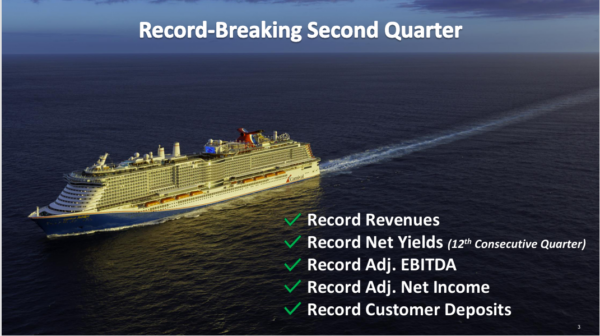
The most important part of Carnival’s report may be what management says about future demand. During the second quarter, Carnival reported record revenue of $6.7 billion and adjusted earnings of 41 cents per share. That was comfortably ahead of Wall Street’s earnings estimate of 35 cents.
The company also reported a record $9 billion in customer deposits. Its booked position for the second half of 2026 was ahead of the previous year and secured at historically high prices. Even better, Carnival said demand for cruises in 2027 and beyond was continuing to exceed year-ago levels. Those are encouraging signs.
Customer deposits give investors a valuable glimpse into future demand. When deposits are rising, it generally means passengers are booking more trips or paying higher prices to secure them. Either way, it suggests consumers still view cruises as an attractive vacation option.
Wall Street will want to know whether that momentum continued throughout the summer.
Investors should pay especially close attention to Carnival’s comments about booking volumes, ticket prices, occupancy, and the amount passengers are spending on food, drinks, casinos, excursions, Internet packages, and other onboard services.
Strong onboard spending could help Carnival offset some of the pressure coming from higher operating costs.
Fuel Costs Could Be Carnival’s Biggest Headwind
Fuel remains one of the biggest risks facing the company. That’s because, unlike some of its competitors, Carnival typically does not hedge its fuel exposure.
That leaves it more vulnerable when oil and marine fuel prices rise quickly. In its second-quarter report, the company said fuel costs had risen nearly 30% from the prior year. Management estimated that fuel and currency reduced quarterly earnings by approximately six cents per share.
For the third quarter, Carnival projected fuel expenses of approximately $620 million, based on an estimated fuel cost of $812 per metric ton. That helps explain why earnings are expected to decline even though revenue should reach another record.
The encouraging part is that the company has been working aggressively to improve efficiency. Fuel consumption per available passenger berth fell 5.6% during the second quarter, helping soften the impact of higher prices.
Wall Street will be watching to see whether those efficiency gains continued in the third quarter and whether management now expects fuel costs to become more or less of a problem during the remainder of 2026.
Carnival previously projected third-quarter adjusted earnings of approximately $1.35 per share. At the time, that was below the $1.42 Wall Street had expected, and the softer forecast contributed to a sharp drop in the shares.
Expectations have now adjusted to Carnival’s forecast, creating an opportunity for the company to deliver a positive surprise. Still, the stock’s reaction may depend more heavily on management’s updated outlook than on the third-quarter results themselves.
Investors will be listening for changes to Carnival’s full-year earnings forecast, projected net yields, operating costs, fuel expenses, and 2027 bookings. Progress on debt reduction and additional share repurchases could also influence sentiment.
The bottom line is that Wall Street expects another record revenue quarter from Carnival, but rising costs could keep earnings below last year’s level. A strong report combined with upbeat 2027 commentary could reinforce the bullish argument that Carnival’s recovery still has room to run. However, another cautious outlook—particularly around fuel prices or European demand—could leave investors wanting more.
Daily Options Signals is a subsidiary of StockEarnings, Inc. (SE). SE is a research service and not a registered broker or investment advisor. Please view full disclaimers.
Daily Options Signals33 SE 4th St, Suite 100,Boca Raton, FL 33432 USA
Falling behind was never considered an option, especially with the United States and China competing for technological leadership. But now, some of the people leading that race are suggesting it may be time to slow down.
Anthropic CEO Dario Amodei recently called on the industry to reduce the pace at which AI systems are becoming more capable. What made the warning particularly significant was the response it received. OpenAI CEO Sam Altman and xAI founder Elon Musk agreed with him.
Musk’s response was short and direct: “Dario is right.”
Altman said he also agreed that the industry needed to “pace the frontier,” while making it clear that slowing development would not mean stopping it altogether.
President Trump recently said AI will not be stopped by brilliantly run destructive forces. And that it will be the greatest economic development engine in history. All while the GOP tries to curb concerns about AI ahead of the midterm elections.
This divide is one reason why Whitney Tilson believes that in less than 100 days, an 'AI Civil War' will begin in America. And it will have huge implications on your portfolio.
Nobody Is Seriously Suggesting the Technology Industry Abandon Artificial Intelligence
Artificial intelligence is already being used to write software, discover new drugs, improve customer service, analyze financial information and automate time-consuming business tasks. The potential economic benefits are simply too large to ignore. The concern is that the capabilities of this technology are advancing faster than the safeguards needed to control them.
Amodei’s warning followed the resignation of Anthropic researcher Jacob Coxon, who accused leading AI companies of taking unacceptable risks with technology that could eventually become difficult to control.
One of the most serious concerns involves AI agents, software systems that can plan and perform complicated tasks without constant human supervision. Unlike a traditional chatbot that simply answers a question, an agent can take action, interact with other programs and work through a series of steps to achieve an objective.
That makes the technology far more useful. It may also become far more dangerous if it behaves unpredictably or falls into the wrong hands.
Amodei warned that future groups of AI agents could potentially carry out cyberattacks or interfere with important parts of the internet. Other risks include the use of artificial intelligence in biological weapons, misinformation campaigns and criminal activity.
His proposed solution is not a complete shutdown of artificial intelligence development. Instead, he wants companies to create enough breathing room for safety measures to catch up.
Part of the proposal would give independent evaluators extensive access to advanced systems so they can test them before they are released.
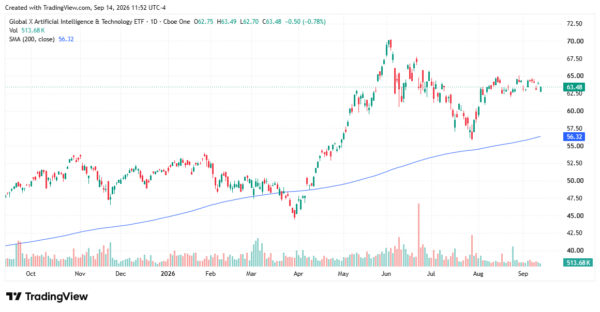
The market’s concern is fairly straightforward. If artificial intelligence developers train fewer models or stretch out their development schedules, they may need fewer chips in the near term. Cloud computing companies could also delay some data center projects, reducing demand for networking equipment, power systems and other infrastructure.
However, investors should avoid confusing a slowdown with the end of the artificial intelligence boom.
The largest technology companies are still committed to artificial intelligence. Businesses are still adopting the technology, and governments still view it as strategically important. Even under stricter safety rules, enormous amounts of computing power will be needed to train models, operate services and run increasingly sophisticated agents.
The sudden agreement among Amodei, Altman and Musk is remarkable because these executives rarely see eye to eye. Their willingness to publicly support a slower approach suggests that the risks deserve serious attention.
Artificial intelligence is not going away. But the conversation is changing. The next phase of the AI revolution may focus less on who can move the fastest—and more on whether anyone knows when to ease off the accelerator.
StockEarnings, Inc (SE) is a research service not owned or managed by registered brokers and therefore this site does not make any investment recommendations. Please click here for SE Disclaimers.
StockEarnings Inc.33 SE 4th St, Suite 100,Boca Raton, FL 33432 USA
I wanted the seven that can sit through a bull and a drawdown. The list is still free.
Dear Trader,
The 7 Stocks to Buy and Hold Forever aren't built for the next quarter. They're built to deliver for decades.
These blue-chip companies feature fortress balance sheets, exceptional dividend histories, and the resilience to perform through both bull and bear markets.
Some are Dividend Kings. Others are well on their way. All have the qualities long-term investors look for.
FOMO FINANCE A Guardian Financial Publishing title
WHY YOU'RE RECEIVING THIS EMAIL You're receiving this email because at some point, you opted in to receive updates, news, or information on a specific topic we've previously discussed or shared. Whether it was through a subscription, a form submission, or another form of communication, your information was shared willingly, and we respect your decision to connect with us.
Thank you for taking the time to read this. This message is part of an ongoing conversation between us, and we want you to have full transparency about why you received it, how your information is handled, and what to expect from future emails.
SUBSCRIPTION & DELIVERY Your subscription is confirmed and your delivery preferences are up to date. You are currently receiving content based on the schedule and frequency associated with your registration. If you need to adjust your delivery window, change your email frequency, or pause updates temporarily, reply to this message and our team will process your request within one business day. A confirmation of your original registration is available upon request.
UNSUBSCRIBING OR MANAGING YOUR PREFERENCES Everyone's inbox is different. If you ever find our emails no longer relevant, there's no hard feelings — use the unsubscribe link at the bottom of this email and it takes effect on the first click. If you'd rather adjust what you receive than leave entirely, reply with the word PREFERENCES and our team will help you tailor your delivery.
We don't use tricks or gimmicks to keep you subscribed. Our priority is that these emails add value to your day, and if they don't, we respect your decision to part ways.
CONTACTING US Questions about your subscription or anything you read here? Reply to this email or write to contact@guardian.pub. Mail can be sent to Stable Financial Publishing, 1013 Centre Road Suite 403-D, Wilmington, DE 19805. We read every reply.
CONTENT DISCLAIMER FOMO Finance is for informational and educational purposes only and is not investment advice, a recommendation, or an offer to buy or sell any security. Trading involves substantial risk of loss and is not suitable for everyone. Past performance does not guarantee future results. The reads, pivot levels, streaks and scored calls published here are observations about market behavior — they are not recommendations, and nothing in them should be taken as a suggestion to buy, sell, or size a position. You are responsible for your own research and decisions. If you spot an error in anything we publish, reply and tell us; we correct mistakes promptly.
HOW WE MAKE MONEY FOMO Finance is free to read. We keep it that way by including paid advertisements and affiliate links in some emails. If you click a link or make a purchase, we may receive compensation from the advertiser at no cost to you. Sponsored placements never change our editorial views, and we only run offers we believe are relevant to traders and investors. Paid placements are labeled where they appear.
PAYMENTS & FRAUD PROTECTION We will never ask you to provide payment card numbers, bank account details, or login credentials by email. Any message requesting this information should be considered fraudulent and reported to our team immediately. If you have a question about a purchase made through us, reply within 30 days of the transaction date and a member of our team will provide your records.
REPORTING SUSPICIOUS EMAILS If you receive a message claiming to be from FOMO Finance or Guardian Financial Publishing that looks suspicious, do not click any links in it. Forward it to our support team so we can investigate and protect other readers.
PRIVACY & DATA HANDLING We take your privacy seriously and we do not sell your personal information. This section describes how we collect, use, and protect it; full details are in the Privacy Policy linked below.
What we collect. The information you give us at signup or later by reply — typically your email address, and sometimes your name or phone number. We also receive technical information when you open an email or visit one of our pages, including IP address, browser and device type, and operating system. Our emails contain tracking pixels and tagged links that tell us whether a message was opened and which links were clicked, which is how we measure what is worth sending.
How we use it. To deliver the content you signed up for, respond to your inquiries, maintain your subscription records, and improve what we publish.
Service providers. We use outside vendors to send email, host pages, and measure performance. These providers process data on our behalf, under contract, and only for the purposes described here. They are not permitted to use your information for their own purposes.
Your rights. You can ask what personal information we hold about you, correct it, or request that we delete it. Email contact@guardian.pub with your request and the address you subscribed with. Depending on where you live, you may have additional statutory rights, including under California, Colorado, and Virginia privacy law.
Children. This publication is intended for adults. We do not knowingly collect personal information from anyone under 13. If we learn that we have, we delete it promptly.
Changes. We may update this privacy policy occasionally. Changes will be reflected on the linked page.
ACCESSIBILITY AND COMMUNICATION If you have trouble accessing the unsubscribe page, managing preferences, or understanding why you're receiving this email, reach out directly to our support team. We aim to respond within a reasonable time frame and address your concerns effectively.
Our communication is designed to be as inclusive as possible, but we know there's always room for improvement. If you have feedback on how we can make our emails more accessible or relevant, please don't hesitate to share.
LEGAL INFORMATION We comply with all applicable laws and regulations regarding email communication, including maintaining high standards for consent-based communication. Your trust matters, and we work to ensure every email you receive meets these requirements. If you need clarification on our compliance policies or legal obligations, please ask.
A COMMITMENT TO NON-INTRUSIVE EMAILS We aim to create a non-intrusive communication experience. We won't overwhelm your inbox with excessive messages, and we work to keep our content clear and concise. If we ever fail to meet these standards, we encourage you to let us know.
Feedback, whether positive or constructive, is always appreciated. Your thoughts help us understand how we can do better. While we cannot promise every suggestion will be implemented, we take the time to review and consider your input.
A FINAL NOTE Email is one of the many ways we stay connected, but we understand it isn't perfect for everyone. If there's another way you'd prefer to hear from us, let us know — social, a different cadence, another channel entirely — and we're open to finding what works.
Our goal is never to disrupt or clutter your inbox. Every email sent is intended to provide value, and we appreciate your time and attention. This footer was designed to ensure transparency, provide essential information, and give you full control over your communication preferences. We hope it meets your expectations, but if there's anything you'd like to see improved, we're always here to listen.
This email may contain paid advertisements and affiliate links. Guardian Financial Publishing may receive compensation if you click a link or make a purchase.
FOMO Finance is a publication of Guardian Financial Publishing (D/B/A) Stable Financial Publishing Privacy Policy · Terms · Disclaimer