Trump goes "all-in" on Grand Canyon energy breakthrough 
OpenAI's Revenue Scare Could Be a Big Opportunity for InvestorsWritten by Thomas Hughes on October 12, 2026 
Key Points
- OpenAI's reported $50 billion revenue run rate appeared weaker than prior estimates mainly because it excluded system partner revenue, not because growth slowed.
- The company's revenue multiple and IPO timeline face scrutiny, especially if Anthropic goes public first and sets a higher valuation benchmark.
- Oracle's massive OpenAI contract and strong cloud growth suggest its AI investments are beginning to pay off despite negative free cash flow concerns.
- Special Report: This AI fund sends investors payouts every Thursday

The October report that OpenAI's annualized revenue run rate was approaching $50 billion, roughly $20 billion below earlier reports, highlights a persistent disconnect between investor perceptions and the reality of AI growth—and a potential opportunity for investors. The broad market, a mob driven by headlines and hearsay, still doesn’t comprehend the scope, scale, and reality of AI. It reflects a deep, penetrating anxiety that AI isn’t happening, even though all the data suggests otherwise—even OpenAI’s supposedly “weak” revenue run rate. What the market got wrong was easy to avoid: comparing apples to oranges. While OpenAI’s run rate was far below expectations, it didn’t include revenue from system partners, and the earlier forecast did, making any comparisons to the prior figure worthless. The reality is that demand for compute continues to outstrip supply, and bottlenecks threaten to curtail capacity ramps over the coming years. OpenAI's annualized revenue run rate grew 77% during the third quarter, with expectations for continued growth. Forecasts put its run rate at $70 billion or higher by year’s end and expect it to continue growing over the subsequent year. For the rest of the AI industry, this means current trends are likely to continue strongly, potentially accelerating by year’s end or early 2027. Factors such as Advanced Micro Devices' (NASDAQ: AMD) Helios launch and NVIDIA’s (NASDAQ: NVDA) upcoming Vera Rubin release are two reasons why.
A small, publicly traded supplier trading under $100 a share has reportedly worked alongside Elon Musk for more than a decade.
A federal filing may outline Musk's next major move: an AI network of up to a million satellites powered by the sun. James Altucher says this supplier holds the piece Musk doesn't own. Watch James Altucher's free Masterclass on this Musk-linked supplier stock
OpenAI’s IPO Just Got More ComplicatedThe biggest impact of OpenAI's revenue surprise may be on its IPO ambitions. The news doesn't fundamentally change the outlook for the AI trade, but could affect OpenAI's potential valuation. The $50 billion figure is about 28.5% lower than previously available figures and implies a revenue multiple of 28x at a $1.4 trillion valuation. Private markets are valuing tech stocks on run rates and public markets on revenue, making it more important than ever for the company to achieve its target range of $280 to $350 billion in revenue by 2030. As it stands, the push for AI safety has pushed the IPO timeline to 2027, with some analysts forecasting a midyear IPO at the earliest. One risk for OpenAI is that Anthropic goes public first. In this scenario, Anthropic sets the benchmark for reporting and growth, leaving OpenAI to reformulate its reporting and filing metrics to match. Word on the street is that OpenAI could IPO before Thanksgiving, beating the industry leader by a half year or more. Anthropic targets a valuation above $2 trillion, more than double OpenAI CEO Sam Altman’s expressed baseline. Is Oracle’s Outlook Undercut by OpenAI’s Miss?Oracle (NYSE: ORCL) is among the front-line companies impacted by OpenAI’s business. Its contract with OpenAI is worth $300 billion over five years and accounts for about 45% of its backlog. The revenue miss raises questions about whether OpenAI can live up to its commitment, but there are still signs that suggest it can. The accelerating run rate reveals the strength of OpenAI’s offerings, with internals showing a 107% increase in Enterprise revenue run rate, 3,000 basis points better than the headline. Enterprise demand is likely to continue to grow robustly, driven by a virtuous cycle in which AI results drive AI demand. Meanwhile, Oracle’s most recent results reflect the monetization of previous investments. Revenue growth accelerated to 30% as new capacity was added, driving a record quarter, with total Cloud up by 62% and cloud infrastructure up by 121%. More importantly, cash flow improved by an accelerated 184% and would have been a stock-price catalyst if not for negative free cash flow. Backlog metrics were also robust, with the $664 billion in Q2 remaining performance obligation up 46% year over year, plus $30 billion in new contracts. 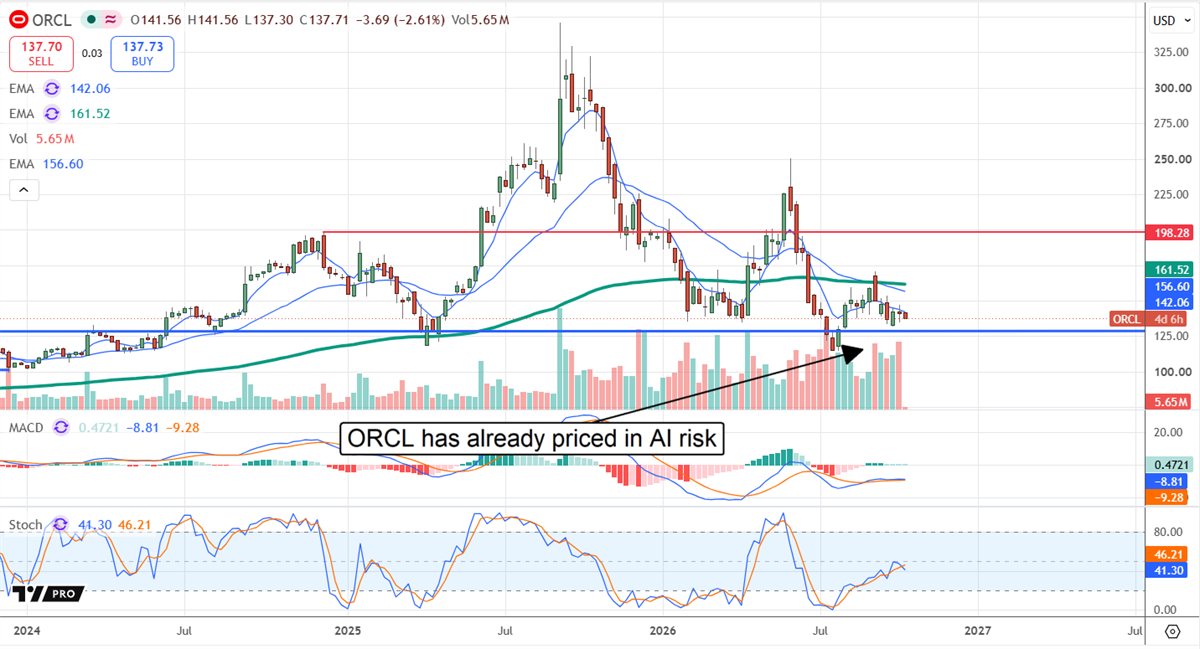
Negative free cash flow is a real risk and a concern for investors. AI requires a massive initial capital outlay, and it takes time to monetize. What the market mob gets wrong is that the buildout is in transition. Initial builds are coming online, companies like Oracle are monetizing their investments, and the trend will gain momentum in 2027. Next year's narrative will be less spend, more monetization, and a trajectory for both metrics to continue improving in 2028.
Bill Poulos is offering his Smart Trade Options Checklist at no cost today - normally priced at $29.97.
It's a single-page, seven-point filter designed to help traders identify weak setups before placing any options trade. Print it, keep it at your desk, and run it before every trade. The download link expires soon. Download your free copy of the Smart Trade Options Checklist now
SaaSpocalypse Is a Tailwind for BusinessSaaSpocalypse fears drove Oracle’s stock price decline and the declines of so many others, but AI didn’t disrupt software providers' businesses; rather, it accelerated them. Enterprises want insights and automation, and both are driving the need for security. That means securing not just frontier AI models but the entire tech ecosystem, which is unprepared for the volume, speed, and tenacity of AI-driven cyber threats. Companies like Snowflake (NYSE: SNOW), MongoDB (NASDAQ: MDB), and Datadog (NASDAQ: DDOG) are only three examples of companies leveraging AI to their and their clients' advantage. Read this article online › Featured Articles

Did you learn something from this article?  
|






No comments:
Post a Comment