| Unsubscribe |
Hi, Tim Plaehn here.
Gold prices are breaking records.
But while everyone else is fixated on headlines…
They're missing something much bigger:
There's a new way to collect income from gold.
Not mining stocks.
Not options.
Not a single ounce of physical metal.
Instead, it's a $15 fund that's quietly paying out up to $1,152 a month to regular investors…
All thanks to a breakthrough strategy that transforms gold's rally into reliable monthly payouts.
Click here to discover the gold income breakthrough most investors are missing.
But move fast: the next payout is just days away.
To your income,
Tim Plaehn
Chief Income Strategist, Investors Alley
Rocket Lab Lands a Wave of Contracts Ahead of Earnings
By Ryan Hasson. First Published: 8/6/2026.
Key Points
- Rocket Lab secured three major contracts in under two weeks, including a $397 million Space Force award and a record $266 million launch deal, ahead of its Aug. 10 earnings report.
- Investors should watch for updates on revenue growth, backlog size, and the Neutron rocket's development timeline, which remains on track for a fourth-quarter 2026 debut.
- Despite a more than 50% drop from its May high and a rich valuation exceeding 70 times trailing sales, analysts maintain a Moderate Buy rating with 48% implied upside.
- Special Report: The company SpaceX cannot operate without
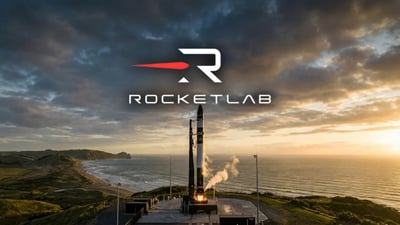
Rocket Lab (NASDAQ: RKLB) has spent the past two weeks doing exactly what a company wants to do heading into an earnings report: winning business. After a brutal correction that saw the stock fall more than 50% from its May high, a rapid succession of major contract awards has put the spotlight back on the fundamentals. The stock jumped 5.75% on Tuesday to close at $74.48, and with Q2 results due Aug. 10, the timing of these wins could hardly be better.
A $397 Million Space Force Award
The largest of the recent wins landed Monday. Rocket Lab announced a $397 million contract from the U.S. Space Force under the Space-Based Airborne Moving Target Indicator, or SB-AMTI, program. The award was part of a larger $615 million allocation split among three companies, with Rocket Lab taking the lion's share.
Ray Dalio: Buy Gold. Get Paid. (Ad)
Ray Dalio, founder of Bridgewater Associates, is urging investors to hold 15% of their portfolio in gold and crypto as U.S. debt continues to climb and fiat currencies lose purchasing power.
A little-known $15 fund is already converting gold's momentum into monthly income - as much as $1,152 per month. No gold bars, no mining stocks, just consistent payouts.
See how to follow Dalio's gold strategy and collect monthly incomeUnder the deal, the company will develop, launch and operate multiple next-generation "Flatellites"—flat satellites optimized for large constellations and equipped with space-based sensors designed to detect and track airborne threats in real time. Critically, those satellites will fly on Rocket Lab's upcoming Neutron rocket, adding a marquee national security customer to Neutron's manifest before the vehicle has even flown.
A Record $266 Million Launch Contract
Just days earlier, on July 27, Rocket Lab secured what it called the largest launch contract in company history: a $266 million agreement with the U.S. Space Force for 12 dedicated suborbital launches supporting missile defense, with options for six more.
The missions will primarily fly from Rocket Lab's new Pacific Spaceport Complex in Kodiak, Alaska, expanding the company's growing launch footprint. The agreement is a powerful signal of the government's confidence in Rocket Lab's ability to deliver responsive, high-cadence launch capability for urgent national security needs.
A Commercial Win, Too
The momentum has not been limited to defense. On July 30, Rocket Lab announced a multi-launch deal with Japanese Earth-imaging company iQPS for three dedicated Electron missions. The agreement underscores the continued strength of Rocket Lab's core Electron business, which remains the world's second-most-active launch vehicle, even as the company expands into larger and more strategic programs.
Together, these three awards in less than two weeks reinforce a business winning across commercial, civil and national security markets simultaneously.
What to Watch on Aug. 10
With the contract news setting a positive tone, attention now turns to the Q2 report. Investors should focus on several things. First is revenue relative to guidance. Rocket Lab posted record Q1 revenue of $200.35 million, up 63.5% year over year, and the market will want to see that growth trajectory continue. Second is backlog. The figure stood at a record $2.2 billion last quarter, and the recent contract haul should push it meaningfully higher—one of the clearest reasons to tune in.
Third, and most important, is Neutron. The medium-lift rocket remains on target for its debut in the fourth quarter of 2026, and CEO Peter Beck has cited flight hardware reaching the test stands as the key marker of progress. Any update on that timeline could move the stock.
Finally, investors will want commentary on the pending $8 billion Iridium acquisition, which is expected to close in mid-2027 and would transform Rocket Lab into a vertically integrated space company with a recurring-revenue satellite network.
The Setup Into the Print
The backdrop remains a study in contrasts. While the stock is back in positive territory for the year, it remains below a flattening 200-day simple moving average. The new area of support the bulls will need to defend is July's low near $60, which has formed a major support level with confirmation across higher time frames.
Rocket Lab still trades at a rich valuation—more than 70 times trailing sales—and is not yet profitable, which is precisely why the stock corrected so sharply alongside the broader space sell-off. Yet the consensus rating among 22 analysts remains Moderate Buy, with an average price target of $110.29, implying nearly 48% upside from current levels.
The recent flurry of contract wins does not resolve the valuation debate, but it does answer the more important question of whether demand for Rocket Lab's services is real and growing. Heading into Aug. 10, the business is executing at a high level, and the order book is the proof. Now the earnings need to match the momentum.
What Tesla Stands to Lose If It Walks Away From China
By Sam Quirke. First Published: 8/6/2026.
Key Points
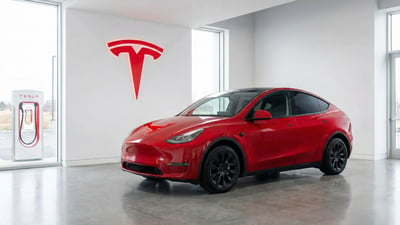
- Reports that Tesla may sell or close its China business have raised concerns because China represents about 25% of Tesla's estimated sum-of-the-parts value, according to RBC Capital Markets.
- Most of that China-derived value comes from speculative future businesses like Optimus robots and robotaxis rather than current car sales, making a forced sale potentially undervalued for Tesla.
- Tesla's China operations already face intensifying competition from BYD, underused factory capacity, and regulatory pressure, complicating the timing and strategic logic of any potential departure.
- Special Report: The company SpaceX cannot operate without
For all the noise surrounding Tesla Inc. (NASDAQ: TSLA) in recent weeks, one of the most consequential questions facing the stock has little to do with its latest delivery numbers.
A report in the Wall Street Journal last week suggested the company may be considering a sale or even closure of its China business—a move some analysts believe could be necessary on regulatory grounds if the long-rumored SpaceX Corp (NASDAQ: SPCX) merger ever goes ahead.
Ray Dalio: Buy Gold. Get Paid. (Ad)
Ray Dalio, founder of Bridgewater Associates, is urging investors to hold 15% of their portfolio in gold and crypto as U.S. debt continues to climb and fiat currencies lose purchasing power.
A little-known $15 fund is already converting gold's momentum into monthly income - as much as $1,152 per month. No gold bars, no mining stocks, just consistent payouts.
See how to follow Dalio's gold strategy and collect monthly incomeCEO Elon Musk denied the report, but the mere possibility has sent analysts scrambling to model what such a move would mean. Their early conclusions are sobering. Far from being a tidy piece of corporate housekeeping, walking away from China could quietly strip out a large part of what makes Tesla worth more than $1 trillion in the first place.
More Than Just a Revenue Line
The most obvious cost of leaving China would be the lost revenue. China is Tesla's second-largest market, contributing roughly a fifth of total sales, and walking away from that much business would be a serious blow by any measure.
Yet the revenue may be the least of Tesla's concerns. According to RBC Capital Markets analyst Tom Narayan, China accounts for around 25% of Tesla's sum-of-the-parts value. On its own, that sounds broadly in line with the country's share of sales, but the composition of that value tells a very different—and far more worrying—story.
By RBC's estimates, only a small portion of China's value to Tesla comes from car sales today. The overwhelming majority is tied to unproven future businesses, with roughly half attributed to the Optimus humanoid robot program, a fifth to robotaxis, and only modest amounts to automotive and energy storage.
In other words, China's value to Tesla is overwhelmingly a bet on what the company might one day become, not on what it sells right now. That distinction is crucial because it means the part of China most at risk in a sale is also the part carrying the greatest promise.
Why a Sale Would Be So Damaging
This is where the real danger lies: There is a mismatch between what Tesla would be selling and what any buyer would actually want. A sale driven by regulatory necessity is rarely conducted from a position of strength.
As Narayan put it, if Tesla were forced to sell, it would likely not receive fair value, and the logic is straightforward. A likely acquirer—probably a domestic Chinese player—would be interested primarily in the tangible automotive business and perhaps the self-driving technology. The speculative humanoid and robotaxi upside—the very assets that make up the bulk of Tesla's China-based value—would command little to nothing from such a buyer.
The result could be a deeply lopsided transaction. Tesla would hand over the part of its business with the greatest long-term promise while being compensated only for the more tangible but far less valuable assets.
A Business Already Under Pressure
Complicating matters further is the fact that Tesla's position in China is already far from comfortable. Competition has intensified dramatically, with companies like BYD (OTCMKTS: BYDDY) aggressively winning share both at home and increasingly abroad, where they have started matching Tesla in key markets.
The pressure is evident elsewhere, too. Tesla's enormous Shanghai factory has reportedly been running below full capacity, and regulators are pushing the company toward deeper local integration—including plans to replace Tesla's own vehicle AI systems in China with Chinese-developed alternatives.
Against that backdrop, the timing of a potential departure looks awkward. Walking away from a tough but enormous market just as the company is fighting to stabilize its position there could easily look more like a panicked retreat than a strategic decision.
What It Means for Investors
That said, a sale of the China business wouldn't be entirely negative, and it's worth acknowledging the potential upside.
For starters, such a sale would bring in a large amount of cash. Tesla could then pour that money into the AI and computing projects at the heart of its growth plans. If the deal helped clear the way for the rumored SpaceX merger, a combined company could do the same. For a business spending so heavily on that future, an injection of cash like that would be far from insignificant.
Ultimately, though, this is a risk that cuts to the heart of the Tesla investment case. The company's enormous valuation rests not on the cars it sells today, but on the future businesses it promises to build. In China, a forced sale would likely hand away a sizable chunk of exactly that promise for a fraction of its worth.
This email message is a paid advertisement for Investors Alley, a third-party advertiser of Earnings360 and MarketBeat.
All information contained herein is copyright 2025, Magnifi Communities LLC.
If you need assistance with your subscription, please feel free to email our South Dakota based support team at contact@marketbeat.com.
If you no longer wish to receive email from Earnings360, you can unsubscribe.
© 2006-2026 MarketBeat Media, LLC. All rights protected.
345 North Reid Place, Sixth Floor, Sioux Falls, South Dakota 57103-7078. USA..





No comments:
Post a Comment