| Unsubscribe |
Dear Fellow Investor,
The government just made one of the biggest bets in its history.
Two hundred billion dollars.
All of it aimed at building computer chips on American soil.
Most investors likely saw the headline and moved on.
George Gilder did not.
He thinks Washington tipped its hand, and almost nobody is recognizing this tell.
When the government pours money this big into one corner of technology, it is pointing to where the future is going.
George has spent forty- plus years watching for signals exactly like this one.
And he believes this one points to a coming shift in computing that could leave today's machines behind.
He will lay out what he found the moment you take a look.
See the signal George is reading.
To the future,

Roger Michalski
Publisher, Eagle Financial Publications
A Sweet Beat and a Wearables Rally Came With Reasons to Pause
Authored by Dan Schmidt. Publication Date: 8/3/2026.

Key Points
- Garmin and The Cheesecake Factory both delivered strong earnings beats and raised guidance, sending their shares sharply higher this year.
- Cheesecake Factory's comp sales growth was partly driven by a non-recurring loyalty app promotion, and its stock trades at a premium with limited analyst upside.
- Garmin's second-half guidance implies margin contraction due to fading tariff refunds, rising memory costs, and a declining Outdoor segment despite fitness growth.
- Special Report: Everyone wanted SpaceX. Smart money wants this.
Two of the cleanest earnings beats of the quarter came from a pair of under-the-radar sources: Garmin Ltd. (NYSE: GRMN) and The Cheesecake Factory Inc. (NASDAQ: CAKE). Both companies beat estimates, raised guidance and saw significant stock-price pops following their releases.
But even the cleanest beats often come with caveats, and these two companies hinted during their conference calls that the party might be entering its “turn the music down” stage. Analysts and investors are now chasing the tape, and some portfolio trimming might be in order following these massive gains.
Cheesecake Factory: Comp Growth Juiced by Non-Recurring Loyalty Rewards
Ray Dalio: Buy Gold. Get Paid. (Ad)
Ray Dalio, founder of Bridgewater Associates, is urging investors to hold 15% of their portfolio in gold and crypto as U.S. debt continues to climb and fiat currencies lose purchasing power.
A little-known $15 fund is already converting gold's momentum into monthly income - as much as $1,152 per month. No gold bars, no mining stocks, just consistent payouts.
See how to follow Dalio's gold strategy and collect monthly incomeThe stock chart of The Cheesecake Factory looks more like that of a next-generation semiconductor company than a restaurant chain with fewer than 500 locations. Shares are up more than 100% year-to-date (YTD), including a gain of more than 25% in the last month alone. And earnings, not hype, have fueled the impressive run.
The latest quarter was another slice of sweetness for CAKE, following its impressive performance in Q1. The Q2 2026 numbers released on July 28 showed year-over-year (YOY) revenue growth of 7.7% and earnings-per-share (EPS) growth of 19.5%. It was the company’s first-ever $1 billion sales quarter, and management raised both full-year and Q3 revenue guidance. Open-and-shut case, right? Not exactly.
Second-quarter comp sales grew 5.8%, following a 1.6% advance in Q1. That’s an impressive figure, but management implicitly called out the mix: 3.0% came from pricing and 2.8% from traffic. Management noted that traffic was driven by the revamped Cheesecake Rewards app, which offered a free piece of cheesecake to new users. Loyalty rewards programs are often effective at driving repeat business, but a promotion-driven initial surge isn’t sustainable. Now that the promotion has been redeemed, app-driven traffic is likely to decline toward a more sustainable baseline. That factor must be incorporated into projections for the next few quarters, especially if food inflation remains sticky.
Additionally, the Street is simply running out of room. Only Argus Research has a price target above CAKE's current market price, while the consensus target of $79.81 represents downside of more than 20%. The stock already trades at a premium to its industry, at 24 times forward earnings versus the hospitality average of 17 times. That valuation has also triggered recent insider selling.
Garmin: Projecting Margin Contraction in Second Half of 2026
Garmin has enjoyed a second life beyond GPS thanks to its assortment of wearables and fitness watches. The stock is up more than 40% YTD, with 20% of that gain occurring in the last week following its Q2 2026 earnings blowout. The company handily beat top- and bottom-line expectations in Q2, growing revenue 11.4% YOY, while the fitness segment generated 25% YOY sales growth. Garmin raised its full-year revenue and EPS guidance to $8.01 billion and $10 per share, respectively.
But when we break down the company’s second-half expectations, we can see subtle hints that margin growth is waning. Implied second-half revenue of $4.28 billion represents 9.8% YOY growth, with an expected operating margin of 26.3%. That would be lower than the 27.6% operating margin the company earned during the same period last year. There are two key reasons for the expected margin decline:
Tariff refunds totaled $21 million, adding 100 basis points to the company’s gross margin. Obviously, tariff refunds are a non-recurring line item, so this one-time margin boost will fade in the coming quarters.
Garmin products require many of the same high-speed memory components that AI hyperscalers are gobbling up, especially NAND and DRAM. Management flagged high memory costs as a potential margin drag for the rest of the year and into 2027.
Another potential red flag is the Outdoor segment’s performance, which has traditionally been the margin driver supporting the other segments. Outdoor revenue dipped 2% YOY in Q2 to $482 million, a moderately concerning decline given that the segment contributed $2.05 billion in fiscal 2025 and posted an operating margin of more than 34%. Fitness is now the growth driver, but that space is filled with fierce, well-funded competitors such as Apple Inc. (NASDAQ: AAPL) and Oura Health.
Much like CAKE shares, analysts are now chasing the tape with GRMN as well. Following the earnings release, Barclays and Morgan Stanley raised their GRMN price targets to $297 and $289, respectively. The Morgan Stanley target has already been surpassed, and the stock is currently about 1% below the Barclays target. Both management and the Street are signaling that the upside is flattening, suggesting that trimming rather than accumulating may be the best course of action.
Lost in Space: Why Aerospace Valuations Are Plummeting Right Now
Authored by Jeffrey Neal Johnson. Publication Date: 8/1/2026.
Key Points
- SpaceX shares have lost about $1.2 trillion from their post-IPO peak, pressured by an unsustainable valuation and an upcoming August 2026 insider lock-up expiration.
- SpaceX's repricing has triggered a sympathy sell-off across space stocks, with Rocket Lab shares falling roughly 37% in a month despite 63% revenue growth.
- Investors are shifting focus from speculative growth narratives to balance sheet strength, favoring companies like Rocket Lab with strong liquidity and low debt to weather cash burn.
- Special Report: Everyone wanted SpaceX. Smart money wants this.
The commercial space sector is undergoing a profound and necessary transition. For years, the narrative of interplanetary expansion and global satellite constellations fueled a growth-at-all-costs euphoria on Wall Street. Investors poured capital into aerospace sector ventures based on distant projections, largely ignoring near-term cash burn and the rising cost of capital.
That speculative era is rapidly closing. As borrowing costs remain elevated, institutional capital is pivoting sharply toward strict fundamental discipline. The market now prioritizes balance-sheet solvency, capital expenditure timelines and clear paths to positive free cash flow over speculative launch manifests. This structural shift was recently catalyzed by a historic repricing in the industry's premier anchor asset.
Crashing to Earth: SpaceX's Trillion-Dollar Reality Check
The 1974 Kissinger "Secret" Wall Street Never Decoded (Ad)
In 1974, Henry Kissinger helped create the U.S.-Saudi Arabia Joint Commission on Economic Cooperation - a little-known arrangement that tied global oil trade to the U.S. dollar for 50 years. On June 9, 2024, it quietly expired.
Garrett Goggin, CFA, CMT, believes this dollar reset could hit stocks, real estate, and retirement accounts hard - with inflation potentially running 10% to 15% for years. He has identified a small group of gold stocks he thinks are positioned to benefit as the dollar system shifts.
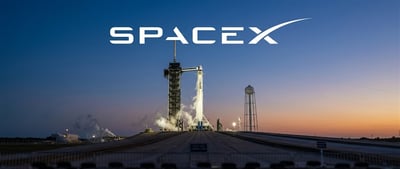
Read Garrett Goggin's full presentation on the dollar reset nowSpace Exploration Technologies Corp., trading publicly as SpaceX (NASDAQ: SPCX), serves as the undeniable gravitational center of the aerospace landscape. Following its highly publicized initial public offering, SpaceX has faced a violent valuation contraction. The stock has shed about $1.2 trillion from its post-IPO market capitalization peak, with shares currently hovering near $115. This reflects a steep, double-digit discount to the original IPO price.
This downward pressure is rooted in fundamental multiple exhaustion. Following its public debut, SpaceX commanded an astronomical price-to-sales ratio approaching 76. That is a premium traditionally reserved for highly scalable software providers with near-perfect margins, not hardware-intensive aerospace manufacturers.
While a significant portion of SpaceX's top-line revenue stems from its Starlink broadband segment, the market is waking up to the inherent costs of maintaining a low-Earth-orbit network. Any margin compression in that delivery infrastructure fundamentally undermines the broader valuation model.
Adding acute technical pressure is the impending Aug. 6, 2026, insider lockup expiration. Approximately 911.5 million shares are slated to enter the tradable float. This represents secondary supply, meaning the anticipated downward price action provides no structural capital injection to SpaceX's balance sheet.
It helps to view the $26 billion in short interest accumulating against the stock not as a complete rejection of the long-term operating model, but rather as a highly targeted structural hedge by institutional players anticipating the incoming supply shock and the exhaustion of mechanical index-inclusion buying.
Sympathy Sell-off: Contagion Spreads Through the Cosmos
The gravity of the SpaceX repricing has initiated a sympathetic sell-off across the entire pure-play space sector. When an anchor asset undergoes this level of multiple compression, it sets a lower benchmark for other firms with similar models. The days of trading on private-market valuation halos are over. Investors can see this dynamic playing out clearly with operators like Rocket Lab (NASDAQ: RKLB).
Rocket Lab recently demonstrated exceptional commercial traction, reporting impressive 63% year-over-year revenue growth for the first quarter of 2026. In a zero-interest-rate environment, that kind of top-line growth would typically trigger a sustained rally. Today, however, the market is focused squarely on the bottom line. Rocket Lab's net margin remains deeply negative at roughly 27%, resulting in trailing 12-month earnings per share of negative 32 cents.
Despite excellent commercial execution and an expanding annual sales run rate of roughly $600 million, Rocket Lab shares have contracted about 37% over the past month. Retail aerospace equities are now exposed to the harsh reality of their cash-burn requirements, as elevated, risk-averse yields heavily discount distant cash flows.
Fueling the Burn: CapEx vs. Defense Backlogs
Securing government defense contracts is often viewed as the ultimate insulation against macroeconomic headwinds. Rocket Lab recently secured a landmark $266 million U.S. Space Force contract for suborbital launches supporting missile defense testing. While this is a notable win for the operational backlog, investors need to look closely at how government defense contracts are executed through multiyear milestones.
Revenue recognition is heavily staggered. That $266 million does not immediately flow to the balance sheet to offset near-term operating costs. At the same time, Rocket Lab is directing significant capital expenditures toward the development of its medium-lift Neutron rocket. This concurrent capital requirement suppresses near-term EBITDA, neutralizing the immediate fundamental benefit of the growing backlog.
However, survival in a high-rate environment ultimately comes down to solvency. Rocket Lab maintains a highly insulated balance sheet, boasting a robust current ratio of about 4.47 and a minimal debt-to-equity ratio of 0.02. This means Rocket Lab has more than four times the current assets needed to cover its short-term liabilities. This level of financial health provides the runway needed to survive sustained cash-burn cycles, bridging the critical gap between current development costs and future defense contract payouts.
The New Mission: Profitability Over Pipe Dreams
The current turbulence rippling through the commercial space economy represents a necessary and ultimately healthy transition. The market is aggressively rotating capital away from pure valuation plays and speculative growth narratives, demanding rigorous balance-sheet discipline in their place. The physical space economy remains entirely viable, but the days of infinite cash funding indefinite losses are firmly behind us.
While the impending secondary supply unlock for major players threatens further near-term price declines, it creates a landscape where fundamentals actually matter again. Investors tracking the aerospace sector might prefer to evaluate companies based strictly on their cash runways, manageable debt obligations and realistic timelines to profitability. Those with a higher risk tolerance might consider accumulating positions in well-capitalized space infrastructure providers if they can maintain strong liquidity metrics and secure a steady government backlog amid this sector-wide repricing event.
This email is a paid sponsorship sent on behalf of Eagle Publishing, a third-party advertiser of Earnings360 and MarketBeat.
If you need assistance with your newsletter, please don't hesitate to contact our South Dakota based support team at contact@marketbeat.com.
If you no longer wish to receive email from Earnings360, you can unsubscribe.
© 2006-2026 MarketBeat Media, LLC. All rights protected.
345 N Reid Place, Sixth Floor, Sioux Falls, S.D. 57103-7078. United States..





No comments:
Post a Comment