| Unsubscribe |
Dear Reader,
If you suspect AI is going to crash, I just want you to know, you’re right.
My name is Alexander Green.
I started my career on Wall Street four decades ago. I retired in my 40s. And today, I’m the chief investment strategist of one of the longest running private investment research groups in the U.S.
And I’m sending you a recording of a private presentation I recently gave, to tell you the truth about AI that no one else will tell you…

It’s partly to do with what will happen after the AI crash… and what the #1 investment of the next decade will be.
Prepare now, and thank me later.
Nobody else sees this coming.
Click here and I’ll reveal what’s going on in full…
Good investing,
Alexander Green
Chief Investment Strategist, The Oxford Club
P.S. This could make or break your financial future… But you’ll grow old and grey waiting to hear about it on CNBC. Details here.
Vertex’s Crinetics Deal Balances Growth with Integration Risk
Author: Chris Markoch. Publication Date: 7/8/2026.
Key Points
- Vertex Pharmaceuticals agreed to acquire Crinetics Pharmaceuticals for $10 billion, paying $85 per share in cash, with closing expected in the third quarter of 2026.
- The acquisition adds PALSONIFY, an approved acromegaly treatment, and Atumelant, a Phase 3 candidate for congenital adrenal hyperplasia, expanding Vertex's rare disease pipeline.
- Analysts have not yet rerated VRTX shares since the announcement, though H.C. Wainwright maintains a Buy rating with a Street-high $641 price target.
- Special Report: Everyone wanted SpaceX. Smart money wants this.
Vertex Pharmaceuticals (NASDAQ: VRTX) recently announced plans to acquire Crinetics Pharmaceuticals (NASDAQ: CRNX) for $10 billion. The deal, which has already been approved by the boards of directors of both companies, is expected to close in the third quarter of 2026.
Vertex will pay $85 per share in cash, for a total equity value of approximately $10 billion, or about $8.8 billion net of estimated cash acquired. Vertex expects to finance the acquisition using a combination of cash on hand and debt.
3 AI stocks to buy before August 2026 (Ad)
Alexander Green bought Apple in 1996, recommended Nvidia at a split-adjusted 66 cents in 2004, and picked up Amazon and Netflix under $3 per share in 2005.
Now the chief investment strategist at The Oxford Club has identified three AI stocks he believes could be the most profitable investments of the next decade.
Click here to get all three AI stock names from Alexander GreenAt the time of the announcement, CRNX was trading at around $42 per share. Vertex is willing to pay an $85 per share premium for the company’s pipeline depth outside its core cystic fibrosis (CF) franchise. The Crinetics pipeline will also strengthen Vertex’s position in specialty therapeutics.
Investors liked what they heard, with CRNX up around 98% immediately after the announcement. The bigger question is what the deal means—and what it doesn’t mean—for the broader biotech sector.
Big Pharma Will Still Pay Up for De-Risked Biotech Assets
Deals like this are not uncommon in the biopharmaceutical space. Companies like Crinetics take on the risk of moving a drug through the clinical trial stage, sometimes with financial backing from a larger biotech company. Then, when regulatory approval is granted, or is nearly certain, a company like Vertex buys the business for access to its pipeline.
In this case, Vertex has been looking to expand beyond its leadership role in the CF space. But drug development is time-consuming and expensive. That’s why it was willing to pay a premium for Crinetics, which has enticing, de-risked assets.
What Does Crinetics Add to the Vertex Portfolio?
Immediately, Vertex will start to see revenue from PALSONIFY. This is the only once-daily oral therapy for adults with acromegaly, a rare and debilitating condition caused by a pituitary tumor that secretes growth hormone. There are an estimated 20,000 cases in the United States as of this writing.
Crinetics received U.S. Food and Drug Administration (FDA) approval for PALSONIFY in September 2025. The drug was also recently approved by the European Medicines Agency (EMA) and is under review by other global regulatory bodies. Since its approval and launch, PALSONIFY has shown strong demand across all patient segments, expanding prescribing activity and, crucially, growing reimbursement coverage.
Crinetics also has an advanced pipeline candidate, Atumelant, a once-daily oral adrenocorticotropic hormone (ACTH) receptor antagonist for the treatment of congenital adrenal hyperplasia (CAH). The drug is currently in Phase 3 development.
Classic CAH is a rare, chronic genetic condition affecting the adrenal glands, and there are significant unmet needs. The most severe form of the disease impacts 17,000 patients in the United States. In the Phase 2 study, Atumelnant was generally well tolerated, with no treatment-related severe or serious adverse events to date.
What This Deal Doesn’t Say About the Biotech Trade
Many analysts are forecasting a breakout in the biotech sector. There are several reasons for this view:
Patent cliffs at large pharmaceutical companies
Depressed biotech valuations
Cash-rich balance sheets
Pipeline productivity concerns
Vertex has a long patent runway for its cystic fibrosis portfolio. CASGEVY (developed in partnership with CRISPR Therapeutics (NASDAQ: CRSP)) and JOURNAVX, which provide exposure to gene therapy and non-opioid pain medication, have only recently been approved, so there’s plenty of runway.
Trading at around 31x earnings, VRTX is trading at a premium to its historic average and right around the S&P 500 average as of July 7. Plus, as of March 31, Vertex’s trailing 12-month (TTM) free cash flow was $3.71 billion. That’s healthy, but the company has experienced volatility in FCF over the last five years.
That leaves pipeline concerns. While it’s not fair to say that Vertex is concerned about the depth of its pipeline, this acquisition does help with its breadth. Having treatments in endocrinology will be the company’s fifth major business pillar, alongside cystic fibrosis, hematology, pain, and renal therapies.
Balancing the Integration Risk
Here’s where investors should be watching closely. The Vertex analyst forecasts on MarketBeat don’t indicate that analysts have rerated or repriced VRTX since the announcement.
However, H.C. Wainwright maintains its Buy rating with a Street-high $641 price target. That’s 15% above the consensus price target as of July 7.
The company’s earnings are coming up on August 3, and analysts may be waiting to hear what management says on the earnings call before reconsidering their outlook. But the strategic fit is clear. Vertex is buying its way into the rare disease space, and investors believe it is a move that could pay off for shareholders.
Why Conagra’s Dividend Cut Could Be the Best Thing for Investors
Author: Thomas Hughes. Publication Date: 7/16/2026.

Key Points
- Conagra's dividend cut frees up $335 million in annual cash flow to accelerate debt reduction, supply chain upgrades, and brand investments supporting its turnaround.
- Analysts maintain a consensus Reduce rating with declining price targets, but institutions holding nearly 85% of shares have been accumulating stock near long-term lows.
- Technical indicators, rising volume, and a post-earnings Buy signal suggest CAG may have bottomed, though full recovery will require years of margin expansion.
- Special Report: Everyone wanted SpaceX. Smart money wants this.
Conagra's (NYSE: CAG) dividend cut makes it the best buy in the grocery category because it accelerates the timeline for an ongoing turnaround. The dividend cut is expected to free up $335 million in annual cash flow, with that money going toward accelerated debt reduction, supply chain improvements, and brand investments to reinvigorate growth, widen margins, and improve cash flow.
Today’s dividend pain is tomorrow's investment gain, and the market response suggests that the pain hurts so good. What the market sees is a consumer staple with a healthy brand portfolio trading at 8x current-year earnings and paying a reliable dividend yielding about 4.8% after the cut, with a turnaround already underway.
3 AI stocks to buy before August 2026 (Ad)
Alexander Green bought Apple in 1996, recommended Nvidia at a split-adjusted 66 cents in 2004, and picked up Amazon and Netflix under $3 per share in 2005.
Now the chief investment strategist at The Oxford Club has identified three AI stocks he believes could be the most profitable investments of the next decade.
Click here to get all three AI stock names from Alexander GreenThe likely outcome is that Conagra improves its business health over time, delivers dividend increases along the way, and buys back shares, as many cash-flow-producing staple companies do.
In this scenario, the stock price can rise due to a combination of factors, including growth, capital leverage, and valuation, with valuation alone implying up to 100% upside. The only hurdles are execution and time. The dividend cut reflects execution, as do the balance sheet highlights, leaving time as the remaining barrier. The key question is how long it will take for the stock price to recover, and stabilization is already underway. Full recovery, though, will take years.
Conagra at Inflection: What Comes Next Matters
Conagra had a mediocre quarter, with 3.6% growth primarily due to an extra week in its 2026 fiscal year. Organic revenue was flat, offset by a 4.6% decline from divestitures and more than 7% growth from the extra week. Within that, growth was driven by Foodservice, International, and Refrigerated/Freezer categories, which grew by 8.1%, 6.3%, and 5.3%, respectively.
Margin news was mixed but ultimately favorable to investors. The company reported margin compression and higher expenses, though to a lesser degree than expected, providing sufficient cash flow to sustain the turnaround outlook. Adjusted earnings per share of 47 cents was down from last year but beat estimates by a penny. Looking ahead, the company expects another tough year, forecasting a low-single-digit decline in organic sales, which is better than the market had feared.
The balance sheet highlights reflect the company’s efforts to reposition. While cash, current assets, and total assets have declined, liabilities have as well, helping to improve the outlook. The only bad news is that equity also declined, but improvement is expected in the coming quarters as debt is reduced and growth is reinvigorated.
Analysts and Institutions in Stark Contrast: Who’s Right About CAG Stock?
The analyst trends are sketchy, with 18 analysts tracked by MarketBeat rating CAG a consensus Reduce, while price targets are declining. The caveat is that this is rear-looking sentiment that fails to account for expected improvement in upcoming quarters, and internals suggest a higher degree of confidence than the consensus implies. MarketBeat data shows a 61% Hold bias and a price floor aligned with recent market lows.
Institutions, on the other hand, have been accumulating CAG while it traded near long-term lows, underpinning the market bottom in place. They reflect a high degree of optimism, with ownership of nearly 85% of the stock, and will likely continue to limit downside risk in 2026.
The stock price action strongly suggests that a bottom has indeed been reached. While the mid-July setup leaves the downtrend in place, the steady rise in volume over the trailing 12 months reflects institutional support, and the fiscal Q4 earnings release triggered a Buy signal.
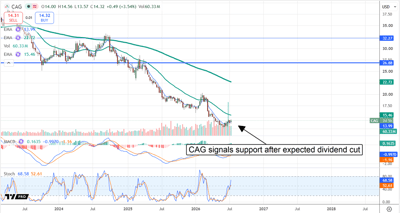
The market advanced despite the dividend cut, showing support at the 30-day exponential moving average and potential to continue rebounding. The potential for a rebound is also evident in indicators and short interest. The MACD and stochastic align with a strong entry signal, and short interest is high. The worst-case scenario is that CAG moves sideways within a range for the next few quarters until turnaround traction is clearly visible in the results.
The primary catalyst for share price increases will be margin expansion. Efforts include price increases but do not rely solely on them due to consumer pushback and durability. Instead, CEO John Brase is leaning into technology and supply chain improvements, targeting a mid-single-digit efficiency gain in the near term. Additionally, increased ad spend is intended to boost brand recognition and sales, thereby improving margins through greater leverage. The risk is inflation and its prolonged impact on consumers. Conagra's portfolio isn't considered premium, but its mid-market offerings price out some lower-end shoppers and prompt others to trade down.
This email communication is a sponsored email provided by The Oxford Club, a third-party advertiser of DividendStocks.com and MarketBeat.
This ad is sent on behalf of The Oxford Club. 105 W Monument St, Baltimore, Maryland 21201. If you would like to optout from receiving offers from The Oxford Club please click here
If you need assistance with your subscription, feel free to contact MarketBeat's U.S. based support team at contact@marketbeat.com.
If you no longer wish to receive email from DividendStocks.com, you can unsubscribe.
© 2006-2026 MarketBeat Media, LLC. All rights reserved.
345 North Reid Place, Sixth Floor, Sioux Falls, SD 57103. USA..




No comments:
Post a Comment