|
Hello – Today, we’re inviting you to take a free look at MarketBeat’s proprietary, up-to-the-minute list of 20 stocks that Wall Street’s top-rated analysts hate. These aren’t mild downgrades or lukewarm opinions.
These are true Strong Sell stocks. Some of them may look fine on the surface. A few even have what appear to be solid fundamentals. But when analysts issue a rare Sell rating, it’s usually because something beneath the surface is deeply wrong. Sell-side analysts may not nail every Buy call… but when they raise red flags, they’re almost always worth listening to. If any of these stocks are lurking around in your portfolio, you may seriously want to consider dumping them.
Click here to see the list now. Stay one step ahead, Matthew Paulson
Founder & CEO, MarketBeat
P.S. Access to 20 Stocks to Sell Now is completely free. Don’t miss your chance to review these timely, high-conviction warnings before the market reacts.
Just For You
Is Apple’s Latest Plunge the Canary in the Coal Mine for Tech Stocks?Written by Sam Quirke. Posted: 6/29/2026. 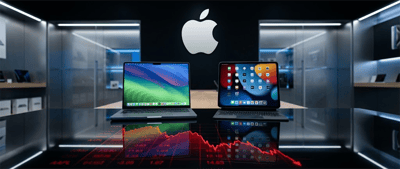
Key Points
- Apple shares suffered their worst trading day in more than a year on Thursday, dropping over 6% after the company announced price hikes on MacBooks and iPads.
- The hikes had been flagged in advance by management, but the scale of the increases still spooked the market, particularly given what they signal for the rest of the company's product lineup.
- With Microsoft also announcing major price hikes on Xbox consoles this week, the question for investors is whether this is the start of a broader tech inflation story finally biting.
- Special Report: Forget SpaceX. Buy the company Musk can't replace.
Shares of Apple Inc. (NASDAQ: AAPL) have been trading around $280 recently, giving up all of the gains they had logged since the first week of May. The stock had been steadily recovering toward its earlier highs of around $317, supported by a strengthening AI narrative and last week's strategic partnership with Intel Corp. (NASDAQ: INTC). However, Thursday, June 25, disrupted that momentum in a major way, as the stock suffered its biggest one-day decline in more than a year. The trigger was a long-flagged but still painful announcement of price increases across the company's MacBook and iPad ranges, in some cases by as much as $300 per product. CEO Tim Cook had been signaling this move for some time, having previously described the cost pressure from surging memory chip prices as "unsustainable."
Top analysts are calling for $5,000 gold within months - and one $15 fund is designed to turn that rally into monthly income of up to 64% a year.
While most investors chase mining stocks or ETFs, this single position lets you collect steady payouts without trading or options strategies. Click here to see how to claim your first payout today
Even so, seeing the hikes arrive in black and white was enough to send investors scrambling for the exits. With other major tech names like Microsoft Corp. (NASDAQ: MSFT) also announcing significant hikes this week, the question is whether this marks the beginning of something much bigger. What Was Actually AnnouncedThe new price points are not insignificant. Apple's MacBook models have each seen meaningful increases, while its iPad models have also been bumped up substantially. Depending on the model, the changes have ranged from $100 to $300 per device. In percentage terms, the move is even less attractive. Apple’s HomePod, for example, has seen its price increase by about 50% overnight. Worryingly, Apple itself made no effort to soften the messaging. The company stated that it had "reached a point where we need to begin raising prices on several products," a statement that clearly leaves the door open for further increases down the line. For investors looking for reassurance, that is the exact opposite of what they wanted to hear, and it goes a long way toward explaining why a price hike that had already been telegraphed still sparked such a sharp sell-off. The Real Concern Is What Comes NextSure, the MacBook and iPad announcements are a worry in their own right, but the deeper concern for investors is what they may signal about Apple's all-important iPhone lineup. Industry research suggests the higher cost of components could add roughly $200 per iPhone, and analysts are increasingly penciling in price hikes of $150 to $200 across the upcoming iPhone 18 range when it launches this autumn, with the heavier impact landing on the higher-memory Pro and Pro Max models. That sets up a critical test for the company in the second half of the year. Apple can either pass those higher memory costs straight through to consumers and test just how much loyalty its premium customer base really has, or it can absorb more of the hit in its own margins. Neither option is especially attractive, and the market's brutal reaction this week suggests investors are not fully convinced Apple can navigate the trade-off without leaving some damage behind. Microsoft Is Telling the Same StoryWhat makes Apple's announcement particularly worrying is that it is not happening in isolation. On Thursday, Microsoft separately announced that Xbox prices in the U.S. would increase by $100 to $150 per console, sending its own stock lower in the process. Two of the biggest names in tech, on the same day, telling investors that input-cost pressures are now severe enough to force meaningful price hikes onto consumers is not the kind of coincidence that gets brushed off easily. The common thread is the surging cost of memory and storage chips, driven by relentless AI-related demand and pushing up prices across the entire semiconductor supply chain. As we covered recently, this is the same dynamic that has been driving extraordinary rallies in names like Applied Materials (NASDAQ: AMAT) and SanDisk (NASDAQ: SNDK). The flip side of that boom is the cost pressure now landing on the world's biggest consumer hardware companies, and Apple and Microsoft are simply the first to formally pass that cost along. So Is This the Canary, or Just Noise?The honest answer is that it is probably both. The price hikes themselves are unlikely to derail Apple's broader bull case, which still rests on a multi-year AI device cycle, a deepening Services revenue mix, and the strategic moves we've covered around U.S. manufacturing and Intel. Those pillars remain intact, and at $280, the stock trades at a significant discount to where it was a month ago. But the market's reaction this week is sending a clear warning that the cost environment for consumer tech has tightened sharply, and any company that cannot pass through pricing or absorb margin compression is now suddenly vulnerable. For investors with a long time horizon, this dip may eventually look like another opportunity, but in the short term, the canary in the coal mine is chirping loud enough to be heard. |






No comments:
Post a Comment