

Wednesday, April 1, 2026

Entrevista do secretário de Estado Marco Rubio com Sean Hannity, da Fox News

Department of State United States of America

Tradução cortesia do Departamento de Estado dos Estados Unidos


ENTREVISTA – Trechos

MARCO RUBIO, SECRETÁRIO DE ESTADO
Washington, DC

(…)

PERGUNTA: Sr. secretário, o senhor acredita que os norte-coreanos — tem havido inúmeros relatos de que eles têm ajudado o Irã tanto em seu programa de mísseis balísticos quanto em seu programa nuclear?

SECRETÁRIO RUBIO: Bem, não posso comentar sobre isso, exceto para dizer que não há nada que qualquer governo esteja fazendo, ou que qualquer país no mundo esteja fazendo agora para ajudar o Irã, que esteja, de alguma forma, impedindo a nossa missão. Eles têm países que os ajudaram no passado? Sim, têm. Quero dizer — e, a propósito, o Irã também ajuda outros países fornecendo drones, foguetes e coisas dessa natureza que eles próprios desenvolveram.

Mas entendam isto: o Irã — este é um país que tem dificuldade até para obter água potável. É um país cuja economia está em frangalhos. E ficará em situação ainda pior após esta operação. É um país cujo povo tem protestado nas ruas, não apenas pela falta de liberdade, mas também pela falta de oportunidades econômicas, pois eles tomaram todo o seu dinheiro — todo o dinheiro que possuem, o pouco dinheiro que lhes resta devido às sanções — e investiram tudo em patrocinar o terrorismo, em construir mísseis de longo alcance, aumentar o alcance desses mísseis a cada ano e produzir milhares deles, além de fabricar drones de ataque unidirecional que estão usando contra seus vizinhos. Foi nisso que eles investiram seu dinheiro, e era isso que pretendiam continuar fazendo. Eles se recusaram a negociar sobre os mísseis. Recusaram-se até mesmo a negociar sobre o terrorismo e se recusaram a negociar sobre o enriquecimento . Eles exigem o direito de realizar o enriquecimento.

Portanto, para todas aquelas pessoas que andam dizendo por aí que isso poderia ter sido evitado: foram dadas a eles todas as oportunidades, ao longo de múltiplas rodadas de negociação, e tudo o que fizeram foi rejeitar ou protelar. E isso não acontecerá sob a liderança do presidente Trump. Ele não permitirá que o Irã se torne uma potência nuclear durante o seu mandato e ameace os Estados Unidos, agora ou no futuro. 

(…)

PERGUNTA: Sr. secretário, voltemos à questão do urânio enriquecido a 60%. Claramente, esse material jamais pode cair em mãos erradas. Isso representaria uma ameaça existencial para o mundo e, especificamente, para os Estados Unidos. Portanto, ou eles renunciam a esse material voluntariamente, ou será que podemos selá-lo para que nunca seja usado? Tenho lido muitos artigos sobre essa possibilidade. Ou será que, caso eles não concordem em abrir mão voluntariamente, teremos simplesmente de assumir o controle por conta própria? 

SECRETÁRIO RUBIO: Bem, não vou discutir táticas ou opções que estejam à disposição do presidente. O que posso afirmar é que se trata de uma questão muito… não há… não há utilidade alguma para o urânio enriquecido a 60%. Sei que estamos entrando em detalhes um pouco técnicos aqui, mas, não há utilidade para ele. Não se utiliza esse material para gerar eletricidade, nem para fins médicos. A única razão para possuir urânio enriquecido a 60% é ter a capacidade de enriquecê-lo até 90% e utilizá-lo em uma bomba. Essa é a única razão para tê-lo. O Irã não tem motivo algum para possuí-lo. Eles deveriam — eles devem abrir mão disso. Já lhes foram oferecidas múltiplas oportunidades para fazê-lo. Diversos países, inclusive países considerados aliados por eles, já os procuraram e pediram que entregassem esse material. No entanto, eles continuam se recusando a fazê-lo. 

Então, por que eles continuam se recusando a entregar o urânio enriquecido a 60%? Há apenas uma razão: porque desejam retê-lo e mantê-lo para, um dia, utilizá-lo na construção de uma bomba. Essa é a única intenção — e eles pretendiam se esconder por trás de todos esses mísseis, de todos esses drones, de sua marinha e de sua força aérea. Pretendiam continuar reforçando tudo isso até o ponto em que pudessem dizer ao mundo: "Vocês nada podem fazer a respeito, pois lançaremos esses mísseis contra vocês e os destruiremos."

Veja bem: este é o momento de maior fragilidade que o Irã já enfrentou. Sem dúvida alguma, a situação atual representa o ponto mais fraco em que o Irã se encontra em 25 anos. Observe os danos que eles foram capazes de infligir aos seus vizinhos em seu momento de maior vulnerabilidade. Imagine daqui a dois anos, quando tivessem tido a oportunidade de dobrar o número de mísseis que possuíam, de dobrar o número de drones que possuíam. Imagine isso. Isso não iria acontecer. O presidente não permitiria que isso acontecesse. É por isso que ele agiu.

E, mais uma vez, quero lembrar — pois ouço esses noticiários e é muito frustrante — dizendo que não sabemos quais são os objetivos. Os objetivos são muito claros. Quero repeti-los, e vamos alcançar todos os quatro: vamos destruir a força aérea deles — o que já fizemos; vamos destruir a marinha deles — o que já fizemos em grande parte; vamos destruir as fábricas que produzem esses mísseis e esses drones; e vamos destruir — vamos degradar severamente seus lançadores de mísseis para que não possam disparar essas múltiplas salvas contra seus vizinhos, nem nos ameaçar, ameaçar nossas tropas na região e ameaçar nossos aliados na região. E estamos bem encaminhados para alcançar todos esses quatro objetivos. Esses objetivos serão alcançados. Serão alcançados muito em breve.

PERGUNTA: Vamos falar sobre o Estreito de Ormuz. Vinte por cento do suprimento mundial de petróleo passa por ali diariamente. O senhor tem afirmado categoricamente que não lhes será permitido instituir um sistema de "pedágio", no qual cobrariam dos países para transitar — milhões de dólares —; esse é o ponto número um. E, em segundo lugar, trata-se do livre fluxo de petróleo a preços de mercado. Isso é fundamental para a economia mundial, obviamente, embora não tanto para a economia americana. E isso levanta a questão da Otan, à qual chegarei em um instante. Qual é a importância disso e como o senhor determina se será ou não seguro retirar as forças dos EUA, sabendo e tendo a confiança de que o Estreito permanecerá aberto para o livre fluxo de petróleo?

SECRETÁRIO RUBIO: Bem, o Estreito de Ormuz constitui águas internacionais, certo? Portanto, qualquer ação do Irã para impedir o tráfego comercial é ilegal. Para todos aqueles países que adoram falar sobre Direito Internacional: impedir o livre fluxo de navegação em águas internacionais constitui uma violação do direito marítimo internacional, okay? Então, esse é o ponto número um.

Ponto número dois: é ilegal bombardear, atingir e atacar embarcações comerciais, bem como afundá-las. Quero dizer, foi exatamente isso que os nazistas fizeram durante a Segunda Guerra Mundial, no Atlântico; e é isso que eles estão fazendo agora com navios — navios de países de que não gostam, ou que ostentam a bandeira de países de que não gostam. Trata-se de atos terroristas que eles estão perpetrando.

Sendo assim, os Estados Unidos obtêm uma parcela muito pequena de sua energia por meio do Estreito de Ormuz. Nossos aliados transportam grandes volumes de petróleo por essa rota e me refiro aos nossos aliados do Golfo e, certamente, países da Ásia e da Europa dependem dela. Nós dependemos muito pouco desse Estreito. Portanto — se, de fato, o Irã decidir instituir uma taxa de "pedágio"; se, de fato, o Irã decidir controlar ilegalmente o Estreito de Ormuz, ou decidir tentar fazê-lo, olhe, imagino que caberá ao presidente decidir se deseja prestar auxílio. Mas este é um problema para o mundo. São os países ao redor do mundo que deveriam se mobilizar, lidar com a situação e declarar que isso é intolerável. E é exatamente isso que temos incentivado que façam.

(…)

PERGUNTA: (…) Eu seria negligente, já que tenho a oportunidade de falar com o senhor agora, se não pedisse uma atualização sobre a Venezuela. O senhor se reuniu, mais cedo hoje, com a líder da oposição venezuelana, María Corina Machado. Neste momento, Delcy Rodríguez parece estar cooperando com os Estados Unidos. E, se possível, poderia nos dar uma atualização sobre Cuba? A queda do regime lá parece, de certa forma, iminente.

SECRETÁRIO RUBIO: Bem, quanto à Venezuela, lembre-se de que tínhamos um plano em três etapas. A primeira era a estabilização. Não queríamos que o país enfrentasse uma migração em massa. Não queríamos uma guerra civil. Não queríamos tumultos nas ruas. Isso foi, em grande parte, alcançado. De fato, não presenciamos nada disso.

A segunda é uma fase de recuperação. E é nela — a fase de recuperação — que nos encontramos agora; um momento em que se observa não apenas uma recuperação econômica acontecendo na Venezuela, mas também uma recuperação econômica que é benéfica para os Estados Unidos. Refiro-me ao fato de que eles estão enviando todo aquele petróleo para as nossas refinarias, e o dinheiro resultante — os lucros gerados — está sendo depositado em contas bancárias controladas pelo Tesouro dos Estados Unidos. Esse dinheiro está sendo revertido em benefício do povo venezuelano, em vez de ser roubado.

Parte dessa recuperação se manifesta na libertação de centenas de prisioneiros políticos que pudemos presenciar. Vimos também o fechamento daquela prisão muito infame, onde costumavam encarcerar todos os prisioneiros políticos. Já se passaram apenas três meses. O que foi alcançado na Venezuela em apenas três meses é nada menos que extraordinário. 

Em última análise, será necessária uma fase de transição. Terão de ser realizadas eleições livres e justas na Venezuela, e esse momento precisa chegar. E isso exige — não é algo para sempre, mas precisamos ser pacientes; contudo, também não podemos ser complacentes. Sendo assim, sinto-me muito satisfeito com o progresso que fizemos na Venezuela ao longo de três meses. E todos aqueles pessimistas que previam um cenário catastrófico afirmando que, depois que Maduro foi detido, como deveria ter sido, e levado à justiça, que as coisas iriam dar terrivelmente errado, bem, creio que eles precisam admitir que estavam equivocados. Até o momento, tudo correu bem na Venezuela ao longo destes últimos três meses.

O caso de Cuba é, na verdade, trágico. Cuba possui um modelo econômico que não funcionaria em lugar nenhum do mundo. Eles não têm um modelo econômico. Não existe uma economia em Cuba. Literalmente, não há economia alguma. E, infelizmente, as pessoas que comandam o aparato governamental de lá são, ao mesmo tempo, incompetentes e incapazes de solucionar esses problemas.

Portanto, acredito que Cuba necessita de duas coisas: reformas econômicas e reforma política. Não é possível consertar a economia do país sem alterar o seu sistema de governo. E — bem, eles estão em sérias dificuldades, não há dúvida quanto a isso, e teremos mais notícias a respeito muito em breve. Estamos trabalhando nisso também.

(…)


Veja o conteúdo original: https://www.state.gov/releases/office-of-the-spokesperson/2026/03/secretary-of-state-marco-rubio-with-sean-hannity-of-fox-news-3/ 

Esta tradução é fornecida como cortesia e apenas o texto original em inglês deve ser considerado oficial


This email was sent to stevenmagallanes520.nims@blogger.com using GovDelivery Communications Cloud on behalf of: Department of State Office of International Media Engagement · 2201 C Street, NW · Washington, DC · 20520 GovDelivery logo

U.S. Department of Justice Office of the Solicitor General Supreme Court Briefs Update

U.S. Department of Justice


You are subscribed to Office of the Solicitor General Supreme Court Briefs for U.S. Department of Justice. This information has recently been updated, and is now available.

04/01/2026 09:24 AM EDT

Supreme Court Term: 2025 Term
Docket Number: 25-966
Brief Type: Petition Stage Reply Brief
Civil Div. I: General (e.g., DOT, FEC, FOIA, FTC (except antitrust), HUD), Constitutional, Immigration, Naturalization, & Citizenship


We're excited to have you on board

How are government tech leaders harnessing AI, automation and modern frameworks while avoiding risk?

World's largest lithium producer chose this junior as its partner

The world needs 74 new lithium mines by 2035.

Few companies are positioned alongside a group actively building them.

One TSX Venture-listed company operates a 50/50 partnership with Ganfeng Lithium, the world's largest lithium chemical producer and the force behind one of the largest lithium deposits globally.

That changes the entire equation. They're working alongside a global industry leader with aligned incentives, shared funding, and a clear path from discovery to production.

And it's doing it in one of the last places the industry hasn't fully explored.

The explorer controls more than 4,200 km² across six African countries - the largest lithium-focused land position on the continent, in regions that have seen only a fraction of global exploration spending.

At its flagship Springbok Project, the company has already outlined what appears to be a new lithium district stretching over 50 kilometers, with more than 40 known spodumene-bearing pegmatites.

Sitting at surface is a stockpile with an estimated value of ~US$4.2 million, enough to effectively cover the project's acquisition cost and fund upcoming drilling without dilution.

So, while most companies are raising capital just to begin drilling... this one may already have the means to move forward. And Springbok is only one piece of the story.

In Mali, the company holds ground directly beside Ganfeng's own massive deposit.

In Zimbabwe, it moved from first pass to a meaningful drill intercept in under six months.

In Ivory Coast, drilling is already underway.

Same style of geology, same type of targets, and with a global lithium heavyweight already at the table.

Get the full breakdown on this TSXV-listed company.


Tomorrow Investor


More Reading from MarketBeat

3 Stocks Where Insiders Are Putting Their Own Money to Work

Written by Thomas Hughes. First Published: 3/18/2026.

Stack of “INSIDER BUYING” documents on office desk.

Key Points

  • Insider buying is clustering in E.W. Scripps, First Financial Bankshares, and Crane, signaling confidence—but each setup has distinct risks.
  • E.W. Scripps is the highest-risk turnaround of the group, while First Financial Bankshares is positioned as the steadier capital-return story.
  • Crane combines insider buying with raised guidance and a dividend increase, with analyst and institutional sentiment reinforcing the upside case.
  • Special Report: The Biggest IPO Ever: Claim Your Stake Today

Insiders are buying stocks in 2026, but that doesn't guarantee they're good investments. The names on this list carry risks, yet each shows upside potential tied to operational improvements and profit capacity. Headwinds persist, but the opportunity is meaningful — insiders typically have no reason to buy unless they see value. The remaining questions are how long gains will take to materialize and how high prices can climb. In every case, catalysts are present and the upside potential begins in the double-digit range.

Insiders Bet Big on E.W. Scripps Rebound Potential 

Insiders have made notable purchases of E.W. Scripps (NASDAQ: SSP), suggesting they see value the market is overlooking. InsiderTrades data shows executives — including the CEO, a director and several family-related holders — bought shares in March. The volume and timing are striking: insiders hadn't traded the stock in years, and suddenly they are buying.

Ticker Revealed: Pre-IPO Access to "Next Elon Musk" Company (Ad)

We've found The Next Elon Musk… and what we believe to be the next Tesla.

It's already racked up $26 billion in government contracts.

Peter Thiel just bet $1 Billion on it.

👉 Unlock the ticker now and get it completely free.tc pixel

Management is pushing efficiency, integrating AI to lower costs and expand growth, and focusing on sports and local broadcasting to broaden the network. Analyst expectations are muted: coverage is thin and consensus forecasts a contraction in fiscal 2027. Those estimates may not fully reflect potential recovery dynamics. The company also faces the broader challenges confronting traditional TV and is undertaking a high-risk turnaround while carrying meaningful debt.

Analyst recommendations are mixed — the consensus rating is Reduce, yet price targets imply roughly 80% upside. Institutional holders own nearly 80% of the shares and have accumulated stock over recent quarters. That institutional buying matches technical signals of a market bottom: a rounding base in 2024–2025 followed by a move above key exponential moving averages (EMAs) in 2026.
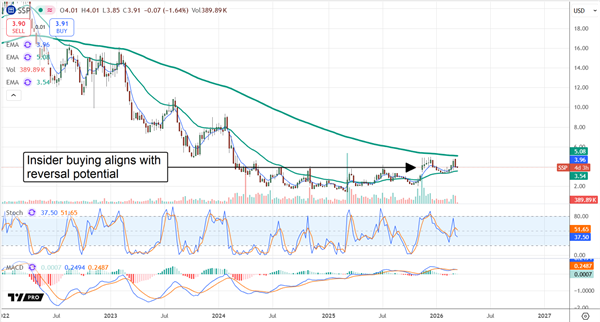
E.W. Scripps (SSP) stock chart shows base near $4 as insider buying suggests reversal potential amid improving momentum.

First Financial Bankshares Insiders Buy, Buy, Buy

First Financial Bankshares (NASDAQ: FFIN) has seen steady insider buying for five consecutive quarters with no insider selling. Activity was uneven through 2025 but accelerated to a historic high in early 2026, led by directors and the CFO. They purchased more than $650,000 in shares, bringing insider ownership to over 3.8% of the company's stock.

Key attractions include a roughly 2.5% dividend (as of mid-March) that appears sustainable — the payout is under 50% of earnings — ongoing share buybacks and a growing business. Book value rose more than 17.5% in fiscal 2025 and is expected to continue expanding in 2026. Buybacks have been meaningful, though they didn't fully offset dilution in 2025.

Analyst coverage is light (three tracked) but generally optimistic; the consensus rating is Hold and price targets point to about 30% upside from early-March lows, with room for more if trends continue. Institutional ownership is stronger, at roughly 70%, and institutions have been accumulating on a trailing-12-month basis, particularly after a solid Q1 2026 earnings report that reinforced the company's capacity to return capital.
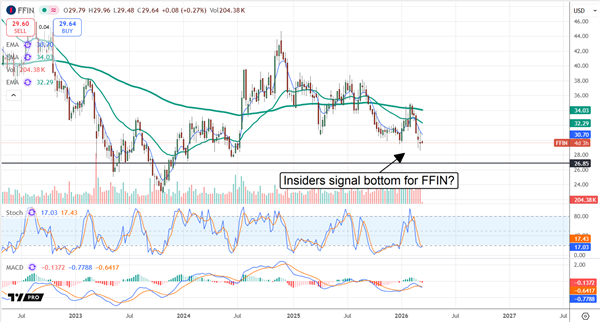
First Financial Bankshares (FFIN) stock chart shows pullback toward support near $28, with insider buying hinting at a potential bottom.

Crane Company Insiders Think It Can Fly Higher

Crane Company (NYSE: CR) insiders purchased shares in early Q1 after the company reported a strong quarter, raised guidance and boosted the dividend by 10%. The yield is modest but well-covered: the payout ratio is only about 15%, leaving ample room for acquisitions to drive growth and shareholder value. Management and analysts expect mid-single-digit revenue growth in the coming years and margin expansion at a low double-digit pace.

Analysts are strongly bullish: of the eight tracked, all rate the stock a Buy and see roughly 30% upside. Institutions also show conviction, owning about 75% of the company's shares and buying aggressively in Q1. Institutional activity in Q1 translated to more than $3.50 bought for every $1 sold, creating a supportive base that helps limit downside risk.
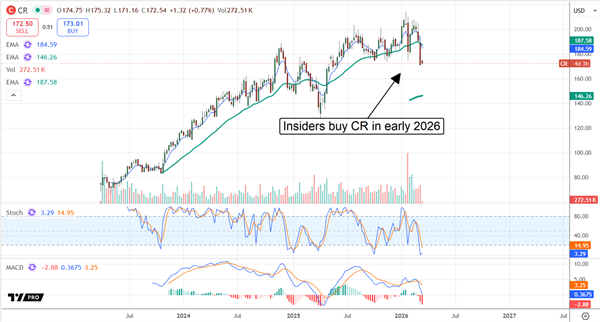
Crane Co. (CR) stock chart shows a pullback after a strong uptrend, with insider buying in early 2026.


Further Reading from MarketBeat Media

This Beer Stock's Valuation Is Too Good to Ignore

Authored by Sam Quirke. Date Posted: 3/26/2026.

Constellation Brands beer and wine lineup with Corona and Modelo bottles, reflecting undervalued stock and demand rebound theme.

Key Points

  • After a poor 2025, Constellation Brands' shares have also struggled to get going so far in 2026. 
  • However, a wave of recent analyst upgrades suggests the worst may be behind it ahead of a major catalyst in the form of this summer's FIFA World Cup. 
  • At the same time, an attractive valuation relative to peers means the downside is limited, and the risk/reward profile is solid. 
  • Special Report: The Biggest IPO Ever: Claim Your Stake Today

In a market dominated by talk of artificial intelligence and technology, it's not surprising that stocks like Constellation Brands Inc. (NYSE: STZ) can fly under the radar — which is exactly what's happened in recent months. Despite owning some of the most dominant beer brands in the U.S., the company's shares have struggled to generate meaningful momentum amid concerns about slowing demand and consumer weakness.

The stock is currently trading around $150. While bears have repeatedly tried to push it lower, it has managed to hold above last year's low. In fact, a series of higher lows has formed in recent months, suggesting selling pressure may be fading and a potential base might be forming. That's notable because, beyond the emerging technical setup, Constellation's valuation alone is beginning to look like a buy — let's take a closer look.

Analysts Are Turning Bullish in 2026

Ticker Revealed: Pre-IPO Access to "Next Elon Musk" Company (Ad)

We've found The Next Elon Musk… and what we believe to be the next Tesla.

It's already racked up $26 billion in government contracts.

Peter Thiel just bet $1 Billion on it.

👉 Unlock the ticker now and get it completely free.tc pixel

Despite the stock losing roughly 10% of its value from February to late March, analyst sentiment has clearly begun to shift. Citigroup upgraded the stock to Buy on March 18, echoing RBC's Outperform rating. A week later, Goldman Sachs also reiterated a Buy.

If it were just a single update, it would be easy to dismiss as isolated optimism. But the run of analyst updates over the back half of March reflects a growing consensus that Constellation is not only positioned to navigate current headwinds, but could be set up for a strong rally in Q2.

Price targets are beginning to reflect that view. With estimates as high as $180, analysts are calling for roughly 20% upside from current levels. More importantly, lowered expectations mean even modest outperformance from Constellation could produce meaningful upside.

Demand Pressures May Be Nearing an Inflection Point

A common theme among the analyst notes tied much of the recent weakness to Constellation's core customer base. Hispanic consumers, who over-index for brands like Modelo and Corona, have pared back spending amid economic and immigration-related concerns.

There's a timely catalyst that could help reverse that trend: the FIFA World Cup is around the corner, and drinking beer while watching soccer is a habit closely aligned with Constellation's core demographic. That creates a natural tailwind just as the company appears positioned for stabilization.

There are also early signs the worst of the demand slowdown may already be behind the company. While its most recently reported revenue declined partly due to wine divestitures, underlying organic sales held up much better — suggesting the core beer business remains resilient. Brands like Pacifico and Victoria have continued to perform strongly, helping offset softness elsewhere and reinforcing the view that Constellation's issues are cyclical rather than structural.

A High-Quality Business Trading at a Discount

Perhaps the most compelling part of the story is valuation. Constellation Brands is trading at a price-to-earnings (P/E) ratio of around 12, well below the sector median near 16. That disconnect suggests the market may have overreacted and sent the stock lower than warranted. In reality, the company continues to generate strong cash flow and has been actively improving its cost structure.

Management's cost-cutting initiatives are reportedly running ahead of schedule, and portfolio streamlining has sharpened focus on the most profitable segments. At the same time, the company has maintained a decent dividend payout while running share buyback programs — signaling management believes the stock is undervalued.

For investors considering a position, it's an attractive setup: Constellation offers a compelling valuation relative to peers, early signs of operational improvement, and multiple analysts recommending the stock.

The Setup Into Earnings Looks Compelling

With the next earnings report due in the second week of April, the timing could be favorable for shares to grind higher into the print as anticipation builds.

If the company can deliver even modest improvements in demand trends or margins, the market reaction could be meaningful. In a context of subdued expectations, it won't take much to produce an upside surprise. At the same time, the risk-reward profile looks relatively favorable: with the stock trading at a discount and sentiment cautious, downside appears more limited than it was earlier in the year.


This email is a paid sponsorship for The Tomorrow Investor, a third-party advertiser of MarketBeat. Why did I receive this email?.
 
If you have questions or concerns about your account, please email MarketBeat's U.S. based support team at contact@marketbeat.com.
 
If you would no longer like to receive promotional emails from MarketBeat advertisers, you can unsubscribe or manage your mailing preferences here.
 
Copyright 2006-2026 MarketBeat Media, LLC. All rights reserved.
345 North Reid Place, Suite 620, Sioux Falls, South Dakota 57103. USA..
 
Link of the Day: Ticker Revealed: Pre-IPO Access to "Next Elon Musk" Company 

Page List

Blog Archive

Search This Blog

Microsoft Commits 190 Billion to Ai as Stock Lags Behind Peers

Microsoft Corp. (NASDAQ: MSFT) delivered what, by almost any conventional measure, was a... ͏  ͏  ͏  ͏  ...