| Unsubscribe |
If we’ve learned anything from President Trump’s second term, it’s that his jokes have a funny way of happening.
When he floated putting his own face on American currency, it sounded like just another one of his vain musings.
The U.S. Mint is now striking $1 coins bearing his portrait – the first living president to appear on American money since Abraham Lincoln.
When he boasted about hosting a UFC cage fight on the White House lawn, late-night hosts had a field day.
Then the octagon went up on the South Lawn.
And when recently asked point-blank whether Greenland would be under U.S. control by the end of his term. His answer: "Yeah, you should make that bet, actually."
Again, the press laughed it off as another Trump provocation – a quip to agitate Brussels and rattle NATO.
But I believe Trump’s declaration to control Greenland is not only real, it’s part of something far bigger and more consequential for all of us.
This strange story has resurfaced again and again since 2019, in defiance of every diplomatic embarrassment it causes.
There is a reason for that persistence – and once you see it, you will start to see the same reason behind a dozen other stories the press has been reporting as separate events.
Greenland sits on one of the largest untapped deposits of rare-earth minerals on the planet – the metals without which not a single advanced semiconductor, AI data center, or American fighter jet can be built. Its deposits contain dozens of the minerals Washington officially classifies as critical to national security.
Now hold that thought, and look at what else this administration has been doing.
Trump has signed an executive order creating a $12 billion strategic stockpile of critical minerals. The administration calls it Project Vault.
The government has taken direct equity stakes in American mining companies – MP Materials, Lithium Americas, Trilogy Metals. Washington now co-owns the miners.
Trump secured $500 billion in mineral rights from Ukraine as a condition of continued American support.
Shuttered nuclear plants are being reopened across the country, and permitting for new reactors has been slashed from years to months – because the AI buildout requires more electricity than the American grid can currently produce.
The CEOs of Nvidia, Apple, Microsoft, and BlackRock have been shuttling between Washington, Riyadh, and Beijing alongside the President – cutting deals that have committed more than a trillion dollars of Gulf money to American AI infrastructure.
And on December 12, 2025, representatives of 13 nations quietly signed a pact at the State Department that almost no one in the financial press has covered.
The tariffs… The threats to annex Canada… The strike on Venezuela… The obsession with Greenland…
They are not separate stories – they are one story.
Every single one of these moves secures the same thing: American control over the critical resources and energy that the next century's economy will run on. The materials Russian President Vladimir Putin was talking about when he said whoever leads in this sphere will "become the ruler of the world."
And the reason Trump is moving this fast, this aggressively – and on this many fronts at once – is the biggest part of his grand plan, the part that connects all of it:
He needs these resources to instigate an emergency reset of the U.S. dollar.
For 50 years, America's currency has been anchored to Saudi oil – the petrodollar arrangement Henry Kissinger struck in the desert in 1974. That arrangement quietly expired in June 2024.
Since that expiration, Central banks have been dumping U.S. Treasuries at a pace not seen in decades.
China has cut its holdings by 45% from their peak. The BRICS nations offloaded $47 billion of American debt in a single month earlier this year. And the dollar's share of global reserves has sunk to its lowest level this century.
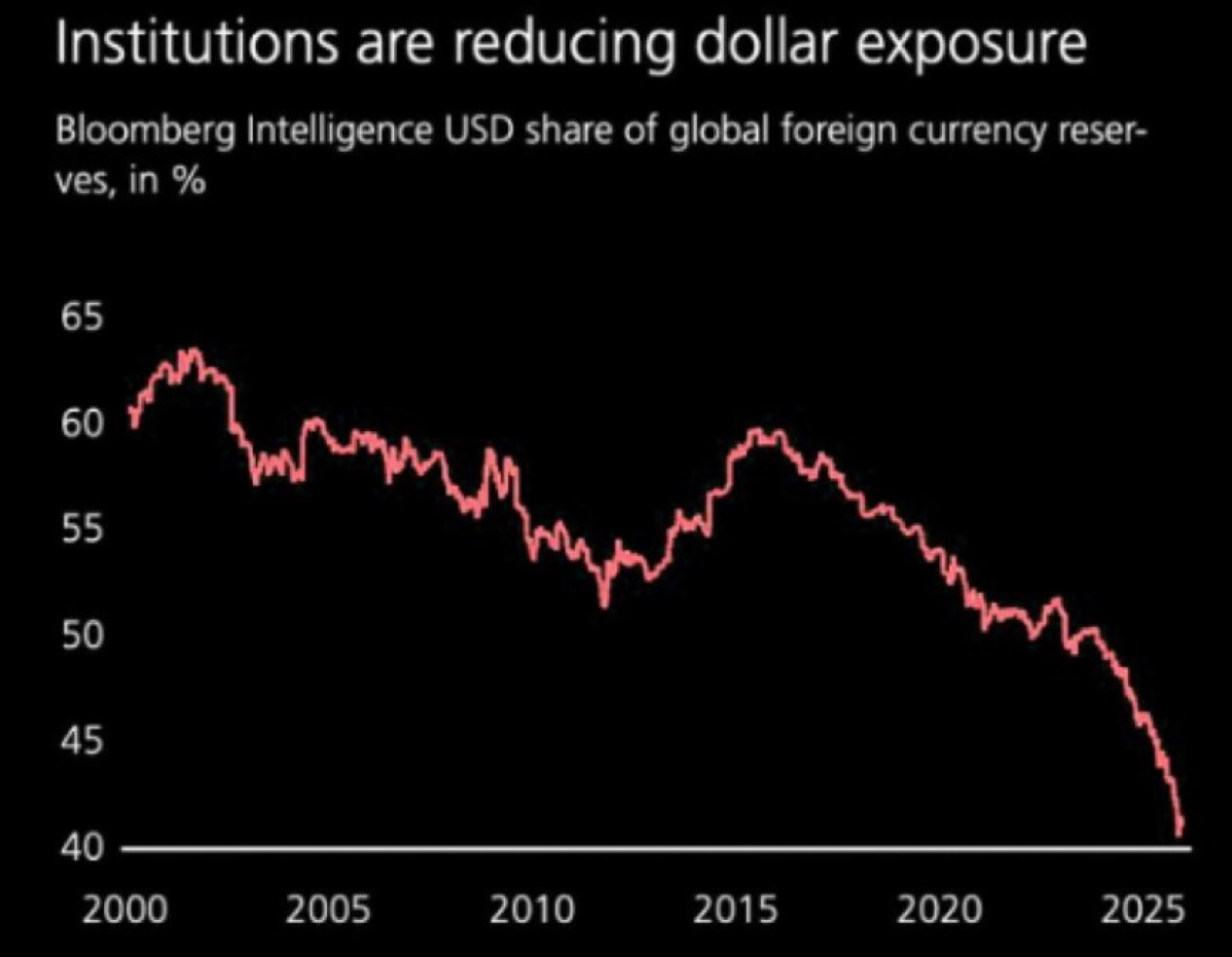
Source: Bloomberg
Everything about our way of life – the low interest rates, the cheap mortgages, the government's ability to borrow trillions without collapsing – all of it rests on one privilege: the world's willingness to hold our money.
Take that away, and the entire American standard of living is in peril.
The Trump administration is painfully aware of this. It is the crisis lurking behind every move I've just described and why they are moving heaven and earth to give the world a new reason to need the dollar.
What's being assembled is a new monetary order – anchored not to oil, but to the critical minerals, energy, and AI infrastructure this administration is now racing to lock up on every continent. A reset already signed and sealed in the back rooms of Washington, bypassing Congress entirely.
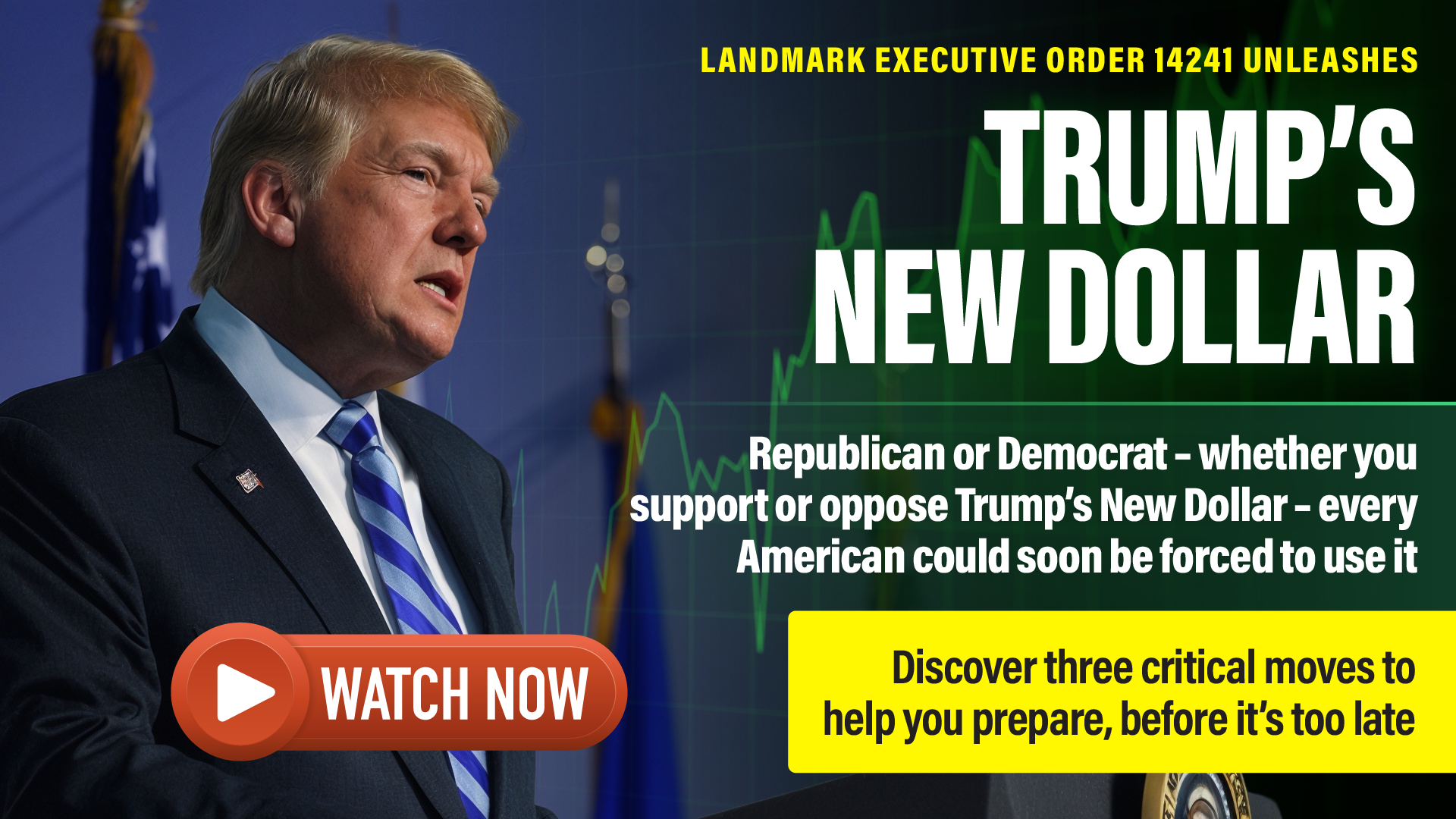
And it is the first reset of America's money in half a century.
When Kissinger struck that deal with the Saudis, it minted more than a thousand new millionaires a day for 50 years – and quietly hollowed out the savings of the millions who never understood what was happening.
I've laid out the whole story in my new documentary – including the five companies sitting at the chokepoints of the new monetary order, and one move to gain immediate exposure to what's unfolding.
And I'd urge you to watch it soon… because this December, when the leaders of the world's 20 largest economies gather at Trump's own resort in Miami, I believe the President could unveil his new monetary order to the world.
The dividing line is being drawn now and which side of it you end up on may depend on what you do before then.
Good investing,
Porter Stansberry
Microsoft's Sell-Off May Be a Gift, Not a Warning
Author: Chris Markoch. Article Published: 8/21/2026.

Key Points
- Microsoft has pulled back after a sharp post-earnings rally, putting the stock’s recent recovery back under scrutiny.
- Azure growth, a large contracted backlog and aggressive AI infrastructure spending remain central to the Microsoft investment case.
- Investors are weighing whether the recent dip is a healthy reset or the start of a deeper reassessment of the stock.
- Special Report: Forget SpaceX. Buy the company Musk can't replace.
Microsoft (NASDAQ: MSFT) stock surged roughly 30% in the three weeks following its Q4 report for fiscal year 2026 (FY2026).
That made it one of the biggest winners of the tech earnings season and reversed a sell-off that had felt overdone.
Your trading strategy could be quietly costing you (Ad)
Most retail crypto holders have put more in than they have to show for it over the last three years. That is not Bitcoin's fault - it is a strategy problem.
Joel Peterson built a framework that flips the usual buy high, sell low pattern. His free 75-minute workshop this week covers exactly when to enter, when to exit if wrong, when to take profit if right, and the single signal to wait for.
Attendees keep the full framework either way, plus $10 in Bitcoin just for showing up.
Save your free seat for Joel Peterson's live workshop nowHowever, MSFT just gave back part of its August rally. Shares are down nearly 8% from a recent high near $520.
For anyone who watched the stock surge from $440 to $520 in three weeks and felt like the train had left the station, this dip looks like an opportunity.
Microsoft Stock's Pullback Looks Worse Than the Business
Price action drives headlines faster than earnings reports. That's the perception-versus-fundamentals gap in action. Microsoft stock has pulled back sharply from its all-time closing high near $538, and the recent slide from around $520 adds a fresh layer of anxiety for anyone who bought the August breakout.
But a pullback in a stock and a pullback in the underlying business are two different things. Right now, only one of them is actually happening.
Microsoft's Fundamentals Keep Getting Stronger
Microsoft's Q4 FY2026 results gave bulls almost everything they could ask for. Revenue hit $90 billion, up 18% year over year, while Azure crossed $100 billion in annual revenue for the first time. Contracted backlog reached $678 billion, giving investors more visibility into future AI spending than most rivals can offer. Azure itself grew 43% in the quarter, and Microsoft 365 Copilot passed 30 million paid seats.
That backlog number is perhaps the most important. It jumped by roughly $51 billion in a single quarter and represents signed revenue waiting to convert. Companies don't commit $190 billion to capital expenditures (CapEx) on hope.
Management has repeatedly said demand for AI-enabled cloud capacity is outpacing what the company can currently supply. A company that is supply-constrained in its fastest-growing product isn't one investors should worry about.
Microsoft's AI Spending Is a Hyperscaler-Wide Concern
Free cash flow has compressed as Microsoft plows record sums into GPUs and data centers, and that's the number bears keep circling. It's a legitimate metric to watch, but it isn't unique to Microsoft.
Every hyperscaler is running the same playbook. Alphabet (NASDAQ: GOOGL), Amazon (NASDAQ: AMZN), and Meta Platforms (NASDAQ: META) have all raised their own 2026 capital-spending guidance in recent months.
The credit-market noise adds to the confusion. Hyperscalers, including Microsoft, have more than doubled their collective debt load over the past year to fund the buildout. Bond investors are paying closer attention, and demand for hyperscaler bonds has thinned somewhat from earlier in the year.
But analysts covering this debt are largely consistent on one point: These companies aren't in financial distress. The financing is simply moving further off balance sheet, into private-credit and leasing structures that are harder for the average investor to see. That's a sector-wide question worth monitoring over the next several years, but it says nothing specific about whether Microsoft's core Azure business is healthy today.
MSFT Chart Shows a Constructive Setup
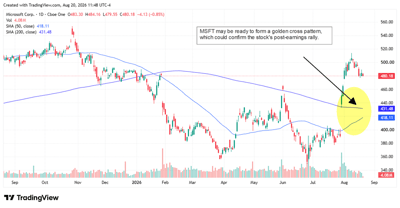
Zoom out on the chart, and the sell-off looks less like a breakdown and more like digestion after a violent recovery. Microsoft's 50-day moving average sits at $418.11, still below the 200-day at $431.48, but the gap has narrowed sharply since the stock's April lows near $345.
If the 50-day average continues climbing at its current pace, a golden cross—the 50-day moving above the 200-day—is a realistic setup over the coming weeks. That crossover doesn't guarantee anything on its own, but it typically confirms an intermediate-term trend shift rather than just a headline-driven price bounce.
Just as important, this week's pullback found support right around the $480 level, which had acted as resistance in June and July. Old resistance becoming new support is a classic technical signal that the breakout above it was rooted in real demand.
Microsoft's Pullback Could Give Investors a Second Chance
Investors who sat out Microsoft's April-to-August recovery watched the stock nearly double off its lows and understandably felt like they'd missed the move. A stock that runs hard without you creates a very human urge to wait for the next dip, only to talk yourself out of buying when it appears because the headlines during the dip sound worse than those during the run.
This week is that dip. The business didn't get worse between last Thursday and today. Azure demand still exceeds supply. The backlog is still growing faster than the stock can price it in. The CapEx concerns are real, but they belong to the entire hyperscaler cohort, not to Microsoft alone.
Nebius Just Exploded 34% on Blowout Earnings—Is It Time to Buy?
Author: Ryan Hasson. Article Published: 8/13/2026.

Key Points
- Nebius Group shares surged nearly 34% on Aug. 12 after second-quarter revenue jumped 454% year over year to $582.3 million.
- Annualized run-rate revenue reached $3 billion, up 598% year over year, as the company raised its year-end contracted power target to 5 gigawatts to meet surging demand.
- Despite strong technical momentum and reclaimed moving averages, Nebius trades at roughly 130 times trailing sales, prompting caution about valuation before buying.
- Special Report: Forget SpaceX. Buy the company Musk can't replace.
Nebius Group (NASDAQ: NBIS), one of the world's most exciting neocloud companies, exploded nearly 34% on Aug. 12 following the release of its second-quarter results. The timing could hardly have been better for the company.
The stock had fallen significantly from its 52-week high, dragged down by the broad risk-off sentiment sweeping across the AI trade. Wednesday's surge changed that picture in a single session. But after such a large move, the big question is whether this is the time to buy or whether the easy money has already been made.
A Blowout Quarter
Your trading strategy could be quietly costing you (Ad)
Most retail crypto holders have put more in than they have to show for it over the last three years. That is not Bitcoin's fault - it is a strategy problem.
Joel Peterson built a framework that flips the usual buy high, sell low pattern. His free 75-minute workshop this week covers exactly when to enter, when to exit if wrong, when to take profit if right, and the single signal to wait for.
Attendees keep the full framework either way, plus $10 in Bitcoin just for showing up.
Save your free seat for Joel Peterson's live workshop nowThe results were nothing short of spectacular, which helps explain the remarkable 34% surge. Nebius reported Q2 revenue of $582.3 million, a staggering 454% increase year over year and a 46% increase from the prior quarter. The core Nebius AI cloud business grew even faster, surging more than 500% year over year to $574.9 million and accounting for roughly 98% of total group revenue. The company posted a loss of just 12 cents per share, dramatically better than the 67-cent loss analysts had modeled, and generated $236 million in positive adjusted EBITDA.
Perhaps the most important figure was annualized run-rate revenue (ARR), which reached $3 billion at the end of June, up 598% year over year and 56% from the $1.9 billion reported at the end of March. That ARR trajectory is the clearest evidence yet that Nebius is scaling at an almost unprecedented pace in the infrastructure space. Management reaffirmed its full-year 2026 guidance of $3.0 billion to $3.4 billion in revenue and an ARR target of $7 billion to $9 billion.
Demand Is Not the Problem—Capacity Is
The most telling theme from the quarter was that Nebius is not struggling to find customers; it is racing to build fast enough to serve them. The company raised its year-end contracted power target to 5 gigawatts, a figure that has now increased fivefold since August 2025. The AI cloud business expanded its adjusted EBITDA margin to 50%, up from 24% in the fourth quarter of 2025, a remarkable improvement that shows scale is translating directly into profitability.
CEO Arkady Volozh drove the point home in his letter to shareholders, saying the company could sell its entire planned 2027 capacity today under current terms but is deliberately holding back some supply for higher-priced, shorter-duration deals. Those short-term agreements are reportedly being negotiated in the range of $40 million to $50 million per megawatt, and sometimes higher. When a company turns down the chance to pre-sell next year's capacity because it expects to command better pricing later, it says a great deal about the strength of demand. The expansion is being funded through customer prepayments, a $775 million asset-backed debt facility and an asset-light partnership model that limits balance-sheet strain.
The Technical Picture
From a technical standpoint, the stock has made major progress in resuming its upward momentum. Wednesday's move completely changed the look of the chart. Nebius has now reclaimed all of its key moving averages and, importantly, broken through the $220 resistance level—the exact point from which it had failed on three separate occasions.
That $220 area should now turn into support during any future pullbacks, and holding above it would allow the bulls to remain confident. After such a large earnings-driven move, however, a few days of price digestion may be what the bulls would welcome most, allowing the stock to consolidate its gains rather than extend too far, too fast.
So, Is It Time to Buy?
Here is where investors need to balance enthusiasm with discipline. The business is firing on all cylinders, and the quarter resolved many of the questions hanging over the stock. But the valuation remains extreme. Even after its recent pullback and despite its explosive growth, Nebius trades at roughly 130 times trailing sales, a multiple that leaves little room for disappointment and helps explain the stock's ferocious volatility.
For long-term believers in the AI infrastructure buildout, this quarter was powerful confirmation that Nebius is among the sector's genuine leaders. For those looking to gain exposure to the company, the more prudent approach may be to watch how the stock handles the $220 zone and let the dust settle before committing.
This email is a paid sponsorship sent on behalf of Porter & Company, a third-party advertiser of MarketBeat. Why did I get this email?.
If you have questions or concerns about your newsletter, please contact MarketBeat's South Dakota based support team at contact@marketbeat.com.
If you would no longer like to receive promotional emails from MarketBeat advertisers, you can unsubscribe or manage your mailing preferences here.
© 2006-2026 MarketBeat Media, LLC.
345 N Reid Pl. #620, Sioux Falls, SD 57103. USA..




No comments:
Post a Comment