| Unsubscribe |
Tim Sykes here.
I want to talk to the person who's watched other people make real money trading and thought…
"I could do that. But I don't have the time."
If that's you, hear me out.
You don't have a discipline problem. You have a schedule problem. There's a difference.
Everything you've ever been sold about trading has the same catch. You have to be glued to a screen from 9:30 to 4:00, watching charts, catching moves all day long.
Which is exactly when you have a job, a family, and a life.
I've spent years building the opposite. A strategy for people who have lives outside the market.
Click here to see how it works.
-Tim Sykes
P.S. Every claim I make is backed by verified profits. Look me up, then decide.
Abercrombie’s Comeback Is a Work in Progress
By Peter Frank. Published: 8/13/2026.

Key Points
- Abercrombie & Fitch posted first-quarter sales growth but faced slipping comparable sales, narrowing operating margins, and weakness in its EMEA region.
- Hollister drove fiscal 2025 results with 15% revenue growth, while the flagship Abercrombie brand declined 1%, highlighting reliance on one sub-brand.
- Analysts hold a Moderate Buy consensus with a $117.55 price target, even as competition, China uncertainty, and margin pressures raise investor questions.
- Special Report: SpaceX is offering you shares. Don't take them.
Abercrombie & Fitch (NYSE: ANF) has spent the past decade rewriting its story in American retail. Mostly written off by investors in the mid-2010s, the company has transformed itself from a fading mall brand that teenagers had outgrown into a closely watched turnaround. Driven by its popular Hollister sub-brand, Abercrombie delivered 14 consecutive quarters of sales growth and once again became a favorite, reaching a dramatic peak in 2024.
Now, the story is less clear. After a punishing stock slide during the first five months of this year, the retailer’s stock has rebounded, gaining more than 50% over the past three months. Its business continues to expand, but pressures are beginning to surface.
CODE RED: AI Meltdown Imminent? (Ad)
After correctly predicting the 2008 and 2020 stock market meltdowns, I believe this AI company is about to trigger the next crash. The research firm Bernstein Research said this AI company has the power to crash the global economy for a decade, the CEO just issued a CODE RED in an internal memo warning employees they're dealing with a critical situation, and another company executive even implied they might need a government bailout. The last time I saw something like this was in 2008 when I predicted a stock market meltdown just three weeks before Lehman went under.
See the five simple steps to prepare before it's too lateThe question for investors now is whether Abercrombie has already delivered its best showing or whether meaningful upside remains.
First-Quarter Growth Masks Softer Trends
The first-quarter report was mixed, although it came in ahead of expectations. Net sales rose 1.5% year over year to $1.1 billion, marking the company’s 14th consecutive quarter of growth and a record for the period. Diluted earnings per share came in at $1.47, ahead of analysts’ expectations.
Investors initially cheered the results, but the underlying trend was softer than it first appeared. Comparable sales slipped 1%, while operating margin narrowed to 8% from 9.3% a year earlier. The company attributed part of the decline to higher marketing spending and costs related to rolling out a new enterprise resource planning system.
Geography also told an interesting story for this international retailer. The Americas, the company’s largest market, grew sales by 3%, while the Asia-Pacific region surged 24%.
However, EMEA sales fell 10% as regional conflict in the Middle East weighed on demand, particularly for the youth-focused Hollister brand in the Middle East and Europe. This sales split is worth watching, as the American brand is no longer a domestic story and is clearly affected by overseas volatility.
Hollister Remains the Key Growth Engine
The quarter’s results show just how quickly disruptions can affect performance. For the full 2025 fiscal year, however, the picture looked strong. Abercrombie topped $5 billion in annual net sales for the first time in company history, reporting revenue of $5.3 billion, up 6%. Comparable sales rose 3% during the year.
Hollister was the real engine last year, posting its best year ever with 15% revenue growth. The flagship Abercrombie brand actually declined 1%, a sign of how much this remains a two-brand company, with one brand carrying the other.
For fiscal 2026, guidance calls for net sales growth of 3% to 5%, an operating margin of 12% to 12.5%, and earnings per share of $10.20 to $11. The company also expects to complete roughly $450 million in additional buybacks.
Profitability Pressures Add to the Risks
That was the good news, but none of it erases the risks.
The most glaring concern is what the flagship Abercrombie brand’s ongoing weakness could mean for Hollister’s future momentum, particularly because fashion retail is decidedly fickle.
Although net sales for 2025 were promising, the company also showed some weakening further down the income statement.
Full-year operating income slid about 5.7%, while operating margin came in at 13.3% on a reported basis, down from 15% the prior year. Diluted earnings per share reached $10.46, marking the second straight year above $10 but declining from $10.69 the year before.
In the first quarter, although net income surpassed expectations, earnings of $1.47 per share were down from $1.59 a year earlier, while operating income fell to $88.8 million from $101.5 million.
Competition and China Add More Uncertainty
Competition is also intensifying, from American Eagle Outfitters (NYSE: AEO), Gap (NYSE: GAP), and Urban Outfitters (NASDAQ: URBN) to fast-fashion players such as Zara and H&M, which capitalize on trends more quickly and cheaply.
There is fresh corporate uncertainty as well. A report surfaced in early August that Abercrombie was exploring options for its China business, including bringing in local partners or selling a stake valued at several hundred million dollars. The deliberations were still described as being in the early stages.
Analysts Remain Cautiously Optimistic
Despite the mixed signals, analysts remain generally optimistic, though not especially enthusiastic.
The stock carries a consensus rating of Moderate Buy from 13 analysts, including eight Buy ratings and five Holds. The average 12-month price target is $117.55.
Overall, the target-price range runs from a high of $136 to a low of $87.
Abercrombie does not currently pay a dividend, but management has been aggressive about returning cash to shareholders.
The company repurchased $450 million of stock in fiscal 2025, retiring about 11% of its outstanding shares, and followed that with another $105 million in buybacks during the first quarter of fiscal 2026.
Next Earnings Report Could Be Pivotal
Putting the pieces together, Abercrombie remains a legitimately interesting, if unglamorous, story for investors interested in refreshed versions of traditional mall-retail brands.
However, softening comparable sales, margin compression, and EMEA weakness should remain in focus.
Still, the company’s next earnings report could reveal a great deal about its trajectory. The test is whether Hollister’s momentum last year can offset some of Abercrombie’s brand softness and whether younger generations still consider Abercrombie’s offerings among the latest must-have trends.
Cardinal Health Earnings: Can Perfection Get Priced In Twice?
By Chris Markoch. Published: 8/12/2026.
Key Points
- Cardinal Health posted mixed fiscal fourth-quarter results, including a 2.2% revenue miss and declining Global Medical Products and Distribution segment revenue, yet the stock hit a new all-time high.
- The company is expanding its high-margin cell-and-gene-therapy logistics business, now exclusively serving nearly half of that market, which could grow to $106 billion by 2033.
- Analysts have raised price targets and maintained a consensus above the current share price, while Cardinal Health continues a 29-year streak of dividend increases as a dividend aristocrat.
- Special Report: SpaceX is offering you shares. Don't take them.
Cardinal Health (NYSE: CAH) has been one of the best-performing stocks in one of the market’s best-performing sectors in 2026. Heading into the company’s fourth-quarter earnings report for its 2026 fiscal year (FY), CAH was up more than 40% over the previous 12 months. Despite mixed results, including a 2.2% revenue miss, the stock may soon reach a new 52-week high.
The only notable negative in the report came from the company’s Global Medical Products and Distribution (GMPD) unit. Revenue was down 2% year over year (YOY), and approximately 31 cents of earnings came from a one-time net benefit related to IEEPA tariff refunds.
CODE RED: AI Meltdown Imminent? (Ad)
After correctly predicting the 2008 and 2020 stock market meltdowns, I believe this AI company is about to trigger the next crash. The research firm Bernstein Research said this AI company has the power to crash the global economy for a decade, the CEO just issued a CODE RED in an internal memo warning employees they're dealing with a critical situation, and another company executive even implied they might need a government bailout. The last time I saw something like this was in 2008 when I predicted a stock market meltdown just three weeks before Lehman went under.
See the five simple steps to prepare before it's too lateThe company also said that several factors could limit full-year profit for the business to the lower end of its FY2027 range.
CAH Was Priced for Perfection Before Earnings
CAH stock was up nearly 30% in the three months before the report. Institutional investors were doing the heavy lifting. During the quarter, institutions bought more than $7.2 billion of the stock and sold only about $8 million. That contributed to the perception that Cardinal Health was priced for perfection.
That said, Cardinal Health was below its 52-week high heading into earnings. The concern then—as it is now—was valuation. Many conventional metrics show that Cardinal Health is overvalued. That is not new for the stock, and investors have made it clear so far that it is not a concern.
But is this the right time for new money to get involved with CAH? To help answer that question, it is important to understand Cardinal Health’s role in the healthcare sector. That role shows why a stock well known to income and value investors may also be a growth play for the rest of 2026 and beyond.
Cardinal Health’s Healthcare Supply Chain Role Supports Growth
Cardinal Health is a healthcare services and products company that sits at the center of the healthcare supply chain, connecting patients, providers, payers, pharmacists, and manufacturers to support integrated care coordination and better patient management. Cardinal Health is one of the "Big Three" U.S. drug distributors, alongside McKesson (NYSE: MCK) and Cencora (NYSE: COR).
The company operates through two primary segments:
Pharmaceutical and Specialty Solutions: Distributes branded and generic pharmaceuticals, specialty pharmaceuticals, over-the-counter healthcare products, and consumer products. This is by far the largest segment of the business, generating $204.6 billion in revenue in fiscal 2025.
Global Medical Products and Distribution (GMPD): Manufactures, sources, and allocates Cardinal Health-branded medical, surgical, and laboratory products, serving customers across the United States, Europe, Canada, Asia, and other international markets.
Cardinal Health Finds a High-Margin Niche in Gene Therapy
There is also a third part of the business to consider: the company’s NPHS, at-Home Solutions, and OptiFreight businesses. This business unit delivered one of the report’s headline takeaways.
Cardinal has been a leader in managing the complex logistics of the cell-and-gene therapy (CGT) business. The company announced that it secured two additional gene therapy commercialization agreements through its third-party logistics business.
With those wins, the company now exclusively serves nearly half of the cell-and-gene therapy market and approximately three-quarters of the total market. While that market is still relatively small, it is a high-margin niche compared with the company’s core commodity drug distribution business. However, it is expected to become a $106 billion market for Cardinal by 2033.
Analyst Price Targets and Dividend Growth Support CAH Stock
The Cardinal Health analyst forecasts on MarketBeat give CAH a consensus price target of $251.73. However, in late July, four analysts raised their price targets on the stock to levels 3% to 10% above its price as of this writing. That is in addition to the gain of more than 15% in 2026 and the gain of more than 360% over the last five years.
Along with its stock price growth, CAH has rewarded buy-and-hold investors with a modest but growing dividend. Cardinal Health is a dividend aristocrat that has increased its dividend for 29 consecutive years.
CAH Holds Its Uptrend Despite Post-Earnings Pullback
When the market opened after Cardinal Health reported its results, CAH hit a new all-time high of $258.30. Sellers quickly jumped in, perhaps led by high-speed trading programs, and sent the stock lower. However, by the end of the session, CAH was up about 1%.
CAH closed at $240.08 on Aug. 11, up $2.90, on volume of 2.24 million shares, slightly above the average daily volume. The stock’s 50-day simple moving average is $226.92 and has been rising steadily since May, with the price holding comfortably above it. That is a sign that the broader uptrend remains intact, even after the post-earnings whipsaw.
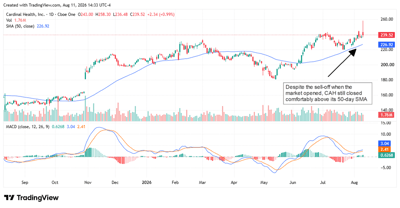
The MACD line reads 3.04, above its signal line at 2.41, with the histogram at 0.63—suggesting that momentum has cooled from its July peak but remains net positive. In other words, the pullback from the all-time high looks more like profit-taking after a “priced for perfection” report than a trend reversal.
This email is a sponsored message for Tim Sykes, a third-party advertiser of MarketBeat. Why was I sent this email?.
If you have questions about your newsletter, feel free to contact MarketBeat's U.S. based support team at contact@marketbeat.com.
If you would no longer like to receive promotional emails from MarketBeat advertisers, you can unsubscribe or manage your mailing preferences here.
© 2006-2026 MarketBeat Media, LLC. All rights reserved.
345 N Reid Place, Sixth Floor, Sioux Falls, SD 57103-7078. USA..




No comments:
Post a Comment