| Unsubscribe |
For 50 years, one rule has held the US dollar in place as the world’s reserve currency…
Sell oil for anything but dollars and the U.S. military would like a word with you.
Sadaam Hussien tried it. Gaddafi tried it. Their efforts didn’t end well.
Then Iran sold oil to China in yuan… and nothing happened.
No new attacks. No new sanctions. Why?
Because Iran took our best punch and remained standing. Which means…
The rule that held the whole reserve system together just stopped mattering.
Now every country with a reason to bypass the dollar has a working playbook. And every central bank with reserves is rotating out of paper… into gold.
I’m Garrett Goggin – the man Porter Stansberry recently called:
"THE most knowledgeable gold investor in the world. If you want to maintain your standard of living… you have GOT to be allocated to gold. And there's nobody better in the entire world to explain exactly how to do that [than Garrett]."
If you want to protect your wealth and maintain your standard of living, you simply must position yourself in gold. But not physical bullion…
There’s a better way to own gold at this stage of the bull market…
Go here for details on my top four undervalued miners.
Garrett Goggin CFA, CMT
Chief Analyst and Founder, Golden Portfolio
Fabrinet’s Sell-Off May Prove It Is One of AI’s Most Misunderstood Stocks
Author: Thomas Hughes. Article Published: 8/18/2026.
Key Points
- Fabrinet’s post-earnings drop may have more to do with investor caution than a weak fundamental story.
- The company remains tied to AI infrastructure demand through advanced optical packaging and precision manufacturing.
- Heavy spending and customer concentration are risks, but analysts still see room for the stock to recover.
- Special Report: Forget SpaceX. Buy the company Musk can't replace.
When fundamentals are strong, as they are for Fabrinet (NYSE: FN), and the market sells good news, investors may be looking at a classic buy-the-dip setup. Fabrinet plays an important role in AI infrastructure through its advanced optical packaging solutions. Its results are outperforming expectations, and its guidance was solid.
Given these trends, Fabrinet’s guidance may prove cautious, as it also reflects systemwide capacity constraints that the industry is actively working to overcome. The potential outcome is that, if not in the upcoming quarter, then in a quarter soon after, Fabrinet’s results could unexpectedly accelerate along with the broader AI industry.
Fabrinet Among a Group of Widely Misunderstood AI-Critical Stocks
Small Colorado Company (Backed by Sam Altman) Could Save U.S. Power Grid (Ad)
A small Colorado company has secured rights to technology that could prevent the U.S. public power grid from collapsing — and billionaire Sam Altman is now an investor.
This under-the-radar firm is drawing serious attention from those watching the energy infrastructure space closely.
Click here to learn this company's name for free todayThe primary cause of Fabrinet’s post-release plunge appears to be market anxiety. As strong as the Q4 fiscal year 2026 (FY2026) results were, they included heavy capital expenditures (CapEx), which weighed on GAAP results. The caveat for investors is that Fabrinet is a critical component of the AI supply chain, and its spending is backed by demand. This isn’t a start-up trying to ramp production; it’s an established cog in the AI machine, growing alongside the industry. The bull case is clear, though timing remains the key question.
As it stands, the leading semiconductor foundry, Taiwan Semiconductor Manufacturing Company (NYSE: TSM), is struggling to keep up with demand. The company is expanding existing facilities while building new ones, and much of what it makes is routed to Fabrinet’s facilities for advanced optical packaging. The market may be underestimating how systemically entrenched Fabrinet is becoming in NVIDIA’s manufacturing process and how firmly it has established its niche in the expanding ecosystem. With NVIDIA’s (NASDAQ: NVDA) sales ramping and next-generation products rolling down the pipeline, investors have reason to expect TSMC and Fabrinet revenue and earnings power to remain robust well into the future.
Fabrinet Plunges on Beat-and-Raise Quarter
Fabrinet posted a strong Q4 FY2026, with revenue up more than 45% to over $1.3 billion. That was a company record, supported by margin strength and well above forecasts. The top line exceeded MarketBeat’s consensus estimate by $40 million, or roughly 3.1%, and is expected to remain strong in the coming quarters. Margins, the critical detail, expanded at all levels, driving an approximate 56% increase in adjusted net income and a 55% increase in adjusted earnings. Adjusted earnings per share (EPS) came in at $4.10, or 29 cents above expectations.
Guidance is equally strong and points to a solid year. Q1 FY2027 revenue and earnings are forecast to exceed analysts’ consensus estimates by a wide margin, even at the low end of their ranges, setting the stage for persistent outperformance through the end of the year. In this environment, analysts may have to adjust their forecasts to match, and the bullish sentiment cycle could continue well into the next fiscal year.
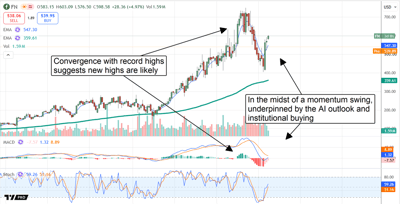
Analysts initially sold the news, citing concerns about spending and the shift to negative cash flow. However, that spending reflects expanded capacity and production ramps for AI-critical components, making it a bullish factor in this thesis. While near-term headwinds remain, spending could eventually normalize as revenue grows, leading to significantly improved margins and a return to free cash flow. Until then, analysts rate the stock as a consensus Moderate Buy; the data shows a 50% buy-side bias and no sell ratings. Price targets suggest fair value is near $645, well below the all-time high, but the stock could trend higher over the coming quarters as capacity ramps and backlogs are realized.
Fabrinet: Limited Downside With Unknown Upside Potential
Fabrinet’s upside potential is unknown because the market has yet to see a top in the AI boom. Fears persist, but NVIDIA CEO Jensen Huang has been de-risking the outlook, paving the way for financing and reduced investor risk across the AI industry. If NVIDIA’s business remains secure and GPUs continue rolling off the shelf, advanced packaging and other GPU-adjacent businesses should remain strong as well.
Institutional support suggests that the downside is limited. Institutions own more than 95% of the stock and have been accumulating shares throughout 2026. More importantly, activity ramped in early Q3, ahead of the release, coinciding with a robust rebound in the stock price. Institutions are likely to continue buying and may accelerate their activity given the mid-August price discount. The key technical factor investors and traders should watch is the MACD’s convergence with the existing high; it suggests a high probability that fresh highs will be set over time.
The company’s biggest risk is extreme customer concentration, with NVIDIA and Cisco (NASDAQ: CSCO) accounting for nearly half of revenue. Any changes in production, product design or AI demand, whether positive or negative, will be reflected in the stock price. The next visible catalyst is NVIDIA’s Q2 FY2027 earnings release, scheduled for late August.
3 Stocks That Prove the AI Trade Isn't Over, It Moved
Author: Bridget Bennett. Article Published: 8/5/2026.
Key Points
- As AI infrastructure spending peaks near $725 billion in 2026, investors are shifting focus toward companies profitably applying AI in real businesses.
- Lemonade, AppLovin, and Hinge Health each use AI to run profitable operations in insurance, advertising, and healthcare, despite recent stock volatility.
- TradeSmith's Keith Kaplan recommends sizing positions by risk level, favoring large-cap names first while treating smaller AI application stocks as higher-risk opportunities.
- Special Report: Forget SpaceX. Buy the company Musk can't replace.
Everyone has already made money on the AI buildout. The next money will be made by whoever is actually using it.
For the past two years, the easiest trades in the market were tied directly to AI infrastructure: chips, data centers and power contracts. Much of that money has already been made. The stocks that ran hardest on the AI story have already been rewarded—and, in some cases, punished—as investors begin asking a harder question: Who is actually turning all this spending into profit? That tension runs through this year's AI story, and it's why the next round of winners may look nothing like the last one.
The Buildout Is Over, the Payoff Begins
Small Colorado Company (Backed by Sam Altman) Could Save U.S. Power Grid (Ad)
A small Colorado company has secured rights to technology that could prevent the U.S. public power grid from collapsing — and billionaire Sam Altman is now an investor.
This under-the-radar firm is drawing serious attention from those watching the energy infrastructure space closely.
Click here to learn this company's name for free todayAlphabet Inc. (NASDAQ: GOOGL), Amazon.com, Inc. (NASDAQ: AMZN), Microsoft Corporation (NASDAQ: MSFT) and Meta Platforms, Inc. (NASDAQ: META) are on track to spend a combined $725 billion on AI infrastructure in 2026, up 77% from last year's $410 billion. That's a staggering number, and it remains only a cost until someone builds a real business on top of it.
History keeps repeating this pattern. The railroads laid tracks across America in the 1800s, and it was Montgomery Ward and Sears—not the railroad men—that got rich shipping catalog goods to every town the tracks reached. Amazon did the same thing with the internet: It built a bookstore on top of someone else's infrastructure and became the country's biggest retailer.
The application layer is where that is happening now, according to Keith Kaplan, CEO of TradeSmith. These companies are running real businesses on AI in insurance, advertising and healthcare, and most of them do not even screen as AI stocks. That's exactly why they remain relatively cheap compared with infrastructure names.
Lemonade Turns a Sell-Off Into an Entry Point
Lemonade, Inc. (NYSE: LMND) uses AI to underwrite insurance in seconds rather than weeks. Its second-quarter revenue rose 79% to $294.4 million, while in-force premium climbed 32.5% to $1.43 billion, marking the 11th consecutive quarter of accelerating growth. Gross profit has grown roughly tenfold over the past several years while headcount has barely moved—a sign of how much of the workload AI has absorbed. The stock still fell roughly 20% following the report.
Why the drop? Wall Street wanted a guidance increase, not another quarter of solid execution. Adjusted EBITDA losses narrowed to $19 million from $41 million a year earlier, and the company still expects to reach positive adjusted EBITDA by the fourth quarter of 2026. A newly announced CFO transition added some uncertainty, but nothing about the underwriting engine itself changed. When a cash-generating business is discounted based on expectations rather than execution, that is typically an entry point—not a red flag.
AppLovin's Margins Make Chipmakers Look Inefficient
AppLovin runs a different kind of machine. AppLovin Corporation (NASDAQ: APP) built Axon AI, an AI engine that decides which ad reaches your phone billions of times a day, with no factory or inventory behind it. Its most recent quarterly revenue rose 59% year over year to $1.84 billion, while net income reached roughly $1.2 billion. The company has a market capitalization near $131 billion. Institutional ownership sits at roughly 41%, leaving meaningful room to grow if larger funds decide those margins are too good to ignore.
The catch is an ongoing SEC investigation into AppLovin and how Axon AI collects the data that makes it work. That is a real risk that warrants modest position sizing. But the numbers are difficult to ignore: This is one of the most profitable software businesses in the public markets, and its next earnings report lands Aug. 5 after the market closes. The report could clarify how much the probe is actually weighing on growth.
Hinge Health Rebuilds Physical Therapy Around AI
Hinge Health, Inc. (NYSE: HNGE) is the smallest and newest name here. With a market capitalization of nearly $6 billion, the company has put a physical therapist's judgment into a phone camera. It watches users exercise, corrects their form and targets one of the largest categories of employer health spending in the country.
Revenue grew 53% year over year in the latest quarter to $213 million, and Hinge Health once again raised its full-year guidance, calling for 2026 revenue of $856 million to $860 million. The Aug. 4 report gave investors a stronger read on the company's post-IPO momentum, with free cash flow of $100 million. A new agreement to acquire Cylinder Health adds another layer to the growth story.
Because Hinge Health only went public in 2025, many institutional investors may still be forming their view of the stock. However, the latest quarter gives them more to work with than a simple early-stage growth narrative.
How to Size the Risk
Not every name in this group carries the same risk, and Kaplan's approach is to size positions accordingly. The safest starting point is the large-cap names with proven, profitable business models. Mid-cap names carry bigger swings and may hinge on a single industry trend or regulatory decision. The smallest and newest names offer the most speculative upside, along with the most volatility.
Lemonade, AppLovin and Hinge Health are three names from a broader list that Kaplan and his team at TradeSmith have grouped using this same risk framework. The list sorts names by whether AI is making decisions, buying ads or rebuilding an entire industry from scratch. The practical takeaway is to treat a list like this as a menu, not a checklist: Pick the handful of names that fit your risk tolerance rather than trying to own all of them equally, and keep position sizes small enough to ride out the swings without panic-selling into weakness.
Where the Risk and the Upside Actually Sit
The upside across all three names is similar: They did not build the infrastructure; they bought into it. That means they can achieve faster payback with a fraction of the capital commitment the hyperscalers are making. The risk is just as consistent: Every one of these stocks can swing sharply on a single earnings report, regulatory headline or guidance number that fails to match inflated expectations.
None of that changes the underlying setup. The infrastructure money has already moved. Stay focused on who is actually running a business on top of it, because that is what moves these stocks next.
This message is a sponsored email from Golden Portfolio, a third-party advertiser of InsiderTrades.com and MarketBeat.
If you need help with your account, please don't hesitate to contact MarketBeat's South Dakota based support team at contact@marketbeat.com.
If you no longer wish to receive email from InsiderTrades.com, you can unsubscribe.
Copyright 2006-2026 MarketBeat Media, LLC.
345 North Reid Place, Sixth Floor, Sioux Falls, SD 57103-7078. USA..




No comments:
Post a Comment