| Unsubscribe |
Dear Reader,
$2.9 billion walked out of the world's largest gold fund in one day back in March.
The total is now $14 billion.
Not one ounce of that was metal. It was paper.
Over those same months the World Gold Council counted more central bank buying than in any quarter on record.
One crowd sold the certificate.
The other took delivery of the bars.
Meet the company on the buying side >>>
The next delivery date is September 30th.
"The Buck Stops Here,"
Dylan Jovine
Behind the Markets
Travel + Leisure Goes Big—Is It Ready to Rally?
By Peter Frank. Published: 8/23/2026.

Key Points
- Travel + Leisure reported strong second-quarter results, with revenue up 4.4% and adjusted EPS up 14%, prompting raised full-year guidance.
- The company expanded its reach through a combined $343 million acquisition of Yes& Vacations and Spinnaker Resorts, adding 23 resorts and over 100,000 owners.
- Analysts hold a consensus Buy rating with roughly 24% implied upside, though the shrinking Travel and Membership segment remains a key risk.
- Special Report: Forget SpaceX. Buy the company Musk can't replace.
Travel + Leisure (NYSE: TNL) recently expanded into some difficult-to-enter markets and reported strong second-quarter results. Analysts rate the stock a Buy and say it has room to run.
However, not all of its businesses are surging ahead, and investors’ sharp reaction to disappointing first-quarter results shows that this leading timeshare company is not a sure thing.
Move Your Money Here Before August 31st (Ad)
TradeSmith CEO Keith Kaplan warns that AI's rapid rise has a dark side, threatening American jobs and livelihoods. He says now is the time to prepare before August 31st.
TradeSmith has invested $17 million in AI tools and built a platform used by 180,000 traders worldwide. One user, Stephen, credits it with building a $2.95 million retirement portfolio.
See where Kaplan says to move your money before August 31stFor investors, the question is whether the acquisitions will pay off and whether vacation owners and consumers will continue signing up and spending.
Acquisitions Expand Travel + Leisure’s Reach
Travel + Leisure is the corporate descendant of Wyndham’s former vacation-ownership business. Today, with more than 280 resort locations across the United States, Canada, Mexico, the Caribbean and Asia Pacific, the company is the world’s largest vacation-ownership business, with 29,000 individual vacation-ownership units and 797,000 owner families, according to company filings.
The company’s operations include specialized brands such as Sports Illustrated Resorts, Eddie Bauer Adventure Club, Margaritaville Vacation Club and Accor Vacation Club, as well as its timeshare brands, Club Wyndham, WorldMark and RCI.
That reach expanded further in July when Travel + Leisure closed the acquisition of Yes& Vacations and signed a deal to buy Spinnaker Resorts. The combined $343 million investment adds 23 resorts and more than 100,000 owners in Maui and Hilton Head, two of the most difficult markets in the country for developing new timeshare inventory.
Second Quarter Shows Growth
Even without the new acquisitions, Travel + Leisure’s results have been improving. The second quarter was strong overall.
Net revenue rose 4.4% year over year to $1.06 billion, topping the $1.04 billion analysts had projected.
Adjusted diluted earnings per share came in at $1.88, up 14% from a year earlier and in line with consensus estimates. GAAP earnings reached $109 million, while diluted earnings per share came in at $1.72, up 6.2%. Adjusted EBITDA climbed 8% to $269 million, and the adjusted EBITDA margin expanded to 25.3% from 24.6%.
Core Vacation-Ownership Business Leads the Way
However, the company’s two major business segments told different stories beneath those headline numbers.
Vacation Ownership, the timeshare-sales engine that generates most of the company’s profit, grew revenue 6% to $907 million and adjusted EBITDA 13% to $247 million. Results were helped by a 2% increase in volume per guest and 6% growth in gross vacation-ownership interest (VOI) sales, which reached $693 million.
Travel and Membership, the RCI exchange and travel-club business, moved in the opposite direction. Revenue fell 5% to $157 million, while adjusted EBITDA declined 11% to $49 million as exchange transactions and membership declined.
The Travel and Membership segment also weighed on the company’s first-quarter results. Revenue fell 8% to $165 million, while adjusted EBITDA dropped 13% to $59 million.
Combined with flat guidance for the year, those results sent the company’s shares down more than 10%. After climbing more than 80% in the preceding 12 months, the disappointing figures may have had a greater impact than they otherwise would have. However, weakness in Travel and Membership remains a concern. The shares are roughly flat year to date and still up 20% over the past 12 months.
Higher Guidance and Returns Add Momentum
For the second quarter, however, revenue and income growth, along with the acquisitions, changed the narrative and prompted management to raise its full-year guidance. The company now expects consolidated adjusted EBITDA of $1.065 billion to $1.085 billion, including the new acquisitions, compared with standalone guidance of $1.05 billion to $1.065 billion. Adjusted earnings per share are projected to grow roughly 20% for the year.
The company is also rewarding shareholders. It returned $125 million during the quarter through $37 million in dividends and $88 million in buybacks, bringing first-half capital returns to $253 million and reducing the share count by 4%.
That follows the board’s decision earlier this year to raise the quarterly dividend 7% to 60 cents per share. The dividend yields about 3.3% and represents the company’s fifth consecutive year of increases.
Analysts See Further Upside
Despite the ups and downs, Wall Street remains optimistic. Thirteen analysts cover the stock, with a consensus Buy rating. Two analysts rate the company a Strong Buy, 10 assign a Buy rating and one recommends Hold.
The average 12-month price target is $87.82, implying roughly 24% upside from recent levels. The highest price target is $107, while the lowest is $71.
Competition and Segment Weakness Pose Risks
Beyond the questions surrounding the long-term trajectory of Travel and Membership, Travel + Leisure also faces external pressures. Even as the largest player in its segment, the company faces considerable competition.
The company’s annual report warns that the timeshare industry is highly competitive, pitting Travel + Leisure against large rivals such as Marriott Vacations Worldwide (NYSE: VAC), whose stock has doubled year to date, and Hilton Grand Vacations (NYSE: HGV). In addition, asset-light alternatives such as home-sharing platforms compete for some of the same customers without carrying the same capital burden.
Valuation Leaves Room for Further Gains
Despite these pressures, Travel + Leisure appears to be a disciplined operator using its scale to acquire additional growth while returning cash to shareholders. Its core Vacation Ownership business continues to expand, and its forward price-to-earnings ratio of less than 10 leaves room for further gains if execution remains strong.
However, the stock has shown that the ride will not always be smooth. Sentiment can shift quickly after even a hint of disappointment, and the shrinking Travel and Membership segment continues to raise questions.
Still, for income investors who believe in the timeshare model, the stock’s modest pullback and apparent momentum could make it worth considering.
Snowflake Could Be Headed for New Highs Despite Insider Selling
By Thomas Hughes. Published: 8/24/2026.

Key Points
- Insider selling by former CEO Frank Slootman and other executives largely reflects prearranged trading plans rather than a warning sign for Snowflake's stock.
- Analysts hold a consensus Buy rating with rising price targets, and institutions have been accumulating shares ahead of Snowflake's early September earnings report.
- Snowflake's technical chart pattern and strong Q1 demand suggest further upside potential, though reliance on hyperscale cloud providers remains a key risk.
- Special Report: Forget SpaceX. Buy the company Musk can't replace.
Insiders are selling into Snowflake’s (NASDAQ: SNOW) rally, raising the question: Is it time to get out? Up about 200% as of late August, the stock is on a tear but remains vulnerable to a correction at any time. The recent insider selling could be a red flag. The list of insiders who have sold includes a broad range of executives and directors, with former CEO Frank Slootman accounting for the bulk of the selling.
The caveat for investors is that these insiders—particularly Mr. Slootman—have held significant positions in the stock for years and now face a unique opportunity in 2026: the chance to lock in profits. More importantly, most sales were made through prearranged trading plans and do not signal impending trouble for the stock price.
Get my No. 1 gold stock now (Ad)
Gold has broken past 4400 per ounce, and major banks think it has further to run. Goldman Sachs now sees 4900, while JPMorgan projects 6000 by year-end.
Some analysts point to a broader monetary shift, dubbed the Mar-a-Lago Accord, as a driving force behind the rally. Hedge fund investors, including Steven Cohen, are reportedly building positions.
See the research behind gold's record run and what could come nextRather, they reflect forethought and planning. Mr. Slootman, who has held as much as 5.9% of the shares—worth an estimated $6 billion at the post-IPO peak—is particularly well-positioned and is executing a prearranged plan to drastically reduce his exposure.
Analysts and Institutions Reflect a High Degree of Confidence in SNOW
Analyst and institutional trends are robust, reflecting strong confidence in SNOW’s outlook. There are 40 active analyst ratings on the stock, which has a consensus Buy rating and an 87.5% Buy-side bias. Analysts have also been raising their price targets.
The consensus price target of $320 implies fair value near late-August trading levels, but the trend is what matters. The consensus target is up 40% year over year (YOY) and 8% in August, with recent revisions pushing the high-end price target to $425, just short of the existing highs.
Institutions, which many analysts cater to, are taking their cue. They own about 65% of the stock and have been accumulating shares at an aggressive $7-to-$1 pace over the trailing 12-month period, with activity ramping up in early Q3. Institutional ownership could limit risk in this scenario, as these investors are likely to buy on price pullbacks and provide a solid support base for future rallies.
The next visible catalyst for SNOW is its Q2 earnings report, scheduled for early September. Analysts forecast that the company will report 30% revenue growth and wider margins, but there are whispers that the company could deliver even stronger numbers.
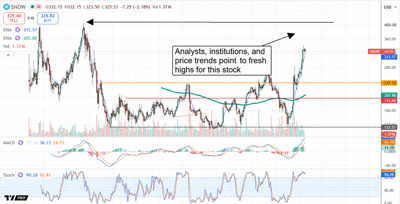
The technical setup is highly suggestive: The stock is making a run to reclaim its post-IPO highs. The question is whether it can keep rallying, and the odds appear favorable given the melt-up underway. Price action since June includes a robust upswing of about $110, or 50% for buyers who entered in mid-June, and the rally is likely to continue based on August’s action. The stock spent several weeks moving sideways near its highs, forming a consolidation that resembles a bull-flag continuation signal.
The bull flag is a strong signal that the trend will continue and typically marks the halfway point of a rally. That leaves another $110 of potential upside, assuming the pattern confirms with a fresh high following the earnings report. In this scenario, SNOW’s share price could reach a new all-time high of around $440 within two to three months of the breakout. The risk is that Snowflake’s sudden rise and growing expectations for strength could set the market up for a sell-the-news event—or worse, outright disappointment.
SaaS-pocalypse Fears Were Overblown
While the threat of AI disruption remains a risk, the fear-driven sell-off was overblown. Snowflake’s Q1 results showed strong demand for its services, with growth outperforming expectations and internal signals pointing to sustained strength in the coming quarters. The reality is that Snowflake’s data-centric, multicloud and cross-cloud capabilities, along with Cortex AI, are better positioned to deploy AI than AI is positioned to disrupt them.
Snowflake’s customers are using its tools to structure data for custom AI applications, making the platform a critical software layer. Enterprises in heavily regulated industries need reliable, secure AI functionality that minimizes hallucinations, and that is what Snowflake’s tools enable. The platform stores company data and provides the governance that allows large language models (LLMs) to access that data for helpful context. The Cortex AI platform lets major models run natively behind Snowflake’s security and compliance controls, enabling enterprises to automate workflows with a variety of tools.
Among Snowflake’s biggest risks is its reliance on external infrastructure. Rather than building its own data centers, the company deploys its architecture across existing hyperscale environments to manage the data therein. This provides a lower-cost framework for Snowflake but also makes the business highly susceptible to disruption. Platforms such as Amazon’s (NASDAQ: AMZN) AWS, Microsoft's (NASDAQ: MSFT) Azure and Alphabet’s (NASDAQ: GOOGL) Google Cloud rent capacity to Snowflake, which then wraps and resells it while also providing competing data management services.
This message is a paid advertisement for Behind the Markets, a third-party advertiser of MarketBeat. Why did I get this email content?.
If you have questions about your newsletter, please contact MarketBeat's U.S. based support team at contact@marketbeat.com.
If you would no longer like to receive promotional emails from MarketBeat advertisers, you can unsubscribe or manage your mailing preferences here.
© 2006-2026 MarketBeat Media, LLC.
345 N Reid Pl., Suite 620, Sioux Falls, S.D. 57103. USA..




No comments:
Post a Comment