| Unsubscribe |
For 50 years, one rule has held the US dollar in place as the world’s reserve currency…
Sell oil for anything but dollars and the U.S. military would like a word with you.
Sadaam Hussien tried it. Gaddafi tried it. Their efforts didn’t end well.
Then Iran sold oil to China in yuan… and nothing happened.
No new attacks. No new sanctions. Why?
Because Iran took our best punch and remained standing. Which means…
The rule that held the whole reserve system together just stopped mattering.
Now every country with a reason to bypass the dollar has a working playbook. And every central bank with reserves is rotating out of paper… into gold.
I’m Garrett Goggin – the man Porter Stansberry recently called:
"THE most knowledgeable gold investor in the world. If you want to maintain your standard of living… you have GOT to be allocated to gold. And there's nobody better in the entire world to explain exactly how to do that [than Garrett]."
If you want to protect your wealth and maintain your standard of living, you simply must position yourself in gold. But not physical bullion…
There’s a better way to own gold at this stage of the bull market…
Go here for details on my top four undervalued miners.
Garrett Goggin CFA, CMT
Chief Analyst and Founder, Golden Portfolio
2 Consumer Staples Stocks Giving Investors a Break From the AI Trade
Author: Chris Markoch. First Published: 8/3/2026.
Key Points
- Investors seeking alternatives to the AI trade may consider consumer staples like Coca-Cola and Hershey, which offer dividends and relative value.
- Coca-Cola posted strong second-quarter results driven by its FIFA World Cup marketing campaign, though investors question whether the growth boost will prove durable.
- Hershey's second-quarter earnings beat expectations, fueled by robust salty snacks growth and lower cocoa prices, while both companies maintain strong dividend growth track records.
- Special Report: The company SpaceX cannot operate without
Heading into 2026, many investors were looking for alternatives to the artificial intelligence (AI) trade. The problem has been that many diversified approaches that are performing well, such as emerging markets or small-cap stocks, lead back to tech.
One option for true sector rotation would be to invest in consumer staples. The Consumer Staples Select Sector SPDR Fund (NYSEARCA: XLP) is up about 10% year to date. That’s lower than the broader market, but it may also indicate that the broader rotation has further to go.
Ray Dalio: Buy Gold. Get Paid. (Ad)
Ray Dalio, founder of Bridgewater Associates, is urging investors to hold 15% of their portfolio in gold and crypto as U.S. debt continues to climb and fiat currencies lose purchasing power.
A little-known $15 fund is already converting gold's momentum into monthly income - as much as $1,152 per month. No gold bars, no mining stocks, just consistent payouts.
See how to follow Dalio's gold strategy and collect monthly incomeAside from the potential upside in stock prices, there’s another reason to reconsider consumer staples stocks. Many investors have been moving toward safety, igniting interest in dividend stocks.
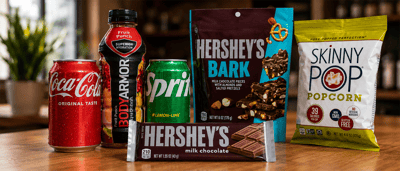
Two stocks that fit that profile have moved in different directions year to date. The Coca-Cola Company (NYSE: KO) is up roughly 26% in 2026. On the other hand, The Hershey Company (NYSE: HSY) is down about 3% in 2026.
Neither stock is particularly cheap based on valuation, but both are bargains compared with many stocks in the artificial intelligence (AI) trade. Plus, as we head into the second half of the year, there are reasons beyond their dividends to buy each stock.
Coca-Cola's World Cup Bet Is Paying Off—But Will It Stick?
Coca-Cola's second-quarter results show that its World Cup activation is working as intended. Net revenue grew 7% to $13.4 billion, while organic revenue climbed 6% and unit case volume increased 5%. Earnings per share (EPS) jumped 16% to $1.03, while comparable EPS grew 11% to 97 cents.
The volume numbers in the earnings report clearly showed that the company’s FIFA World Cup campaign wasn't a frivolous marketing expense. The trademark Coca-Cola brand grew 5%, and Powerade grew 8%. The company credited the tournament's more than 60 billion digital impressions and connected-packaging engagement with over 80 million consumers for a meaningful share of that growth.
KO jumped more than 5% after the report, but the rally stalled as investors may be questioning the durability of the results. Coca-Cola gained value share in total NARTD beverages this quarter, but the World Cup only comes around every four years.
The bull case is that the first-party data collected—more than 25 million records—will outlive the tournament and sharpen future targeting. The skeptical view is that a one-summer marketing event flatters this quarter's numbers without changing the long-term growth algorithm.
Management raised full-year organic revenue guidance to approximately 5% growth and comparable EPS guidance to 9%–10% growth, both modest increases from prior guidance. That's a signal that management sees the World Cup lift as real but not transformative.
Hershey’s Salty Snacks Give the Stock a Sweeter Setup
The Hershey Company delivered a strong Q2 2026 earnings report, and one of the biggest reasons was the company’s investment in its salty snacks business. Revenue of $2.79 billion beat expectations of $2.63 billion and was 6% higher year over year.
On the bottom line, the results were even better. Adjusted EPS of $1.90 was well ahead of the forecast of $1.43, representing a 57% year-over-year increase. Hershey also reported an adjusted gross margin of 41.6%, an increase of 350 basis points compared with the second quarter of 2025.
That increase is largely due to the company’s focus on salty snacks, which delivered growth of more than 20% at a time when the company’s core confectionery business is growing at a mid-single-digit pace.
But it’s also due to lower cocoa prices, which are down sharply from their 2024–2025 highs. That removes one headwind, as the impact of reduced snacking from increased use of GLP-1 drugs remains more anecdotal than backed by tangible data.
Coca-Cola and Hershey Offer Two Paths to Dividend Growth
Coca-Cola and Hershey are two strong dividend stocks, though they present distinct cases for investors. Coca-Cola has a dividend yield of 2.39% and an annual payout of $2.12 as of the company’s last earnings report.
Those headline numbers may not sound particularly attractive, but KO makes up for that with impressive longevity. The company is a Dividend King that has increased its dividend for 64 consecutive years. That record covers the stagflation of the 1970s, the dot-com crisis, the Great Financial Crisis, and more. Through it all, Coke has continued to reward shareholders.
Hershey has “only” increased its dividend for 15 consecutive years. That said, investors get a yield of 3.28% and an annual payout of $5.81. Some investors may balk at a payout ratio that is elevated by every measure. But the company has increased its dividend at an annualized five-year growth rate of around 11%.
The broader point is that Coca-Cola and Hershey give investors two different ways to play the same consumer staples rotation. Coca-Cola offers global scale, marketing strength, and one of the market’s longest dividend-growth records. Hershey offers a higher yield, improving margins, and a salty snacks business that is starting to matter more.
Neither stock is cheap, but both offer something investors may value more if the AI trade keeps cooling: steady demand, recognizable brands, and dividends that can keep compounding through a choppier market.
Tyson Foods Offers a Meaty Opportunity for Income Investors
Author: Thomas Hughes. First Published: 8/4/2026.
Key Points
- Tyson Foods’ beef business remains under pressure from tight cattle supplies and higher costs, but chicken and prepared foods helped offset the drag.
- Tyson Foods reported flat fiscal third-quarter sales, higher adjusted earnings and lower full-year adjusted operating income guidance.
- Tyson Foods’ dividend, cash flow and coming CEO transition remain central to the long-term investor case.
- Special Report: The company SpaceX cannot operate without
Tyson Foods (NYSE: TSN) is a leading player in protein, ranking as the largest U.S. producer and one of the most diversified globally. Diversification is key, with protein representing a primary consumer category supported by high-protein trends. It also provides some insulation from volatile commodity prices, including the impact of this year’s high beef prices. Beef prices are hurting Tyson’s top- and bottom-line results, but the impact is insufficient to offset strength in other categories or derail the company’s long-term opportunity.
The long-term opportunity is sustainable growth, margin expansion, and cash flow. Tyson Foods, like its consumer-staples peers, is a highly visible and very large company whose growth trajectory is limited, but its cash flow is not. Future growth won’t be robust, but cash flow supports dividends and share buybacks, which underpin a healthy outlook for the stock price.
Here’s the stock symbol I’ve promised (Ad)
Whitney Tilson of Stansberry Research has long recommended Berkshire Hathaway as a core retirement holding - but now he believes he's found something better.
This under-the-radar company sits at the intersection of America's two most important industries, including AI, pays massive dividends, and attracted a famous money manager who put 60% of his multi-billion-dollar fund into it. Tilson is revealing the name and ticker symbol completely free - no credit card or email required.
Get the stock name and ticker symbol free of charge todayThe leverage provided by capital returns keeps institutional interest high and the share count falling—a combination that equates to higher share prices over time. As it stands, buybacks are modest but accelerating in 2026, while the dividend yields an annualized 3.5% and annual increases are expected. Tyson is a Dividend Achiever and Contender, putting it on track for Champion status.
Optimistic Sell-Side Support Highlights Tyson’s Long-Term Opportunity
There are some mixed signals in Tyson’s analyst and institutional data, but nothing raises a red flag heading into Q3, and the net impact is bullish for investors. Analysts trimmed their price targets ahead of the fiscal Q3 release, signaling caution, but did not alter their forecasts. They merely tempered near-term expectations. Consensus is a Hold; the 13 tracked analysts provide sufficient confidence, with no Sells and a Buy-side bias in the data. The consensus target also implies more than 25% upside relative to TSN’s 2026 lows.
Institutions are also supportive of the stock, owning more than 65% of its shares and aggressively accumulating over the trailing 12 months. MarketBeat data reflects some selling in early Q3 2026 but otherwise shows healthy activity, with buying outpacing selling by a $2-to-$1 ratio and likely to pick up as the quarter progresses. The Q3 earnings release left something to be desired on the top line, causing the stock to pull back to a critical support level.
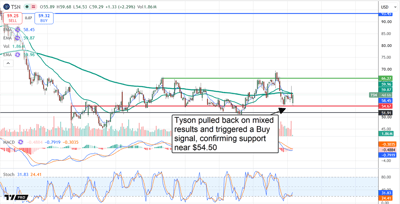
The market response suggests that analyst support and institutional inflows were indeed triggered. The early price decline generated a Buy signal, with the stock rising from its early lows to confirm support near $54.50, a likely launchpad for a recovery. It may take time for TSN’s share price to gain traction, but the odds are high that a recovery lies ahead, while downside risk appears severely limited.
Technical action also suggests that downside is limited. TSN’s weekly price action reflects a bottom at $54.50, with the MACD and stochastic indicators diverging from recent lows and positioned to generate strong entry signals on a price advance. The signal would comprise bullish crossovers in both indicators. Stochastic has already generated its own strong signal through a bullish crossover, a retest of support, and a subsequent crossover. MACD has yet to confirm but appears poised to do so.
Where’s the Beef? Tyson Widens Margins Despite Massive Cattle Shortage
Tyson’s biggest problem this year is a massive cattle shortage, which has more than doubled consumer costs. The impact on Tyson includes rising cattle costs and lower volumes, a combination that has resulted in contraction at every level. However, Tyson’s diversified position, aided by improved efficiency and consumer trends, enabled systemwide margin expansion.
Not only did Q3 adjusted earnings come in slightly above expectations despite weaker-than-expected revenue, but GAAP income increased by 39%, adjusted income by 8.3%, and adjusted earnings per share (EPS) by 8.8%. These results enabled the company to narrow guidance around its previously stated ranges. The bad news is that revenue guidance fell slightly short of estimates, but this is likely only a near-term headwind; earnings forecasts remain sufficient to sustain the company’s financial health and capital returns.
This year’s catalysts include chicken and prepared foods. The company’s long experience and focus on poultry are supporting margins as demand grows, helping offset the impact of beef-market dynamics. Meanwhile, value-added products in prepared foods are also gaining momentum and supporting margins. AI is aiding this segment by accelerating product innovation and improving returns on promotional investments.
The key factor is the upcoming CEO transition. It is expected to go smoothly because the incoming CEO has a long history with the company, and the transition could also serve as a catalyst for growth. A new playbook may accelerate volume growth and margin expansion, but the transition remains an unknown hanging over the market—one that won’t be resolved until early 2027 or later.
This email message is a paid sponsorship sent on behalf of Golden Portfolio, a third-party advertiser of The Early Bird and MarketBeat.
If you need assistance with your subscription, please contact MarketBeat's U.S. based support team at contact@marketbeat.com.
If you no longer wish to receive email from The Early Bird, you can unsubscribe.
Copyright 2006-2026 MarketBeat Media, LLC.
345 N Reid Pl., Sixth Floor, Sioux Falls, South Dakota 57103. United States of America..




No comments:
Post a Comment