| Unsubscribe |
Dear Reader,
I screened 23,281 publicly traded companies looking for something almost impossible to find.
I wanted huge operating profits. Double-digit revenue growth. Rapid dividend growth. And a market valuation so cheap it looked completely disconnected from the underlying business.
Only one American company survived every test.
One.
It generates more than $3 billion in operating income. Its revenue growth tops 15%. Its dividend growth exceeded 20% over the previous three years.
Yet its entire market capitalization remains below $8 billion.
That combination should not exist.
This is not an unprofitable AI startup hoping to make money someday. It is an established American energy producer sitting directly in the path of the AI electricity boom.
It also pays a dividend more than 300% larger than the S&P 500 average.
And while individual investors have largely ignored it, Wall Street institutions already own approximately 88% of the shares.
That is why I call it my Ultimate Stock Unicorn: wildly profitable, insanely cheap and almost completely unknown outside professional investing circles.
But out of 23,281 stocks, I found only one company with this exact financial profile.
I believe waiting until everyone recognizes it could mean surrendering the price advantage.
Click here now to learn about the only American stock that passed my screen.
Yours in smart speculation,
Karim Rahemtulla, Head Fundamental Tactician
Monument Traders Alliance
P.S. I checked 23,281 stocks. Only one American company delivered this combination of profits, growth, dividend expansion and a sub-$8 billion valuation.
Once the crowd discovers why it passed, today's price may be history - click here now and learn about the Ultimate Stock Unicorn.
Why Lowe’s Could Be a Bargain Before Housing Recovers
By Thomas Hughes. Published: 8/19/2026.

Key Points
- Lowe's stock trades near multi-year lows with a low P/E, a 2.3% dividend yield, and over 50 years of consecutive dividend increases.
- The company's Pro pivot, recent acquisitions, and improving capital allocation are positioned as near-term and long-term catalysts despite ongoing DIY market weakness.
- Analysts rate Lowe's a consensus Moderate Buy with 20% upside to a $262 target, while institutions have bought aggressively and limited downside risk.
- Special Report: Everyone wanted SpaceX. Smart money wants this.
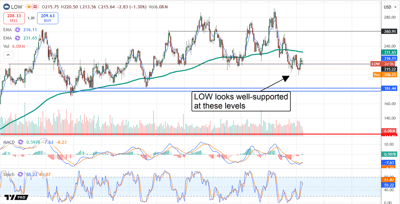
Lowe’s (NYSE: LOW) continues to face headwinds in 2026. However, the stock’s valuation, capital returns, and long-term catalysts make for a compelling setup. Trading in the low $200s, LOW is near multi-year lows and at the bottom end of its historical price-to-earnings (P/E) range, setting the stage for a significant rebound.
Until then, the dividend is reliable and market-beating, yielding 2.3% compared with the low-1% range for most S&P 500 stocks. It is also a growing distribution. Lowe’s is a Dividend King with more than 50 years of consecutive increases and the capacity to continue raising its dividend annually for years to come.
Lowe’s Has Near-Term and Long-Term Catalysts
I found Rolls-Royce at $2 - now I see the same setup again (Ad)
In 2022, Karim Rahemtulla recommended Rolls-Royce under $2 - a misunderstood aerospace name the market had written off. The stock climbed more than 1,100% over the next 3-4 years, with some subscribers reporting gains of $141,000, $272,000, or more.
He believes a similar setup is forming now around what he calls the 'Energy Cube' - a compact nuclear system roughly the size of a shipping container, capable of powering up to 1,000 homes with no emissions, 24 hours a day. Bill Gates, Jeff Bezos, Google, and Microsoft have all backed companies in this space. The Nuclear Regulatory Commission is expected to issue a key approval as early as August - the first of its kind for this technology class in over a decade.
Watch the full presentation before the NRC decision arrivesLowe’s has several near-term catalysts, including its Pro pivot, capital allocation, and the potential for housing markets to unstick. The Pro pivot—Lowe’s strategic shift toward professional customers such as contractors, remodelers, and builders rather than DIY weekend shoppers—is helping sustain growth and margins today. The strategy is supported by an aggressive acquisition posture in 2025.
Additions such as Foundation Building Materials and Artisan Design Group not only strengthened Lowe’s position in Pro markets but also expanded its offerings and created cross-selling opportunities.
Capital allocation is critical, as the company paused its aggressive buyback plans to fund acquisitions and, more recently, to reduce debt. Capital allocation could provide a triple catalyst: a strengthening dividend outlook, an improving balance sheet, and an emerging path to future share reduction. As it stands, it will take a few more quarters for debt reduction to make an impact, but the shareholder deficit is falling sharply, providing evidence that the company’s strategy is working.
As for housing markets, when they unstick is anyone’s guess, with oil prices running high, inflation following suit, and the FOMC on track to hold, if not raise, interest rates. The takeaway, however, is that Lowe’s is positioning itself for success today and accelerated growth and profitability when housing markets improve. Between then and now, investors can take advantage of low stock prices to build a position and reap the dividend.
Lowe’s Mixed Results Overshadow Underlying Strength
Lowe’s had a tough Q2, with revenue of $26 billion falling slightly short of consensus estimates. The miss was attributed to persistent weakness in DIY projects, the company’s core driver. However tepid the results were, the weakness was relative, with revenue up 8.3% year over year and analysts having expected worse.
Data shows that 100% of analysts have lowered their targets since the quarter began, with most expecting results at the low end of the range, well below the consensus. Internally, growth was supported by a 0.2% comparable-store gain and strength in the Pro business linked to acquisitions. Digital was another critical component, rising 15.7% year over year (YOY) and contributing significantly to comparable-store strength.
Margin news was good, although the IEEPA tariff refund had an effect. Key details for investors include $2.4 billion in net income and $4.40 in adjusted earnings per share (EPS), which grew marginally from the prior year and exceeded MarketBeat’s consensus by a nickel. Looking ahead, the company expects persistent DIY weakness to weigh on its full-year outlook and guidance, but less than the market feared. The new target assumes results at the low end of the prior range—enough for YOY growth, healthy profits, and continued execution of the strategy.
Analysts Expected Worse for Lowe’s—The Bottom Is In
The good news is that analysts had already trimmed expectations ahead of the release and were expecting worse news. In this scenario, sentiment trends remain steady and supportive for the market.
MarketBeat tracks 36 analysts who rate LOW a consensus Moderate Buy, with about 64% Buy-side bias and 20% upside to the consensus.
The range of recent targets is wide, suggesting some uncertainty among the group, but it centers around the consensus figure, providing a moderate level of conviction in the outlook. A move to the consensus target of $262 would put the stock at the high end of its trading range, within easy reach of its all-time high.
Institutional activity suggests that downside is limited now that Lowe’s stock has sold off. The group owns nearly 75% of the shares and has bought aggressively over the trailing 12 months (TTM). Institutions sold shares in Q1 2026, but overall, they bought $2 for every $1 sold during the TTM.
The likely outcome is that this group will continue to underpin support at the low end of Lowe’s trading range until sufficient catalysts emerge for the stock to regain traction.
3 Ways to Invest in Cybersecurity Through ETFs
By Dan Schmidt. Published: 8/20/2026.

Key Points
- Cybersecurity ETFs may look similar at first glance, but their portfolio construction can lead to very different results.
- Global X Cybersecurity ETF, iShares Cybersecurity and Tech ETF and WisdomTree Cybersecurity Fund each take a distinct approach to the sector.
- For investors, the key differences come down to liquidity, diversification and how aggressively each fund targets growth.
- Special Report: Everyone wanted SpaceX. Smart money wants this.
The AI rally has gone through several iterations, with the latest being the rotation from hardware to software. AI’s threat to major software providers was likely always overblown, but that has never been more apparent than in the cybersecurity space. Cybersecurity stocks have soared lately as AI agents pose a growing cyber threat, and many companies now treat cybersecurity spending as a non-discretionary budget item.
Cybersecurity ETFs may look interchangeable at first glance, but their performance can diverge meaningfully. The reason isn’t a few basis points in fees—it’s how each portfolio is built. For investors choosing between funds in this space, composition matters far more than the label on the package.
Breaking Down 3 Cybersecurity ETFs by Fund Construction
I found Rolls-Royce at $2 - now I see the same setup again (Ad)
In 2022, Karim Rahemtulla recommended Rolls-Royce under $2 - a misunderstood aerospace name the market had written off. The stock climbed more than 1,100% over the next 3-4 years, with some subscribers reporting gains of $141,000, $272,000, or more.
He believes a similar setup is forming now around what he calls the 'Energy Cube' - a compact nuclear system roughly the size of a shipping container, capable of powering up to 1,000 homes with no emissions, 24 hours a day. Bill Gates, Jeff Bezos, Google, and Microsoft have all backed companies in this space. The Nuclear Regulatory Commission is expected to issue a key approval as early as August - the first of its kind for this technology class in over a decade.
Watch the full presentation before the NRC decision arrivesEach of these ETFs is among the cheapest cybersecurity-themed options, with expense ratios ranging from 0.45% to 0.50%. Five basis points in fees may add up over decades, but they’re typically a rounding error for investors buying thematic ETFs that aren’t intended to be held for a lifetime. Instead, composition matters, and each fund takes a different approach to the industry. At this scale, there’s no “best” ETF; there’s only personal preference and risk tolerance.
Global X Cybersecurity ETF: The Choice for Liquidity
The Global X Cybersecurity ETF (NASDAQ: BUG) is the largest fund on our list, with more than $1.51 billion in assets under management (AUM) and more than 1 million shares traded daily on average. The fund tracks the Indxx Cybersecurity Index, a global index that uses a modified market-cap weighting system and screens for companies with at least 50% of revenue coming from cybersecurity-related activities. While each holding is cap-weighted with a limit on single-name exposure, the top 10 holdings represent more than 60% of assets. The fund holds 34 positions, with 85% based in the U.S., but it is the most top-heavy of the three ETFs, with core holdings in large caps like Palo Alto Networks Inc. (NASDAQ: PANW) and CrowdStrike Holdings Inc. (NASDAQ: CRWD).
BUG also has the highest expense ratio at 0.50%, but its narrow spreads erase this five-basis-point gap. The median 30-day bid/ask spread is just 0.08%, making it the cheapest fund on our list to trade. That’s important for active investors moving large blocks. BUG is an ideal vehicle for those who want an affordable, liquid pure play on the cybersecurity trade that also includes mid- and small-cap stocks.
iShares Cybersecurity and Tech ETF: The Choice for Balance
The iShares Cybersecurity and Tech ETF (NYSEARCA: IHAK) adds an industrials component to its portfolio, and its unique mix of holdings offers diversification beyond typical cybersecurity funds. IHAK has $1.08 billion in AUM, trades about 180,000 shares daily on average and has a median 30-day bid/ask spread of 0.17%. While it’s smaller and less liquid than BUG, it’s more balanced because of its international holdings and diversification beyond the tech sector.
The fund holds 51 different stocks and follows the same rule requiring 50% of revenue to come from cybersecurity activities. The top 10 holdings represent just 45% of assets, and more than 20% of the portfolio comes from stocks based outside the U.S. Companies like Qualys Inc. (NASDAQ: QLYS) and Netskope Inc. (NASDAQ: NTSK) are among the top five holdings, while non-tech firms like Booz Allen Hamilton Holding Corp. (NYSE: BAH) are also in the top 20. IHAK is a great option for investors who want a balanced cybersecurity portfolio. The fund is diversified across countries and industries, has low volatility and carries mid-pack fees.
WisdomTree Cybersecurity Fund: The Choice for Conviction
Finally, the WisdomTree Cybersecurity Fund (NASDAQ: WCBR) has the smallest AUM and the highest risk. It may also have the most upside because of its unique filter. The fund tracks an index with a revenue-growth filter: constituent companies must derive 50% of their revenue from cybersecurity activities and have grown revenue by 7% over a trailing three-year period.
This additional growth screen helps explain why WCBR has outperformed BUG and IHAK so far in 2026. By screening for growth and focusing 100% on information technology, WCBR has the highest beta of the three ETFs, at 0.97, which also means it has the smallest margin of safety. The fund holds just 33 stocks and has a mere $133 million in AUM, so its 0.45% expense ratio is often offset by the 0.23% median 30-day bid/ask spread.
WCBR is the riskiest of the three, but it also gives significant portfolio weight to growing upstarts like Rubrik Inc. (NYSE: RBRK) alongside megacap giants like Palo Alto. The growth screen helps capture maximum upside, but it also offers the least protection against drawdowns.
This email content is a paid sponsorship provided by Monument Traders Alliance, a third-party advertiser of The Early Bird and MarketBeat.
This ad is sent on behalf of The Oxford Club. 105 W Monument St, Baltimore, Maryland 21201. If you would like to optout from receiving offers from The Oxford Club please click here
If you need assistance with your subscription, please don't hesitate to email our U.S. based support team at contact@marketbeat.com.
If you no longer wish to receive email from The Early Bird, you can unsubscribe.
Copyright 2006-2026 MarketBeat Media, LLC. All rights reserved.
345 N Reid Pl., Suite 620, Sioux Falls, South Dakota 57103. USA..




No comments:
Post a Comment