| Unsubscribe |
Dear Reader,
Here’s the AI number most investors are not thinking about.
Only a small fraction of companies are using AI in a serious way today.
But what happens when that number is no longer tiny?
What happens when AI adoption moves from the experimental stage… into the normal operating system of corporate America?
That’s when the real divide opens.
On one side will be companies using AI as a gimmick.
On the other side will be companies using AI to lock in customers, lower costs, speed up critical work, and make themselves almost impossible to replace.
That second group is where I’m focused.
Because in every great technology boom, the first wave gets the attention.
But the second wave often creates the lasting fortunes.
The first wave of the internet was routers, cables, servers, and infrastructure.
Then came Amazon, Google, Netflix, and the businesses that used the internet to reshape entire industries.
I believe AI is following the same pattern.
Phase 1 was chips and infrastructure.
Phase 2 is the rise of companies using AI to build legal monopolies in massive markets.
I’ve found three that stand out.
- One is using AI to reshape cybersecurity.
- One is using AI-powered automation to change how goods move through America’s retail system.
- One is using AI inside the high-stakes world of big pharma and regulatory work.
That is the shift I believe investors need to understand now.
Click here to watch the Great AI Divide briefing now.
Good investing,
Alexander Green
Chief Investment Strategist, The Oxford Club
One Short- and One Long-Term ETF for Quantum Computing Bulls
Author: Nathan Reiff. First Published: 7/13/2026.
Key Points
- Pure-play quantum computing stocks like D-Wave Quantum and IonQ have declined sharply this year, even as broader enthusiasm for the sector remains strong.
- The WisdomTree Quantum Computing Fund offers a narrow, less liquid basket of quantum-focused companies suited to long-term, higher-risk investors.
- The Defiance Quantum ETF diversifies into machine learning and AI holdings, providing greater liquidity and stronger year-to-date returns for shorter-term investors.
- Special Report: Everyone wanted SpaceX. Smart money wants this.
Share declines for companies with an exclusive focus on quantum computing have been significant this year—D-Wave Quantum Inc. (NYSE: QBTS), for instance, has dropped a dismal 23% year-to-date (YTD), while even better-performing rivals like IonQ Inc. (NYSE: IONQ) are still down 5%. A perfect storm of threats from larger rivals (or up-and-coming new names), continued struggles with marketability and profits, and uneven revenue performance have prompted many companies in the space to slump.
This isn't to say that quantum computing as a sector is dead—in fact, enthusiasm for the industry may be as high as ever, based on inflows of cash from the federal government and renewed attention from major tech firms. The big issue for many investors is timing—quantum computing may still be years away from becoming widespread and lucrative.
ALERT: Drop these 5 stocks before the market opens tomorrow! (Ad)
The Wall Street Journal is already raising the alarm about a potential market crash, and Weiss Ratings research points to the first half of 2026 as a particularly rough stretch for certain holdings.
Some of America's most popular stocks could take serious damage as a radical market shift plays out. Analysts at Weiss Ratings have identified five names you may want to remove from your portfolio before this unfolds.
If any of these are in your portfolio, now is the time to review your positions.
See the 5 stocks to avoidThis is why investors seeking broad-based quantum exchange-traded funds (ETFs) to access the industry must consider their time horizon. Fortunately, funds exist for both long- and short-term investors.
A Long-Term Candidate: WQTM
For investors looking at quantum as a buy-and-hold or other long-term strategy, an ETF like the WisdomTree Quantum Computing Fund (BATS: WQTM) may be a place to start. WQTM only launched in the fall of 2025, making it one of the newer tech funds available to investors. It has a narrow focus on quantum computing, with a basket of fewer than 50 companies dedicated to the technology.
That focus is precisely what makes WQTM a candidate for investors with longer time horizons. While WQTM does hold several larger tech firms, including Dell Technologies Inc. (NYSE: DELL) and Intel Corp. (NASDAQ: INTC), it primarily targets companies directly involved in the development of quantum technology. Investors should therefore expect volatility in these constituent stocks—and in WQTM—as the industry continues to grow.
Another reason WQTM may be a good fit for traders planning to hold is that it is not the most liquid tech fund available. It has about a third of a billion dollars in managed assets and a one-month average trading volume below 500,000 shares. Neither figure is tiny, but broader tech funds are available with much larger asset bases and trading volumes for investors more focused on liquidity.
With an expense ratio of 0.45%, WQTM sits in the middle of the road for niche tech-sector funds, though it is more expensive than many investors will accept in the broader ETF world. It may be an option for investors with a higher risk tolerance, or for those who believe it will continue to outperform—it currently boasts YTD returns above 30%.
Notably, the fund may have been buoyed by holdings with broader roles in the tech space beyond quantum.
A Shorter-Term Play: QTUM
The ups and downs of the quantum space in its earlier days can create the potential for short-term wins for investors willing to take the chance. The Defiance Quantum ETF (NASDAQ: QTUM) has performed quite well, with 38% YTD returns despite sector-wide volatility, making it an attractive option for investors seeking quick gains.
One reason QTUM's performance has diverged from the share-price declines of individual quantum companies is that it also focuses on machine learning companies. This fund provides access to quantum firms, yes, but also to makers of embedded AI chips and to software firms building tools for data management, perception, and more. With 86 holdings, QTUM has a broader basket than WQTM but still represents just a small slice of the tech space overall.
QTUM also places greater emphasis on equal weighting than WQTM. The fund has no single position accounting for more than about 2.4% of the portfolio, which may help it capture positive returns when they are available and cushion against declines.
The fund's managed asset base of $5.4 billion and one-month average trading volume above 540,000 shares also support a stronger liquidity case than WQTM, although it is far from the largest or most heavily traded tech fund. Part of this advantage could be due to its lower expense ratio of 0.4%, while performance may also be a factor, as it has solidly outperformed both WQTM and the S&P 500 so far this year. QTUM has been down over the last month amid the industry-wide dip, showing that it cannot completely avoid these issues. However, those willing to take on this volatility may be well rewarded.
Freeport McMoRan Post-Earnings: Why Good Enough May Finally Be Good Enough
Submitted by Chris Markoch. Published: 7/24/2026.

Key Points
- Freeport-McMoRan's second-quarter 2026 earnings showed sharply higher copper and gold prices offsetting lower sales volumes caused by Grasberg's phased restart.
- The Grasberg Block Cave mine ramp-up is progressing toward full production capacity by the end of 2027, reducing long-term operational risk for the company.
- Despite a post-earnings pullback from 52-week highs, FCX shares remain in a broader uptrend supported by rising 50-day and 200-day moving averages and higher analyst price targets.
- Special Report: Everyone wanted SpaceX. Smart money wants this.
On July 23, Freeport-McMoRan (NYSE: FCX) delivered an earnings report shaped by two forces that will define how investors read the quarter.
Copper and gold prices remained at historically elevated levels, lifting realizations across the board. The report also showed that the company continues to move toward full production at its Grasberg mine in Indonesia. The mine was closed in 2025 following a mining accident that locked up a significant portion of the company’s production.
The quietest monopoly in energy (Ad)
One company has spent 60 years developing an energy source the International Energy Agency estimates at 140 times global electricity demand - with zero competition.
Last year, their crew drilled in 16 days what the government projected would take 64. Now Google has a 15-year deal locked in, Bill Gates has committed $100 million, and the Pentagon has made it a top priority. On August 18th, a new Washington policy adds another advantage rivals cannot match.
See the full story behind the 60-year energy monopolyHowever, FCX was down after the report.
This may be a “buy the rumor, sell the news” situation. The stock climbed approximately 15% from July 17 through the market's close on July 22.
That suggests a lot of good news was priced into the report, which, by the numbers, was strong but perhaps not enough to justify FCX at a 52-week high in the short term.
But in the long term, there are two key factors to consider when analyzing Freeport-McMoRan's earnings.
Freeport Earnings Get a Boost From Higher Copper and Gold Prices
The headline numbers for the second quarter of 2026 show why investors were pushing FCX higher ahead of earnings. Freeport-McMoRan posted second-quarter net income of $984 million, or 68 cents per share, with adjusted earnings per share (EPS) of 74 cents after backing out one-time charges tied to the Grasberg incident. Revenue totaled $7 billion, and the company generated $2 billion in operating cash flow for the quarter.
The real story was pricing:
The company realized an average of $6.17 per pound for copper in the quarter, up roughly 36% from $4.54 a year ago.
Gold realizations jumped to $4,520 per ounce from $3,291, a year-over-year (YOY) gain of roughly 37%.
Molybdenum, often an afterthought in Freeport's story, also strengthened meaningfully, realizing $28.75 per pound versus $21.10 last year.
Copper sales volumes were down significantly year over year (710 million pounds versus 1.0 billion), a direct consequence of Grasberg's phased restart. In other words, FCX is earning more money while selling less copper. That dynamic won't repeat itself once Grasberg volumes normalize, which is worth keeping in mind when projecting forward growth rates.
Grasberg Mine Ramp-Up Strengthens Freeport's Long-Term Outlook
The other half of the bull case is de-risking, not just pricing. Freeport confirmed that its Grasberg Block Cave ramp-up met expectations in the second quarter, with mining rates climbing from 34,000 tons per day in April to 69,000 tons per day in June. Management now expects PTFI's overall production capacity to reach roughly 65% in the second half of 2026, 80% by mid-2027, and near full capacity by the end of 2027.
That timeline also explains why unit net cash costs in Indonesia remain negative. PT Freeport Indonesia (PTFI) reported unit net cash credits of 81 cents per pound of copper in the quarter, meaning by-product gold credits more than offset production costs. As volumes recover, that credit dynamic should continue to provide a tailwind to consolidated margins even if copper prices cool off from current levels.
Freeport Maintains Strong Balance Sheet While Returning Capital
Freeport also used the quarter to reinforce its capital discipline story. The company returned $600 million to shareholders in the first half of 2026, including $200 million in share repurchases, and separately increased its ownership stake in the Cerro Verde mine to 55.66% for roughly $107 million.
Net debt stood at just $2.1 billion (excluding downstream processing debt), well below the company's $3–$4 billion target ceiling. That balance sheet flexibility is part of why analysts have been comfortable raising price targets even as the stock notches new highs. The company is showing its ability to keep funding both shareholder returns and its growth pipeline (Bagdad, El Abra, Kucing Liar) without straining its investment-grade rating.
Is the Post-Earnings Pullback a Buying Opportunity?
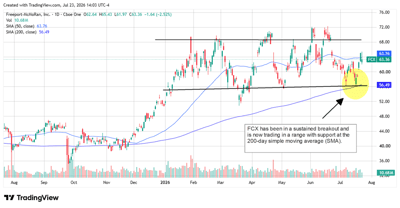
Turning to the technical picture, FCX spent most of 2025 consolidating in the low-$40s before staging a sustained breakout beginning in December, eventually pushing to a 52-week high near $72 in June. The pullback since then, including the post-earnings drop to around $63, has brought shares back toward both the 50-day moving average (about $64) and the lower end of the recent trading range, without breaking the broader uptrend.
Notably, the 200-day moving average has been rising steadily since bottoming near $40 late last year, now sitting at about $56—a sign that the medium-term trend remains constructive even after the post-earnings dip. Volume on the down day was elevated but not dramatically outsized relative to recent sessions, which is consistent with profit-taking after a steep run-up rather than a fundamental reassessment of the story.
Is Freeport-McMoRan Stock Still a Buy After Earnings?
One challenge in valuing FCX is that the company’s current strong growth is an outlier for two reasons. First, spot prices for copper and gold are at historically elevated levels. Second, the company is just now reporting production from its Grasberg mine, which had been closed. That skews the year-over-year comparisons.
Both variables are likely to support strong earnings and free cash flow growth, which are two of the best predictors of stock price growth. But many traditional discounted cash flow models suggest more modest growth.
That said, the structural case for copper demand remains in place. Price is starting to reflect that demand, and the same is true of gold.
It will take another earnings report or two to see whether that demand is fully priced into FCX. For now, the stock is trading in a defined range. But rising 50- and 200-day simple moving averages show that investors have been willing to let the stock grind higher.
Leading into the report, analysts raised their price targets for FCX, with the highest price targets coming in at $80. With the Grasberg project moving toward full production by the end of 2027, the current stock price may create an attractive entry point.
This email communication is a paid advertisement sent on behalf of The Oxford Club, a third-party advertiser of The Early Bird and MarketBeat.
This ad is sent on behalf of The Oxford Club. 105 W Monument St, Baltimore, Maryland 21201. If you would like to optout from receiving offers from The Oxford Club please click here
If you have questions or concerns about your newsletter, please don't hesitate to contact our South Dakota based support team at contact@marketbeat.com.
If you no longer wish to receive email from The Early Bird, you can unsubscribe.
© 2006-2026 MarketBeat Media, LLC.
345 N Reid Place, Sixth Floor, Sioux Falls, South Dakota 57103. U.S.A..




No comments:
Post a Comment