| Unsubscribe |
Below is an important message from one of our highly valued sponsors. Please read it carefully as they have some special information to share with you.
Man who Predicted Trump 2016 Win:
“Prepare for Mid-Term Meltdown”
Dear Reader,
In 2016, one major election model gave Hillary Clinton more than a 99% chance of winning right up until election night.
But right before the election…
Former advisor to the CIA, the Pentagon and the White House Jim Rickards went on multiple TV news programs…
And predicted Trump would win.
What he’s predicting now is even more shocking.
Click here to see it because it’s a BOMBSHELL…
And it could soon send shockwaves through the financial markets.
Regards,
Matt Insley
Publisher, Paradigm Press
Microsoft Bets on In-House AI to Cut OpenAI and Anthropic Costs
Submitted by Chris Markoch. Published: 7/12/2026.

Key Points
- Microsoft is routing some Excel and Outlook prompts to its own MAI models instead of OpenAI or Anthropic to cut costs and improve margins.
- Microsoft is hedging its AI dependency through a three-way approach involving OpenAI, Anthropic's Claude, and its own in-house MAI models.
- Despite falling about 20% year-to-date, MSFT trades near 22 times forward earnings with a bullish analyst consensus and a price target well above its current level.
- Special Report: Forget SpaceX. Buy the company Musk can't replace.
Microsoft Corp. (NASDAQ: MSFT) has taken steps to reduce its reliance on frontier AI models, though this is not exactly an outright declaration of protest. In June, the tech giant launched its own proprietary AI models (Microsoft AI, or MAI) across select applications in its Office suite.
What this means for the user experience remains an open question, but for Microsoft, it is a clear margin play. The company competes in multiple areas of the AI infrastructure buildout, which makes this move about controlling the controllables.
Hidden on Tesla's filing: A $12 billion "super startup" (Ad)
Tesla's most recent SEC filing contains a single line showing $12 billion in revenue from a new venture Elon Musk has been quietly building inside the company — one that has nothing to do with cars, robots, space, or AI.
Blackstone calls the underlying opportunity a $23 trillion market. On July 22, Elon is expected to go public with it. Former hedge fund manager Adam O'Dell says he already knows what's coming — and is sharing the name and ticker of one of his top picks to play it, free.
Watch Adam O'Dell's full briefing and claim your free ticker nowInstead of suffering death by a thousand cuts from OpenAI and Anthropic, the frontier model providers, Microsoft is trying to widen its existing moat and generate stronger returns on investment (ROI) from its AI spending. But will that be enough to change sentiment toward MSFT, which has declined approximately 20% year to date?
Microsoft Expands MAI to Reduce Reliance on OpenAI
Here’s the news behind the news. Bloomberg reported that Microsoft is quietly routing some Excel and Outlook prompts to MAI, its in-house model family, rather than to OpenAI or Anthropic. Tens of thousands of prompts each week are already running on Microsoft’s own technology.
That’s still a small slice of total Copilot traffic. OpenAI and Anthropic handle most of it today. But the direction of travel matters more than the current split, and Microsoft has made its intentions clear.
At Build 2026 in June, Microsoft unveiled seven MAI models, including its first reasoning model, MAI-Thinking-1. The company says it matches Anthropic’s Claude Opus 4.6 on coding tasks. AI chief Mustafa Suleyman put it bluntly: "We pay a lot of money to Anthropic, so our goal is to reduce and ultimately eliminate that cost."
How Microsoft's In-House AI Could Boost Profit Margins
For investors, an easy way to think about this is as follows. Copilot is a $30-per-seat subscription that, before the MAI launch, was running on top of someone else’s expensive AI model by default. Every prompt costs Microsoft money to process, and multiplied across hundreds of millions of Office users, that bill adds up fast.
Owning the model instead of renting it changes the equation entirely. Microsoft doesn’t need MAI to win over every customer. It just needs MAI to be good enough for everyday spreadsheet formulas and email drafts, and to do so at a fraction of the cost.
That’s the ROI story. Microsoft won’t win an AI arms race on raw intelligence. But it can compete more efficiently by converting a rented cost center into owned infrastructure.
Microsoft Uses MAI to Strengthen Its AI Competitive Moat
Microsoft chief executive officer (CEO) Satya Nadella has reportedly said he feared Microsoft becoming "the next IBM." By that, he meant a company that let someone else own the most important layer of technology. MAI is Microsoft’s answer to that fear.
Instead of relying on a single point of AI dependency, Microsoft now runs a three-way hedge. It holds a stake in OpenAI, embeds Anthropic’s Claude in Copilot, and increasingly leans on its own models where the economics make sense. That flexibility is arguably a bigger moat than any one model’s benchmark score.
It also insulates Microsoft from a ticking clock. Microsoft’s current discounted OpenAI pricing won’t last forever, and that deal isn’t set to expire until 2032. Building a credible in-house alternative now gives Microsoft leverage in any future renegotiation, rather than leaving it stuck paying whatever OpenAI or Anthropic decides to charge.
The Bear Case: Risks to Microsoft's AI Strategy
Before getting too bullish, a few caveats are worth weighing. This shift is still incremental, and Microsoft hasn’t published a timeline for expanding it further. Most Copilot workloads still run on outside models today.
There’s also a quality question. Microsoft’s own materials frame MAI as matching prior-generation Anthropic models, not necessarily the current large language models (LLMs). If MAI-powered features feel noticeably worse, customer goodwill could take a hit that outweighs the cost savings.
What It Means for OpenAI and Anthropic
This is a warning shot worth watching. Anthropic filed confidentially for an IPO in June, and OpenAI is reportedly preparing a similar filing. Their biggest enterprise distribution partner is now also a competitor, building cheaper in-house alternatives.
That doesn’t mean OpenAI or Anthropic are in immediate trouble. Both still handle the bulk of Copilot’s AI traffic, and Microsoft has made it clear that it isn’t ending either partnership. But the "picks and shovels" trade just got a little more complicated for anyone betting purely on third-party AI labs staying indispensable.
Microsoft Stock Rebounds After Hitting a 52-Week Low
Microsoft hit a 52-week low in late June. The 10% bounce off that level isn’t a sign that everything is perfect, but it does suggest that investors are leaning into the stock’s value proposition.
At around 22x forward earnings, Microsoft is trading at a discount to the S&P 500 and to its own history. An argument could be made that MSFT wasn’t overvalued when the sell-off began in November, and there’s ample reason to believe it’s undervalued now. The relative strength indicator reached oversold territory when MSFT bottomed in June.
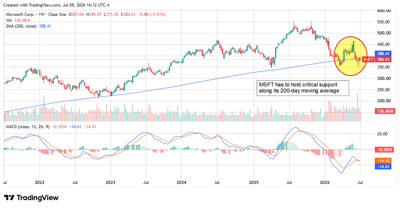
But a larger story comes from analysts and institutions. The MSFT consensus price target of $559.84 is approximately 45% below its recent trading range. Plus, out of 48 analysts tracked by MarketBeat, 41 give MSFT a Buy rating, and seven rate it as a Hold. Analysts notoriously don’t like to be wrong, which may explain why some have trimmed their price targets, but overall sentiment remains bullish.
The same cautious optimism can be found in its institutional ownership. There’s no question that buying has slowed in the first two quarters of the year. But buying still outpaces selling, and with MSFT at 22x earnings, this could be an attractive target for money that hasn’t left the market and is looking for growth in the second half.
Small Caps Are Crushing the S&P 500—3 Stocks Still Worth Buying
Submitted by Chris Markoch. Published: 7/22/2026.

Key Points
- Small-cap stocks have outpaced the S&P 500 over the trailing three months through July 21, 2026, as investors rotate out of richly valued mega-cap tech.
- UFP Technologies faces near-term earnings headwinds tied to product launches, but management expects those pressures to ease in the second half of 2026.
- Willdan Group and NWPX Infrastructure show distinct catalysts, including AI-driven data center demand and a raised free cash flow outlook after a strong earnings beat.
- Special Report: Forget SpaceX. Buy the company Musk can't replace.
Sector rotation doesn't always mean money moving from one sector to another. In many cases, it means capital shifting from large-cap stocks to small-cap stocks. That's exactly the shift playing out in 2026, and the numbers back it up.
Through July 21, small-cap benchmarks have meaningfully outpaced the S&P 500 over the trailing three months, as investors rotate away from mega-cap concentration risk and into names with more room to run.
Sell these "safe" blue chips immediately (Ad)
Marc Chaikin, founder of Chaikin Analytics, says two forces - AI disruption and fracturing global trade - are triggering a historic wealth transfer already underway in 2026. Household names like Intuit (-57%), Boston Scientific (-49%), and Tractor Supply (-40%) are cratering, while lesser-known companies like Sandisk (+573%) and Rackspace (+444%) surge.
Chaikin has identified specific stocks he believes investors should sell before they fall further - and the names may surprise you. He's also pinpointing a company tapped as Nvidia's self-driving partner and a potential AI megadeal that could split into three high-growth stocks.
Stream his free presentation to get every buy and sell recommendation with no membership or credit card required.
Watch Marc Chaikin's free presentation and get his full buy-and-sell list todayWith mega-cap tech trading at historically rich valuations after years of AI-driven gains, both institutional and retail investors are hunting for the market's next leg higher. Small-cap stocks, many of which sat out the narrow rally of the past few years, offer that alternative.
But not every small-cap stock deserves a place in your portfolio just because the group is back in favor. Investors still need to separate the names with durable earnings power from those simply riding the wave. Below are three stocks that combine the sector rotation tailwind with company-specific catalysts worth watching heading into the back half of 2026.
UFP Technologies Stock Could Rebound After Earnings Headwinds Ease
UFP Technologies (NASDAQ: UFPT) is a contract development and manufacturing organization that specializes in comprehensive solutions for medical devices, sterile packaging, and other highly engineered custom products. In layman’s terms, it’s not the name doctors and patients see on the package, but it’s a critical part of the medtech supply chain.
In its June 2026 investor presentation, the company forecast that the global medical device market would grow to approximately $518 billion by 2032, with a compound annual growth rate (CAGR) of about 6.3%.
For all the reasons investors may have to go long UFPT, earnings remain the near-term headwind. The company’s adjusted earnings per share (EPS) in Q1 lagged the revenue gains. Management attributed this to several factors, including simultaneous product launches.
Those headwinds are expected to ease in the second half of 2026. That will be a key point of emphasis for investors when the company reports its Q2 2026 earnings.
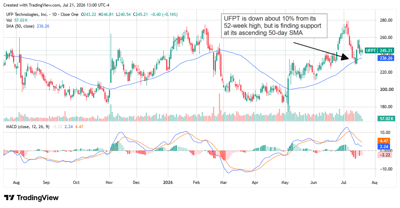
Heading into earnings, UFPT was up 23% over the three months ended July 21, but has dropped about 13% from its 52-week high in early July. That’s likely a function of elevated short interest and institutional selling in Q2. The stock is testing its 50-day simple moving average as support.
Willdan Group Benefits From AI Infrastructure and Data Center Growth
The artificial intelligence (AI) infrastructure buildout is facing supply headwinds. In addition to data centers taking time to construct, the need for power must be addressed. That power demand also requires cooling solutions to handle the heat generated.
That's where Willdan Group (NASDAQ: WLDN) comes in. The company provides energy efficiency, infrastructure engineering, and technical consulting services. It’s a steady, but not always exciting, business model that’s gotten a lift from demand for data center siting and load forecasting. That, along with its acquisition of Burton Energy Group, contributed to the company raising its full-year 2026 forecast.
Solid free cash flow is a key metric for any company, particularly for growing small-cap stocks. That’s why it’s important to note that the company took on debt to fund the Burton acquisition.
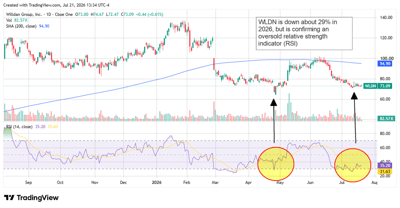
However, the company is confident it can pay down the $30 million it drew on its revolver by the end of the year. That could make WLDN a strong asymmetric choice for the second half. The stock is down 29% in 2026, but the consensus price target of $112.67 suggests 55% upside potential.
NWPX Infrastructure Stock Still Has Water Infrastructure Momentum
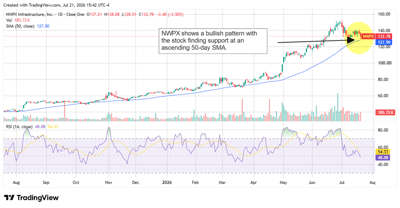
NWPX Infrastructure (NASDAQ: NWPX)—formerly known as Northwest Pipe Company before its 2025 rebrand—has been one of the standout names in the group, and the chart tells the story: shares are still up sharply over the trailing year even after cooling off from the 52-week high they set in early July.
The water infrastructure manufacturer delivered a 60% earnings surprise in its Q1 2026 report, with earnings per share (EPS) of $1.08 against an estimate for 68 cents and revenue up 19% year over year to $138.3 million. Free cash flow jumped more than 20-fold from the prior-year quarter, prompting management to raise its full-year 2026 free cash flow guidance to a range of $50 million to $56 million.
That kind of momentum is exactly why the stock has run so far, so fast—and why it's now digesting those gains. Shares are testing the 50-day simple moving average as support, with the Relative Strength Index sitting in neutral territory near 48. Institutional flows have been mixed following the run-up, a normal pattern after a name more than doubles off its lows.
The consensus price target sits near $110, which is below where shares currently trade—a reminder that analyst targets can lag a stock moving this quickly. With a $430 million backlog and a raised cash flow outlook, the debate now is less about the business and more about how much of that strength is already priced in.
This email message is a sponsored message sent on behalf of Paradigm Press, a third-party advertiser of InsiderTrades.com and MarketBeat.
If you have questions about your subscription, please email MarketBeat's U.S. based support team at contact@marketbeat.com.
If you no longer wish to receive email from InsiderTrades.com, you can unsubscribe.
Copyright 2006-2026 MarketBeat Media, LLC.
345 N Reid Pl. #620, Sioux Falls, S.D. 57103. USA..




No comments:
Post a Comment