| Unsubscribe |
For almost 250 years, America ran on one rule.
The market picks the winners. Not the government. You build something great, customers reward you, and Washington mostly stays out of the way.
That one rule built the richest economy in human history.
It’s being rewritten right now – and hardly anyone has said it out loud.
Look at what’s happened in the last year.
The federal government took a stake of roughly 10% in Intel. It negotiated a 15% cut of every advanced chip Nvidia and AMD sell to China. It took a position in a critical-minerals company. And this month, the most valuable AI company on earth reportedly offered Washington a 5% ownership stake in itself – on the order of $40 billion.
Read that again. The government is becoming a shareholder in the companies building artificial intelligence.
There’s a name for this.
Some are calling it the Technological Republic – a partnership between the state and a handful of tech giants, where AI isn’t treated as a product but as a national weapon, too important to leave to the free market.
Call it the New U.S.A.I. – if you like. Same idea: Washington and Big Tech, fused at the balance sheet.
This is the biggest change to how American markets work in your lifetime. And it’s happening while the headlines argue about everything else.
It also rewrites the trade completely. When the government decides a sector is a national asset, it doesn’t let it fail… and it doesn’t let just anyone win.
A small number of companies get anointed. Everything positioned for the old, may-the-best-company-win world gets left behind. Including, I believe, some of the “safe” names sitting in your index fund right now.
I can tell you which companies are being pulled inside this new arrangement, and which ones get frozen out.
I’m not going to do it in an email. I put it all in a documentary – the new rule, the companies on the right side of it, and the specific moves to make before the rest of the market wakes up.
The names to buy. The names to sell. The three moves that could protect and grow your family’s money under the new rule.
Click here to watch the documentary now.
Good investing,
Porter Stansberry
Aehr Test Systems Stock Soars on Earnings, Eyes Over 150% Revenue Growth
By Leo Miller. Date Posted: 7/17/2026.
Key Points
- Aehr Test Systems shares jumped nearly 22% after the company beat earnings estimates and issued strong fiscal 2027 revenue guidance of $130 million to $150 million.
- Aehr's fourth-quarter revenue grew 33.7% year-over-year to $18.84 million, while adjusted gross margin soared 1,000 basis points to 45%, aided by AI-related demand.
- Aehr's forward price-to-sales ratio has fallen about 56% from its peak, and analysts at Craig Hallum and Lake Street Capital set price targets implying roughly 40% upside.
- Special Report: Forget SpaceX. Buy the company Musk can't replace.
As AI stocks swing up and down, one name that has felt those moves as much as any is Aehr Test Systems (NASDAQ: AEHR). The small-cap stock has risen about 320% in 2026 and had a market capitalization of $2.7 billion in mid-July.
Although shares have been in a downtrend over the past 30 days, they rebounded sharply after Aehr posted its latest earnings report, spiking nearly 22% in a single day.
Most of your net worth in one stock? (Ad)
If a large share of your net worth is tied to a single stock, concentration risk may be working against your long-term plans - and selling without a strategy can stack a serious tax bill in one year.
SmartAsset's free quiz matches you with vetted fiduciary advisors who can build a sequenced, tax-aware plan around your specific position. A few minutes to match, then you choose who to talk to.
Take the free quiz and get matched with a fiduciary advisor todayThe move came after Aehr surpassed estimates for the quarter and issued encouraging guidance.
This outlook meaningfully changes how investors should view Aehr’s valuation and increases confidence in its prospects.
Aehr’s Revenue Rises Over 30%, Gross Margin Surges
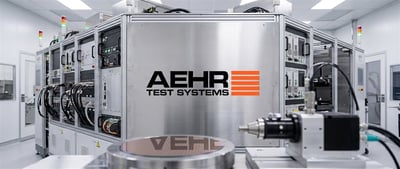
Aehr makes machines that subject semiconductors to intense conditions, testing them for defects. As data center operators look to improve performance by filtering out faulty chips, Aehr has been gaining considerable order momentum.
In the fourth quarter of fiscal 2026 (FY2026), Aehr posted revenue of $18.84 million. (Note that Aehr’s fiscal reporting period is several quarters ahead of the calendar year.) This represented year-over-year (YOY) growth of 33.7%.
Notably, this was the first time in more than a year that Aehr’s quarterly revenue growth turned positive, an important inflection point for the business. Analysts had been expecting a similar result, however, with Aehr slightly beating estimates of $18.69 million.
Alongside that, Aehr crushed estimates on earnings per share (EPS). The figure came in at 11 cents, swinging sharply from a loss of 1 cent a year ago. Analysts had expected EPS to remain unchanged at a loss of 1 cent. The company also materially outperformed on adjusted gross margin, which rose 1,000 basis points to 45%, driven by higher sales, improved manufacturing capacity utilization, and a richer product mix.
Despite Aehr’s impressive quarter, full-year FY2026 revenue declined 15% YOY to $50 million. The company has been transitioning from an overwhelming focus on EV markets to one increasingly centered on non-EV markets, including AI.
Aehr Provides Blockbuster Guidance
Aehr’s Q4 FY2026 results were strong, but the company’s guidance is what really stole the show. For FY2027, Aehr expects full-year sales of between $130 million and $150 million. That would represent growth of 160% to 200% over FY2026.
This guidance underscores Aehr’s success in generating orders for its Sonoma and FOX-XP systems. Over the past few quarters, Aehr has repeatedly announced significant orders from the AI chip industry. That has led the company to make strong statements about bookings, including that second-half FY2026 bookings would come in “at the high end of its $60 million to $80 million range.” A record $41 million hyperscaler order helped it surpass that estimate.
Aehr’s large revenue guidance figure provides a clear measure of how far the company has come.
Another figure that supports this confidence is Aehr’s effective backlog of $100.6 million. The company simply needs to deliver these booked orders to recognize the revenue, absent cancellations. If Aehr ships its full order backlog in FY2027, it would account for 67% to 77% of the company’s revenue guidance. That offers a strong degree of visibility into Aehr meeting its revenue expectations. It is important to note, however, that Aehr did not explicitly say the full backlog would necessarily convert in FY2027.
The additional customer demand Aehr anticipates for the rest of the year is the difference between its backlog and guidance. Notably, the company said it sees an opportunity to raise guidance even higher in FY2027.
Aehr expects adjusted pretax profitability to be between 18% and 22% of revenue in FY2027. At the midpoint, that would imply adjusted pretax income of $28 million. In FY2026, that figure was -$3.7 million, indicating a significant improvement in Aehr’s profitability profile.
Aehr’s Forward Price-to-Sales Ratio Drops Over 50% From Highs
Using the midpoint of Aehr’s revenue guidance would put its forward price-to-sales (P/S) ratio at around 20x. That remains a very high figure by most standards, but it is down approximately 56% from Aehr’s forward P/S peak of 45x. This suggests the company’s valuation has moved much closer to alignment with its revenue expectations.
Additionally, after Aehr’s earnings report, analysts at Craig Hallum and Lake Street Capital placed $125 and $110 price targets on the stock, respectively. The average of those targets implies upside of nearly 40%. Aehr remains a highly volatile and risky stock, but that risk is meaningfully lower than it has been over the past several months. Shares are still well below their highs, and the company just provided important data that supports its fundamental outlook.
Investors interested in Aehr should closely watch how the company’s orders, guidance, and conversion of backlog into revenue progress going forward.
Buyback Boom: These 3 Companies Are Betting Billions on Their Own Stocks
By Jessica Mitacek. Date Posted: 7/20/2026.

Key Points
- Dollar Tree, Morgan Stanley, and Accenture recently announced a combined $24.5 billion in new, replenished, or increased share buyback programs.
- S&P 500 companies announced a record $665 billion in buybacks during early 2026, with full-year authorizations forecast to reach $1.55 trillion.
- Each company's buyback timing suggests management views shares as undervalued, with Dollar Tree and Morgan Stanley rallying while Accenture remains well off its highs.
- Special Report: Forget SpaceX. Buy the company Musk can't replace.
In 1982, the U.S. Securities and Exchange Commission (SEC) adopted Rule 10b-18, giving companies a safe harbor for qualifying share repurchases. Since then, publicly traded companies have been repurchasing their own shares to consolidate ownership and boost earnings per share (EPS). For some firms, however, the timing of those buybacks suggests management sees the current share price as undervalued.
This year, companies are on a record-setting pace.
Most of your net worth in one stock? (Ad)
If a large share of your net worth is tied to a single stock, concentration risk may be working against your long-term plans - and selling without a strategy can stack a serious tax bill in one year.
SmartAsset's free quiz matches you with vetted fiduciary advisors who can build a sequenced, tax-aware plan around your specific position. A few minutes to match, then you choose who to talk to.
Take the free quiz and get matched with a fiduciary advisor todayAccording to Bloomberg, during the first four months of 2026, S&P 500 companies announced plans to repurchase $665 billion worth of shares, the highest total ever recorded for that period. Based on historical rates, analysts now forecast authorized repurchases to reach $1.55 trillion for the full year.
Participating in that shopping spree are three companies that have recently announced a collective $24.5 billion in new, replenished, or increased share repurchase plans.
Dollar Tree: $2.5 Billion Buyback Adds Fuel to Turnaround
On July 2, the board of directors for Dollar Tree (NASDAQ: DLTR) replenished its share repurchase authorization by $2.5 billion.
The board approved the authorization the previous day, and the amount represented approximately 10.7% of the company’s more than 192 million shares outstanding at the time.
Although Dollar Tree’s current authorization doesn’t have an expiration date, the company had already been active in the market, repurchasing $500 million of stock in June under its previous authorization.
When July began, shares were down 5.13% year to date (YTD), presenting an opportunity as the stock’s momentum had recently shifted.
Since its YTD low of $86.80 on May 13, DLTR has gained nearly 48% and now trades about 10% below its 52-week high of $142.40. The current rally can be partly attributed to July 8 upgrades from Raymond James (Outperform) and Goldman Sachs (Sell to Neutral), as well as upwardly revised full-year guidance, with forecasted EPS increasing to a range of $6.70 to $7.10.
With a low-volatility beta of 0.65, a TradeSmith financial health indicator that has been green for about a month, and more than 97% institutional ownership, the discount retailer’s buyback aligns with Wall Street’s improving sentiment. After posting EPS beats for five consecutive quarters and six of the last seven, Dollar Tree is expected to report Q2 earnings on Sept. 2.
Morgan Stanley: $20 Billion Buyback Reinforces Earnings Momentum
Ahead of its record-breaking Q2 earnings report on July 15, Morgan Stanley (NYSE: MS) reauthorized a massive $20 billion buyback—equal to 5.6% of its shares outstanding—on June 24.
The company’s current multi-year repurchase authorization doesn’t have an expiration date, and shares have edged up slightly since the most recent buyback.
Q2 marked the second consecutive quarter in which the investment bank announced all-time high EPS and revenue, with the firm attributing its recent success to a 69% year-over-year jump in equity trading, more investment banking activity, and reaching a $10 trillion milestone in total client assets under management, including a record $148 billion in net new assets.
In Q2, the company spent $1.5 billion on its own shares, and since its YTD low on March 12, shares are up nearly 48%. The stock carries a consensus Moderate Buy rating, while current short interest is just 1.12% of the float.
Accenture: $2 Billion Bet That Its Stock Is Undervalued
On June 23, global professional services and consulting firm Accenture (NYSE: ACN) announced a $2 billion increase to its fiscal 2026 share repurchase program, bringing the total to 2.4% of its shares outstanding.
From management’s perspective, the authorization comes at an opportune time: Shares of ACN are down around 46% YTD and nearly 53% below their 52-week high.
That $2 billion repurchase increase brought its 2026 authorization to $7.5 billion.
The company has until Aug. 31 to exhaust those funds, with CEO Julie Sweet saying that “Accenture is at the center of AI-driven reinvention, and we do not believe our current share price reflects that position or the strength of our business fundamentals.”
Still, the firm faces an uphill battle in getting its stock back near its 52-week high. In Accenture’s Q3, revenue growth slowed to 5.59%, with operating cash flow regressing to a quarter-over-quarter loss of 0.82%.
Meanwhile, the company’s financial health, according to TradeSmith, has been in the red for more than five months. But the stock’s consensus price target suggests around 33% potential upside from current prices. Over the past year, institutional inflows of more than $25 billion, compared with $13.25 billion in outflows, suggest that smart money also sees a buy-low opportunity.
This email communication is a paid advertisement for Porter & Company, a third-party advertiser of DividendStocks.com and MarketBeat.
If you need assistance with your account, feel free to contact MarketBeat's U.S. based support team at contact@marketbeat.com.
If you no longer wish to receive email from DividendStocks.com, you can unsubscribe.
Copyright 2006-2026 MarketBeat Media, LLC. All rights reserved.
345 N Reid Pl., Sixth Floor, Sioux Falls, SD 57103. USA..




No comments:
Post a Comment