Dear Friend,
The President of the United States banned one company's technology.
The Secretary of Defense called it a national security threat.
Then something strange happened.
The Pentagon kept using it anyway. In the middle of a shooting war.
Under oath, the Pentagon's own CIO said it on the record:
"The use of the system is active right now."
Apple, Microsoft, Amazon, NVIDIA - they all depend on it too.
In a matter of months, it's going public in what could be the largest AI IPO in history.
I found the one legal way for regular investors to get in before October.
See the backdoor Wall Street hoped you'd never find >>
“The Buck Stops Here,”
Kelly Maguire
Behind the Markets
BlackBerry’s Rally Is Running on a Bigger AI Story Than Earnings Alone
Reported by Chris Markoch. Originally Published: 6/26/2026.

Key Points
- BlackBerry beat Q1 fiscal 2027 estimates with revenue up 26% year-over-year to $152.9 million, triggering a nearly 20% post-earnings stock surge.
- BlackBerry's QNX operating system, embedded in more than 275 million vehicles, positions the company as a software supplier for the physical AI market.
- Analysts maintain a consensus Hold rating with a price target of around $7, below the current share price of approximately $10, reflecting valuation concerns.
- Special Report: SpaceX is offering you shares. Don't take them.
BlackBerry Limited (NYSE: BB) delivered a Q1 fiscal 2027 earnings beat that impressed investors.
The June 25 report showed revenue surging 26% year-over-year to $152.9 million, well above the $139.8 million consensus estimate.
What really happened in Beijing? (Ad)
Trump just returned from Beijing with the most powerful business delegation in American history - Elon Musk, Jensen Huang, Tim Cook, and the CEOs of BlackRock, Goldman Sachs, and CitiBank. The media covered the handshakes. But what was really being negotiated behind closed doors?
Porter Stansberry has connected the Beijing trip to a landmark pact signed by 13 nations in Washington - a pact designed to cut China out of a $3 trillion investment wave tied to the most critical resource of the 21st century. His new documentary exposes the five assets at the center of it all.
Watch the full documentary and see which assets are positioned to benefitAdjusted earnings per share (EPS) of four cents topped analysts’ expectations of three cents.
However, a double beat alone doesn’t explain BB’s nearly 20% post-earnings surge, or its more than 170% year-to-date rally.
The bigger story is BlackBerry’s ongoing transformation. The company is now a pure-play software business with a real foothold in what many call AI's next frontier: physical AI. The question for investors is whether the recent surge is premature or just the start of a longer rally.
BlackBerry Earnings Beat Shows Software Strategy Is Working
At a time when many technology stocks are being judged by a “what have you done for me lately?” standard, BlackBerry's latest earnings report gave the bulls plenty of ammunition. The numbers show that the company is turning its software pivot into durable profitability.
BlackBerry posted its fifth consecutive quarter of positive GAAP net income. Adjusted EBITDA grew 144% year-over-year. Both the QNX and Secure Communications segments achieved Rule of 40 performance, a benchmark that combines growth and margin into a single measure of software-business quality. The company also generated $4.6 million in operating cash flow, marking its first positive operating cash flow quarter in nine years, excluding a prior patent sale.
Management raised full-year guidance to revenue of $594 million to $621 million and adjusted EPS between 16 cents and 20 cents.
How QNX Positions BlackBerry for the Physical AI Boom
BlackBerry has fully exited handsets and now sells software exclusively. QNX, its real-time operating system, sits inside more than 275 million vehicles on the road today.
That installed base gives BlackBerry a strategic position in physical AI. Physical AI refers to systems where models drive real-world machines: autonomous vehicles, humanoid robots, surgical equipment and industrial automation. These applications need software that responds in microseconds with zero tolerance for failure.
This is where QNX shines. Its deterministic, safety-certified architecture is built for exactly these workloads. Cloud-trained AI must eventually run on certified embedded software when it touches the physical world, and that layer is QNX's value proposition.
The NVIDIA (NASDAQ: NVDA) partnership, which was announced at Hannover Messe in April, amplifies the opportunity. QNX OS for Safety 8.0 now integrates with NVIDIA's IGX Thor platform and Halos Safety Stack. The combination targets autonomous mobile robots, humanoids, surgical robotics, and industrial automation.
Those are categories NVIDIA CEO Jensen Huang has flagged as multi-trillion-dollar end markets. A separate design win with Chinese EV maker Leapmotor for its D19 SUV signals continued automotive traction even as QNX expands into new verticals.
Can BlackBerry's Valuation Support More Upside?
After the post-earnings bump, BB shares trade around $10 with a trailing price-to-earnings (P/E) ratio just shy of 130x.
The BlackBerry analyst consensus forecasts on MarketBeat have the stock rated a Hold, with a consensus price target of around $7.
However, Canaccord Genuity nearly doubled its price target to $8.20 from $4.40 on June 24, and Stifel Nicolaus initiated coverage with a $12 price target. Investors will be watching to see whether these are outliers or the start of a trend.
The consensus Hold rating suggests analysts still view BB as a slow-growth business. But if price targets begin to follow the company’s fundamentals, the outlook will change.
For example, if QNX captures even a small slice of the physical AI software stack, the addressable market expands well beyond automotive. The NVIDIA partnership also opens distribution to a developer ecosystem numbering in the millions.
That is the “early” argument. Bears counter that the revenue base is still small relative to the company’s ambitions. Competition from open-source ROS 2 and established players like Wind River and Green Hills Software is real and well-funded.
The Catch: QNX Momentum May Take Time to Scale
Several risks deserve attention before chasing the rally. QNX revenue grew strongly in Q1, but automotive software design cycles are notoriously long. Royalty revenue depends on vehicle production volumes, which remain choppy globally.
Secure Communications growth runs in the mid-single digits. That segment generates steady cash but will not drive the multiple expansion needed to justify the current price.
Stock-based compensation and dilution are also persistent issues. A buyback program is in place, but the share count needs to fall further for per-share metrics to improve meaningfully.
Is BlackBerry Stock a Buy After Its Massive Rally?
The Q1 print confirmed that BlackBerry's pivot is working. Physical AI gives the company a real growth narrative for the first time in over a decade. But at current prices, investors are paying for a story that needs several quarters of execution to fully play out.
For long-term holders, the thesis remains intact, and the guidance raise gives them another quarter of support. For new buyers, waiting for a pullback or a clearer signal that QNX royalties are accelerating may be the more disciplined approach.
This Single Factor Is Holding Back Carvana’s Disruptive Edge
Reported by Chris Markoch. Originally Published: 6/26/2026.

Key Points
- Carvana’s Q1 results showed record vehicle sales and improving margins, highlighting continued operational momentum.
- High auto loan rates may be the biggest obstacle for CVNA stock as financing-sensitive buyers face affordability challenges.
- Analysts remain optimistic on Carvana, but investors are waiting for Q2 earnings and clearer signals from the Federal Reserve.
- Special Report: SpaceX is offering you shares. Don't take them.
Carvana (NYSE: CVNA) delivered a genuinely impressive Q1 2026 earnings report that included a record number of units sold.
However, in the two months following the report, CVNA is down approximately 15% despite favorable analyst sentiment. That includes a 10% drop on June 17 in sympathy with cost commentary from CarMax (NYSE: KMX), even though Carvana's own unit economics are moving in the opposite direction.
What really happened in Beijing? (Ad)
Trump just returned from Beijing with the most powerful business delegation in American history - Elon Musk, Jensen Huang, Tim Cook, and the CEOs of BlackRock, Goldman Sachs, and CitiBank. The media covered the handshakes. But what was really being negotiated behind closed doors?
Porter Stansberry has connected the Beijing trip to a landmark pact signed by 13 nations in Washington - a pact designed to cut China out of a $3 trillion investment wave tied to the most critical resource of the 21st century. His new documentary exposes the five assets at the center of it all.
Watch the full documentary and see which assets are positioned to benefitAfter the company’s strong Q1 numbers, Carvana still has operational fuel left in the tank. For example, the company’s AI-driven reconditioning tools haven't been rolled out at most facilities, leaving additional margin expansion still on the runway.
The company's new Stellantis (NYSE: STLA) hybrid hub model has also shown early traction. The Casa Grande franchise reportedly went from 30 to 50 units per month to more than 700 after Carvana took it over.
Why Is CVNA Under Pressure?
With all these positive factors supporting the stock's outlook, why is CVNA under pressure? Some may say the issue is valuation. At 41x forward earnings, Carvana is priced like a technology stock. But the company’s innovative, online-only model has been disruptive to a market that wasn’t known for innovation. And although the company doesn’t have a long history of profitability, the 41x figure is a discount to its historic average.
The company also cited the likelihood of lower gross profit per unit (GPU) in the coming quarter for a variety of reasons, including the year-over-year comparison to last year’s tariff anniversary. But that’s likely to be a one-time event and wouldn’t explain a sell-off that is now over 20% in 2026.
Carvana Is More Sensitive to Financing Conditions
The real impact on CVNA is likely coming from something outside of its control. Specifically, the near-term direction of U.S. monetary policy. The tone of Federal Reserve chair Kevin Warsh's statements on June 17 did not indicate that he means to move towards an accommodative stance anytime soon.
The CME FedWatch tool agrees. The odds of a rate cut for the rest of 2026 are not even given a percentage. This may not satisfy investors who want to sharpen their pencils and look for a mathematical reason to sell Carvana in the company’s financials. But before dismissing it, here’s something to consider.
For an auto retailer, interest rates matter because auto loan rates are among the stickiest in consumer credit. The average used car APR is well above 11%. Trade-ins increasingly carry negative equity. A consumer who barely qualifies at current rates gets squeezed harder if rates hold or rise.
Something else to consider: Carvana's competitor CarMax recently delivered earnings and, despite beating estimates and growing penetration, saw net income drop nearly 12% to $185.6 million as it cut prices to defend volume. Its loan-loss reserve also climbed to 2.95% of loans, up from 2.78%, as the company leaned harder into Tier 2. This is a category of consumers with strong but not top-tier credit who usually qualify for rates that carry a cost premium.
The typical Carvana customer skews to a lower FICO score than CarMax and is more dependent on financing. When rates stay high, marginal buyers are the first to be disqualified, and those are disproportionately Carvana's customers. There's also a K-shaped wrinkle to consider. Upper-tier consumers are still spending, but they're prioritizing travel and experiences over big-ticket vehicle purchases.
That gives fundamental investors something to consider. Restrictive policy compresses growth multiples the hardest. At a 41x forward multiple, Carvana needs growth to deliver.
If higher-for-longer rates take $1 of earnings per share (EPS) away from CarMax, it could take 10x off CVNA's multiple. That puts Carvana’s 5-for-1 split last quarter into a different light.
Analysts Remain Bullish, But Technicals Stay Weak
Institutional buying was down sharply in the last quarter, but since the company’s earnings report, analysts have been mostly bullish on CVNA. The Carvana analyst forecasts on MarketBeat show a consensus price target of $93.14 as of June 24, representing a significant gain for investors. However, investors may have to wait until after Carvana reports earnings next month to get a better picture of analyst sentiment.
The CVNA chart shows a stock that continues to be in a downtrend, with recent rallies failing to crack the 200-day simple moving average. A bigger concern for investors may be volume, which is down sharply. The MACD also remains below its signal line, with the histogram near zero. There’s simply no real conviction one way or the other, which amplifies short interest of around 7%, which in and of itself isn’t bearish.
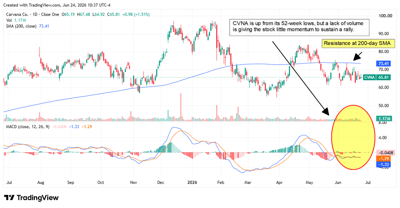
The next potential catalyst comes with Carvana's Q2 earnings report scheduled for July 29. Until then, CVNA is likely to stay tethered to macro signals rather than its own execution. The numbers say the company’s business model is working. The question is whether the Federal Reserve cooperates before the multiple compresses further.
This email communication is a paid sponsorship from Behind the Markets, a third-party advertiser of The Early Bird and MarketBeat.
If you have questions about your account, please contact MarketBeat's South Dakota based support team at contact@marketbeat.com.
If you no longer wish to receive email from The Early Bird, you can unsubscribe.
Copyright 2006-2026 MarketBeat Media, LLC. All rights protected.
345 N Reid Place, Sixth Floor, Sioux Falls, South Dakota 57103-7078. USA..




No comments:
Post a Comment