Hi there,
Want The Early Bird’s Stock of the Day before it hits your email inbox?
We now send it by text each morning, so you can see the pick right away— a full day earlier than the newsletter.
Here’s what you’ll get:
One actionable stock idea selected by MarketBeat’s research team
The key headline(s) moving the stock
A quick bull case and bear case
Follow-up alerts when something changes
If you’d like to start (it’s free), tap here:
Get The Stock of the Day By Text
—The Early Bird Team
P.S. This is a free service. Message frequency will vary. Unsubscribe any time by replying "STOP" to our messages.
DraftKings Hits the Jackpot With Super App Pivot
Reported by Jeffrey Neal Johnson. Posted: 6/11/2026.

Key Points
- DraftKings' June 9 SEC filing revealed its Predictions platform reached $3.1 billion in annualized total volume traded, up 34% from April.
- The prediction market product allows DraftKings to acquire users nationwide, including in states where traditional online sports betting remains illegal.
- Institutional options activity surged around near-term call strikes, and analysts at UBS, TD Cowen, and Morgan Stanley maintained constructive price targets on the stock.
- Special Report: The Biggest IPO Ever: Claim Your Stake Today
An influx of trading volume has completely reshaped the near-term technical and fundamental setup for DraftKings (NASDAQ: DKNG).
DraftKings is currently trading in the $28 to $29 range, extending a double-digit percentage gain that began after the company’s latest prediction-market disclosure.
SpaceX will crumble without these 5 companies (Ad)
The SpaceX IPO is drawing near, but the real opportunity may lie in 5 lesser-known companies providing the critical infrastructure SpaceX depends on to operate.
Goldman Sachs and Morgan Stanley are reportedly already building positions in one of these names. Another is a resource miner that Elon Musk's broader empire - including Tesla - relies on. Lance Ippolito has detailed all five inside his free SpaceX Investing Blackbook.
Download the free SpaceX Investing Blackbook before these names go mainstreamThe catalyst behind this sharp move is not a mysterious acquisition or a speculative short squeeze. Instead, Wall Street is repricing DraftKings after a June 9 Securities and Exchange Commission Form 8-K disclosure that revealed preliminary, unaudited May operating metrics for DraftKings Predictions, the event-contract platform the company launched on Dec. 19, 2025.
Early traction behind the 50-state Super App strategy — $3.1 billion in annualized total volume traded — suggests DraftKings may be creating a new user-acquisition channel in states where online sports betting remains limited or unavailable. The data supports the view that Predictions could become a meaningful non-traditional vertical, though investors still need to see whether trading volume converts into durable revenue, margin expansion, and customer growth.
DraftKings' $3.1 Billion Prediction Jackpot
The metrics in the recent regulatory filing highlight a product that appears to be finding immediate product-market fit. Annualized consumer volume in the Predictions offering accelerated 24% month over month to $1.3 billion. More impressively, annualized total volume traded reached $3.1 billion, up 34% from April.
Understanding the distinction between these volume metrics and traditional sports betting handle is essential for evaluating the revenue potential DraftKings may capture. In a legacy sportsbook model, handle refers to the capital wagered on an outcome. If a user wagers on a football game, that capital is illiquid until the event concludes.
Prediction markets operate as dynamic trading ecosystems. Participants can buy and sell contracts multiple times as real-world probabilities shift before an event resolves. The $3.1 billion annualized total volume traded figure includes traders entering and exiting positions, creating a high-velocity capital environment. This structure allows DraftKings to capture consistent transaction fees without absorbing the heavy directional risk exposure that can occasionally compress margins in traditional sports betting.
While $3.1 billion is a formidable number for a newly launched product, DraftKings is still only scratching the surface of the broader prediction market ecosystem.
Rival platforms like Kalshi currently execute mid-tens of billions in notional monthly volume, while Polymarket regularly processes high single-digit billions. The market is bidding up DraftKings because it is showing signs of capturing early market share in an industry with a massive, proven runway for growth.
The 50-State Super App Strategy
The true value of the prediction market rollout lies in how it supports the broader Super App framework DraftKings envisions.
For years, the core fundamental headwind facing digital gaming operators has been the grueling, state-by-state battle for legislative approval. Expanding a traditional sportsbook requires lobbying state legislatures, fighting local referendums, and navigating a patchwork of complex tax structures.
Event contracts provide a frictionless backdoor to nationwide user acquisition. Because prediction markets operate under different regulatory classifications than traditional sports wagering, DraftKings can deploy this ecosystem across jurisdictions where legacy sports betting remains illegal. By dynamically adjusting the product mix by local jurisdiction, DraftKings could bypass the legislative gridlock constraining its core business model.
This structural shift broadens the growth narrative surrounding DraftKings. Investors are no longer solely dependent on waiting for a new state to legalize sports betting; they are now evaluating a platform capable of scaling an active user base nationwide.
Analysts are paying attention. UBS recently reiterated a Buy rating and boosted its price target from $43 to $49, while others remain constructive. TD Cowen maintained a Buy rating with a $30 target and pointed to prediction markets as a large, early-stage opportunity. Morgan Stanley also maintained an Overweight rating with a $39 price target.
Smart Money Bets Big on DraftKings
Derivative markets quickly recognized the fundamental shift, reflecting an aggressive bullish pivot.
Options chains saw a massive influx of short-dated call buying as institutions positioned for near-term upside. Volume concentrated heavily around the $27, $29, and $30 strike calls expiring June 12. The $30 strike call registered over 6,365 contracts traded against a prior open interest of just 2,243.
When option volume substantially exceeds existing open interest on out-of-the-money strikes, the activity indicates acute speculative interest and institutional repositioning rather than simple hedging. Smart money appears to be positioning DraftKings for a sustained move higher.
The underlying equity technicals support this bullish derivative flow. Following a sluggish 30-day trend in which DraftKings languished below major resistance levels, the sudden price appreciation pushed DraftKings above the 20-day simple moving average at $25.04 and the 50-day simple moving average at $23.84.
Despite the velocity of the move, DraftKings is not technically overextended. The Relative Strength Index, a momentum oscillator that measures the speed and change of price movements on a scale of zero to 100, currently sits at a neutral 51.23. A reading near 50 indicates DraftKings has substantial technical headroom to run before reaching overbought territory, typically defined as a Relative Strength Index reading above 70.
What's Your Best Bet?
While institutional sentiment remains constructive, evaluating the broader ownership landscape requires examining insider activity. Trailing six-month data shows some distribution among key DraftKings executives. Co-founder Paul Liberman recently sold 484,417 shares of DraftKings, and Woodrow Levin sold 34,234 shares. However, executive stock sales often relate to tax obligations, portfolio diversification, or scheduled 10b5-1 trading plans rather than a lack of confidence in the underlying business fundamentals. The divergence between structural insider profit-taking and aggressive institutional derivative accumulation often occurs during major business pivots, just as we see with DraftKings right now.
DraftKings now faces established overhead resistance near the $32 level, with downside support forming at the $23.50 technical breakout zone. The rapid scaling of the predictions platform meaningfully improves DraftKings' revenue mix and national footprint, warranting a higher valuation multiple.
Investors with a higher risk tolerance might consider using options spreads to capture further upside toward the $32 resistance level while strictly defining downside risk. Cautious market participants may prefer to let the initial volatility settle and watch for a constructive pullback near the 50-day moving average before initiating a position in DraftKings.
The Market May Be Missing What’s Changing at BigBear AI
Reported by Thomas Hughes. Posted: 6/8/2026.

Key Points
- BigBear AI's stock price chart is bullish, showing a strong Head & Shoulders Reversal.
- Coverage and institutional interest remain light but will likely pick up as the year progresses.
- The company inflected in early 2026, and upcoming results will confirm it.
- Special Report: The Biggest IPO Ever: Claim Your Stake Today
BigBear AI’s (NYSE: BBAI) price action suggests the bear market is not only over, but that a full reversal is underway. The stock hit a bottom earlier this year and completed a Head & Shoulders reversal pattern.
The company’s turnaround has it on track to grow and achieve profitability within the foreseeable future. As it stands, the pattern suggests this move is, at worst, only halfway done, and a run to $6 is likely ahead.
SpaceX will crumble without these 5 companies (Ad)
The SpaceX IPO is drawing near, but the real opportunity may lie in 5 lesser-known companies providing the critical infrastructure SpaceX depends on to operate.
Goldman Sachs and Morgan Stanley are reportedly already building positions in one of these names. Another is a resource miner that Elon Musk's broader empire - including Tesla - relies on. Lance Ippolito has detailed all five inside his free SpaceX Investing Blackbook.
Download the free SpaceX Investing Blackbook before these names go mainstream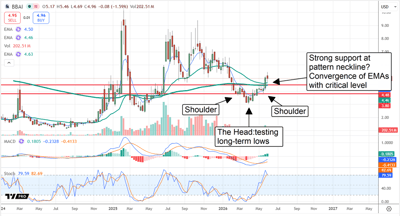
Dilution is the biggest risk, but it isn’t an immediate threat, and several catalysts are in play. Last year’s activity increased the share count by nearly 90%, leading to a steep decline in the share price, but it also eliminated debt, improved capitalization, and supported restructuring and acquisitions that better position the company. As of mid-2026, the business is gaining traction in key markets, is on track to accelerate growth in the coming quarters, and has a modest capital runway. The question is whether it can ramp revenue and improve margins enough to sustain capitalization and reach true profitability without another capital injection.
Big Catalyst for BigBear
Upcoming catalysts include monetizing Ask Sage, converting backlog into revenue, securing a major technology validation, and meeting full-year guidance. Ask Sage is central to the outlook, underpinning not only the revenue forecast but also the margin profile. The acquisition is already driving better margins; the opportunity now is to sustain that improvement and generate additional growth through new clients, deeper penetration, and cross-selling.
The potential is robust, as Ask Sage provides secure access to more than 150 AI models, including major platforms like ChatGPT, and holds high-level government clearances. FedRAMP High and Department of Defense Impact Level 5/6 classifications enable the handling of classified and sensitive material that is in demand. The company already supports more than 16,000 users across thousands of government and enterprise teams.
Backlog provides investors with some visibility. The Q1 2026 earnings release reported a 14% increase in backlog, bringing it to a record level. At approximately $290 million, it is nearly double the annual revenue forecast and is expected to keep growing. Not only are new contracts likely, but existing contracts, such as the one with the Air Force, also include potential for follow-on business.
BigBear’s transition from a government pure play to a diversified business is another theme central to the stock’s outlook. The company wants to expand its client base to include private enterprises, which could accelerate growth and reduce the lumpiness of government contract revenue. Its move into Panama, in partnership with Panama Transshipment Group, puts it in the sights of global operators. The opportunity here is for BigBear to expand to other operators and entrench itself in the fabric of global logistics and security.
Achieving its guidance would mark an inflection point for the company. BigBear’s target range has a midpoint of $150 million, representing double-digit year-over-year growth and more than 10% above the consensus analyst forecast. The risk is that revenue growth will be slower than expected, leaving the market vulnerable to short selling and other bearish forces.
Market in Wait-and-See Mode—Big Gains or Big Drops Are Coming
The sell-side data, including short interest, institutional activity, and analyst coverage, suggests this market is not out of the woods, not by a long shot. While short interest remains high, above 25%, institutional holdings remain low, near 7.5%, and analyst coverage is lukewarm at best. The opportunity here is that upcoming releases could trigger short-covering and accumulation, but there is little evidence of that yet.
Analyst coverage is mixed: the stock is rated Hold, but only three analysts cover it, leaving little data to go on. The best that can be said about this and other sell-side activity is that the market is waiting to see what happens, with higher stock prices possible but still highly uncertain. In this scenario, the stock may remain range-bound near current levels until additional catalysts emerge, which may not happen until later in the summer with the Q2 earnings release. Signs of strength will be reflected in the stock price and may even lead to increased coverage.
What the market gets wrong about BigBear AI is that it is not a pure-play SaaS company, but rather a defense contractor in the midst of a significant transition. While revenue growth has been tepid, the company has been replacing lower-quality revenue streams with higher-quality opportunities while also expanding into heavily regulated commercial markets. Comparisons to Palantir (NASDAQ: PLTR) are misleading, as BigBear provides critical infrastructure to the logistics and border-control markets and won’t see the same upfront growth explosion. Contracts of this nature take time. Additionally, most of the company’s losses stem from non-cash adjustments; profitability is closer than it appears.
MarketBeat empowers everyday investors to make better financial decisions by providing up-to-the-minute financial information and independent market analysis.
This email content is a sponsored email from The Early Bird, a third-party advertiser of MarketBeat. Why did I get this email content?.
If you need assistance with your account, feel free to contact our South Dakota based support team at contact@marketbeat.com.
If you would like to unsubscribe or change which emails you receive, you can manage your mailing preferences or unsubscribe from these emails.
© 2006-2026 MarketBeat Media, LLC. All rights protected.
345 N Reid Place, Suite 620, Sioux Falls, South Dakota 57103-7078. United States of America..




No comments:
Post a Comment