Fair warning:
This new briefing from MarketWise CEO Dr. David "Doc" Eifrig might change how you think about AI stocks.
Doc – a former Goldman Sachs derivatives trader – recently teamed up with one of our best quantitative researchers, who made a huge discovery:
A mathematical signal buried in the financial system that can help predict the day this bull market will end.
What concerns Doc most is this:
Nearly half of the U.S. population's retirement accounts are exposed to a major crash... whether they realize it or not.
When the crash comes, as Doc believes it will, millions of hard-working Americans will be blindsided.
That's why Doc put together an urgent new briefing that walks through the entire thesis...
When to be in... what to buy... how to know when to get out...
And three specific steps you can take right now that could make you a lot of money BEFORE the meltdown.
I guarantee this is worth a few minutes of your time today.
Whether you agree with Doc or not, everyone with money in the market should see this.
All the best,
Corey McLaughlin
Editor, Stansberry Digest
Best Buy’s AI Laptop Boost Sparks Hope for a BBY Turnaround
Written by Chris Markoch. Date Posted: 6/1/2026.

Key Points
- Best Buy posted positive comparable sales growth for the first time in years as AI laptops, gaming, and mobile demand improved.
- Higher-margin initiatives like Ads and Marketplace helped support profit growth and operating leverage in Q1.
- BBY stock surged after earnings, but investors are watching closely to see whether the AI PC upgrade cycle can sustain momentum.
- Special Report: Elon Musk’s $1 Quadrillion AI IPO
Best Buy Co., Inc. (NYSE: BBY) just delivered an earnings report for Q1 of its fiscal year 2027 that was exactly what the bulls had been waiting for. One of the most encouraging signs was that comparable sales were up 2%, ahead of guidance. That may sound modest, but context matters. Best Buy had been running negative comps for much of the past two years, so a move into positive territory is genuinely significant.
Digging into the category mix, the largest contributors on a weighted basis were gaming, computing, and mobile phones, with services adding support.
ALERT: Drop these 5 stocks before the market opens tomorrow! (Ad)
The Wall Street Journal is already raising the alarm about a potential market crash, and Weiss Ratings research points to the first half of 2026 as a particularly rough stretch for certain holdings.
Some of America's most popular stocks could take serious damage as a radical market shift plays out. Analysts at Weiss Ratings have identified five names you may want to remove from your portfolio before this unfolds.
If any of these are in your portfolio, now is the time to review your positions.
See the 5 stocks to avoidAppliances were the notable drag, down 13.6% on a comparable basis, which tracks with the ongoing freeze in the housing market keeping renovation and move-related purchases depressed.
Adjusted EPS was up 11% to $1.28. BBY reacted accordingly, surging approximately 15% on the day to close at $74.84. After years of grinding revenue declines, this is a meaningful data point.
The question worth asking is whether this marks an inflection point, or whether investors are front-running a story that still has plenty of ways to disappoint.
AI PCs and Gaming Powered the Q1 Earnings Beat
The computing and gaming strength is where the AI narrative starts to look real. Computing and mobile phones now make up 47% of domestic revenue, and that category grew 4.2% on a comparable basis. Gaming was the single biggest driver, benefiting from what management described as a "very successful gaming launch" in the prior June period that they will be lapping in Q2. But the computing strength is the more durable signal here, and it ties directly to the AI PC thesis that has been circulating for more than a year.
The margin picture was also encouraging. Domestic gross profit rate expanded to 23.7% from 23.5%, driven by growth in Best Buy Ads and Marketplace. These are the newer profit stream initiatives the company has been building out, and they are starting to move the needle. Adjusted SG&A actually held flat as a percentage of revenue at 19.3%, which means the operating leverage is real, not just top-line driven.
Is the AI Laptop Upgrade Cycle Just Beginning?
The AI PC refresh cycle has been the central bull thesis for Best Buy for much of the past 18 months. The logic is straightforward: Microsoft's Copilot+ requirements, combined with a massive installed base of aging laptops (many purchased during the 2020–2021 pandemic surge), create a natural upgrade wave.
Best Buy, as the dominant brick-and-mortar electronics retailer, stands to be the primary physical destination for those purchases. This is particularly true given that consumers tend to want to touch and compare laptops before buying.
The Q1 results offer some validation of that thesis. A 4.2% comp in computing is good. But the real question is whether the cycle is in its early innings or whether part of the upgrade demand has already been pulled forward.
Given that management maintained rather than raised full-year guidance—revenue of $41.2 to $42.1 billion, comparable sales of -1.0% to +1.0%—they are clearly not extrapolating the Q1 beat into the rest of the year. That's either prudent conservatism or a signal that the back half looks murkier than the front.
The tariff environment adds another layer of uncertainty. Best Buy sells a lot of hardware manufactured in Asia, and while tariff impacts were not a major topic in the earnings release, the risk sits squarely in the background for any consumer electronics retailer. If tariffs drive price increases on laptops and TVs, unit volumes could soften even if average selling prices hold up.
The CEO Transition Adds a New Variable for BBY
There was also an unexpected element in the earnings announcement that deserves attention: Corie Barry is stepping down as CEO, with Chief Customer and Product Officer Jason Bonfig taking the reins on Nov. 1, 2026. Barry framed the transition positively, and at first glance, it appears orderly—an internal promotion rather than an external hire or an emergency change.
But leadership transitions during a potential cyclical inflection always introduce execution risk. Bonfig will inherit a company with real momentum and will need to keep the Ads and Marketplace initiatives scaling without disruption.
What the Technical Setup Says About BBY Stock
Before earnings, BBY was trading well below both its 50-day SMA (about $61.84) and its 200-day SMA (about $69.75) and had been in a sustained downtrend since late 2024. The earnings gap launched the stock to $77, decisively through both moving averages as well as its consensus price target of $70.70.
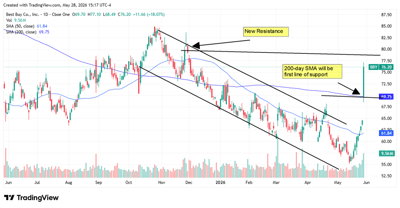
That kind of move is exciting for investors who are already long. For new buyers, it creates a tactical problem. Gap-ups of 15% on earnings frequently see at least partial mean reversion in the weeks that follow, particularly when the stock is clearing major technical resistance levels all at once. The 200-day SMA near $69.75 is now a logical first support level on any pullback, and the prior resistance zone around $75–$77 will need to be digested before the stock can sustain levels above it.
Is BBY a Buy After Earnings?
Chasing a gap of this magnitude is typically a losing proposition. The more patient approach is to let the stock work off some of the excitement, watch whether the $70–$72 range holds on any pullback (former resistance becoming support), and look for a setup with a more defined risk level.
The full-year guidance of $6.30–$6.60 in adjusted EPS—reiterated, not raised—gives you a valuation anchor. At $76, the stock trades at roughly 11x–12x that range, which is not expensive for a company that's re-accelerating on comps and building out higher-margin revenue streams. But the multiple expansion argument requires solid execution over multiple quarters.
The fundamental thesis is cleaner than it's been in years. AI PCs are a real cycle, Ads and Marketplace are working, the operational discipline appears intact, and the dividend—which has a yield of 4.9%—looks safe. The trade is to watch for a pullback that offers a better risk-reward entry, likely somewhere in the low-to-mid $70s, rather than following the gap on day one.
From Industry Titans to Tiny Fish: 3 Key Stocks Insiders are Trading
Written by Leo Miller. Date Posted: 6/6/2026.

Key Points
- GeneDx insiders purchased $82 million worth of shares in Q2 2026 after the stock dropped 49% following a disappointing earnings report.
- Chevron director John B. Hess sold $109 million in shares in May without a 10b5-1 plan, a moderately negative signal as oil prices retreat.
- TSMC insider trading activity was mixed in Q2, with $14 million in sales versus $162,000 in purchases, including a buy from CEO C.C. Wei.
- Special Report: Elon Musk’s $1 Quadrillion AI IPO
Insiders are making moves in massive and minuscule stocks in Q2 2026, with MarketBeat tracking notable buys and sells across several interesting names. That includes one of the world’s biggest energy companies, a gene-testing stock that surged more than 2,000% in 2024, and a firm that some consider to be the most important company in the world.
Chevron Insider Sells Over $100M as Oil Prices Retreat From Highs
Shares of oil giant Chevron (NYSE: CVX) have performed well in 2026, like many stocks in the oil industry. The conflict in the Middle East and the closure of the Strait of Hormuz sent oil prices soaring, benefiting energy stocks. The strait has seen intermittent increases in traffic since the conflict began, but it remains effectively closed, with traffic down sharply compared to pre-March levels.
ALERT: Drop these 5 stocks before the market opens tomorrow! (Ad)
The Wall Street Journal is already raising the alarm about a potential market crash, and Weiss Ratings research points to the first half of 2026 as a particularly rough stretch for certain holdings.
Some of America's most popular stocks could take serious damage as a radical market shift plays out. Analysts at Weiss Ratings have identified five names you may want to remove from your portfolio before this unfolds.
If any of these are in your portfolio, now is the time to review your positions.
See the 5 stocks to avoidStill, oil has come down meaningfully, with West Texas Intermediate crude down almost 20% from 2026 highs. That may reflect markets anticipating that a deal between the U.S. and Iran will eventually be reached, avoiding an all-out war and longer-term oil disruptions. Chevron has pulled back as well, falling around 10% from its 2026 highs, but it is still up more than 20% on the year.
The stock also saw a large amount of insider selling in May, with MarketBeat tracking $109 million in sales. These sales were made by director John B. Hess and were not made under a predetermined 10b5-1 plan. Given that oil prices are easing, this is a moderately negative signal for Chevron. The stock may not be able to rely on higher oil prices to drive shares higher. However, it is worth noting that sales have actually slowed versus Q1, when MarketBeat tracked $205 million worth of sales.
GeneDx Insiders Load Up After Massive Earnings Plunge
Next up is GeneDx (NASDAQ: WGS). The company provides genetic testing services, specializing in pediatrics and rare-disease diagnostics. This small-cap stock went ballistic in 2024, gaining just under 2,700%. It followed that up with a 69% gain in 2025. However, things have taken a turn for the worse in 2026, with shares now down more than 50% for the year.
Notably, its revenue growth rate has slowed from a peak near 67% year over year (YOY) to 17% YOY in its latest quarter. GeneDx shares dropped 49% after the company’s latest earnings report as it posted a $10 million miss on revenue and a 22-cent miss on loss per share. The company also lowered its full-year guidance, and GeneDx’s market capitalization now sits near $1.6 billion.
However, insiders have been showing strong confidence in GeneDx since its post-earnings plunge. Overall, MarketBeat has tracked $82 million worth of insider buys in Q2, all of which came after its report. These buys came from Director Keith A. Meister and Casdin Capital LLC. Meanwhile, MarketBeat has tracked just $167,000 worth of insider sales, which came before the earnings report. While these buys are positive indicators for GeneDx, the stock clearly remains a highly volatile and risky name.
TSMC Sees Buys and Sells as Shares Continue to Climb
Last up is a stock that is anything but small, Taiwan Semiconductor Manufacturing (NYSE: TSM). As the artificial intelligence (AI) buildout has continued to progress with few signs of slowing, TSMC shares have kept climbing. Overall, the stock is up well more than 40% on the year, with TSMC now trading just below a $2 trillion market capitalization. It now ranks as one of the world’s 10 most valuable publicly traded companies. With its dominance in advanced chip manufacturing, many have called TSMC the world’s most important company.
TSMC’s last earnings report showed the company posting solid beats on sales and adjusted earnings per share. The company boosted its 2026 revenue growth guidance to more than 30% YOY and increased its capital expenditure outlook, signaling long-term confidence.
Insiders are sending mixed signals around the stock. MarketBeat has tracked $14 million worth of insider sales in Q2, compared to $162,000 worth of insider purchases.
Notably, CEO Che-Chia Wei (C.C. Wei) was one of the individuals who purchased shares. Vice President Chuang Tzu-Sou was a seller, reducing his holdings by around 7%.
Overall, these insider trades amount to a neutral indicator. Despite insider sales being significantly higher than buys, sales are generally much less indicative of insider sentiment. Insiders often sell simply to gain liquidity, while buys signal direct confidence in a firm’s outlook.
Don’t Take Insider Trades as Gospel
While many of these trades send interesting signals to investors, it is important to note that they are just one of many factors to consider. As stated, sales do not necessarily mean an insider is bearish on a stock. Meanwhile, insiders who purchase shares can be wrong about their company’s stock—especially in the near term.
A recent example of this involves apparel giant Nike (NYSE: NKE). CEO Elliott Hill made headlines at the end of 2025 when he bought $1 million worth of beaten-down Nike shares near $61. Nike has continued to fall sharply since then and is now trading in the mid-$40s range.
This email is a paid sponsorship from Stansberry Research, a third-party advertiser of InsiderTrades.com and MarketBeat.
This ad is sent on behalf of Stansberry Research, 1125 N Charles St, Baltimore, MD 21201. If you would like to optout from receiving offers from Stansberry Research please click here.
If you need assistance with your account, please don't hesitate to contact MarketBeat's U.S. based support team at contact@marketbeat.com.
If you no longer wish to receive email from InsiderTrades.com, you can unsubscribe.
Copyright 2006-2026 MarketBeat Media, LLC.
345 N Reid Place, Sixth Floor, Sioux Falls, South Dakota 57103. United States of America..





No comments:
Post a Comment