SPCX Crisis Could Be Worst News for Stocks in 50 Years
As SpaceX's stock continues to disappoint - even after the biggest IPO in history...
And now that Elon Musk has lost the equivalent of Warren Buffet's entire fortune - in a single day...
Wall Street's declared what could be the worst news for the U.S. stock market in 50 years.
If Goldman Sachs and Morgan Stanley are right... what's coming next could be a historic crisis much worse than a single stock falling.
But won't be like the crashes you're used to.
What's about to hit America next could keep your portfolio in the red for 10 years or longer - unless you make a big change now.
To hear about this decade-long crisis now being predicted by multiple Wall Street banks...
And to see what you can do to protect your wealth...
Click here to learn how to prepare your portfolio.
Regards,
Keith Kaplan
CEO, TradeSmith
How to Invest in the Biggest European Defense Surge in Decades
Written by Nathan Reiff. First Published: 6/19/2026.

Key Points
- European defense spending surged by 14% from 2024 to 2025 as NATO members bulk up military operations.
- Accessing European defense names can be difficult for U.S. investors, but several ETFs make the process more straightforward.
- EUAD is perhaps the most direct way to gain exposure to European defense stocks, but funds like SHLD and WAR also provide access as part of a broader geographic reach.
- Special Report: SpaceX is offering you shares. Don't take them.
According to the Stockholm International Peace Research Institute, military spending around the world is rising rapidly and reached $2.9 trillion in 2025. Europe has led the way in this growth, with a 14% year-over-year (YOY) increase in military spending from 2024 to 2025. Not only are Russia and Ukraine continuing to pour more money into the ongoing war in that region, but a broader rearmament trend is boosting NATO spending; European NATO member military spending rose at its fastest pace since 1953 last year.
For U.S. investors, the easiest access point to the global defense industry is through major domestic players with international exposure, such as RTX (NYSE: RTX). However, these investments do not provide direct access to the European market, a segment that can be difficult for investors in other regions to explore. Fortunately, a growing number of defense exchange-traded funds (ETFs) can provide diversified exposure in a ready-made, easy-access portfolio. Beware, though, that not all of these defense ETFs focus exclusively on European names.
The Primary Pure-Play European Defense Fund, But Some Performance Issues Linger
The $15 Gold Fund That Pays Up to $1,152/Month (Ad)
Gold is hitting record highs, but most investors are leaving income on the table. A $15 fund is quietly paying out up to $1,152 a month to regular investors - no mining stocks, no options, no physical metal required.
Chief Income Strategist Tim Plaehn calls it a breakthrough strategy that transforms gold's rally into reliable monthly payouts. The next distribution is just days away.
Discover the gold income fund before the next payout dateFor exclusively European aerospace and defense names, the best bet for many U.S. investors is likely the Select STOXX Europe Aerospace & Defense ETF (BATS: EUAD). Launched in late 2024, EUAD stands out among the growing list of domestic ETFs for its regional focus on developed European nations. Despite its passive management, this unique exposure comes at a price: EUAD carries an expense ratio of 0.50%, which is relatively high for a passive fund.
EUAD is also not especially diversified, with just 23 holdings. Those holdings include companies deriving a majority of their revenue from making, servicing, supplying, or distributing equipment for European military defense and aeronautics, or related industries.
Investors can expect significant allocations to major producers like Rolls-Royce Holdings (OTCMKTS: RYCEY), Safran (OTCMKTS: SAFRY), and Airbus Group (OTCMKTS: EADSY), each of which accounts for between 17% and 21% of the overall portfolio.
The companies EUAD focuses on are all well established, which may make the fund a good long-term buy-and-hold investment for investors concerned that, after 61% growth since launch, EUAD's biggest rally may be behind it for now.
A Globally-Focused Fund With Greater Diversification
The Global X Defense Tech ETF (NYSEARCA: SHLD) is a much larger fund than EUAD—it has several times the managed assets and a significantly higher one-month average trading volume approaching 2 million.
Its expense ratio also matches EUAD's exactly at 0.50%. However, SHLD is not as direct a way to access the European market in particular. While SHLD offers exposure to key European defense players—companies like Rheinmetall (OTCMKTS: RNMBY) and BAE Systems (OTCMKTS: BAESY), among others—more than 62% of its portfolio consists of U.S. firms. Combined, British, German, French, and Italian companies make up only about 20% of the total basket, although a handful of additional European nations bring that exposure up slightly.
Still, the 50 or so holdings in SHLD's portfolio have fared very well since the fund launched in the fall of 2023 and are up about 8% in the last year.
A Top-Performing Fund With an Active Approach
For an actively managed approach, one of the few options available to investors with a global focus is the U.S. Global Technology and Aerospace & Defense ETF (NYSEARCA: WAR), a fund holding about 30 defense industry names from around the globe. Like SHLD, WAR does not specifically focus on European names. However, its largest holding is Swedish defense contractor MilDef Group AB, and it also holds shares of Rolls-Royce and other prominent European companies.
WAR's industry purview is a bit broader than the funds above, as this ETF also holds firms involved in cybersecurity, data centers, semiconductors, and more.
Because it is actively managed, it has a slightly higher annual fee of 0.60%, as well as a much smaller asset base and trading volume than even EUAD above.
For investors primarily focused on recent performance, however, WAR stands out above these peers. The fund has returned an impressive 42% year-to-date (YTD). By comparison, one of the largest defense ETFs available to investors—the iShares U.S. Aerospace & Defense ETF (BATS: ITA), with nearly $14 billion in assets under management and a focus on North American companies—has returned only 12% YTD. Investors willing to pay a bit more may be handsomely rewarded by WAR's strategy.
Palantir’s Valuation Problem Just Met 2 New Growth Catalysts
Written by Chris Markoch. First Published: 6/26/2026.
Key Points
- Palantir's seven-year partnership with Zeta Global could unlock more than $100 million in annual commercial revenue opportunities.
- The company's role in the Army's NGC2 architecture reinforces its importance in next-generation military AI and data systems.
- Despite a 40% decline in 2026, recent deals suggest the sell-off reflects valuation normalization rather than weakening fundamentals.
- Special Report: SpaceX is offering you shares. Don't take them.
It’s been a rough first half of the year for Palantir Technologies (NASDAQ: PLTR) shareholders. The stock is down nearly 40% in 2026, with shares recently sliding again to test the $107 level.
Short interest, while still low on a percentage basis, is rising. Technology stocks, and software stocks in particular, are being met with suspicion due to the rapid, but perhaps misunderstood, adoption of agentic AI.
Central banks bought 710 tonnes - this fund pays monthly (Ad)
Gold is hitting new highs, fueled by tariffs and record central bank demand - 710 tonnes per quarter. JPMorgan is now targeting $4,900.
One $15 fund is converting gold's momentum into up to $1,152 per month in payouts. No miners, no active trading - just monthly income.
See how to collect your first payout before the next surgeThat pressure feeds the tried-and-true critique that PLTR is simply overvalued. Even after the sell-off, the stock still trades at a steep forward price-to-earnings (P/E) multiple, well above the S&P 500 average and most software-stock benchmarks.
However, Palantir has consistently shown that its stock may be worth the premium. Two announcements in the past week reinforce that view and suggest the sell-off is creating a buying opportunity rather than confirming the bear thesis.
Zeta Global Partnership Expands the Commercial Pipeline
Palantir and Zeta Global (NYSE: ZETA) have entered into a seven-year strategic partnership in which Zeta's Data Cloud will be rearchitected on Palantir's Foundry infrastructure, with Athena by Zeta remaining as the application layer. Foundry provides the ontology, governance, and operational backbone; Athena (Zeta's AI intelligence layer) sits on top to drive real-time, agentic marketing decisions for enterprise clients.
What does that mean for Palantir’s finances? The partnership gives Palantir access to a new batch of potential customers representing more than $100 million in annual revenue. It also includes the development of a joint forward-deployed engineering team. CEO David Steinberg framed that $100 million-plus figure as an annual run-rate target "in the coming years," not a contract value.
ZETA shares climbed 5% on Tuesday, June 23, following the announcement. Wedbush and DA Davidson have flagged it as further enterprise AI validation for Palantir.
Another Government Win Builds on a Core Strength
Next Generation Command and Control (NGC2) is the Army's top modernization priority and its contribution to Joint All-Domain Command and Control (JADC2). That's the Pentagon's effort to fuse data across land, air, sea, space, and cyber. The Army has now established the foundational data architecture for NGC2, built on Palantir's Foundry as the cloud data layer and Anduril's Lattice as the tactical data layer. Raft handles data registries, transformation tools, and federation.
The financial implications are substantial, even though no contract value was disclosed. The award falls under Anduril's 10-year enterprise licensing agreement with the Army, which carries a $20 billion ceiling. Palantir's role is foundational rather than peripheral. Every future NGC2 application, AI model, and battlefield system built on this architecture will run on Foundry.
That matters because Palantir's government segment remains the company's largest revenue base. NGC2 is just beginning to scale beyond the 4th Infantry Division and 25th Infantry Division pilots. As the Army rolls the architecture out to additional formations, Foundry captures recurring revenue at the platform level. The win also complements existing government franchises, such as TITAN and the Maven Smart System.
The takeaway for investors is that new contracts lead to higher revenue and earnings. That’s the signal. The rest is noise.
There's nothing wrong with taking profits on a stock that was ahead of itself at over $200 per share. There’s also nothing wrong with having been early on PLTR. It’s a one-of-one company, and those don’t come around often.
Chart Shows Weak Hands Exiting, Not Capitulation
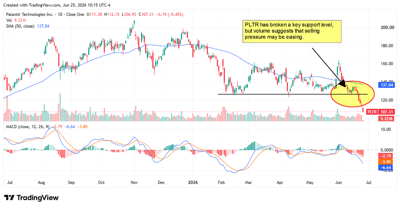
PLTR has broken through a support level of around $128. The $115 level has now given way as well, and shares are sitting roughly $30 below the 50-day simple moving average at $137. Palantir bears smell blood, which could lead to more selling.
But a fair read of the chart shows that the recent sell-off is taking place on, at best, average volume. That’s not a sign of capitulation, but rather a sign of the weak hands exiting the trade. The relative strength index (RSI) has also dipped below 30, a sign that selling may run out of steam sooner than expected.
The MACD is deeply negative but extended, a setup that often precedes a counter-trend bounce. The next logical catalyst for a sustained rally will be the company’s upcoming earnings report, expected on Aug. 3, 2026. Palantir is likely to report strong results, and history suggests the stock may not immediately reflect that strength.
The question for investors is what role PLTR plays in a portfolio. As a short-term investment or trade, it’s a poor choice. There are many headwinds against software stocks in general and Palantir in particular. But the two deals announced this week reinforce why Palantir still merits a place in a long-term portfolio. The sell-off is uncomfortable, but for now it appears to be normal portfolio rebalancing driven by valuation normalization rather than a thesis breaker.
This email communication is a paid advertisement from TradeSmith, a third-party advertiser of InsiderTrades.com and MarketBeat.
This ad is sent on behalf of TradeSmith at 1125 N. Charles Street, Baltimore, Maryland 21201. If you’re not interested in this opportunity, please click here.
If you have questions about your account, please contact MarketBeat's South Dakota based support team at contact@marketbeat.com.
If you no longer wish to receive email from InsiderTrades.com, you can unsubscribe.
© 2006-2026 MarketBeat Media, LLC. All rights protected.
345 N Reid Pl., Sixth Floor, Sioux Falls, S.D. 57103-7078. United States..





No comments:
Post a Comment