
Lithium Supply Takes Years. This Company Isn't Waiting
Most lithium supply still lives in the future.
New projects, new builds, long timelines - 7 to 10 years in many cases. That's the part the market understands.
Demand is moving faster.
EVs, AI, storage - all pulling on the same materials at once. The projections keep getting revised higher, and the gap is starting to show.
That gap creates urgency.
And urgency rewards the companies that move first.
This one did.
Instead of waiting on new supply, it found a way to produce lithium from a source the market largely overlooked - working inside a system that's been running for years, right here in the U.S.
No long buildout. No waiting on new infrastructure.
Just production.
It's early.
But it's already happening.
Qualcomm's TikTok AI Chip Deal Rewrites the Rules
Author: Jeffrey Neal Johnson. Originally Published: 5/27/2026.

Key Points
- Qualcomm secured a multi-million unit ASIC order from ByteDance, sending shares to an all-time high near $258 and driving a 60% advance over 30 days.
- Qualcomm's automotive revenue reached a record $1.3 billion in fiscal Q2 2026, up 38% year over year, with management targeting a $6 billion annualized run rate.
- Geopolitical export control risks and notable insider selling, including nearly $2 million in shares liquidated by Representative Sara Jacobs, present meaningful risks alongside the rally.
- Special Report: Have $500? Invest in Elon’s AI Masterplan
For investors looking to capitalize on the structural transformation underway in artificial intelligence (AI) infrastructure, Qualcomm Incorporated (NASDAQ: QCOM) should now be a primary focus following a sudden shift in market dynamics.
A significant disruption has hit the semiconductor sector: Qualcomm recently landed a multi-million-unit order from ByteDance to provide custom Application-Specific Integrated Circuits (ASICs) for the tech giant's AI data centers.
The #1 stock to buy BEFORE the June 12th filing (Ad)
When the SpaceX IPO launches, most retail investors will be locked out. The banks, funds, and insiders get in early - while everyone else waits on the sidelines.
But one small infrastructure supplier - a critical piece Musk can't scale the Colossus network without - is still trading well under institutional radar. A new briefing reveals the name and ticker at no cost.
Get the SpaceX infrastructure stock name and ticker hereThe market reacted decisively to the news, sending shares to a new intraday all-time high of around $258 and driving a 60% advance over the trailing 30 days. This rapid repricing reflects a broader realization on Wall Street: Qualcomm's days as a purely cyclical smartphone supplier are officially over. Backed by a $29.4 billion capital expenditure tailwind from ByteDance and accelerating automotive sector revenue, Qualcomm's fundamentals are now demanding a valuation re-rating to match its tier-one semiconductor peers.
Cracking the Code, Qualcomm's Data Center ASIC Pivot
For years, institutional money managers assigned Qualcomm a lower multiple because of its heavy reliance on the volatile smartphone cycle. The ByteDance contract decisively breaks that legacy narrative. ByteDance is aggressively scaling Doubao, its highly popular artificial intelligence chatbot, and recently expanded its infrastructure budget by 25% to nearly $29.4 billion. Rather than relying entirely on traditional graphics processing units, which are currently constrained by global supply chains, ByteDance chose Qualcomm's custom ASICs to handle complex inference workloads.
This transition validates a strategic move Qualcomm quietly initiated months ago. The company executed a $2.4 billion acquisition of U.K.-based Alphawave Semi, which established a dedicated data center division. That acquisition also secured a separate, multi-generation custom ASIC co-development agreement with a top-tier hyperscaler, with initial shipments planned for Q4 2026.
By winning the ByteDance contract, Qualcomm has successfully entered a highly lucrative sector previously dominated by a tight Broadcom (NASDAQ: AVGO) and Marvell (NASDAQ: MRVL) duopoly. The market now sees a tangible revenue ceiling for Qualcomm's ASIC deployment, underscoring the company's ability to deliver power-efficient alternative compute architectures at massive scale.
Cars and Compute—A Two-Pronged Profit Attack
While the data center pivot is grabbing headlines, a second high-growth vertical provides a stabilizing revenue floor. Qualcomm continues to expand its automotive footprint, recently deepening a strategic partnership with Stellantis (NYSE: STLA) to integrate the Snapdragon Digital Chassis across connected vehicle fleets.
The financial impact of this automotive expansion is already visible on the income statement. In the fiscal second quarter of 2026, automotive revenue reached a record $1.3 billion, representing 38% year-over-year growth. Management now targets a $6 billion annualized run-rate exit by fiscal year 2026 (FY2026). This consistent, high-margin revenue stream helps offset the legacy mobile headwinds, which saw a slight 3.5% revenue contraction in the most recent quarter.
Beyond top-line growth, Qualcomm's balance sheet continues to improve. While analysts cheered a non-GAAP earnings beat of $2.65 per share, GAAP earnings rose 173% to $6.88 per share. A $5.7 billion deferred tax asset valuation reversal drove that spike, materially strengthening near-term balance sheet health. This financial flexibility supports the active $20 billion share buyback program, representing nearly 14.5% of outstanding shares, and a recent dividend increase to 92 cents per share, bringing the yield to a steady 1.43%.
The Qualcomm Paradox: Insiders Sell While Bulls Charge
The sudden ASIC catalyst caught many institutional bears off guard, triggering a short squeeze. Short interest had recently peaked near $11.8 billion, representing approximately 4.6% of the outstanding float. As news of the ByteDance deal hit the wire, forced covering accelerated the upward price action, resulting in a 16.59% climb over five trading days. Options data corroborates this momentum, showing aggressive institutional call buying concentrated at the 230 and 235 strikes.
Strategic investors must still balance this structural optimism with localized risks. Corporate insiders are actively distributing shares into this rally. Recent Securities and Exchange Commission filings reveal that an executive vice president offloaded $529,750 in stock. At the same time, Representative Sara Jacobs, granddaughter of a Qualcomm co-founder, liquidated nearly $2 million in shares near record highs. Total insider ownership now sits at a marginal 0.05%, signaling a stark divergence between institutional accumulation and executive profit-taking.
Geopolitical variables also introduce execution risk. ByteDance operates under strict regulatory scrutiny, and U.S. semiconductor export controls could potentially bottleneck future ASIC deliveries to Chinese data centers. Investors tracking this trade should monitor trade policy shifts, as any tightening of export restrictions could directly affect the realization of that $29.4 billion capital expenditure tailwind.
The June Catalyst, Get Ready for Qualcomm's Next Act
Despite the 40% year-to-date return, valuation metrics suggest the stock remains compressed relative to its tier-one peers. Qualcomm trades at a forward price-to-earnings ratio of 29. While elevated compared with legacy smartphone hardware multiples, this valuation sits below the premium multiples assigned to pure-play artificial intelligence infrastructure leaders. Profitability metrics remain exceptionally robust, with a 42.11% return on equity and a healthy net margin of 22.31%.
Wall Street analysts are scrambling to update their financial models. Firms like Tigress Financial recently raised their price targets to $280, while Benchmark raised its target to $225. Yet the broader market may not fully price in the next major event. On June 24, Chief Executive Officer Cristiano Amon will take the stage for Investor Day 2026. Market participants expect management to unveil a consolidated data center and physical artificial intelligence roadmap. This event could provide a near-term trigger for further multiple expansion, giving institutional money managers the long-term visibility needed to justify a higher premium.
Investors monitoring the semiconductor space may want to keep a close eye on Qualcomm as the June 24 presentation approaches. The combination of an active $20 billion buyback program, accelerating automotive margins, and a proven ability to win massive infrastructure contracts creates a compelling setup. Those with a moderate risk tolerance may want to add the stock to their watchlist to see whether Qualcomm can successfully navigate geopolitical export risks while executing its ambitious ASIC deployment strategy.
Kiniksa Pharmaceuticals Still Has Room to Run After 100% Rally
Author: Chris Markoch. Originally Published: 5/23/2026.
Key Points
- Kiniksa raised revenue guidance after ARCALYST sales jumped 56% year-over-year.
- The company remains the only FDA-approved treatment provider for recurrent pericarditis.
- Investors are closely watching KPL-387 as a potential next-generation growth catalyst.
- Special Report: Have $500? Invest in Elon’s AI Masterplan
Biopharmaceutical stocks take time and patience. But when a company gets it right, investors can be rewarded, as they have with Kiniksa Pharmaceuticals (NASDAQ: KNSA). The stock is up more than 100% over the past year. Much of that gain came after the company’s strong Q1 earnings report on April 28, when it topped adjusted earnings per share (EPS) estimates by 9 cents, coming in at 27 cents.
At that time, the company also announced the launch of a targeted direct-to-consumer TV campaign for ARCALYST in recurrent pericarditis. ARCALYST is the first and only U.S. Food & Drug Administration (FDA) approved therapy for recurrent pericarditis, a designation it received in 2021.
ALERT: Drop these 5 stocks before the market opens tomorrow! (Ad)
The Wall Street Journal is already raising the alarm about a potential market crash, and Weiss Ratings research points to the first half of 2026 as a particularly rough stretch for certain holdings.
Some of America's most popular stocks could take serious damage as a radical market shift plays out. Analysts at Weiss Ratings have identified five names you may want to remove from your portfolio before this unfolds.
If any of these are in your portfolio, now is the time to review your positions.
See the 5 stocks to avoidAfter some initial volatility, ARCALYST generated revenue of about $48 million in March 2023. Revenue growth has since accelerated, reaching a record $214.27 million in Q1 2026, a 56% year-over-year (YOY) gain. The new campaign is important because it shows that Kiniksa is investing in demand generation at scale rather than relying solely on prescriber growth.
To that end, the company raised its full-year revenue guidance to $930 million to $945 million. The previous guidance called for a range between $900 million and $920 million.
A Singular Focus Moving Into Its Second Generation
Like many biotech companies, Kiniksa focuses on discovering and advancing novel, transformative therapies for patients with unmet medical needs. The company’s specific focus is on cardiovascular diseases, specifically pericarditis.
Pericarditis is an inflammation of the pericardium—the thin, fluid-filled sac surrounding the heart—that causes sharp chest pain, fatigue, and in severe cases, dangerous fluid buildup around the heart. When the condition keeps returning despite standard anti-inflammatory treatments like NSAIDs and colchicine, it becomes recurrent pericarditis, a chronic autoinflammatory disease driven by an overactive IL-1 immune response.
How big is this market? Approximately 40,000 patients in the U.S. seek and receive treatment for recurrent pericarditis each year, with roughly 14,000 of those experiencing two or more recurrences because of persistent underlying disease or an inadequate response to conventional therapies.
That 14,000 figure is roughly equal to Kiniksa’s initial target, of which 18% were on ARCALYST by the end of 2025. That leaves about 80% of the addressable market untreated, and, for now, Kiniksa has the field to itself as it works to keep competitors out.
That leads to the company’s pipeline, which includes its KPL-387 drug. This is a once-monthly subcutaneous self-injection that marks a significant upgrade over ARCALYST’s more frequent dosing. KPL-387, which is in Phase 2 trials, received FDA Orphan Drug Designation (ODD) in October 2025.
Among the many benefits of ODD is that Kiniksa will have exclusive marketing rights for seven years. Investors in the biotech space like exclusivity, and this is another opportunity for Kiniksa to deliver.
Valuation May Become a Concern
Biotechnology stocks can be volatile, and Kiniksa is no exception. However, unlike many speculative biotech names that are unprofitable and generate little to no revenue, Kiniksa has become a profitable company with revenue that is growing sequentially and YOY.
That said, KNSA now trades at around 60x earnings. That’s a significant premium to the S&P 500 (around 27x) and the broader biotech sector (around 17x). The bull case is that Kiniksa has earned this premium with an outlook for strong revenue growth and higher margins.
Skeptics could argue that the current stock price depends on flawless execution, which may or may not happen. However, waiting on the sidelines has not worked out well for investors so far, and the consensus price target of $60.86 still points to meaningful upside from current levels.
KNSA Chart Makes an Argument to Wait
The technical picture supports a measured approach for investors considering a position. After surging nearly 20% following the earnings report, KNSA has pulled back to the $53-$54 range on declining volume. This suggests a healthy consolidation, not a structural breakdown. The relative strength index (RSI) has retreated from overbought territory near 80 to a neutral 51, meaning the post-earnings momentum has been worked off without significant price damage. The MACD crossover, however, suggests modest near-term selling pressure may not be fully exhausted.
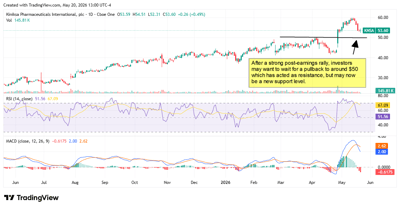
Investors looking for a more defined entry point may want to watch the 50-day simple moving average, currently tracking in the $47-$49 range. A successful test of that level—particularly if the MACD turns positive on the retest—would confirm the broader uptrend remains intact and offer a more favorable risk-reward setup ahead of the anticipated KPL-387 Phase 2 data in the second half of 2026.
This email is a paid sponsorship for i2i Marketing Group, LLC, a third-party advertiser of MarketBeat. Why did I receive this message?.
We are not securities dealers or brokers, investment advisers or financial advisers, and you should not rely on the information herein as investment advice. Any investment should be made only after consulting a professional investment advisor and only after reviewing the financial statements and other pertinent corporate information. Further, readers are advised to read and carefully consider the Risk Factors identified and discussed in the profiled company's SEC and/or other government filings. Investing in securities, particularly microcap securities, is speculative and carries a high degree of risk.
If you have questions or concerns about your account, feel free to email our South Dakota based support team at contact@marketbeat.com.
If you would no longer like to receive promotional emails from MarketBeat advertisers, you can unsubscribe or manage your mailing preferences here.
Copyright 2006-2026 MarketBeat Media, LLC.
345 North Reid Place, Suite 620, Sioux Falls, South Dakota 57103-7078. United States..




No comments:
Post a Comment