Dear Reader,
Elon Musk did something he has never done before.
He bought ad space during the biggest television event of the year... at $266,000 per second.
125 million Americans watched his ad and probably forgot all about it.
But I haven't stopped thinking about what it means...
You see, when the world's richest man spends millions to speak directly to America, investors should pay close attention. Especially when 1 in 3 people watching the Big Game that night were using "buy now pay later" services, and when 40% of Americans have more credit card debt than emergency savings.
There were two completely different Americas watching the same football game that night...
And Elon knows exactly which one he's building his future for.
What he told the world that night is the most important financial signal I've seen in years.
My name is Whitney Tilson. I spent 30 years on Wall Street and managed a $200 million fund firm. I've made a career out of seeing what other people miss...
That’s why I've put together a free presentation explaining exactly what happened that night, and what I think you should do with your money before everyone else figures it out.
Regards,
Whitney Tilson
Editor, Stansberry Investment Advisory
Former Hedge Fund Manager
Co-Founder, Teach for America
Harvard MBA
P.S. After the game ended, 600 private jets flew out of San Francisco. It broke city records. And it's all related. Elon... the private jets... they're all part of a huge economic current ripping through America. I explain why in the same presentation.
Dave & Buster’s Q1 Miss Raises the Stakes for Its Turnaround Plan
Written by Thomas Hughes. Article Posted: 6/17/2026.

Key Points
- Dave & Buster’s missed Q1 expectations as comparable sales fell, keeping pressure on a stock already trading near multiyear lows.
- The company returned to positive adjusted free cash flow, giving management more flexibility as it tries to stabilize the business.
- The turnaround case depends on whether remodels, menu changes and better guest traffic can offset weak discretionary spending.
- Special Report: The company SpaceX cannot operate without
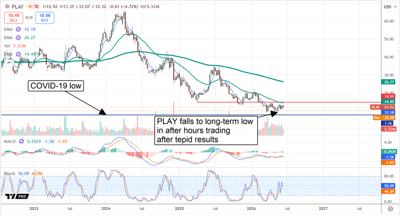
Dave & Buster’s (NASDAQ: PLAY) price action has not been encouraging for bulls. The stock has trended lower for more than two years and could continue to fall. The Q1 earnings release fell short of expectations, setting the stage for new lows.
The caveat is that PLAY stock is already trading at historically depressed levels, matching lows seen during the height of COVID-19 fear. Even so, there are signs of traction in the report.
Where to Put $100 Before Trump's New Tech Law Rolls Out (Ad)
The Financial Times says a new tech law puts America 'on the verge of a financial revolution.' Yahoo Finance estimates it could unlock $400 trillion - but analyst Jeff Brown, who was consulted by Congressional offices on the legislation, believes the real figure could reach $2.6 quadrillion.
Brown says this shift will pour onto a new type of investment exchange - and he's showing investors how to position themselves starting with just $100.
Click here to see how Jeff Brown says to claim your stakeWhile comps remain an issue, the Back-to-Basics strategy is improving food sales and cash flow metrics, both of which are central to the stock’s outlook. In this scenario, PLAY’s downtrend is played out, and a price recovery lies ahead.
Dave & Buster’s Reverts to Free Cash Flow in Q1
Dave & Buster’s is a growth story gone awry, but it is also trying to become a recovery and capital-return story. The company has historically used cash flow to fund opportunistic share repurchases, which remain in play if the turnaround gains traction. Although Q1 results missed expectations, Dave & Buster’s reported a small quarterly profit and returned to positive adjusted free cash flow. That result was modest compared with prior periods, but it was enough to help the company build cash despite continued investment in new stores and remodels.
Looking ahead, management plans a less aggressive capital expenditure year for 2027 than initially reported, focusing on free cash flow (FCF) and the leverage it provides. Dave & Buster’s did not buy back shares in Q1, but it will likely do so as the year progresses, given the FCF outlook. As it stands, trailing-12-month activity contributed to a 0.7% average share count reduction in FQ1.
Institutional trends suggest that they, too, may buy PLAY stock in July and throughout summer 2026. Institutions own more than 90% of the stock and, after selling in 2025, returned to buying in 2026. Q1 activity reflects rotation within the group, with selling rising alongside buying, but the overall balance remains bullish for investors. Activity in early Q2 is less robust overall, but the balance is far more favorable at approximately $2 bought for every $1 sold. The likely outcome is that buying accelerates as prices weaken, with critical support in the $8 to $10 range.
Dave & Buster’s Falters on Weak Store Traffic
Dave & Buster’s Q1 results showed some early strengths, but also persistent weaknesses. The company’s $559.2 million in net revenue was down 1.5% year over year (YOY) and came in $21.4 million below consensus on a 5.4% decline in comp sales. Comp sales are the critical factor in PLAY’s rebound thesis and are expected to provide a catalyst this year. As weak as the Q1 results are, management remains confident in the outlook for positive full-year comps and new-store growth. Store count was up approximately 4% at the end of Q1 and is expected to rise by another 100 to 200 bps by year-end.
The margin news is also uninspiring, but here too there is a catalyst. Gross margin expanded incrementally but was offset by higher costs, resulting in profit compression. Cost increases tied to wages, labor and other drivers are accelerating deleveraging as revenue declines. The catalyst is a return to positive comps, revenue growth and improving margins.
Analysts Wait and See: Trends Highlight Deep Value Opportunity
Dave & Buster’s analyst trends have contributed to the stock’s decline, as they remain bearish, but the market may have overreacted to the shift. Trading around $12, the stock remains deeply discounted to analysts’ average price target, leaving meaningful upside if the turnaround gains traction. A move toward that target is unlikely without clearer evidence of recovery, but improving comps and profitability could provide the catalyst investors need. Until then, analysts remain cautious, with the consensus rating at Hold and the average price target near $20.
Dave & Buster’s risk this year includes high oil prices and inflation. Elevated oil prices are helping sustain inflation and weighing on discretionary spending. In this environment, it may be difficult for PLAY to grow comp sales.
Debt is also a risk. The company carries significant debt, and maintenance spending cuts into cash flow. If the turnaround fails to gain traction by year-end, the company’s ability to continue as-is will be in jeopardy.
Catalysts include a renewed focus on targeted store remodels, menu changes, new games and Eat-and-Play offers. Management’s Back-to-Basics strategy appears to be helping food and beverage sales, but the stock likely needs clearer evidence that those gains can translate into better traffic, stronger comps and improved margins. The company is also still opening new stores and expanding internationally through franchise partnerships, giving it longer-term growth levers if the core business stabilizes.
Plot Twist: How the $110B Paramount-Warner Deal Rewrites Media
By Jeffrey Neal Johnson. Published: 6/16/2026.

Key Points
- Unrestricted government approval for legacy media consolidation paves the way for a highly anticipated and lucrative valuation rerating across the broader industry.
- The current pricing disparity between the acquisition target and the official buyout offer provides a merger arbitrage opportunity for proactive institutional capital.
- Cash-rich technology platforms are now perfectly positioned to aggressively acquire deeply discounted entertainment assets to build out premium streaming content libraries.
- Special Report: The company SpaceX cannot operate without
For the past three years, the market has applied a steep regulatory discount across the entire entertainment sector. Investors broadly assumed Washington regulators would quickly block any horizontal integration that concentrated too much market share among the legacy Hollywood studios. That foundational assumption was shattered this week. The Department of Justice Antitrust Division cleared Paramount Skydance (NASDAQ: PSKY) to acquire Warner Bros. Discovery (NASDAQ: WBD) in a massive $110.9 billion all-cash transaction.
By allowing this monumental transaction to proceed without requiring a single asset spin-off or behavioral remedy, federal regulators have signaled open season for large-scale media consolidation. The decision effectively dismantles the regulatory ceiling that has suppressed legacy media valuations for years. Valuing the combined entity at 7.5 times 2026 EBITDA, this landmark clearance creates an immediate ripple effect across the broader communications and technology sectors.
The 14% Arbitrage Ticket: Pricing the Final Act
Where to Put $100 Before Trump's New Tech Law Rolls Out (Ad)
The Financial Times says a new tech law puts America 'on the verge of a financial revolution.' Yahoo Finance estimates it could unlock $400 trillion - but analyst Jeff Brown, who was consulted by Congressional offices on the legislation, believes the real figure could reach $2.6 quadrillion.
Brown says this shift will pour onto a new type of investment exchange - and he's showing investors how to position themselves starting with just $100.
Click here to see how Jeff Brown says to claim your stakeThe mechanics of this transaction offer a useful window into how institutional capital prices regulatory risk in real time. Paramount Skydance is officially acquiring Warner Bros. Discovery at a buyout price of $31 per share.
Despite the unconditional domestic approval, Warner Bros. Discovery currently trades near $27. That pricing gap creates a highly attractive 14% merger arbitrage spread. In an all-cash buyout scenario, a spread of this magnitude reflects the time value of money and the remaining secondary hurdles the deal must clear before the anticipated third-quarter 2026 closing date.
While domestic clearance is usually the heaviest lift in any merger, the transaction still faces international scrutiny. The European Union and the United Kingdom Competition and Markets Authority have review deadlines approaching in July and August, respectively. Localized lawsuits from state attorneys general remain a peripheral threat that institutional investors must factor into their risk profiles. The current 14% spread effectively absorbs these secondary risks, pricing in a high probability of completion while still rewarding investors willing to park capital through the expected closing date.
Big Tech's Binge Watch
Beyond the immediate arbitrage opportunity on the table, the Department of Justice decision forces a structural rerating of the global streaming hierarchy. Streaming pure-plays currently command massive market premiums over their legacy counterparts. Netflix (NASDAQ: NFLX) holds a market capitalization exceeding $340 billion, far outstripping the combined enterprise values of nearly all legacy studios.
These tech-backed streaming platforms desperately need premium content libraries to maintain subscriber growth, but creating original content from scratch is highly capital-intensive and incredibly speculative. Buying existing distressed media assets is far more efficient for a tech giant. Netflix previously validated this strategic imperative with an $82.7 billion cash offer for Warner Bros. Discovery, a highly aggressive bid that ultimately forced Paramount Skydance to the table with its $110.9 billion winning offer to secure the assets.
With the federal government officially greenlighting horizontal integration, distressed media assets trading at fractional price-to-sales ratios are now prime defensive acquisition targets. Paramount Skydance currently trades at just 0.41x sales, while Warner Bros. Discovery trades at 1.83x sales. Cash-rich tech platforms can now use their pristine balance sheets to swallow these deeply discounted content libraries, potentially accelerating a wave of defensive acquisitions across the industry.
Curing the Linear Television Hangover
To understand why legacy studios are so desperate to merge now, investors have to look beneath the surface of the balance sheets. The painful shift from traditional linear television to direct-to-consumer streaming has triggered severe margin compression across the entire entertainment industry. Building a flawless global streaming infrastructure requires immense upfront capital, while the legacy cable networks that traditionally funded these studios are suffering from rapidly declining subscriber revenues.
Warner Bros. Discovery highlights this exact fundamental friction. Warner Bros. generates an impressive $37.21 billion in annual sales but struggles with profitability, reporting a trailing 12-month earnings-per-share loss of 70 cents and a painful net margin of negative 4.67%. Warner Bros.' balance sheet shows a debt-to-equity ratio of 0.92, a financial hangover from the 2022 merger that originally formed the company. Corporate governance friction remains elevated, highlighted by shareholders' recent rejection of Chief Executive Officer David Zaslav's $165 million compensation package for 2025.
Paramount Skydance faces similarly structural headwinds. While Paramount Skydance generates $28.89 billion in annual sales and offers a respectable 1.9% dividend yield, the business operates with a negative net margin of 2.08% and a high debt-to-equity ratio of 1.16. Aggressively scaling operations is the only viable path to offset the massive integration and content-acquisition costs inherent to the modern streaming business. By combining physical infrastructure, large marketing budgets, and valuable intellectual property portfolios, the newly formed media conglomerate aims to restore pricing power and finally stabilize margins.
Institutional Casting Calls
Institutional investors have already begun aggressively positioning portfolios for the post-merger landscape. Dimensional Fund Advisors and Bank of America maintain steady equity positions in Warner Bros. Discovery, using the current arbitrage spread as a low-beta accumulation zone while waiting for the deal to finalize. On the other side of the aisle, large private equity firms like KKR & Company hold strategic positions in Paramount Skydance, signaling strong institutional conviction in the newly scaled production model.
Paramount Skydance also carries a surprisingly bearish short interest profile. This elevated short positioning reflects deep skepticism about the massive debt load the newly combined entity will carry and the sheer complexity of post-merger integration. Extracting the projected financial savings from two massive legacy studio bureaucracies is notoriously difficult. Bearish traders are betting that integration costs will severely dent free cash flow in the quarters immediately following the close, delaying any meaningful return on investment.
Positioning for the Next Media Blockbuster
The regulatory dam breaking completely transforms the media sector from a distressed value trap into a highly lucrative, catalyst-rich environment. The combination of deeply depressed equity valuations, a newly cleared path to regulatory approval, and the looming threat of tech-driven acquisitions creates a highly dynamic setup for proactive investors. Taking a close look at the 14% merger arbitrage spread in Warner Bros. Discovery offers a compelling short-duration play, while monitoring the broader media ecosystem may help identify the next wave of defensive consolidation before it hits the tape.
This message is a sponsored email provided by Stansberry Research, a third-party advertiser of MarketBeat. Why did I receive this email content?.
This ad is sent on behalf of Stansberry Research, 1125 N Charles St, Baltimore, MD 21201. If you would like to optout from receiving offers from Stansberry Research please click here.
If you have questions about your subscription, don't hesitate to contact our U.S. based support team at contact@marketbeat.com.
If you would no longer like to receive promotional emails from MarketBeat advertisers, you can unsubscribe or manage your mailing preferences here.
© 2006-2026 MarketBeat Media, LLC. All rights reserved.
345 North Reid Place, Suite 620, Sioux Falls, SD 57103-7078. United States of America..




No comments:
Post a Comment