After one of the most aggressive runs in the market, Palantir Technologies Inc. (NASDAQ: PLTR) has pulled back despite continuing to deliver solid operational results, leaving investors questioning whether Michael “The Big Short” Burry’s bearish position reflects a deeper weakness in the business or simply a reset in expectations that had become detached from reality. This is a clear contradiction as Palantir did not report weak numbers, yet the stock declined.
Whitney Tilson - the Wall Street analyst who called the 2000 dot-com collapse and appeared on an Emmy-winning 60 Minutes segment covering the 2008 financial crisis - is issuing what he calls his most urgent warning yet.
Tilson says the next six months will bring extreme change for millions of Americans, and he's outlined specific steps to protect your money - moves he believes could outperform stocks, bonds, and gold.
Long before the recent pullback, Palantir’s stock had already moved far beyond what its underlying growth could comfortably support. PLTR is up more than 150% over the past year. This has kept its valuation at extreme levels, with forward multiples exceeding 200x earnings and analyst price targets stretching as high as $220-$260, even as revenue continues to grow at roughly 70% year-over-year.
At that point, the market is no longer pricing a growth company. More specifically, it’s pricing Palantir as if its entire business could sustain hypergrowth, not just pockets of it. That distinction is where expectations began to separate from reality.
Strong Numbers, But Not Strong Enough for the Narrative
Beneath the recent pullback, Palantir’s actual performance tells a very different story from what the price action might suggest, as the company reported $1.41 billion in Q4 2025 revenue, up 70% year-over-year, with its core U.S. commercial segment, the engine behind the AI narrative, surging 137% year-over-year to $507 million, while total commercial revenue grew 82% and government revenue still expanded a solid 66% over the same period.
Profitability reinforces this accelerative strength, with adjusted operating margins reaching 57% and GAAP operating margins at 41%, alongside $791 million in quarterly free cash flow, representing a 56% margin, and a balance sheet holding $7.2 billion in cash with zero debt.
Yet, despite this level of performance, the stock failed to hold its prior momentum. This has never been a matter of underperformance, but rather of expectations moving even faster than the business itself.
While the U.S. commercial is clearly operating at hypergrowth levels, the broader business, though still expanding at exceptional rates, is not scaling at the same pace, creating a gap between what investors had anchored on and what the company actually delivered. Consequently, when a stock is priced for perfection like this, even 70% growth can feel like a miss.
Where Michael Burry’s Position Finds Its Footing
Seen through that lens, the recent slump in Palantir’s stock is less about deterioration and more about recalibration, as investors adjust from pricing the company as a hypergrowth AI leader to valuing it as a business with one hypergrowth segment and a broader, more moderate growth base.
That shift in expectations is not happening in isolation, as sentiment around Palantir has increasingly been shaped by comparisons to faster-moving AI players, with discussions across both retail and institutional circles pointing to companies like Anthropic as potential disruptors. In one widely circulated discussion, Burry’s view was framed as a “Google vs Yahoo moment,” suggesting that while Palantir continues to grow, the market may already be rotating its expectations toward companies perceived to be scaling faster within the AI ecosystem.
That framing matters because it shows the market is no longer just evaluating Palantir on its current performance, but on where it sits relative to the broader AI race. This is where Michael Burry’s position finds its footing.
The valuation still leaves limited room for error, particularly if commercial growth slows or fails to scale fast enough to offset the slower-moving government segment, meaning even solid execution may fall short of what is already embedded in the price.
At the same time, the bearish case assumes that current growth levels represent a ceiling rather than a phase, overlooking the possibility that continued adoption of Palantir’s AI platform (over 1,400 verified companies, including Walmart, Amazon, U.S Department of Veterans amongst others, across various sizes, industries, and geographies have already adopted the Palantir’s software platform) could expand the commercial segment further and gradually shift the company’s overall growth profile higher.
The Technical Picture Confirms the Reset
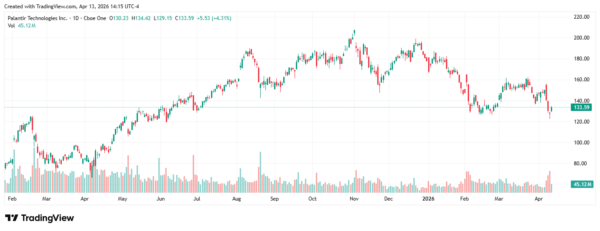
Palantir’s daily chart shows a clear transition from a strong uptrend into a controlled pullback, with price breaking below short-term support levels around $150 and testing the $125–$130 zone, an area that previously acted as consolidation support before the last major leg higher.
Momentum indicators reflect this reset rather than a breakdown, with RSI compressing toward the mid-30s, signaling oversold conditions without entering panic territory, while price remains above the long-term 200-day moving average, which continues to trend upward and acts as structural support.
Volume patterns also suggest distribution rather than capitulation, as the recent selling has come in controlled waves rather than a single high-volume flush, suggesting that investors are adjusting their positions rather than exiting entirely.
Taken together, the technicals align with the fundamental story that this is not a collapse driven by deteriorating business conditions, but a repricing phase where elevated expectations are being recalibrated back toward realistic growth assumptions.
Palantir’s current position reflects a company transitioning from narrative-driven momentum to fundamentals-driven validation, where revenue continues to grow at approximately 70%, cash flow remains strong at around $791 million, and profitability has already been established, but valuation is adjusting to reflect what the business is today rather than what investors once assumed it could immediately become.
This does not invalidate the long-term story because if the commercial segment continues expanding at elevated rates while the rest of the business stabilizes, Palantir has a path to grow into its valuation over time, even if that process unfolds more gradually than the market initially expected.
StockEarnings, Inc (SE) is a research service not owned or managed by registered brokers and therefore this site does not make any investment recommendations. The information provided in this newsletter is not guaranteed as to the accuracy or completeness. Each user of SE chooses to do trades at their sole discretion and risk. SE is not responsible for gains/losses that may result in the trading of these securities.
This newsletter includes paid advertisements. The source of all third-party content in which SE receives some sort of compensation, is clearly and prominently identified herein as "ad" or "Sponsored". Although we have sent you these advertisements, SE does not specifically endorse any third-party product nor is it responsible for the content of the advertisement or the experience with the third-party advertiser. Furthermore, we make no guarantee or warranty about what is advertised.
All investments involve risk, losses may exceed the principal invested, and the past performance of a security, industry, sector, market, or financial product does not guarantee future results or returns. Please click here for SE Disclaimers.
StockEarnings Inc.33 SE 4th St, Suite 100,Boca Raton, FL 33432 USA ! W;887, 6 STOCKS






No comments:
Post a Comment