| DAILY ISSUE My “Kick It and Pick It” Strategy for the AI Age VIEW IN BROWSER Hello, Reader. If you gave David Bowie’s “Changes” a listen when it came out in 1972, you’d mostly be limited to a record player or a radio station. The internet was barely more than an idea among scientists and engineers, let alone music streaming apps. That was also the year that Atari released the arcade video game “Pong,” and when Intel Corp. (INTC) introduced the Q1 microcomputer (pictured below). 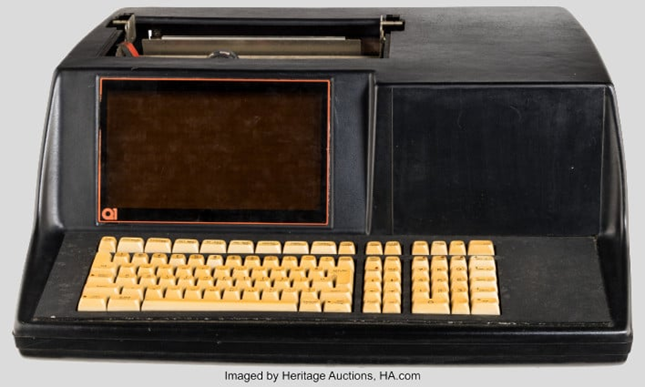
Source But, to put it in Bowie’s words, “Time may change me, but I can’t trace time.” Essentially, time has the power to transform, and we have no ability to control it. And much has changed in the decades since. We now have personal computers and video game consoles. The internet and music streaming apps. But time’s biggest technological changes are happening right now, thanks to artificial intelligence. The CEO of DeepMind Technologies, Demis Hassabis, believes that AI and, eventually, artificial general intelligence will have 10X the impact of the U.S. Industrial Revolution in a 10th of the time. Change used to unfold over decades. Now it’s happening in real time. The leap from AI chatbots to AI agents is happening in a fraction of the time it took to develop the models themselves. And that acceleration is where the biggest opportunities are forming… Often in places where few investors are looking. So today, let’s dive into the latest change on the AI block – the rise of agentic AI – and what it means for where the smart money flows next. Let’s jump in… | Recommended Link | | | | This company is the lifeblood of AI data centers, yet almost no one has caught up with the story. Their hardware is so essential that the data center industry uses enough of it to stretch around the world 8 times – in a single building! So, if you own Nvidia stock now, you might be well-served to sell those shares and check out this under-the-radar play instead. Or if you missed the boat on Nvidia, this is a rare second chance to target tremendous profit potential as AI data centers spring up in every corner of the world. Get my full take on this exciting play right here… |  | | LLMs Were the Warm-Up Act AI chatbots are now incredibly normalized. According to a March 2025 survey by Elon University, 52% of U.S. adults use LLMs such as ChatGPT or Google Gemini. And a December 2025 Pew Research Center survey found that 64% of U.S. teens use these chatbots, and about 28% use them every day. Those numbers help explain this projection: An April 2025 report from UN Trade & Development projects that the global AI market will soar from $189 billion in 2023 to $4.8 trillion by 2033. AI agents will be a major driver of that surge. Many AI companies have dipped their toes in the agentic world – Anthropic’s Claude Code and Cowork tools keep making headlines. Cognition AI has coding agent Devin AI. Microsoft Corp. (MSFT) offers Copilot. Now AI agents have gone global: Chinese tech giant Alibaba Group Holding Ltd. (BABA) released its new agentic AI system, Wukong, on Tuesday. By enabling businesses to manage multiple agents through a single interface, Wukong lets AI agents handle tasks such as document editing, approvals, meeting transcription, and research. OpenClaw also made waves earlier this week. It’s another agentic AI system, created by Austrian software developer Peter Steinberger, and already gaining traction in China. At Nvidia Corp.’s (NVDA) recent GTC (GPU Technology Conference), CEO Jensen Huang called OpenClaw “probably the single most important release of software, you know, probably ever.” We can’t forget the effect that AI agents have already had on software stocks. The iShares Expanded Tech-Software Sector ETF (IGV) has dropped 18% since the beginning of the year. AI is changing the world around us so rapidly and in so many mind-blowing ways that I hesitate to anoint any technology company immune to AI’s disruption. But I’ve narrowed down a swath of stocks that possess a significant defense against AI agents’ encroachment… Those that have an essential connection to physical products or infrastructure. Here’s a simple way to identify this group of stocks… The One Rule for Investing in an AI-Disrupted World For simplicity and clarity, I’m referring to this essential investment qualification as: “If you can kick it, you can pick it.” The corollary is equally valid: “If you can’t kick it, you can’t pick it.” In other words, in the AI-infested world we now inhabit, many of the most secure and successful companies will be those that maintain a connection to the tangible world. That connection could take many forms, including proprietary medical machinery or devices, copper mines, wind turbines and solar panels, and even trash-sorting equipment. You get the idea. I believe physical connections like these will help companies defend against competition from AI agents. By contrast, pure technology companies that operate entirely in a digital world seem increasingly vulnerable to this next version of AI. I’ll admit right now that I don’t know what those future versions will look like. So, to “turn and face the strange”… world of AI, I recommend investing in the tangible. While that includes businesses that prioritize human experiences or products that AI cannot replace, it also includes the physical components that keep AI and data centers running, which are in short supply. I’m talking about raw materials like copper, energy sources, and memory chips. In fact, in my new presentation, FutureProof 2026, I discuss each of these bottlenecks in detail and reveal 15 companies, five for each component, that are set to profit as AI continues to change our everyday lives. AI is changing itself and the world in the blink of an eye. So instead of trying to make sense of this enormous, unpredictable wave, I recommend riding it. Click here to learn how to profit. Regards, | 










No comments:
Post a Comment