
The overnight session has quietly become the most profitable window in the entire trading day.
I have watched stocks gap, options reprice, and entire moves complete before most traders even pour their first cup of coffee.
The opportunity is real. The returns can be triple digits in a single trade.
But how you play for those overnight moves matters enormously.
Most traders default to the old playbook when they see a big move forming. They buy stock, buy calls or puts outright, or sell options naked.
Each of those approaches can produce winners. Each one also carries a level of risk that can turn a good idea into a devastating loss.
I have spent years refining a better way to capture overnight 0DTE moves.
It costs less, risks less, and can return multiples of what traditional approaches deliver.
The Problem With the Old Playbook
Let me walk you through what most people do when they think Tesla is going to gap lower overnight. The expected move points to the downside, and the setup looks clean.
The first instinct is to buy put options outright.
A near-the-money Tesla put expiring the next day might cost three or four dollars. That is three to four hundred dollars per contract.
If Tesla gaps lower, the put could double or triple in value.
If Tesla opens flat or gaps higher, that put goes to zero. The entire premium evaporates.
Time decay on a one-day option is brutal. Every hour without movement erodes the value of that put.
You have to be right on direction, magnitude, and timing all at once.
Buying stock outright is even more capital-intensive. A hundred shares of Tesla at $390 is a $39,000 position.
If Tesla gaps down three percent overnight, you make roughly $1,170. That is only about a three percent return on nearly forty thousand dollars of capital.
If Tesla gaps the wrong way, you are staring at a four-figure unrealized loss with no defined exit.
Selling options naked carries even more danger. A short call or short put may bring in premium, but the risk on the wrong side of an overnight move is enormous.
One unexpected gap can wipe out weeks of collected premium in minutes.
Every one of these approaches shares the same fundamental flaw. The risk is disproportionate to the reward, or the capital required is far too large relative to the opportunity.
Why the Butterfly Changes Everything
The long butterfly spread flips the entire risk equation on its head. The numbers tell the story better than I can.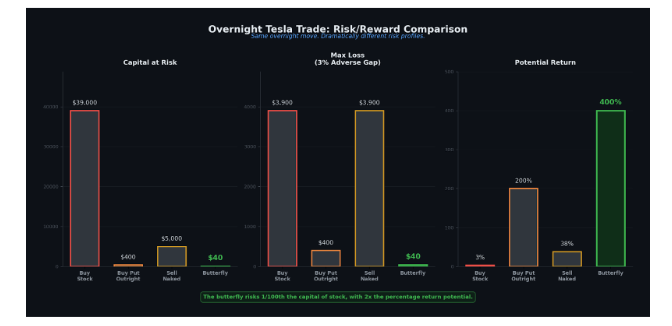
When you line up all four approaches side by side on the same Tesla overnight trade, the contrast is staggering:
- Buy stock ties up $39,000 in capital for a potential 3% return. A gap the wrong way means a four-figure loss with no ceiling.
- Buy a put outright costs $400 per contract and goes to zero if direction or timing is wrong. Theta works against you every hour.
- Sell naked options brings in small premium but carries enormous downside. One adverse gap can erase weeks of gains in minutes.
- Buy a butterfly costs $40 per contract, caps the max loss at that same $40, and can return 400% or more if the stock lands near the target.
The butterfly risks one-hundredth the capital of a stock position and delivers over a hundred times the percentage return.
I recently entered a Tesla butterfly for forty-three cents and it returned two dollars. That is a 365% return on a trade that risked forty-three dollars per contract.
I hit a Meta butterfly at twenty-eight cents that returned a dollar fifteen. A Microsoft butterfly I entered for thirty-nine cents returned a dollar ten.
The entry costs were tiny. The returns were enormous.
How the Butterfly Captures Overnight Moves
The butterfly profits when the underlying stock lands near its center strike at expiration. The key word is "near."
I like to think of it as pin the tail on the donkey. You do not need a bullseye.
You just need to get close.
If the target is $370 on Tesla and the stock opens at $372, the butterfly still pays. Close counts.
In horseshoes, hand grenades, and butterflies, getting in the neighborhood is good enough.
Contrast that with buying a put outright. You paid three or four dollars for the privilege, and theta is eating you alive the entire time.
My butterfly cost forty cents and can return multiples. The forgiveness built into the structure is what makes it viable as a repeatable strategy.
The Allocation Secret That Ties It All Together
I cannot stress this enough. The butterfly approach only works if allocation is treated with absolute discipline.
Every trade gets the same dollar amount of risk. If you risk a hundred dollars on a Tesla butterfly, you risk a hundred dollars on the next Meta butterfly.
This is not optional. It is the foundation that makes the entire strategy profitable.
When you are right thirty percent of the time and your winners return three to five times your risk, the wins have to cover the losses. That only works if each loss is the same size.
I have seen traders break this rule and wonder why the strategy stopped working for them.
The oversized loss on the wrong trade erases the gains from the right one. Every time.
Here are the allocation rules I follow, and I need you to follow them too:
- Risk the same dollar amount on every butterfly, regardless of the underlying stock or direction.
- If you risk a hundred dollars on Tesla, risk a hundred dollars on Meta, a hundred on Google, and a hundred on Microsoft.
- Never size up on a trade because you "feel good" about the setup. The math only works when every position is equal.
- Start small. One contract on a forty-cent butterfly is forty dollars of risk. Learn the strategy at that level before scaling.
Consistent allocation turns a thirty percent win rate into a profitable year. Inconsistent allocation turns the same win rate into a losing one.
Playing Both Sides of the Overnight Move
Here is something that stock traders and outright option buyers simply cannot do.
You can play both directions at the same time.
I will place a bearish butterfly on Tesla targeting the lower expected move edge and a bullish butterfly on Google targeting the upper edge. Each one costs roughly fifty cents.
Total risk across both trades is about a hundred dollars.
If the market sells off overnight, the Tesla butterfly pays. If the market rallies, the Google butterfly pays.
One of those two butterflies has a real chance of hitting. The winner returns enough to cover the loser and still produce a net gain.
A stock trader would need to pick one direction and commit thousands of dollars. I just need one of two cheap bets to land close enough.
Real Risk vs. Theoretical Risk
The psychological advantage of this approach cannot be overstated.
When you buy stock overnight, you wake up wondering what happened. A gap against you means a four-figure loss before the day even starts.
That kind of exposure creates anxiety, poor decision-making, and the temptation to revenge trade.
When I buy a forty-cent butterfly, I already know the worst-case scenario. Forty dollars, gone, and that is it.
There is no gap risk beyond the premium paid. There is no margin expansion.
That mental clarity allows me to take shot after shot without emotional damage. Losses are small and expected.
Winners are large and meaningful. The process becomes repeatable precisely because the downside is contained.
In a market driven by geopolitical risk, tariff headlines, and Fed uncertainty, you need a strategy that does not require you to be nervous.
The butterfly lets you participate in overnight moves without exposing your account to the kind of risk that keeps you up at night.
See This Strategy in Action
The overnight 0DTE edge is real, and it is growing. Every week, new expirations get added, volume increases, and the expected move magnets get stronger.
But reading about it and seeing it executed live are two very different things.
This Tuesday at 1:00 PM EST, I am going live to break down the 0DTE butterfly strategy in real time. I will walk through live expected move calculations, identify which products are setting up for overnight plays, and show exactly how I structure, enter, and manage these trades.
This is the same approach that has produced 365% returns on Tesla, 310% on Meta, and 270% on Microsoft in recent weeks.
I will cover all of it, including my allocation framework, the criteria I use to filter setups, and how to avoid the mistakes that cost most 0DTE traders money.
Whether you are new to 0DTE or have been trading it and want a better edge, this session will give you a complete framework for capturing overnight moves with defined, minimal risk.
Register here to join my 0DTE Webinar this Tuesday at 1:00 PM EST.
One hour of your time could change the way you trade for the rest of the year. I will see you there.
To your success,
Don Kaufman
Chief Market Strategist, TheoTRADE





No comments:
Post a Comment