|
Thursday, August 13, 2026
Do long-run breaks MATTER?
|


The world's #2 gold miner is running on fumes [it has to buy]
| Unsubscribe |
There’s a secret the gold majors don't like to advertise:
They're running out of gold.
Barrick, the second-biggest miner on earth, watched its production fall from two million ounces…
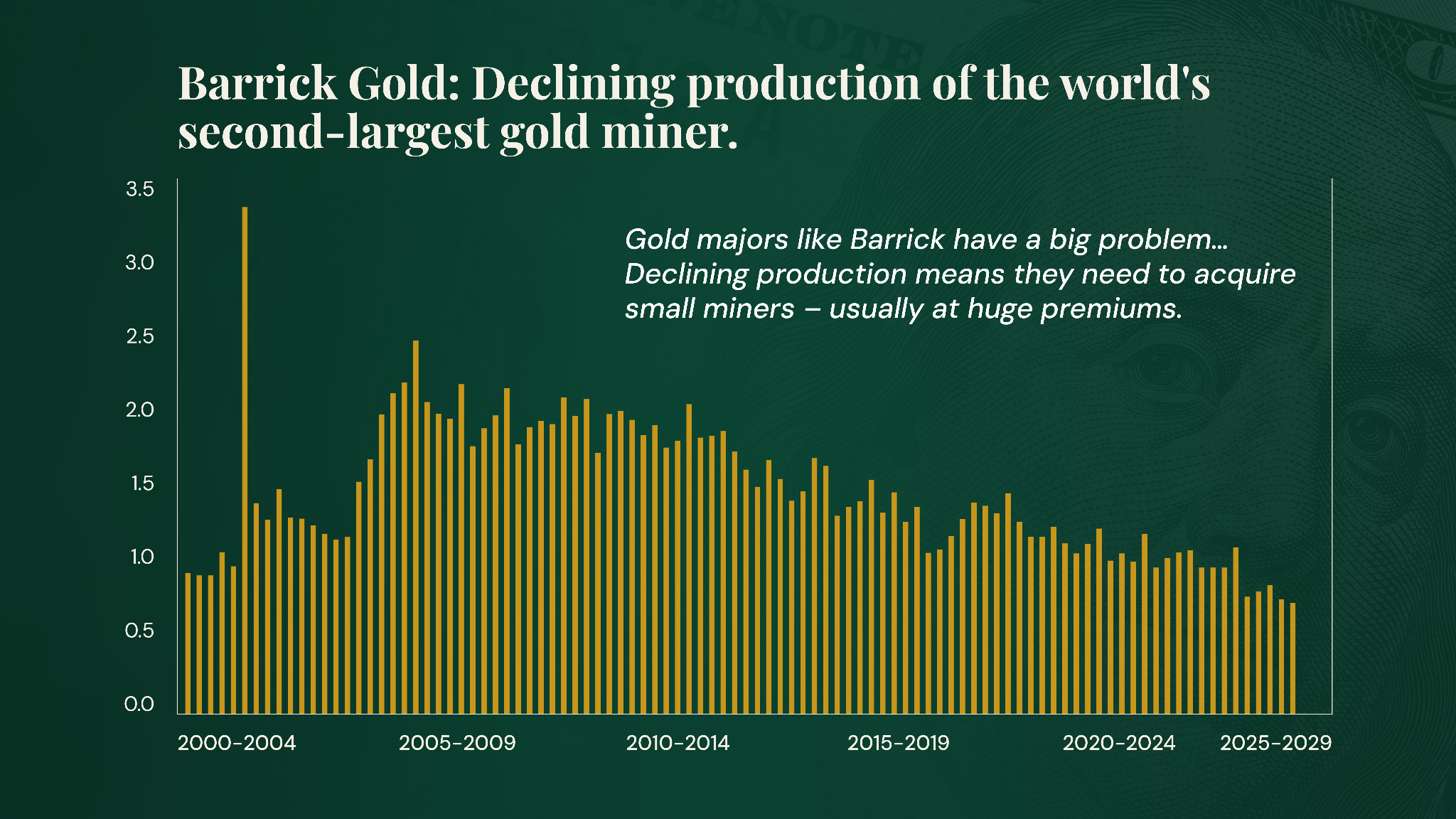
Down to 719,000.
For a company as big as Barrick… that's running on fumes.
Go here to learn why gold majors are forced to buy – and get details on my top three buyout targets.
This is not an isolated problem…
In 2023, gold major Newmont paid $15 billion for Newcrest in the largest mining deal in history.
Today, Newmont’s production is basically flat. Why?
Because every ounce of gold a major pulls out of the ground makes their mine worth a little less.
A gold mine is a shrinking asset – in slow motion.
So, how does a major fix shrinking mine output?
Simple:
It has to buy the best small mining assets… (and here’s why I’m telling you this):
At whatever premium it takes.
Gold majors are sitting on record cash flows – with shrinking production.
That means the coming wave of buyouts isn't a maybe.
It’s a slam dunk. If majors don’t go out and buy productive junior assets…
They go out of business. So…
Unless you think the world no longer cares to have any more gold mined and brought to market…
The coming wave of acquisitions is just math.
Go here to learn about my top three buyout targets.
Best,
Garrett Goggin, CFA, CMT
Lead Analyst and Founder, Golden Portfolio
Tesla: After a Rough Quarter, 2 Very Different Futures Come Into Focus
Reported by Sam Quirke. Article Published: 7/30/2026.
Key Points
- Tesla's stock has dropped 30% in less than a month after an earnings report showed record revenue alongside collapsing operating margins and negative free cash flow.
- Speculation about a potential Tesla-SpaceX merger has intensified after Musk acknowledged overlapping ambitions, though he stopped short of confirming any formal discussions.
- Bulls point to a possible merger as a major upside catalyst, but SpaceX's own falling valuation and cash burn make that thesis speculative and fragile for now.
- Special Report: Forget SpaceX. Buy the company Musk can't replace.
After a 30% drop in less than a month, it’s fair to say that Wall Street is more divided on Tesla Inc. (NASDAQ: TSLA) than it has been in years. The company's latest earnings report, released last week, delivered a jarring split between record headline revenue and sharply deteriorating profitability. The market has been trying to make sense of that contrast ever since.
Out of that confusion, two starkly different visions of Tesla's future have emerged. One camp sees a core business whose margins are collapsing under the weight of enormous artificial intelligence spending—and is heading for the exit.
Small Colorado Company (Backed by Sam Altman) Could Save U.S. Power Grid (Ad)
A small Colorado company has secured rights to technology that could prevent the U.S. public power grid from collapsing — and billionaire Sam Altman is now an investor.
This under-the-radar firm is drawing serious attention from those watching the energy infrastructure space closely.
Click here to learn this company's name for free todayThe other looks beyond the quarter to a potential merger with SpaceX (NASDAQ: SPCX) that could reshape the entire company.
Which of these two paths the stock ultimately follows may matter far more than any single line in the earnings report.
Path #1: A Core Business Under Severe Pressure
The bearish case is grounded in what the numbers actually showed. Yes, headline revenue grew strongly year over year, but operating margin collapsed by more than 60% from where it stood a year earlier, while free cash flow turned negative. Earnings per share missed expectations as capital spending surged.
Dig beneath the headline numbers, and the picture looks starker still. A large chunk of Tesla's reported net income came from a one-time gain on its stake in SpaceX rather than from selling cars or storing energy. Strip that out, along with fading regulatory-credit income, and the underlying profitability shrinks dramatically. For a company still valued as one of the most expensive mega-cap stocks in the market, that’s an uncomfortable place to be.
The bigger concern is that the spending shows no sign of slowing. Tesla's capital expenditure plans have ballooned to enormous levels, funding everything from its Optimus robots and Cybercabs to new factories and fresh AI initiatives. However, none of these projects has a clear near-term path to profitability, making Tesla, in the eyes of the bears, a stock best left alone.
Path #2: The SpaceX Card
The bulls, meanwhile, are focused on something else entirely. On the earnings call, CEO Elon Musk acknowledged the growing overlap between Tesla and SpaceX, particularly around their shared chip ambitions. However, he was careful not to confirm any formal merger discussions.
Given the extensive speculation around a possible merger, his comments were enough to send speculation into overdrive. Deepwater Asset Management's Gene Munster subsequently raised the odds of an eventual combination to 90%.
The vision behind a deal is undeniably ambitious. Proponents describe a business that would knit together SpaceX's satellite connectivity, Tesla's real-world AI and orbital computing into a single, vertically integrated AI ecosystem.
RBC Capital Markets analyst Tom Narayan has gone as far as to model specific deal terms, arguing that a combination at a hypothetical $480 per Tesla share—a premium of more than 60% to the current price—would leave existing shareholders owning more than half of a combined entity worth trillions.
If that vision were to come to pass, the margin questions hanging over Tesla’s car business today would end up looking like a footnote.
Why the Merger Thesis Is Still Fragile
There is a significant catch, however. Far from being a rock-solid backstop, SpaceX's own valuation has been anything but stable. Its shares have fallen by around 40% from their June peak as pre-IPO hype evaporates and the company faces the same AI spending fears that have pressured tech valuations.
There is also the simple fact that a future combination would merge two intensely capital-hungry businesses rather than pair a cash generator with a growth project. SpaceX may boast stronger margins than Tesla in some areas, but it remains deeply unprofitable and is burning through cash as it pursues its own massive investment cycle. Far from being an antidote to Tesla’s woes, it could be a poisoned chalice.
Which Path Is Tesla On?
Based on the stock’s recent price action, at least, it’s hard not to feel that Tesla’s near-term path belongs firmly to the first camp. The dramatic margin compression, negative free cash flow and enormous spending plans are already reported facts, sitting in black and white in the latest earnings report.
The SpaceX merger, by contrast, remains speculative, with no formal process announced and Musk's own comments carefully hedged. For now, the SpaceX thesis should be treated as a potential upside catalyst layered on top of a Tesla comeback story that has yet to materialize.
Tyson Foods Offers a Meaty Opportunity for Income Investors
Reported by Thomas Hughes. Article Published: 8/4/2026.
Key Points
- Tyson Foods’ beef business remains under pressure from tight cattle supplies and higher costs, but chicken and prepared foods helped offset the drag.
- Tyson Foods reported flat fiscal third-quarter sales, higher adjusted earnings and lower full-year adjusted operating income guidance.
- Tyson Foods’ dividend, cash flow and coming CEO transition remain central to the long-term investor case.
- Special Report: Forget SpaceX. Buy the company Musk can't replace.
Tyson Foods (NYSE: TSN) is the leading player in protein, the largest producer in the United States and one of the most diversified globally. Diversification is key, with protein representing a primary consumer category supported by high-protein trends. It also provides some insulation from volatile commodity prices, including the impact of this year’s elevated beef prices. Beef prices are weighing on top- and bottom-line results, but they are not enough to offset strength in other categories or derail the company’s long-term opportunity.
The long-term opportunity is sustainable growth, margin expansion and cash flow. Like its consumer-staples peers, Tyson Foods is a highly visible and very large company whose growth trajectory is limited, but its cash flow is not. Future growth will not be robust, but cash flow supports dividends and share buybacks, which underpin a healthy outlook for the stock price.
Small Colorado Company (Backed by Sam Altman) Could Save U.S. Power Grid (Ad)
A small Colorado company has secured rights to technology that could prevent the U.S. public power grid from collapsing — and billionaire Sam Altman is now an investor.
This under-the-radar firm is drawing serious attention from those watching the energy infrastructure space closely.
Click here to learn this company's name for free todayThe leverage provided by capital returns keeps institutional interest high and the share count falling, a combination that supports higher share prices over time. Buybacks remain incremental but are accelerating in 2026, while the dividend yields an annualized 3.5% and annual increases are expected. Tyson is a Dividend Achiever and Contender, putting it on track for Champion status.
Optimistic Sell-Side Support Highlights Tyson’s Long-Term Opportunity
There are some mixed signals in Tyson’s analyst and institutional data, but nothing raises a red flag for Q3, and the net impact is bullish for investors. Analysts trimmed their price targets ahead of the fiscal Q3 release, signaling caution, but they did not alter their forecasts. They merely tempered near-term expectations. Consensus is a Hold, based on the 13 tracked analysts. The data provides sufficient confidence, with no Sells tracked, a Buy-side bias and more than 25% upside to the consensus target relative to TSN’s 2026 lows.
Institutions, which often follow analysts’ lead, are also supportive of the stock, owning more than 65% of its shares and aggressively accumulating stock over the trailing 12 months. MarketBeat data reflects some selling in early Q3 2026 but otherwise shows healthy activity, with buying outpacing selling by a $2-to-$1 ratio. That buying will likely pick up as the quarter progresses. The Q3 earnings release left something to be desired on the top line, causing the share price to pull back to a critical support level.
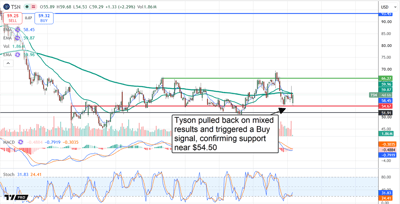
The market response suggests that analyst and institutional interest has been activated. The early price decline triggered a Buy signal, with the price action rising from its early lows to confirm support near $54.50, a level that could serve as a launchpad for the stock. It may take time for TSN’s share price to gain traction and begin its recovery, but the odds favor a recovery ahead, while downside risk appears severely limited.
Technical action also suggests limited downside. TSN’s weekly price action reflects a bottom at $54.50, with the MACD and stochastic indicators diverging from recent lows and positioned to generate strong entry signals on a price advance. The signal would consist of bullish crossovers in both indicators. Stochastic has already generated its own strong signal through a bullish crossover, a retest of support and a subsequent crossover. MACD has yet to confirm but appears poised to do so.
Where’s the Beef? Tyson Widens Margins Despite Massive Cattle Shortage
Tyson’s biggest problem this year is a massive cattle shortage, which has more than doubled consumer costs. The impact on Tyson has been higher cattle costs and lower volumes, a combination that has caused contraction at every level. However, Tyson’s diversified position, supported by improved efficiency and consumer trends, enabled systemwide margin expansion.
Not only did Q3 adjusted earnings come in slightly above expectations while revenue underperformed, but GAAP income increased by 39%, adjusted income by 8.3% and adjusted earnings per share (EPS) by 8.8%. These results enabled the company to narrow its guidance around the previously stated ranges. The bad news is that revenue guidance fell slightly short of estimates, but this is likely only a near-term headwind. Earnings forecasts remain sufficient to support the company’s financial health and capital returns.
This year’s catalysts include chicken and prepared foods. The company’s long experience with poultry and its continued focus on the category are supporting margins as demand grows, helping offset the impact of beef-market dynamics. Meanwhile, value-added products in prepared foods are also gaining momentum and supporting margins. AI is aiding this segment by accelerating product innovation and improving returns on promotional investments.
The key factor is the upcoming CEO transition. It is expected to go smoothly because the incoming CEO has a long history with the company, and the change could also serve as a catalyst for growth. A new playbook may accelerate volume growth and margin expansion, but the transition remains an unknown hanging over the market—one that will not be fully revealed until early 2027 or later.
This email content is a paid sponsorship sent on behalf of Golden Portfolio, a third-party advertiser of Earnings360 and MarketBeat.
If you have questions about your newsletter, feel free to contact our U.S. based support team at contact@marketbeat.com.
If you no longer wish to receive email from Earnings360, you can unsubscribe.
© 2006-2026 MarketBeat Media, LLC. All rights protected.
345 N Reid Place, Suite 620, Sioux Falls, South Dakota 57103-7078. USA..

-
Having trouble viewing this email? View it as a Web page . You are subscribed to Constit...
-
Plus, Deaths of foreign fighters draw renewed attention to the military volunteers in Ukraine. ...
-
View Images Library Photos and Pictures. Как сделать усилитель сигнала сотовой связи своими руками Усилитель 3G сигнала своими руками Антен...


